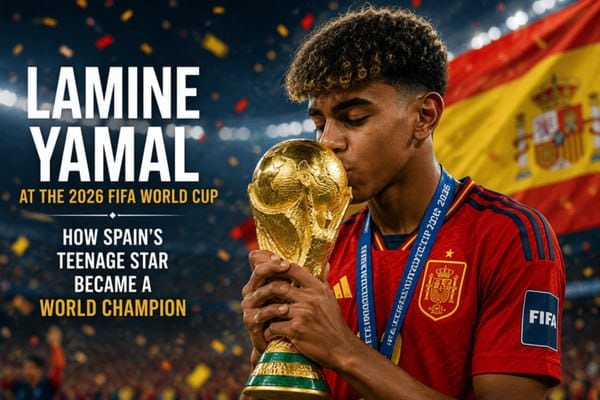
The 2026 FIFA World Cup marked the moment when Lamine Yamal stopped being described as football’s brightest young talent and became one of the game’s defining stars. At just 18 years old, the Barcelona winger played a central role in Spain’s triumphant campaign, helping La Roja lift the World Cup trophy after a 1–0 extra-time victory over Argentina in the final on July 19, 2026, at MetLife Stadium.
Already recognized for his performances during UEFA Euro 2024, Yamal entered the tournament carrying enormous expectations. He left it as a world champion whose influence extended beyond statistics. His creativity, composure, and tactical intelligence made him one of Spain’s most important attacking players throughout the competition while further cementing his status as one of football’s global icons.
Key Takeaways
- Lamine Yamal helped Spain win the 2026 FIFA World Cup, defeating Argentina 1–0 after extra time in the final.
- Born on July 13, 2007, Yamal turned 18 during the tournament and became one of the youngest starters in a World Cup final in modern football.
- He appeared in all eight of Spain’s matches, scoring one goal and playing 615 minutes.
- Yamal completed every knockout-stage match, including the full 120 minutes of the World Cup final.
- Weeks before the tournament, UNICEF appointed Yamal as a Goodwill Ambassador, recognizing his influence beyond football.
Who Is Lamine Yamal?
Lamine Yamal is an 18-year-old winger for FC Barcelona and the Spanish national team, widely regarded as one of the most gifted footballers of his generation.
Born in Esplugues de Llobregat and raised in the Rocafonda neighborhood of Mataró, Yamal represents modern Spain’s multicultural identity. His father is Moroccan, while his mother is from Equatorial Guinea. Whenever he scores, he celebrates by forming the numbers 304 with his fingers, a tribute to Rocafonda’s postal code (08304). His occasional sujoud celebration further reflects his personal background and has become part of his public identity.
Yamal joined Barcelona’s La Masia academy at seven years old and rapidly progressed through every youth level. Before turning 16, he had already broken into Barcelona’s first team, becoming one of the youngest debutants in club history. His performances during UEFA Euro 2024 announced him to the world, but the 2026 World Cup established him among football’s elite.
Why His Age Still Matters
Age has followed every stage of Yamal’s remarkable rise.
He celebrated his 18th birthday on July 13, 2026, only six days before the World Cup final. Although some early reports incorrectly suggested he became the youngest player ever to appear in a World Cup final, that historic record still belongs to Pelé, who was 17 years and 249 days old when Brazil won the 1958 World Cup.
That distinction does little to diminish Yamal’s achievement.
Modern football places greater physical and tactical demands on wide attackers than ever before. Despite his age, Yamal handled those expectations with remarkable maturity, becoming one of Spain’s most trusted players during the tournament’s decisive stages.
His performances suggest that Spain has found a player capable of leading its attack for the next decade.
Lamine Yamal’s 2026 World Cup Performance
Spain’s route to the title required consistency rather than spectacular scorelines, and Yamal became a constant presence throughout the campaign.
He appeared in all eight matches, gradually increasing his minutes during the group stage before becoming an undisputed starter in the knockout rounds.
| Match | Result | Minutes | Goal |
| Cape Verde | 0–0 | 19 | — |
| Saudi Arabia | 4–0 | 45 | ⚽ |
| Uruguay | 1–0 | 76 | — |
| Austria | 3–0 | 85 | — |
| Portugal | 1–0 | 90 | — |
| Belgium | 2–1 | 90 | — |
| France | 2–0 | 90 | — |
| Argentina (Final) | 1–0 (AET) | 120 | — |
His influence extended beyond goals.
Operating from the right wing, Yamal consistently stretched defensive lines, carried possession into dangerous areas, and created numerical advantages through his dribbling. Spain’s attack frequently relied on his ability to beat defenders one-on-one before delivering passes into central areas.
Rather than forcing individual moments, he demonstrated maturity in knowing when to accelerate attacks and when to recycle possession qualities rarely associated with players still in their teenage years.
Tactical Role in Spain’s System
Under Luis de la Fuente, Spain continued using a possession-oriented 4-3-3 built around intelligent movement and positional control.
Yamal occupied the right wing but rarely remained fixed to the touchline.
Instead, he repeatedly drifted into the right half-space, combining with midfielders while creating room for overlapping full-backs. His left foot allowed him to cut inside naturally, opening passing lanes or shooting opportunities while forcing defenders into uncomfortable decisions.
His partnership with Pedri proved especially valuable throughout the tournament. Their understanding, developed through years together at Barcelona, allowed Spain to progress the ball quickly through midfield before attacking compact defensive blocks.
Rather than relying purely on pace, Yamal consistently manipulated defenders with changes of direction, body feints, and quick decision-making. Those qualities made him one of Spain’s primary creative outlets even when he wasn’t directly involved in goals.
Barcelona’s Influence on His Development
Barcelona’s La Masia academy remains one of football’s most successful talent factories, and Yamal represents its latest masterpiece.
Years spent learning positional football helped develop the spatial awareness that now defines his game. Rather than chasing individual statistics, he understands when to hold width, when to attack centrally, and when to support teammates through quick passing combinations.
That education translated seamlessly to Spain’s national team.
Because several Spanish internationals also play or have played for Barcelona, many attacking patterns already existed before international camps began. The familiarity between Yamal and teammates such as Pedri reduced adaptation time and allowed Spain to play with unusual fluidity during the tournament.
Beyond Football: UNICEF and Cultural Impact
Yamal’s influence reaches beyond the pitch.
On June 11, 2026, UNICEF officially appointed him as a Goodwill Ambassador, recognizing his commitment to children’s rights and his ability to inspire young people around the world.
The appointment carried particular symbolism.
In 2007, shortly after Yamal’s birth, a charity calendar organized by UNICEF featured a young Lionel Messi holding the newborn baby during a photoshoot in Barcelona. Nearly two decades later, that image has become one of football’s most recognizable photographs, a visual connection between two generations of stars.
Combined with his proud references to Rocafonda and his multicultural heritage, Yamal has become more than an elite footballer. He represents a generation of players comfortable embracing both sporting excellence and cultural identity.
A World Champion at 18
Many great football careers are defined by a single tournament.
For Lamine Yamal, the 2026 FIFA World Cup may become the moment historians identify as the beginning of an extraordinary legacy.
Spain’s victory over Argentina delivered the country’s second World Cup title, but it also confirmed that the future of Spanish football is already here.
At just 18 years old, Yamal combined technical brilliance with tactical maturity, proving capable of performing under the highest pressure football can offer. Completing every knockout match including 120 demanding minutes in the final demonstrated both his physical resilience and the complete trust placed in him by Luis de la Fuente.
With years of elite football still ahead, the teenager who once arrived as football’s brightest prospect now leaves the 2026 World Cup as a world champion and one of the sport’s defining figures.
Frequently Asked Questions
How old was Lamine Yamal during the 2026 FIFA World Cup?
Lamine Yamal turned 18 on July 13, 2026, during the tournament and was 18 years old when Spain defeated Argentina in the World Cup final on July 19.
Did Lamine Yamal become the youngest player ever to appear in a World Cup final?
No. That record remains with Pelé, who was 17 years and 249 days old in the 1958 FIFA World Cup final. Yamal was among the youngest players to start a World Cup final in the modern era.
How many matches did Yamal play at the 2026 World Cup?
He appeared in all eight of Spain’s matches, playing a total of 615 minutes and scoring one goal during the tournament.
What position did Yamal play for Spain?
Yamal primarily played as an inverted right winger in Luis de la Fuente’s 4-3-3 system, combining creativity, dribbling, and intelligent movement to support Spain’s possession-based attack.
Why is the Messi photo with Lamine Yamal so famous?
The photograph was taken during a UNICEF charity photoshoot in 2007, showing a young Lionel Messi holding baby Lamine Yamal. After Yamal’s emergence as one of football’s biggest stars and his appointment as a UNICEF Goodwill Ambassador in 2026 the image became a powerful symbol linking two generations of football greatness.