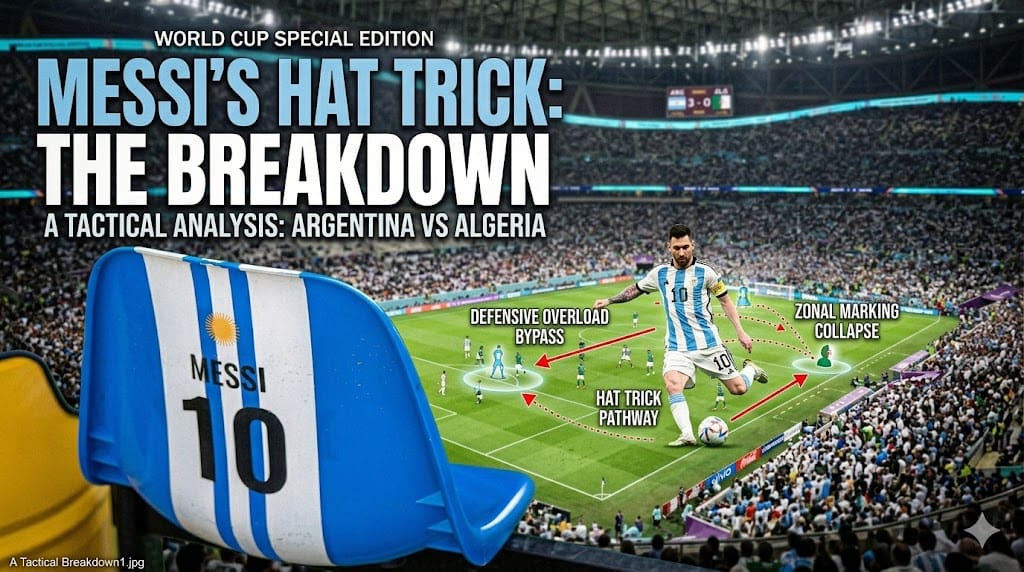
Lionel Messi scored a hat-trick in Argentina’s 3-0 Group J win over Algeria on June 16, 2026, at Kansas City’s Arrowhead Stadium, becoming the oldest player ever to score a hat-trick at a FIFA World Cup and equaling Miroslav Klose’s all-time men’s World Cup scoring record of 16 goals. The goals came in the 17th, 60th, and 76th minutes. It was Messi’s 200th cap for Argentina and his first-ever hat-trick at a World Cup tournament. For more on The Wide Journal’s 2026 FIFA World Cup coverage, follow our ongoing tournament section.
The match carried a secondary layer of symmetry that made the occasion hard to ignore. June 16 marked exactly 20 years since Messi’s World Cup debut as a substitute against Serbia and Montenegro at Germany 2006, a game in which he also scored. The teenager who came off the bench that evening in Gelsenkirchen is now, at 38 years and 357 days, the oldest hat-trick scorer in World Cup history, breaking the record Cristiano Ronaldo set against Spain in 2018 at age 33.
Algeria returned to the World Cup for the first time since 2014, coached by Vladimir Petkovic and featuring Riyad Mahrez and goalkeeper Luca Zidane, son of France World Cup winner Zinedine Zidane. The occasion was a measure of Algeria’s return to the top table; by full-time, the result was a clinical reminder of the gulf between a squad targeting back-to-back titles and one still finding its footing on the biggest stage.
Key Takeaways
- Messi’s hat-trick (17′, 60′, 76′) was his first ever at a FIFA World Cup and his 11th career international hat-trick, taking his World Cup goals tally to 16 to equal Miroslav Klose’s all-time men’s record.
- At 38 years and 357 days, Messi became the oldest player to score a World Cup hat-trick, surpassing Cristiano Ronaldo’s record set at the 2018 tournament.
- The performance came on Messi’s 200th Argentina cap and the 20th anniversary of his World Cup debut, with Argentina managing the match under a low-defensive-workload tactical structure designed to protect Messi’s energy.
- Messi now holds the outright record for World Cup goal contributions with 24 (goals and assists combined), surpassing Pelé’s previous mark of 21.
- Argentina open Group J with a perfect three points and a +3 goal difference as they pursue a second consecutive World Cup, which would make them only the third nation in men’s football history to win back-to-back titles.
How the Goals Were Built: A Three-Act Tactical Study
Messi’s three goals against Algeria came from three distinct phases of play, covering a long-range drive, an opportunistic rebound, and a composed curled finish. Together they illustrate why Lionel Scaloni’s system works: not by asking Messi to do everything, but by creating conditions where one moment of quality is enough.
The opening goal, in the 17th minute, originated from an Algeria turnover in the midfield third. Rodrigo De Paul picked up possession and fed Messi, who was stationed outside the penalty area. What followed was a left-foot drive that gave Luca Zidane no realistic chance. It was the kind of goal that gets described as a “screamer” in post-match coverage, but the more relevant detail is positional: Messi didn’t track the ball back to win it. He drifted into space, waited for the team to do the recovery work, and was in position to punish the moment Argentina regained control.
The second goal, arriving in the 60th minute, was a different kind of score entirely. Zidane spilled a shot, and Messi was inside the box to convert the rebound. No creativity required, just anticipation and presence in the right zone at the right time. That kind of goal doesn’t happen by accident for a forward managing a minor hamstring injury, as Messi was per reports from Al Jazeera ahead of the tournament. It happens because Scaloni’s system keeps Messi in advanced positions, conserving his legs for exactly these moments.
The third goal, in the 76th minute, was the most technically precise of the three: a curled strike into the bottom corner. He was substituted immediately afterward to a standing ovation at Arrowhead Stadium. The timing of that substitution mattered as much as the finish. With the game sealed and a minor injury in the background, taking Messi off in the 76th minute was smart squad management for a group stage that runs through June 22 against Austria in Dallas.
Scaloni’s Tactical Design: Protecting the Asset Without Sacrificing Shape
Argentina’s tactical structure in 2026 is explicitly built to limit Messi’s defensive responsibilities. Midfielders Alexis Mac Allister, Enzo Fernández, and De Paul absorb the press and set the rhythm, freeing Messi to function as a pure attacking threat in the final third.
The approach has been described in detail by Yahoo Sports, which noted that Messi was observed deliberately lingering behind Algeria’s attacking phases during the match, conserving energy during opposition possession before snapping back into position when Argentina won the ball. That role definition isn’t accidental. It is Scaloni’s deliberate answer to the question of how you keep a 38-year-old forward effective at the highest level of the sport. You don’t ask him to press from the front. You let him hunt.
That midfield trio of Mac Allister, Fernández, and De Paul forms the engine room of the system. They win second balls, recycle possession, and manage the tempo in a way that consistently gives Messi clean delivery in space rather than requiring him to manufacture his own chances from deep. De Paul’s assist on the first goal against Algeria was a direct example of that dynamic in action: a teammate doing the dirty work, Messi providing the finish.
Roster continuity supports the system’s cohesion. Per Yahoo Sports, 17 of Argentina’s 26-man 2026 squad were part of the Qatar 2022 group, and 11 players who started or featured against Algeria also played in the 2022 World Cup final win over France. The tactical blueprint has not changed. Scaloni, according to FIFA.com’s official match report, made clear he has no intention of altering a formula that delivered a World Cup title and now opens the defense with a 3-0 win.
Algeria’s Structure and Where It Broke Down
Algeria set up in a 4-2-3-1 / 4-3-3 system under Vladimir Petkovic, with Riyad Mahrez as a primary attacking outlet. They had seven total attempts across the match but managed just one shot on target, which illustrates how completely Argentina controlled the spaces that mattered.
World Soccer Talk and RotoWire both reported Algeria’s tactical setup ahead of the match, noting Mahrez on the right flank and Mohammed Amoura as a pace threat from the left. In practice, the threat was largely managed. Argentina conceded one shot on target across 90 minutes, per FIFA.com’s official match data, and the possession split finished approximately even, suggesting Algeria weren’t simply chasing the game. They had the ball. They just couldn’t do enough with it in dangerous areas.
An early Algerian goal in the 9th minute was disallowed for offside, which Al Jazeera noted came just one minute after a Messi goal at the other end was ruled out for the same reason. Those twin cancellations in the opening ten minutes settled the match into a more controlled Argentina shape, and Algeria never generated the sustained pressure that might have disrupted it. Zidane, facing his own complicated afternoon against a team far above Algeria’s current FIFA ranking of 35th, was beaten three times in total.
The broader structural problem for Algeria is that returning to the World Cup after a 12-year absence, with a best-ever finish of the Round of 16 in 2014, doesn’t prepare a squad for the kind of game Argentina produces. Petkovic’s team will have learned from this, but they face a narrow path out of Group J. Their next fixture is against Jordan.
The Records That Fell: Messi’s Place in the Historical Ledger
Messi’s three goals against Algeria pushed his career World Cup total to 16, equaling Miroslav Klose’s record, made him the all-time leader in World Cup goal contributions, and set the record as the oldest hat-trick scorer in the tournament’s history.
The Klose record was the most anticipated milestone entering the 2026 cycle. Messi began the tournament three goals behind the German striker’s mark of 16, which had stood since the 2014 final. That he wiped out the deficit in a single performance, and in the first match of the group stage, shifts the timeline considerably. If Argentina advance deep into the bracket, a standalone all-time record becomes realistic within weeks.
The goal contributions record, surpassing Pelé’s total of 21, moved Messi to 24. ESPN confirmed that figure. It is the kind of combined metric that acknowledges Messi’s full contribution to Argentina’s World Cup history rather than reducing it to a goal count, and it puts the scope of his tournament career in a different frame entirely.
The age record deserves specific context. Cristiano Ronaldo scored his hat-trick against Spain at Russia 2018 at age 33, which was already considered an outlier. Messi doing it five years older, while managing a pre-tournament hamstring concern, is the kind of performance that makes the “38 years old” qualifier in the stat line feel almost redundant. He scored a penalty in a 20-minute tune-up appearance against Iceland the week before the tournament started, per Al Jazeera. That precaution, and Scaloni’s decision to substitute him in the 76th minute, suggests the staff is managing his minutes carefully. Three goals in 76 minutes under those conditions is not a small thing.
| Milestone | Detail | Previous Record / Holder | Source |
|---|---|---|---|
| World Cup career goals | 16 (equals record) | Miroslav Klose, 16 | FIFA.com, ESPN |
| World Cup goal contributions (goals + assists) | 24 (outright record) | Pelé, 21 | ESPN |
| Oldest World Cup hat-trick scorer | 38 years, 357 days | Cristiano Ronaldo, 33 (2018 vs Spain) | Fox Sports |
| First player in six men’s World Cups | 2006, 2010, 2014, 2018, 2022, 2026 | N/A (no previous player) | ESPN, FIFA.com |
| Argentina’s youngest and oldest World Cup scorer | 18 (2006) and 38 (2026) | N/A (same player, same national team) | Fox Sports |
| Messi international hat-tricks | 11th career | First World Cup hat-trick of career | ESPN |
| Messi Argentina caps | 200th official appearance | N/A | ESPN, FIFA.com |
The Algeria Context: Why the Opposition Mattered
Any honest tactical analysis has to account for the opponent. Algeria were returning to the World Cup after a 12-year absence, their last appearance coming at Brazil 2014, where their best-ever result was a Round of 16 exit. Head coach Vladimir Petkovic set them up in a 4-2-3-1 shape with genuine attacking weapons, including Riyad Mahrez on the right side and Mohammed Amoura providing pace on the left. Algeria were not a passive team built only to absorb pressure.
The opening exchanges actually reflected that. An Algerian goal by Fares Chaibi in the 9th minute was ruled out for offside, and a potential Messi strike in the 8th minute was also disallowed for the same reason. Both teams were active early, and the scoreline could have looked different had either flag stayed down. The 3-0 final margin was a fair reflection of Argentina’s control over 90 minutes, but the early volatility is worth noting when evaluating how clean the performance actually was.
Algeria’s goalkeeper Luca Zidane, carrying the weight of his surname into a World Cup for the first time, was beaten three times and was directly at fault for the spilled save that led to Messi’s second goal. That moment aside, Algeria’s structure held for long stretches. Argentina’s shot count of 10 total attempts and 6 on target tells a story of controlled efficiency rather than overwhelming dominance. Algeria’s single shot on target meant Argentina’s defensive shape, anchored by Nicolas Otamendi and Lisandro Martinez, was rarely exposed.
Alternative Perspectives
It is worth applying some caution before drawing sweeping conclusions from a single group-stage result. Algeria, ranked 35th in the world at the time of the draw, were the weakest team in Group J and were always projected as Argentina’s most manageable opener. A hat-trick and a clean sheet in this fixture, while genuinely historic in statistical terms, does not yet confirm that Scaloni’s side has solved the questions that will arise against more compact and tactically sophisticated opposition in the knockout rounds. The durability of Messi’s body across a full tournament, with the minor hamstring concern that required his absence from preparatory fixtures, remains the central uncertainty that Argentina’s more measured observers will not set aside on the basis of one commanding 90 minutes.
Scaloni’s System and What It Means for Argentina’s Title Defense
The continuity argument is central to understanding why Argentina began the tournament as strong favorites. Seventeen of the 26 players in Scaloni’s 2026 squad were part of the 2022 World Cup-winning group, and 11 players who featured in the Group J opener against Algeria also played in the 2022 final victory over France. The tactical blueprint has not been altered. The midfield triangle of Alexis Mac Allister, Enzo Fernandez, and Rodrigo De Paul continues to carry the defensive and tempo-setting responsibility, deliberately freeing Messi from having to engage during Algeria’s possession phases. According to pre-match reporting, Messi was observed conserving energy during opposition spells, lingering behind the press and snapping back only when Argentina regained the ball. That is not a flaw in the system; it is the system’s explicit purpose.
Argentina are attempting to become only the third nation in the history of the men’s tournament to win back-to-back World Cups, following Italy in 1934 and 1938 and Brazil in 1958 and 1962. The fixture list from here is manageable but not trivial. Their next Group J match is against Austria in Dallas on June 22, a side ranked 24th in the world at the time of the draw and a considerably sterner test of Argentina’s defensive organization and midfield control than Algeria provided. The result in Kansas City buys confidence and goal difference. It does not buy safety.
As Scaloni put it after the final whistle: “For 20 years, he’s had us used to seeing things like this, and he inspires everyone who watches him play. We’re going to take it one game at a time.” That last sentence is the part Argentina’s coaching staff means most sincerely. Messi’s body is being managed carefully, his minutes will be monitored, and the tournament is long. But after what happened on June 16 in Kansas City, the argument that Argentina are the side best equipped to win it a second consecutive time is harder to dismiss than it was 24 hours ago.
The Messi World Cup hat trick 2026 against Algeria was not simply a collection of records compiled in a single night. It was the opening statement of a title defense built around a 38-year-old who has spent two decades redefining what is possible at international football’s highest level, and who showed in his 200th Argentina appearance, exactly 20 years after his World Cup debut, that he has not yet run out of things to say.
Frequently Asked Questions
Did Messi score a hat trick at the 2026 World Cup?
Yes. Lionel Messi scored a hat trick in Argentina’s 3-0 Group J victory over Algeria on June 16, 2026, at Kansas City Stadium. His goals came in the 17th, 60th, and 76th minutes. It was the first hat trick of his FIFA World Cup career and his 11th international hat trick overall.
How many World Cup goals does Messi have after the Algeria match?
Messi’s hat trick against Algeria took his FIFA World Cup career total to 16 goals, equalling the all-time men’s record jointly held by Germany’s Miroslav Klose. He also now leads all players in World Cup goal contributions, meaning goals combined with assists, with 24, surpassing the previous record of 21 held by Pele.
How old was Messi when he scored his World Cup hat trick in 2026?
Messi was 38 years and 357 days old when he scored the hat trick against Algeria, making him the oldest player in history to score a hat trick at a FIFA World Cup. He broke the previous record held by Cristiano Ronaldo, who scored a hat trick against Spain at the 2018 World Cup at the age of 33.
Was the Algeria match a significant personal milestone for Messi beyond the goals?
Yes, on several counts. The match was Messi’s 200th official appearance for the Argentina national team. It also made him the first player in history to appear in six different men’s FIFA World Cups, having featured in 2006, 2010, 2014, 2018, 2022, and 2026. Additionally, the match fell exactly 20 years to the day after his World Cup debut as a substitute against Serbia and Montenegro at Germany 2006, in which he also scored.