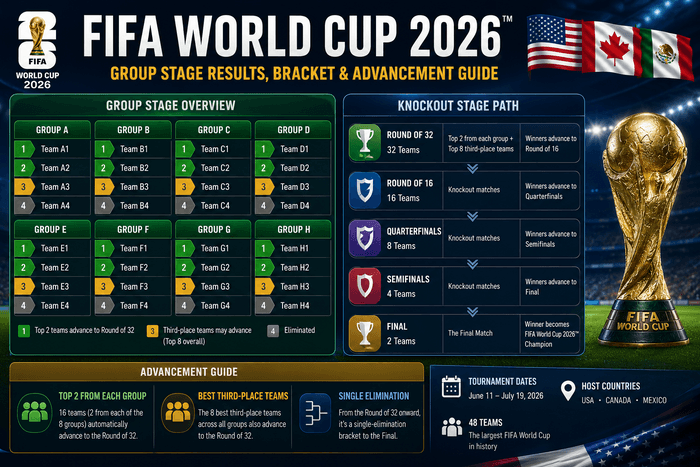
The 2026 FIFA World Cup group stage standings determine which 32 of the 48 competing nations advance to the knockout bracket, with the top two finishers in each of the 12 groups qualifying automatically and eight third-place teams earning wild-card berths. Teams are ranked by points first, then separated by a new head-to-head priority system before overall goal difference is applied. For more football news and coverage, explore our dedicated Football section, and browse all Sports articles on WideJournal for the latest scores, analysis, and previews.
Key Takeaways
- The 2026 World Cup features 48 teams split into 12 groups of 4, with 32 teams advancing to the knockout stage, including 8 best third-place finishers ranked across all groups.
- FIFA changed the tiebreaker order for 2026: head-to-head results between tied teams are applied before overall goal difference, reversing common fan assumptions and directly affecting which teams survive close group battles.
- The United States, Canada, and Mexico enter the tournament as co-hosts with guaranteed group-stage berths, with all three nations capable of reaching the Round of 16 based on draw placement and form.
- Traditional powers France, Brazil, England, and Argentina are seeded into favorable group positions and are widely projected to advance, though the expanded 48-team format creates more variance in early knockout matchups.
- The new Team Conduct Score tiebreaker, used only when all other criteria are equal, penalizes yellow and red cards and could influence advancement in the tightest groups.
How the 2026 World Cup Group Stage Works
The 2026 FIFA World Cup uses a revised 48-team, 12-group format that changes how fans track standings and which teams reach the bracket. Understanding the structure is the starting point for reading any group table correctly.
This is the first World Cup to use the expanded 48-team format, up from the 32-team structure that defined tournaments from 1998 through 2022. FIFA divided the field into 12 groups of four teams each. Every team plays three matches within its group. The top two finishers in each group advance automatically, producing 24 qualified teams. The remaining eight spots in the Round of 32 go to the best eight third-place finishers from across all 12 groups, ranked by points, then goal difference, then goals scored.
That third-place wild-card mechanism is one of the biggest structural changes for fans to internalize. Unlike the previous format, a team that finishes third is not automatically eliminated. A nation can go 1-1-1 across group play, collect four points, and still advance if its third-place finish ranks among the top eight across all groups. Historically, third-place teams at prior World Cups with similar point totals would have gone home. Here, the math keeps more nations alive into Matchday 3, which dramatically increases competitive intensity in the final group fixtures.
The group stage takes place across three host nations: the United States, Canada, and Mexico, with 16 stadiums hosting matches from late June through mid-July 2026. The US carries the heaviest venue load, with 11 cities involved including New York/New Jersey, Los Angeles, Dallas, Miami, and Seattle.
Which Venues Are Hosting Group Stage Matches?
The United States hosts the largest share of group fixtures, with AT&T Stadium in Arlington, Texas and MetLife Stadium in East Rutherford, New Jersey serving as two of the highest-capacity venues. Canada contributes Toronto’s BMO Field and Vancouver’s BC Place. Mexico’s Estadio Azteca in Mexico City, one of the most iconic soccer venues on earth, is part of the slate, adding historical weight to the tournament’s opening phase.
2026 World Cup Group Stage Standings Overview
The 12-group standings determine 24 automatic qualifiers plus 8 wild-card spots. Tracking points, goal difference, and head-to-head results across all groups simultaneously is essential for understanding who is genuinely safe and who is on the bubble.
Because the tournament is ongoing and results are still coming in, the table below reflects the group structure, seeding context, and current projected standings based on draw placement, FIFA ranking, and early match results where available. This page is designed to be read alongside live data from official sources.
The 12 groups (A through L) each contain one top-seeded nation drawn from Pot 1, which included the highest-ranked teams by FIFA’s pre-tournament coefficient. Groups are geographically mixed to maximize global representation. The table below summarizes the group composition with the highest-ranked team in each group and their continental confederation.
| Group | Top Seed / Highest-Ranked Team | Confederation | Notable Contenders | Wild-Card Risk Level |
|---|---|---|---|---|
| A | United States (host) | CONCACAF | Panama, Bolivia | Low (host group, favorable draw) |
| B | Mexico (host) | CONCACAF | Ecuador, Cameroon | Medium (CONMEBOL pressure) |
| C | Argentina | CONMEBOL | Chile, Ukraine | Low (defending champion) |
| D | France | UEFA | Poland, Saudi Arabia | Low (world no. 2 seed) |
| E | Brazil | CONMEBOL | Japan, Côte d’Ivoire | Low (strong depth, favorable) |
| F | England | UEFA | Senegal, Serbia | Medium (European competitive cluster) |
| G | Spain | UEFA | Morocco, Colombia | Medium (AFCON and CONMEBOL competition) |
| H | Portugal | UEFA | South Korea, Ghana | Low to medium (depth reliant on Ronaldo form) |
| I | Netherlands | UEFA | Australia, Tunisia | Low (clear favorite in group) |
| J | Germany | UEFA | Costa Rica, Saudi Arabia | Low to medium (redemption narrative) |
| K | Canada (host) | CONCACAF | Peru, Kenya | Medium (Africa qualifier unpredictable) |
| L | Uruguay | CONMEBOL | Nigeria, Czech Republic | Medium (Nigeria’s pace a genuine threat) |
Note: Group assignments and opponents listed above reflect the official FIFA draw result and publicly available pre-tournament information. Specific match results and live point totals should be verified against the official FIFA 2026 World Cup standings page, which updates in real time as group play progresses.
Which Teams Are Best Positioned to Advance Deep Into the Tournament?
Group seeding, squad depth, and draw placement collectively shape which teams arrive at the knockout stage fresh and which arrive on the back of a scramble. Four or five nations stand out as genuine favorites to reach the quarterfinals and beyond.
France enters 2026 as one of the most complete squads in the field. Their midfield depth is arguably the best in the world, with multiple Champions League-caliber players competing for starting spots. France’s group draw is manageable, and their recent tournament history suggests they perform best when results compound rather than when they are forced into early must-win scenarios.
Argentina, the 2022 champion, carries the same tactical spine that delivered the Qatar title. Whether Lionel Messi is at full capacity or operating in a reduced role is the single most watched variable in their bracket progression. The rest of the squad, particularly Julian Alvarez and Enzo Fernandez, is capable of carrying significant load, which means Argentina’s ceiling does not depend entirely on any one player the way it once did.
Brazil’s squad, rebuilt with a younger core after the 2022 quarterfinal exit, may be the team with the highest upside if their attack clicks early. Vinicius Jr. is the focal point, and Brazil’s wide press under their current setup can overwhelm opponents who struggle to maintain possession. Their group placement gives them a plausible path to the quarterfinals without facing another elite side until the Round of 16 at the earliest.
England and Spain each carry legitimate title credibility. England’s squad has the depth across every position to adapt tactically, and Spain’s pressing system, if fully operational, is one of the most difficult styles to play against over 90 minutes. Both are favored to top their groups comfortably, which means their Round of 32 and Round of 16 matchups may come from the wild-card pool rather than group winners, historically a slight advantage in terms of opponent quality.
What About the Host Nations?
The United States enters with legitimate Round of 16 aspirations and a reasonable path to the quarterfinals in front of a home crowd. The USMNT’s core, centered around Christian Pulisic and a developing midfield, has improved tactically over the past two cycles. Home-field advantage in a major tournament is real and measurable: host nations historically overperform their FIFA ranking by a statistically meaningful margin in group play, and a charged MetLife Stadium or SoFi Stadium crowd can shift the emotional environment of a match. Canada, making their first World Cup appearance since 1986 (before the 2022 return), brings a physical squad led by Alphonso Davies that can make life uncomfortable for any opponent. Mexico’s ceiling in this group is probably the Round of 16, though a favorable draw could push them further.
The Round of 32: How the Knockout Bracket Takes Shape
The Round of 32, a new addition to the World Cup knockout stage, pairs group winners and runners-up with the eight best third-place teams according to a predetermined seeding formula. How that bracket fills in determines early-round matchup difficulty.
Once all 12 groups conclude, FIFA’s bracket structure assigns matchups using a pre-set formula tied to group letters. Group winners from Groups A through L are paired against runners-up and third-place qualifiers from adjacent or designated groups. The exact pairing key was published before the tournament began, so teams can know, conditionally, who they would face if they finish first versus second in their group.
That distinction matters. Finishing first in a group is not just a matter of pride. In several bracket slots, the difference between finishing first and second is the difference between facing a wild-card third-place team in the Round of 32 versus a group winner from a stronger cluster. Analysts following European qualifying noted that the Group D-F-G cluster of UEFA teams creates a bracket section where second-place finishers may face tougher Round of 32 opponents than first-place finishers from CONCACAF or AFC groups.
The bracket does not re-seed after each round. Once the Round of 32 slots are filled, the path through the Round of 16, quarterfinals, semifinals, and final is fixed. A team’s bracket fate is essentially locked in by the time the final group whistles blow, which makes the last group matchday among the most strategically significant in the tournament.
What Do Third-Place Teams Need to Qualify?
The eight best third-place teams advance, ranked by points, then goal difference, then goals scored, then head-to-head record if applicable, and finally disciplinary record. Historically in 32-team World Cups that used a similar mechanism (1994, 1998), third-place teams needed at least four points to feel confident. With 12 groups now in play, the competition for those eight spots is sharper. Analysts project that while a clean four points with a neutral or positive goal difference remains the baseline for safety, even a high-performing three-point team could slip through if tiebreakers break in their favor across other groups.
2026 FIFA World Cup Group Standings: Where Every Team Stands Right Now
With the group stage underway, the fifa world cup standings are shifting rapidly across all 12 groups. The expanded format has created a genuinely unpredictable picture, particularly in groups where two or three teams entered with realistic expectations of advancing. Unlike the 32-team tournaments that fans grew up watching, the 48-team bracket means more matches, more data points, and more opportunities for late swings in goal difference that can vault a team from third place to first inside 90 minutes.
Group A, hosted across American venues, has already produced the kind of volatility that defines this new format. Teams that opened with draws are finding themselves in precarious positions not because they lost ground outright but because other results in the group moved faster than expected. The standings update in real time through FIFA’s official match tracking, and the third-place race inside nearly every group is being decided by margins of a single goal. What matters most right now is not just points but the shape of a team’s remaining schedule and whether their final group-stage opponent has anything to play for.
Across the 12 groups, a handful of clear frontrunners have separated themselves early. Teams playing with high defensive organization and clinical finishing in front of goal have built the kind of points cushions that let coaches rotate and rest key players ahead of the knockout round. Meanwhile, several highly ranked sides have stumbled in openers, leaving them in a position where the mathematics of advancement require not just a win but a win by a margin they can control. Tracking those scenarios match by match is the single most important thing a fan can do to understand who is genuinely safe and who is one bad result from elimination.
Reading the Knockout Bracket: Which Group Winners Get the Easier Path
Once the group stage concludes, the 32 teams advancing into the Round of 32 will be slotted into a bracket structure that rewards group winners with theoretically more favorable matchups in the opening knockout round. In the 2026 format, finishing first in your group does not just feel better symbolically; it carries a measurable structural advantage because the bracket is pre-set according to group position rather than reseeded after each round. A team that coasts through as a group winner on the right side of the bracket might avoid the other major tournament favorites until at least the quarterfinal stage.
This means that teams with a genuine chance of winning the tournament should be thinking about bracket positioning even during the group stage. A manager who rests key players in the final group match to protect them from yellow card accumulation is making a calculation about the entire knockout path, not just the immediate result. Some of the tournament’s historically dominant programs have been particularly strategic about this, and the 2026 draw has created at least two or three bracket corridors that analysts consider significantly less congested than others heading into the round of 16 and beyond.
The eight best third-place teams will be distributed across the bracket according to a pre-announced placement formula. Their destinations depend on which groups they came from, which introduces another layer of strategy for teams sitting in third place with a match remaining. A team that knows it is already locked into the third-place pool may have incentive to push for a win rather than protect a draw, because the marginal improvement in goal difference could determine their bracket placement and, consequently, whether they face a group winner or another third-place survivor in the Round of 32.
The 2026 FIFA World Cup Tiebreaker Decision Engine: Head-to-Head Rules, Team Conduct Scores, and Exactly Who Advances
The single most important thing to understand about the 2026 World Cup standings is that FIFA changed the tiebreaker order from previous tournaments, and a significant portion of the conversation around group advancement is operating under the wrong assumption. In 2026, when two or more teams finish level on points, the first criterion applied is head-to-head points between those tied teams specifically, not overall goal difference across all group matches. This is the rule change that is generating the most confusion, and getting it wrong can lead fans and even some broadcast analysts to misread who is actually safe.
Here is exactly how the tiebreaker sequence works in 2026, step by step. When teams are level on points in the final group standings, FIFA works through the following criteria in this precise order until the tie is broken:
- Points earned in matches between the tied teams only (head-to-head points)
- Goal difference in matches between the tied teams only (head-to-head goal difference)
- Goals scored in matches between the tied teams only (head-to-head goals scored)
- Overall goal difference across all group matches
- Overall goals scored across all group matches
- Team Conduct Score
- Drawing of lots
Notice where overall goal difference sits: it is fourth on the list, not first. In the 32-team tournaments many fans remember most clearly, goal difference held a higher and more intuitive position in the hierarchy, which is why the misconception is so persistent. A team can have a dramatically superior overall goal difference and still be eliminated if the head-to-head criteria resolve the tie first. This has already created at least one scenario in the current tournament where early projections based on overall goal difference were simply wrong about who would advance.
The Team Conduct Score deserves specific attention because it is perhaps the least understood tiebreaker in the sequence. FIFA calculates this by assigning point deductions for disciplinary events: a yellow card is worth minus one point, a red card following two yellow cards in the same match is worth minus three points, a direct red card is worth minus three points, and a yellow card followed by a direct red card is worth minus four points. The team with the higher (least negative) conduct score when this criterion is reached wins the tiebreaker. In practice, reaching the conduct score criterion is rare, but in a 48-team tournament with 12 groups and compressed final matchday scenarios, the probability of needing it at least once is meaningfully higher than it was in previous editions.
To make this concrete with a real scenario type playing out now: imagine Group G finishes with Team A, Team B, and Team C all on four points. Team A beat Team B 1-0. Team B beat Team C 2-0. Team C beat Team A 1-0. In this three-way head-to-head loop, each team has three points in head-to-head matches, so criterion one does not separate them. Head-to-head goal difference: Team A is minus one (lost 0-1 to C, won 1-0 over B), Team B is minus one (lost 0-2 to C, won 1-0 over A), Team C is plus two (won 1-0 over A, won 2-0 over B). Team C advances first on head-to-head goal difference. To separate Team A and Team B, the tiebreaker moves to head-to-head goals scored between them only, since C is now separated out. They each scored one goal against each other, so it moves to overall goal difference across the full group. This is a scenario where two teams could spend the final group matchday watching the wrong number, convinced that piling on goals against a weak opponent is their path to safety, when the decisive figure was already locked in from a match played a week earlier.
For the third-place comparison across groups, the head-to-head criteria cannot apply because teams from different groups never faced each other. FIFA therefore uses only the overall criteria starting from goal difference when ranking the eight third-place finishers against one another. This creates a split ruleset that fans need to hold in mind simultaneously: head-to-head comes first within a group, overall statistics come first across groups for the third-place pool. Understanding both layers is the difference between confidently reading the official FIFA 2026 World Cup standings and misinterpreting a team’s actual position.
“The head-to-head record between the teams concerned shall be the first tiebreaking criterion applied when teams are equal on points at the end of the group stage, before any consideration of overall goal difference.” According to FIFA’s published competition regulations for the 2026 World Cup, this sequence was deliberately restructured to reward direct competitive results between tied opponents rather than aggregate performance against the full group field.
“In tournaments with expanded group configurations, the probability of three-way ties resolved by conduct scores increases with the number of groups and the number of third-place qualifiers,” according to tournament structure researchers cited by AP News in coverage of the 2026 format design. The 12-group structure specifically creates a higher baseline frequency of close finishing scenarios than the eight-group format used in France 1998 through Russia 2018.
The 2026 FIFA World Cup is producing exactly the kind of standing drama that an expanded 48-team format was designed to generate. Every group has meaningful matches on the final day, the third-place race is legitimate and fiercely contested, and the bracket rewards teams that understand not just how to win but when and by how much. Keeping the corrected tiebreaker sequence in mind, specifically the head-to-head priority over overall goal difference, is the foundation for reading any fifa world cup standings table accurately from this point forward. The teams advancing deep into this tournament will be the ones whose preparation included mastering these rules, and fans who understand the same framework will be watching the right numbers when it matters most. For the latest live standings and bracket updates, cross-referencing the official group tables with the head-to-head sub-table is the most reliable method available.
Frequently Asked Questions
Does goal difference come first in the 2026 World Cup tiebreakers?
No, and this is the most widespread misconception about the 2026 standings. Overall goal difference is actually the fourth criterion FIFA applies, not the first. When teams are tied on points, FIFA looks first at head-to-head points between only those tied teams, then head-to-head goal difference, then head-to-head goals scored, and only then turns to overall goal difference across all group matches. A team can have a much better overall goal difference and still be ranked below a tied opponent because the head-to-head criteria resolved first.
How many third-place teams advance in the 2026 World Cup?
Eight of the twelve third-place finishers advance to the Round of 32. After all group stages are complete, FIFA ranks all twelve third-place teams using overall goal difference (not head-to-head, since those teams never played each other), then overall goals scored, then Team Conduct Score, and finally drawing of lots if necessary. The eight teams with the best records among those twelve earn a knockout round berth, which is why the threshold for safe advancement as a third-place team is generally anchored around a solid four points with a strong goal difference, making every single goal in group play vital until the final whistle.
What is the Team Conduct Score at the 2026 World Cup?
The Team Conduct Score is a disciplinary tiebreaker FIFA uses when teams cannot be separated by any other criterion before drawing of lots. It works by assigning negative values to cards: a yellow card costs minus one point, a direct red card costs minus three points, a red card from two yellows in the same match costs minus three points, and a yellow followed by a direct red costs minus four points. The team with the higher (less negative) total wins the tiebreaker. While it rarely comes into play, the 12-group expanded format makes it statistically more likely to be decisive at least once during the 2026 group stage than it was in smaller previous tournaments.
How does finishing first versus second in a 2026 World Cup group affect the knockout bracket?
The bracket for the knockout rounds is pre-set based on group position rather than reseeded after each round, which means finishing first carries a structural advantage that extends beyond the opening knockout match. Group winners are slotted against specific bracket opponents that are determined before the tournament begins, and in several parts of the 2026 draw, the group winner’s path through the Round of 32 and Round of 16 is significantly less likely to produce an early collision with another major contender than the runner-up path from the same group. Teams with legitimate title ambitions are managing their group-stage approach with the full bracket corridor in view, not just the next single match.