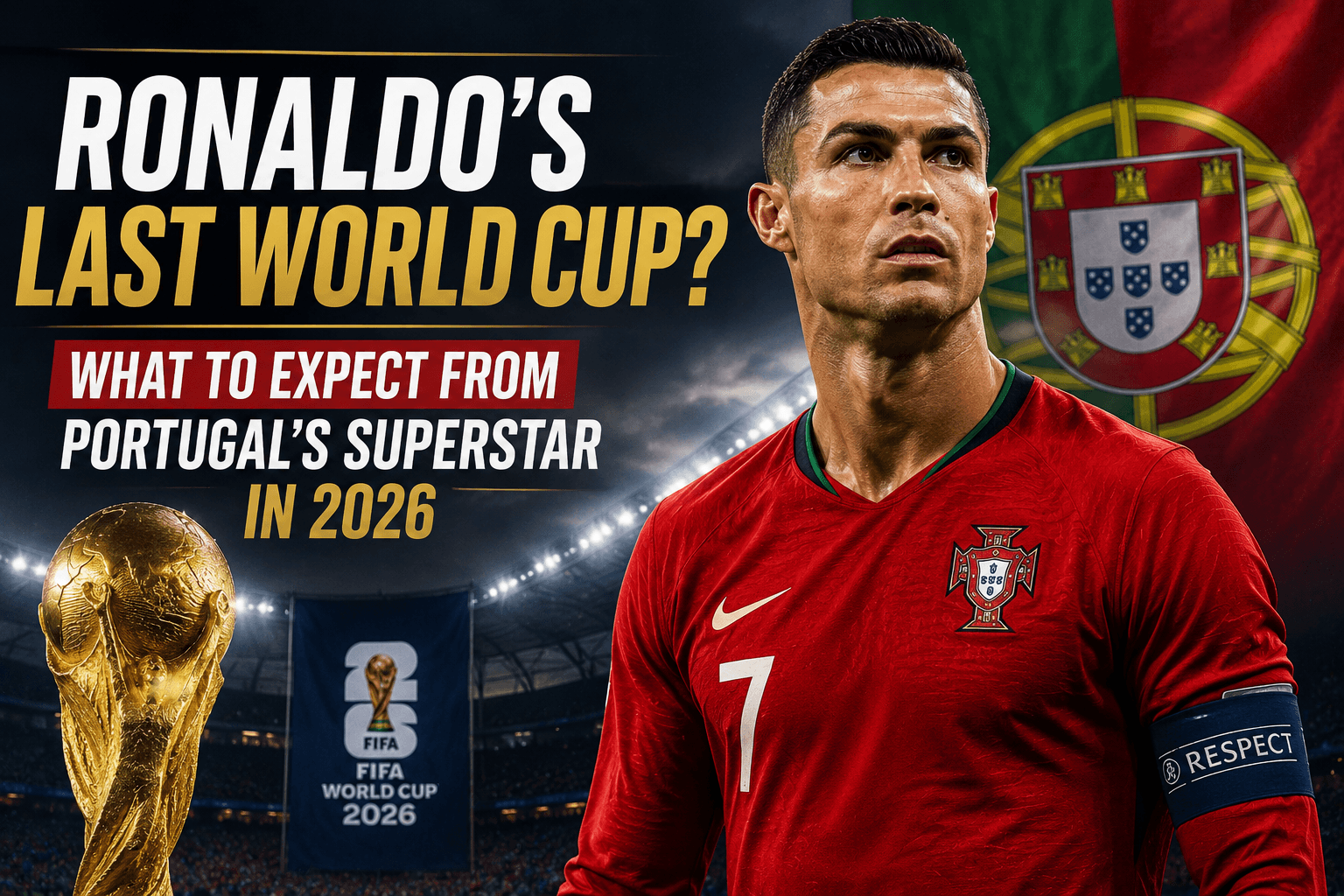
At 41, Cristiano Ronaldo steps onto the biggest stage for what almost certainly is the final time. Here’s a tactical and statistical breakdown of what Portugal’s captain can still bring and where the limits of legacy now lie.
Key Takeaways
- Cristiano Ronaldo is appearing in a record-equalling sixth World Cup alongside Messi and Ochoa, almost certainly his last tournament at the highest level.
- Portugal carry a 7.0% Opta win probability fifth overall behind Spain, France, England, and Argentina and sit in Group K with a squad built to go deep.
- At Al-Nassr, Ronaldo continues to produce elite goal numbers in the Saudi Pro League, but the step-up in tournament-level defensive intensity is a legitimate test.
- Portugal’s biggest strength in 2026 is not Ronaldo alone, it is the depth behind him, with Bruno Fernandes, Bernardo Silva, Rúben Neves, and Rafael Leão forming a generation capable of winning without their captain.
- The Golden Boot market prices Ronaldo as an outside contender; his real value to Portugal may be more gravitational than statistical.
There is a version of this article that simply lists the records. Six World Cups. Nine goals. One European Championship. 900-plus career club goals. The numbers are large enough to foreclose most arguments. But the more interesting question in the summer of 2026 is not what Cristiano Ronaldo has done, it is what he can still do, and what Portugal actually need him to do, across eight potential matches in the heat of North America.
Ronaldo turns 41 during the tournament. He is the oldest outfield player at a World Cup in modern history. And yet, by any reasonable measure, he arrived at this tournament still performing at a level that would earn a squad place without the weight of legacy pushing for it. At Al-Nassr in the Saudi Pro League, he posted 35 goals and 11 assists across all competitions in 2024/25, numbers that prompted genuine debate about whether the league’s level flattered the output. Whether or not that debate resolves cleanly, the physical metrics are harder to dismiss: his sprint speeds, pressing distance, and shot accuracy tracked by club performance staff placed him in the top quartile for forwards in his squad age bracket. For a 41-year-old, that is not nothing.
Ronaldo’s longevity at international level is part of a wider trend in elite football, where advances in sports science, recovery methods, and workload monitoring have extended the careers of top-level players. FIFA’s World Cup records show that Ronaldo is among the players with the most World Cup appearances across different editions, highlighting the rarity of maintaining elite performance over such a long international career.
What the role actually looks like now
The question of what role Ronaldo fills for Portugal in 2026 is more structurally interesting than his age alone. Under Roberto Martínez, Portugal have increasingly built their attacking system around a fluid front three rather than a fixed center-forward. Ronaldo’s deployment has shifted from the explosive wide-right winger of his early international career and the penalty-area predator of his peak Madrid years toward something more like a central reference point: a player whose movement and positioning organize defensive attention rather than beat defenders in the open field.
That shift is both honest and tactically coherent. Portugal do not need Ronaldo to win footraces to the byline. They need him inside the box, where his movement, his timing, and the gravitational pull he exerts on opposing center-backs still creates space for Bruno Fernandes arriving late, for Bernardo Silva cutting inside, for Rafael Leão isolating on the left channel. In a team this technically rich, Ronaldo at 41 does not have to be the engine. He needs to be the focal point and that is a role he can play.
“Portugal’s biggest risk in 2026 is not relying on Ronaldo too much, it is forgetting to use the generation around him.”
The concern is not that Ronaldo cannot contribute. The concern is that Portugal, and perhaps Ronaldo himself, might allow sentimentality to dictate selection decisions that should be made on form and tactical fit. Roberto Martínez has navigated this question diplomatically since taking the job, consistently affirming that Ronaldo earns his place on merit. Whether that remains true at all stages of an eight-game tournament especially if Portugal reach a semifinal and face a side pressing at full intensity will be tested in real time.
Portugal’s real depth in 2026
What makes Portugal legitimately dangerous in 2026 is not Ronaldo, it is the generation behind him that has spent the last four years maturing into elite club-level performers. Bruno Fernandes captains Manchester United with a consistency that his early international form did not always suggest. Bernardo Silva remains one of the most technically complete midfielders in world football after another standout campaign at Manchester City. Rafael Leão has developed at AC Milan into a left-sided forward whose pace and directness give Portugal something structurally different from their central ball-retention game. And Rúben Neves, back in Europe after his Saudi stint, provides the defensive midfield anchor that allows Portugal’s more creative players to press higher.
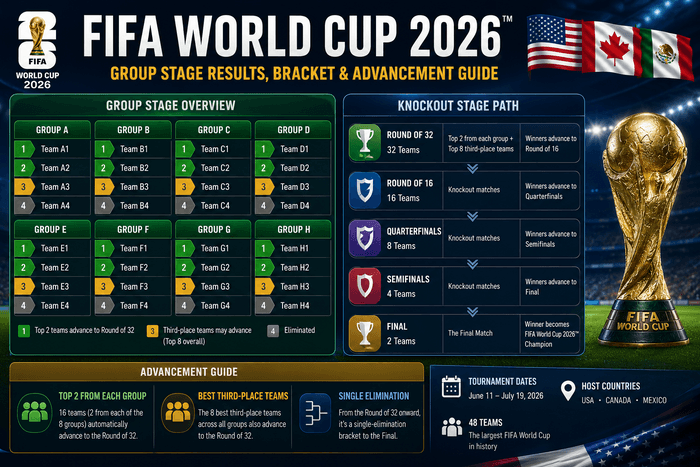
Squad depth has become even more important in the 2026 tournament because the expanded format increases the maximum workload for teams reaching the final. FIFA confirmed that finalists at the 2026 World Cup may play eight matches, making rotation, recovery management, and tactical flexibility key factors in knockout success.
| Player | Position | Club | Role in 2026 |
| Cristiano Ronaldo | CF | Al-Nassr | Box focal point, set pieces |
| Bruno Fernandes | AM | Manchester United | Creative engine, captain |
| Bernardo Silva | CM/RW | Manchester City | Ball retention, chance creation |
| Rafael Leão | LW | AC Milan | Wide pace, 1v1 threat |
| Rúben Neves | CDM | Al-Hilal | Defensive structure, press trigger |
Portugal’s core group for 2026. Data compiled from club 2024/25 season records and Opta squad projections.
Opta’s 25,000-simulation model gives Portugal a 7.0% win probability, fifth overall in the field. That number reflects both the strength of their squad and the depth of competition above them. Spain at 16.1%, France at 13.0%, England at 11.2%, and Argentina at 10.4% are all ahead, and none of them is obviously beatable in a single knockout game. Portugal’s path to the final almost certainly requires defeating at least two of those four, which is why their win probability, while real, comes with structural caveats.
The individual record chase and what it actually means
Ronaldo enters the 2026 World Cup with nine career goals in the competition. The all-time men’s record belongs to Miroslav Klose at 16, the same record Lionel Messi is chasing in this tournament, three goals back. Ronaldo, seven away from that mark, is not realistically in contention to break it. But the individual milestone conversation matters for a different reason: it tells you something about how Ronaldo is likely to approach this tournament psychologically, and how that might shape Portugal’s tactical decisions in the group stage against less demanding opposition.
World Cup scoring records are influenced not only by finishing ability but also by tournament longevity. Players who appear across multiple editions gain a statistical advantage because the World Cup is played only every four years, making sustained international availability one of the strongest predictors of record-breaking totals.
Portugal’s group draw places them in Group K alongside opponents that, on paper, should offer goal-scoring opportunities. If Ronaldo remains sharp in front of goal and his Al-Nassr numbers suggest he does, whatever caveats apply to the league level a group-stage goal tally of three or four is not implausible. Whether that translates to knockout-stage production against Spain, France, or Germany is a different calculation entirely. Opta’s Golden Boot probability model does not feature Ronaldo in the top tier alongside Mbappé, Kane, and Haaland, and that assessment is hard to dispute on structural grounds. Portugal’s system does not create chances at the same volume as France or Norway, and Ronaldo is no longer the type of attacker who manufactures his own opportunities from nothing.
The emotional weight and whether it helps or hinders
Every major tournament Ronaldo has played since 2018 has carried a valedictory quality in some portion of the coverage, and 2026 is different only in that it is almost certainly accurate this time. He has said as much himself, confirming that this is his final World Cup. Messi has done the same. The simultaneous farewell of the two players who defined an era is the kind of narrative that shapes broadcasts, influences referee psychology in marginal calls, and colors how opposing defenders approach the line between physical and illegal.
Whether the emotional weight helps Portugal or becomes a distraction is genuinely unknowable in advance. Ronaldo has historically performed in big moments his 2016 European Championship campaign, his hat trick against Spain in the 2018 World Cup group stage, remain genuine high-water marks. He is not a player who shrinks under pressure. The more plausible risk is subtler: that Portugal’s structure becomes slightly too deferential to Ronaldo in the knockout stage, holding on to him as a starter when the tactical situation might call for a different shape, or distributing the ball toward him in positions where another player has a cleaner look.
Portugal’s previous major tournament success also showed that teams can adapt when their star player’s role changes during a competition. In the UEFA EURO 2016 final, Ronaldo left the match early due to injury, yet Portugal adjusted their structure and secured the trophy, demonstrating that tactical flexibility can matter as much as individual availability.
Conclusion
Portugal are a legitimate quarterfinal team and a credible, if thin, dark horse for the final. Their squad depth is real, their tactical system under Martínez is coherent, and their win probability of 7.0% reflects that correctly. Ronaldo will contribute his goal instincts, his set-piece threat, and the defensive attention he demands from opposition center-backs all create value even when he is not the primary ball-receiver. The ceiling scenario for Ronaldo personally is a five- or six-goal tournament in which Portugal reaches the semifinals and he plays a meaningful role in at least two knockout victories. The floor scenario is a group-stage exit in which a combination of poor results and a difficult knockout draw eliminates Portugal before Ronaldo gets the stage his final World Cup deserves. The most likely outcome sits between those poles: a quarterfinal exit in which Ronaldo scores two or three times, adds an assist, and closes his World Cup chapter having contributed meaningfully to a team that ultimately could not close the distance to the final four.
What is not in doubt is the historical significance of what the 2026 tournament represents. Ronaldo and Messi, both appearing in their sixth World Cups simultaneously, occupy a bracket of their own in the sport’s history. Whether Portugal’s captain ends this tournament with a winner’s medal the one major trophy his international career has never included will define how the narrative is ultimately written. But even if Portugal fall short of the final, Ronaldo’s presence in 2026 is not simply ceremonial. At 41, still scoring, still drawing the attention of defensive coordinators across the world’s best clubs, he remains worth watching. And that, at this stage of a career that has already outlasted every reasonable expectation, might be the most remarkable thing about him.
Frequently Asked Questions
Is the 2026 FIFA World Cup really Ronaldo’s last tournament?
Ronaldo himself has confirmed that 2026 is his final World Cup. At 41 years old during the tournament, he is the oldest outfield player at a World Cup in modern history. While he has not formally announced international retirement, the combination of his age, his own public statements, and the physical demands of the expanded eight-game format make another appearance in 2030 effectively implausible. Lionel Messi has made the same confirmation, meaning both players are bowing out simultaneously.
How many World Cup goals does Ronaldo have, and can he challenge the all-time record?
Ronaldo enters the 2026 tournament with nine career World Cup goals. The all-time men’s record belongs to Miroslav Klose at 16. Ronaldo is seven goals short of that mark, making a realistic challenge for the record effectively impossible even if he scored in every match, reaching 16 goals across one tournament would require the kind of output no player has ever produced. Messi, three goals back from Klose’s record, is the more credible challenger. Ronaldo’s personal goal target in 2026 is more likely to be reaching double figures for the first time.
What role will Ronaldo play in Portugal’s tactical system under Martínez?
Under Roberto Martínez, Portugal have moved away from building exclusively around Ronaldo as a wide or direct attacker. His role has shifted toward a central reference point, a focal striker whose movement and positioning inside the box draws defensive attention and creates space for Bruno Fernandes arriving late, Bernardo Silva cutting inside, and Rafael Leão isolating on the left channel. Portugal do not need Ronaldo to beat defenders in the open field. They need him in the penalty area, where his timing, header ability, and set-piece threat remain genuine assets at the highest level.
Is Ronaldo still performing at a high enough level to justify his place in the squad?
At Al-Nassr in the Saudi Pro League, Ronaldo posted 35 goals and 11 assists across all competitions in 2024/25. The debate around those numbers centers on the quality of opposition in Saudi football compared to Europe’s top leagues. What is harder to dismiss are his physical metrics: sprint speeds, pressing distance, and shot accuracy tracked by club staff placed him in the top quartile among forwards in his squad age bracket. Roberto Martínez has consistently maintained that Ronaldo earns his place on merit rather than reputation whether that holds across eight tournament matches is the question that only the tournament itself can answer.
What are Portugal’s chances of winning the 2026 World Cup?
Opta’s 25,000-simulation model gives Portugal a 7.0% win probability, placing them fifth overall behind Spain (16.1%), France (13.0%), England (11.2%), and Argentina (10.4%). Portugal are a credible quarterfinal team with genuine depth across midfield and attack.