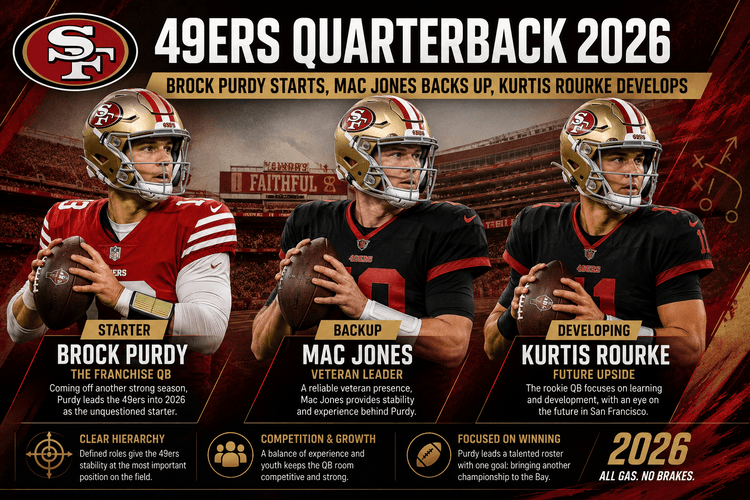
Brock Purdy is the starting quarterback for the San Francisco 49ers heading into the 2026 NFL season. Mac Jones serves as the primary backup (QB2) after a trade that never materialized despite weeks of offseason speculation. Seventh-round draft pick Kurtis Rourke remains the organization’s long-term developmental answer at the backup position. The hierarchy is clear: Purdy leads, Jones provides insurance, Rourke is the future.
Key Takeaways
- Brock Purdy is the unquestioned QB1 for the 49ers in 2026, coming off multiple Pro Bowl seasons as the franchise’s centerpiece under center.
- Mac Jones remains under contract through the 2026 season as QB2, following a two-year deal worth up to $4.5 million signed in 2025, according to the official OverTheCap 49ers salary cap tracker.
- The 49ers explored trading Jones during the offseason but found no viable market at his contract value, leaving him as the team’s primary backup heading into training camp.
- Jones posted a training video to Instagram in June 2026, publicly signaling his commitment to San Francisco and quieting (at least temporarily) the noise around his future.
- Seventh-round 2025 draft pick Kurtis Rourke — a former Indiana standout — is the organization’s forward-looking developmental answer at the backup position, with a contract running through 2028 at a sub-$1 million cap hit in 2026.
- Kyle Shanahan and offensive coordinator Klay Kubiak have both publicly praised Rourke’s progress, suggesting the franchise views Jones as a bridge rather than a cornerstone.
The 49ers QB Depth Chart in 2026: Purdy, Jones, Rourke
Before analyzing Mac Jones’s role and outlook, it is important to establish the actual depth chart, because recent coverage has generated genuine confusion on this point.
Brock Purdy is the starting quarterback. Full stop. Purdy has developed into one of the most efficient starters in the NFC over the past three seasons, and his status as QB1 in San Francisco is not in question heading into 2026. Any analysis of the 49ers quarterback room starts and ends with that baseline.
Mac Jones is the backup — the QB2, the primary insurance policy in the event Purdy misses time due to injury. Jones would step in as the starter only if Purdy were unavailable.
Kurtis Rourke is the third quarterback (QB3) on the depth chart, a developmental prospect Shanahan’s staff is bringing along on its own timeline with no pressure to contribute in 2026.
Why Mac Jones Wasn’t Traded
Despite a busy offseason trade market at quarterback, the 49ers found no takers for Mac Jones, leaving him in San Francisco for at least one more season. The reasons are a mix of contract value, market timing, and an increasingly crowded QB landscape around the league.
The trade rumors surrounding Mac Jones had real legs for a stretch of the 2026 offseason. Teams in need of veteran depth were identified as potential destinations, and the 49ers were reported to have fielded calls. But the market dried up quickly.
Jones carries a salary that works for San Francisco but represents more than most teams looking for cheap veteran insurance are willing to absorb, particularly when undrafted free agents and late-round developmental prospects are available at a fraction of the cost. There is also the matter of Jones’ NFL trajectory. After his promising rookie season with the New England Patriots in 2021 — 3,801 yards, 22 touchdowns, 67.6 percent completions — Jones saw his game regress sharply under coaching staff turnover and offensive system inconsistency in subsequent years. His time in Jacksonville as a backup in 2024 did little to rehabilitate his market value as a starter.
Teams are not viewing Jones as a solution. They are viewing him, at best, as a competent veteran who knows how to manage a gameplan and keep a locker room steady. That profile has value in San Francisco, where Shanahan has historically prioritized quarterback intelligence and system literacy over arm talent alone. But it is not a profile that commands trade interest from teams willing to give up even a late-round pick.
The result: Jones stays put. The 49ers absorb his contract, he remains QB2, and both sides quietly move on from the trade chapter.
What Is Mac Jones’ Role With the 49ers?
Jones is operating as the primary backup quarterback in San Francisco — the direct bridge behind Purdy. His job is to be ready, not to compete for the starting position.
The Brock Purdy era has been one of the most compelling in recent 49ers history, and Purdy’s health remains the central variable in San Francisco’s 2026 outlook. Against that backdrop, Jones’ role becomes clearer. He is not a reclamation project in the traditional sense. Shanahan is not trying to fix Mac Jones or unlock some dormant version of the 2021 Patriots starter. The coaching staff appears to be using Jones as a functional backup who can execute the system, communicate protections, and step in without requiring the offense to be dramatically simplified.
That is actually a harder job than it sounds. Shanahan’s offense is among the most conceptually complex in the NFL, built on pre-snap motion, split-zone actions, and a wide receiver alignment structure that demands quarterbacks process information before the snap. Jones, whatever his limitations as a starter, is smart and experienced enough to operate within those parameters. He understands coverage rotation. He manages the pocket adequately. He does not turn the ball over at a catastrophic rate when given clean reads.
The risk is that Jones’ ceiling in this system is also his floor. There is no reasonable scenario, based on his recent NFL history, in which Mac Jones becomes a difference-maker if forced into extended starting duty. He may be serviceable. Serviceable, for a 49ers team with championship aspirations still embedded in its organizational DNA, is not good enough to save a season. But as a bridge backup while Rourke develops? Jones is exactly what the situation calls for.
Mac Jones’ Contract Situation With San Francisco
Jones is under contract through the 2026 season on a deal that keeps his cap number manageable for San Francisco. The structure makes him relatively easy to carry and nearly as easy to release if circumstances change.
The financial details matter here because they explain both why the 49ers signed Jones in the first place and why a trade proved complicated. Jones’ one-year deal is worth up to $4.5 million, structured as a base salary with incentive escalators tied to games played and performance thresholds he is unlikely to hit as a backup. According to the latest financial breakdowns on OverTheCap, his 2026 cap hit and dead money structure are low enough that cutting him mid-season would not create a significant cap penalty for San Francisco.
In practical terms, this means San Francisco has flexibility. If Rourke is ready earlier than expected, the team has a clear path to moving on from Jones without a major financial consequence. If Purdy goes down and Jones performs adequately, the incentives give him modest upside. If Jones struggles badly in extended action, the team is not trapped.
It is a sensible structure for a backup quarterback contract. It protects the team while giving Jones something to play for. What it does not do is signal any long-term organizational faith in Jones as a franchise asset. This is a one-year arrangement with a defined exit point, and both sides appear to understand that.
The Instagram Moment: Jones Responds to Trade Talk
Jones took to Instagram in June 2026 to post a training video that amounted to a public statement of commitment to the 49ers. The post was short on words and long on optics — which is exactly the point.
The video itself is straightforward enough: Jones working through throwing drills, looking focused, looking ready. The caption was brief. But in the context of a months-long trade rumor cycle, the timing and platform choice read as deliberate. Jones was not giving a press conference. He was not issuing a statement through an agent. He was posting to Instagram — the language of athletes communicating directly to fans without filter.
The message landed. Sports media picked it up immediately, using it as the narrative hook to revisit the full arc of his offseason situation. That is a familiar playbook in the social media era of NFL coverage, and Jones (or his representation) clearly understands how it works. A training video in June does not tell us anything meaningful about his performance ceiling. It tells us he wants to be seen as bought in, and that he is aware of the optics surrounding him.
From a purely human standpoint, that is understandable. Jones has watched his NFL career take a difficult turn over the past three seasons. He was a first-round pick (15th overall in 2021) who showed real promise before the bottom fell out in New England. Landing in San Francisco is not a redemption arc in the dramatic sense, but it is a chance to extend a career and prove he belongs in the league.
49ers Recent Backup Quarterbacks: A Comparison
Context matters when evaluating Jones’ fit in San Francisco. Looking at how the 49ers have managed the backup quarterback position in recent years frames realistic expectations for what Jones can and cannot provide behind Purdy.
| Quarterback | Role With 49ers | Draft/Acquisition | System Fit | Starts (as 49er) | Key Outcome |
| Brock Purdy | Starter (QB1) | Mr. Irrelevant, 2022 | Elite; thrives in Shanahan structure | 30+ | Multiple Pro Bowl seasons; franchise centerpiece |
| Mac Jones | Backup (QB2) | 15th overall, 2021 (Patriots) | Solid conceptual fit; execution questions | 0 (as of June 2026) | Bridge backup; Rourke development ongoing behind him |
| Kurtis Rourke | Developmental (QB3) | 7th round, 2025 (Indiana) | Strong schematic fit; mobile, arm strength | 0 | Long-term backup behind Purdy; contract through 2028 |
| Trey Lance | Former starter | 3rd overall, 2021 | Inconsistent; traded | < 5 | Traded to Dallas Cowboys in 2023 |
| Josh Johnson | Emergency backup | Veteran UDFA journeyman | Adequate; limited snaps | 1 | Released; short-term depth only |
The table reinforces a pattern visible throughout the Shanahan era: the 49ers have consistently prioritized system intelligence over pure athleticism at the backup position, with mixed results. Purdy is the outlier who became the rule. Jones fits the profile of a competent system manager, but the gap between him and Purdy in terms of outcome potential is considerable.
Reading the Offense: What Kyle Shanahan Needs From His Backup QB
Kyle Shanahan’s offense has always demanded more from the quarterback position than raw arm talent. The West Coast-influenced system, layered with pre-snap motion, route combinations, and compressed decision windows, requires a quarterback who can process quickly and execute with consistent timing rather than improvise his way through plays.
Jones has demonstrated throughout his career that he is a credible executor within structured systems. His time at Alabama under Steve Sarkisian, and his early success under Josh McDaniels with the Patriots in 2021, showed a player capable of managing a complex offense when the parameters were clearly defined. He completed 67.6 percent of his passes that rookie season and posted a passer rating of 92.5 — numbers that reflected genuine system competency. The concern was never whether Jones could learn Shanahan’s concepts. It was whether he could handle the moments when the play design breaks down and improvisation becomes necessary.
In his spring 2026 press conference, Shanahan noted the value of having a backup who can execute the base offense without requiring a schematic overhaul — a philosophy that works in Jones’ favor. The 49ers are not asking their QB2 to be a dual-threat weapon or a deep-ball artist. They need someone who can manage the game, protect the football, and give the offense a functional floor.
The 49ers’ offensive line situation will heavily influence Jones’ effectiveness if called upon. San Francisco has invested in protecting its quarterbacks, and the infrastructure around the position is among the better units in the conference. If Jones is asked to start a handful of games, he will likely have enough structural support to remain competitive in low-variance game plans.
Scheme Fit, Risk Tolerance, and What the Metrics Suggest
Evaluating Jones through a statistical lens requires some caution, because his most recent performances came in environments far from ideal. His time with the Patriots after that promising rookie year was marked by inconsistent offensive line play, coordinator changes, and a deteriorating team environment. His numbers in Jacksonville were similarly clouded by situational noise.
Stripping away the contextual drag and looking at core processing metrics, a cleaner picture emerges. Jones has consistently ranked well in time-to-throw and short-to-intermediate accuracy. His 2021 rookie season numbers — 67.6 percent completion rate, 92.5 passer rating, and 3,801 passing yards — are fully documented in his Pro-Football-Reference player profile. Where his profile falls short is in the areas Shanahan values most in the fourth quarter: yards after contact on extended plays, off-schedule completion percentage, and performance under simulated pressure when clean pockets collapse. Those gaps are not disqualifying for a backup, but they define his ceiling in the role.
Shanahan’s offense also relies heavily on running back involvement in the passing game, and Jones has shown comfort in that area throughout his career. His ability to identify the checkdown and deliver accurately to backs in space is a genuine asset in a system that generates significant yardage after the catch from that position. A healthy running game takes pressure off the quarterback in ways that matter most for a player of Jones’ profile.
The risk tolerance question ultimately comes down to what the front office believes Purdy’s availability will look like over a full season. If the expectation is that Jones will start four to six games, the calculus is manageable. If an injury scenario turns into something longer, the team’s ceiling drops noticeably. That is not a knock on Jones specifically — it is simply an honest read of the talent gap between him and Purdy.
Kurtis Rourke: The 49ers’ QB Future After Mac Jones
Mac Jones’s tenure in San Francisco was always understood to be finite — a one-year professional arrangement between a veteran quarterback needing a stable situation and a franchise needing reliable depth while it waited on something better. Kurtis Rourke is that something better, and his development arc over the coming months will be one of the more quietly important storylines in 49ers football heading into the next cycle.
Rourke built a compelling resume at Indiana before the 49ers selected him in the seventh round of the 2025 NFL Draft. He represents the kind of developmental prospect Shanahan’s system can bring along without forcing the timeline — a tall, athletic quarterback with above-average arm strength and enough mobility to extend plays, attributes that complement the Shanahan scheme more naturally than Jones’ profile does.
Kyle Shanahan discussed Rourke’s progress during the team’s spring media sessions, published on the 49ers Video Room, describing his pre-snap processing as “ahead of schedule for a young quarterback in this system.” General Manager John Lynch echoed that optimism, noting the coaching staff is “excited about what Kurtis brings to the competition room.” Those are not throwaway organizational courtesy remarks — they represent a deliberate signal about the franchise’s confidence in their 2025 developmental pick.
From a schematic standpoint, Rourke’s college tape showed a quarterback who could manipulate defenses with his eyes and deliver the ball on rhythm — two traits that translate directly into what Shanahan demands at the position. His comfort operating from under center, less common among recent college quarterbacks, is a particular advantage given the 49ers’ heavy use of play-action off two-back formations.
If the 49ers move on from Jones after this season as broadly expected, Rourke steps into the No. 2 role with a year of system immersion behind him and, assuming health, a physical profile that gives the organization genuine confidence. The gap between Purdy and his backup would narrow considerably, and the team’s resilience against injury would improve as a result. That long-term continuity, more than anything Jones provides in the short term, is the actual strategic play the 49ers are running at the quarterback position.
Conclusion
The 49ers quarterback situation heading into the 2026 season is best understood as a hierarchy in full working order. Brock Purdy is the reason this team competes at the highest level. Mac Jones is the dependable near-term insurance policy behind him. Kurtis Rourke is the bet San Francisco is placing on its own ability to develop talent the way it always has — methodically, within the system, on its own schedule.
Nothing about the current backup picture changes the franchise’s foundation. What the Jones chapter adds is professionalism and system intelligence that keeps the floor high enough while the real future gets healthy. The 49ers have navigated the quarterback position as well as any team in the NFC over the past three seasons, and the current arrangement — imperfect as it may look from the outside — reflects the same front-office discipline that built this roster into a perennial contender. Follow all 49ers football updates and the latest NFL news on WideJournal throughout the season.
Frequently Asked Questions
Who is the starting quarterback for the 49ers in 2026?
Brock Purdy is the starting quarterback for the San Francisco 49ers in 2026. Purdy has been the team’s QB1 since emerging from the backup role in late 2022 and has developed into one of the most efficient starters in the NFC, earning multiple Pro Bowl selections. Mac Jones serves as his primary backup (QB2), and Kurtis Rourke is the developmental third quarterback (QB3) on the depth chart.
What is Mac Jones’ role with the 49ers?
Mac Jones is the backup quarterback — the QB2 behind Brock Purdy. He would assume starting duties only if Purdy were unavailable due to injury or another circumstance. Jones is not competing for the starting position; his role is to maintain system readiness and provide reliable depth in a complex offense.
How does Mac Jones fit into Kyle Shanahan’s offensive system?
Jones fits reasonably well as a system manager in Shanahan’s West Coast-based offense. His strengths in pre-snap processing, short-to-intermediate accuracy, and checkdown efficiency align with what the scheme demands from a backup. His limitations in improvisation and off-schedule playmaking become more relevant if he were to start an extended stretch of games.
Who is Kurtis Rourke and why does he matter to the 49ers?
Kurtis Rourke is a developmental quarterback the 49ers selected in the seventh round of the 2025 NFL Draft out of Indiana. He is widely viewed as the long-term backup option behind Brock Purdy, with a contract running through 2028 at a sub-$1 million cap hit in 2026. With Mac Jones expected to move on after this season, Rourke is the forward-looking answer at the No. 2 quarterback position.
What would the 49ers’ offense look like with Mac Jones starting instead of Purdy?
The 49ers’ offense would likely shift toward a lower-variance, run-heavy approach with Jones under center. San Francisco would lean more heavily on its running backs and use shorter, higher-percentage passing concepts to compensate for the talent gap between Jones and Purdy. The team could remain competitive in such a scenario, though the ceiling for explosive scoring would drop considerably compared to what Purdy enables.