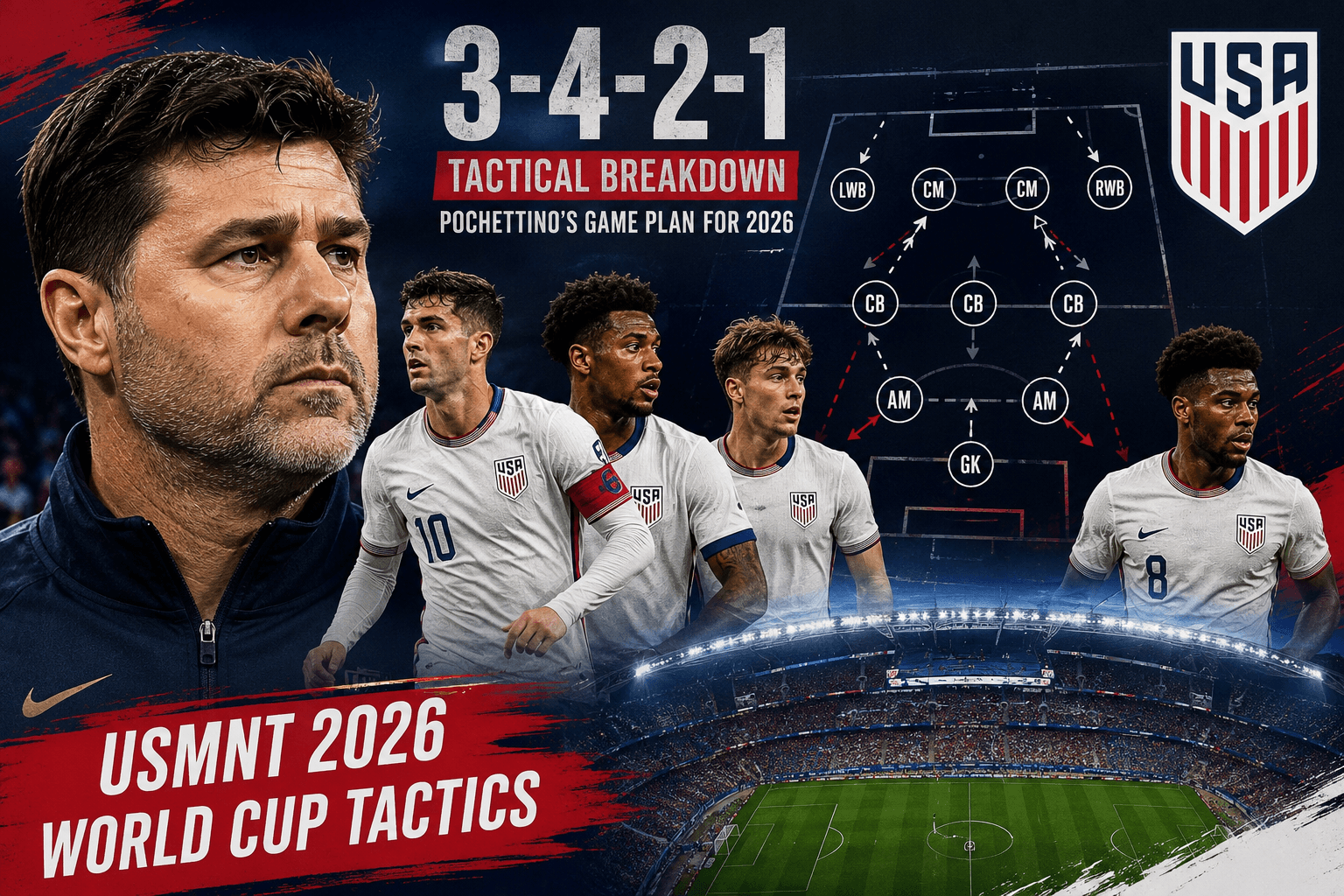
Mauricio Pochettino’s USMNT 2026 World Cup tactics center on a phase-dependent 3-4-2-1 system that has been in development since his very first match in charge, a October 2024 debut against Panama. With the Group D opener against Paraguay set for June 12 in Kansas City, the shape, personnel, and pressing triggers are no longer theoretical — they are locked in. The question is whether the system can hold up across three group-stage matches and potentially deep into a home World Cup.
The formation is best understood not as a static structure but as a system that breathes. In possession, the USMNT expanded into a 3-2-5 shape, with wing-backs pushing high and the back three holding width at the base. Out of possession, the team compresses into a 4-4-2 defensive block, with one wing-back tucking in to form a conventional back four. ESPN has documented how this fluidity places unique demands on every position, especially the players occupying the flanks and the twin No. 10 roles behind striker Folarin Balogun.
Pochettino evaluated 67 players over 20 months before naming his final 26-man roster on May 27, 2026. His overall record through the pre-tournament friendlies stands at 15 wins, 10 losses, and 1 draw. Two of those recent results, a 3-2 win over Senegal on May 31 and a 2-1 loss to Germany on June 7 offer the clearest preview yet of where this system works and where it can be exposed. For ongoing sports news coverage of the USMNT and the broader WideJournal Sports hub, bookmark both ahead of the tournament.
Key Takeaways
- Pochettino’s system is phase-dependent: a 3-4-2-1 in possession that transitions to a 4-4-2 defensive block out of possession, and can expand to a 3-2-5 when wing-backs push to their highest positions.
- Sergino Dest and Antonee Robinson are critical to the system’s structure, with Dest operating as a right wing-back whose forward runs directly trigger the team’s high press.
- The Adams-McKennie double pivot is the engine of the midfield; CBS Sports noted the USMNT are “one team when Tyler Adams is on the pitch and another one entirely when he isn’t.”
- Christian Pulisic’s best role in this system is as one of the twin No. 10s, where he recorded 39 carries and six take-ons in just 66 minutes against Japan in a September 2025 friendly.
- Chris Richards’ fitness remains the single biggest tactical concern entering Group D, with a torn ankle ligament suffered on May 17 threatening his availability for the Paraguay opener.
How the 3-4-2-1 Actually Works: Phase by Phase
Pochettino’s 3-4-2-1 is not a single formation but a shape that shifts based on whether the USMNT has the ball. In possession it becomes a 3-2-5; out of possession it compresses to a 4-4-2. Understanding both phases is essential to understanding the system.
When the USMNT wins the ball and begins to build, the back three holds its position while both wing-backs advance dramatically up the flanks. The two central midfielders, Tyler Adams and Weston McKennie, form a double pivot just in front of the back three, providing structure while the front five the two No. 10s and the striker operate in a wide, high band. Tactical analysts at Backheeled.com, whose phase-by-phase breakdown is the most granular available, describe the in-possession shape as a 3-2-5, noting that this structure has been consistent from Pochettino’s very first match through the pre-tournament schedule.
Defensively, the system changes character quickly. One wing-back, typically Robinson on the left, tucks into a back-four line while the other tracks their immediate opponent. The two No. 10s drop into a mid-block alongside Adams and McKennie, creating a compact 4-4-2 that clogs central channels. NBC Sports characterized the overall system as a “hybrid 3-4-2-1” that “allows them to press high in certain areas of the pitch and brings the best out of their talented wing backs and playmakers.” That framing is accurate, though it undersells how demanding the transitions between phases are for the players executing them.
Sports Illustrated noted that the 3-4-2-1 label is “innately defense-minded,” particularly useful against teams whose attacks run through the center, because the back three provides an extra body in central defensive areas while the wing-backs push forward. That structural security is why Pochettino experimented with the shape in the November 2025 international window, running it in a 5-1 win over Uruguay and a 2-1 win over Paraguay, the exact opponent the U.S. opens against on June 12.
The Wing-Back Engine: Dest, Robinson, and the Press
Sergino Dest and Antonee Robinson are not traditional fullbacks operating in this system. They are the primary width-creators, pressing triggers, and in Dest’s case essentially a right winger in the attacking phase.
USMNT captain Tim Ream publicly described Dest as “a right winger” in comments reported by CBS Sports on June 3. Dest himself prefers the title “wing-back,” a distinction that matters tactically because his role carries defensive recovery responsibilities that a pure winger does not carry. In the Senegal friendly on May 31, CBS Sports detailed how Dest “darted down the flank and essentially kicked off a multipronged press,” disrupting Senegal’s buildup before the U.S. had even settled into their attacking shape. That kind of press-triggering movement from a wide defender is central to Pochettino’s system functioning at its intended tempo.
Robinson operates differently. His role on the left is described across multiple sources as a hybrid: he can push forward as an attacking wing-back, but he also functions as a left-sided center-back during defensive phases, which gives Pochettino flexibility in how he sets the three-back line. That versatility is precisely what allows Dest to stay high on the right without leaving the defense exposed. The roster construction carrying heavy depth at wing-back signals unambiguously that Pochettino intends to run this system throughout the tournament. FOX Sports noted the squad is thin at central midfield but deep on the flanks, and that roster profile does not happen by accident.
Adams, McKennie, and the Double Pivot That Makes It Run
Tyler Adams and Weston McKennie form the central midfield axis in Pochettino’s system. Both need to function defensively and offensively, but their individual profiles are distinct and the gap between them in terms of replaceability is significant.
CBS Sports put it plainly: the USMNT are a different team without Tyler Adams. His 52 caps, his positional discipline, and his ability to screen the back three while the wing-backs push forward make him irreplaceable in this system. When he was absent on June 8 for “load management” Pochettino’s cautious response to Adams’ 72 minutes against Germany a day earlier the concern was visible. Adams has a history of hamstring problems, and managing his minutes before a high-stakes opener is reasonable management, but it underlines how thin the U.S. is if he goes down during the tournament.
McKennie is the attacking complement to Adams’ defensive foundation. Pochettino reportedly described him as “Juventus plus 10,” a nod to how McKennie’s club-level evolution translates directly into international utility. His 2025-26 season at Juventus 9 goals and 8 assists across all competitions shows a midfielder who can genuinely affect the score line, not just circulate possession. In the 3-4-2-1, McKennie carries the license to advance beyond the double pivot when Pulisic or Balogun pull defenders out of position, and his goal threat from late runs is a real tactical dimension that opponents have to account for.
Pulisic, Balogun, and the Creative Axis Behind the Press
Christian Pulisic operates as one of the twin No. 10s in Pochettino’s system, with Folarin Balogun leading the line. The relationship between them — Balogun’s diagonal runs occupying defenders, Pulisic exploiting the space between lines — defines the U.S.’s best attacking sequences.
Pulisic’s numbers in this role are instructive. In a September 2025 friendly against Japan, played in the No. 10 position, ESPN tracked 39 carries and six take-ons in 66 minutes. For context, that is the kind of carrying volume you see from players given genuine license to drive with the ball rather than operate in a structured touchline role. In the wider winger position, Pulisic tends to drift toward the center anyway; this system simply formalizes what he naturally wants to do. At 84 caps and 32 international goals, he is the U.S.’s most accomplished player, and Pochettino has built the creative architecture of the system around maximizing his involvement in central areas.
Balogun enters this World Cup on the back of a 19-goal, 4-assist season at AS Monaco across all competitions. Ricardo Pepi, his primary backup, also finished 2025-26 with 19 goals at PSV. Haji Wright added 17 at Coventry City, helping earn the club promotion to the Premier League. The striker depth is genuine, but the tactical design is built specifically around Balogun: his diagonal movement into wide channels occupies center-backs, which is what creates the space between the lines that Pulisic, McKennie, and Malik Tillman can exploit. Tillman and Gio Reyna are the primary alternatives at the second No. 10 role, with Reyna included in the squad despite limited club minutes at Borussia Monchengladbach.
| Player | Club (2025-26) | Role in System | Club Season Stats | Intl. Caps / Goals |
|---|---|---|---|---|
| Christian Pulisic | AC Milan | Twin No. 10 (right) | N/A (intl. focus) | 84 caps / 32 goals |
| Folarin Balogun | AS Monaco | Starting striker (No. 9) | 19 goals, 4 assists | Roster confirmed |
| Weston McKennie | Juventus | Double pivot (box-to-box) | 9 goals, 8 assists | 64 caps / 12 goals |
| Tyler Adams | AFC Bournemouth | Double pivot (holding) | N/A (injury history) | 52 caps / 2 goals |
| Sergino Dest | Roster confirmed | Right wing-back / press trigger | N/A | Roster confirmed |
| Ricardo Pepi | PSV | Backup striker | 19 goals | Roster confirmed |
| Haji Wright | Coventry City | Backup striker | 17 goals | Roster confirmed |
The System’s Structural Risks: Central Midfield Depth and the Adams Question
The 3-4-2-1 is built on the assumption that its central midfield pair functions close to full capacity throughout the tournament. That assumption carries real weight given the squad Pochettino has assembled. Tyler Adams is the sole specialist defensive midfielder on the roster, despite his extensive and varied injury history over the past half-decade. The absence of Tanner Tessmann, ruled out by a muscle strain at Lyon, made that thinness considerably more acute. Rather than replace Tessmann with another midfielder such as Middlesbrough’s Aidan Morris, Pochettino opted to add another outside back in Borussia Monchengladbach’s Joe Scally. ESPN noted that decision carries clear risk: it is very easy to envision a scenario where Adams gets injured or picks up two yellow cards, and where, in his absence, this thin central midfield group cannot cope with the demands of high-level international soccer.
Behind Adams and McKennie, the realistic fallback options are limited. Vancouver’s Sebastian Berhalter and Seattle’s Cristian Roldan are clever and adaptable, but most often work as box-to-box connectors rather than specialist holding midfielders. Pochettino has publicly named Roldan and Berhalter as potential stand-ins at the No. 6 role, but the gap in profile between Adams and either player is notable at the World Cup level. Yellow card accumulations are a lingering concern, and a suspension or two in midfield would really compromise the Americans’ defensive shape. It is a structural vulnerability that opposing coaches will have identified well before the June 12 opener.
The press itself, when functioning correctly, is designed to reduce the burden on those central midfielders by limiting how often opponents can build through the middle. To make noise in the World Cup, Pochettino needs clarity in the first phase, communication between lines, and a nailed-on second-ball structure, because as much attention as the USMNT’s attacking personnel get, they will matter little if the 4-4-2 press is not locked in. The pre-tournament friendly against Senegal illustrated both the ceiling and the floor. When the press clicked, the U.S. were dominant. When it broke down, the United States’ second-ball structure was nonexistent, with no midfielder in frame and center backs Tim Ream and Mark McKenzie closing on the same man.
The Chris Richards Factor: How One Defender Defines the Entire Back Three
No single fitness question has dominated USMNT pre-tournament coverage more than the status of Crystal Palace center-back Chris Richards. Regardless of the formation, Richards will be tasked with holding down the U.S.’s backline. He is the strongest defender the Stars and Stripes have, led by his tactical fluidity, poise on the ball, and aerial capabilities. That assessment carries added weight inside a back three, where the central defender effectively anchors the entire defensive structure and must be capable of stepping into midfield when the press is triggered.
Richards tore two ankle ligaments in a Crystal Palace vs. Brentford match on May 17, 2026, and missed both pre-tournament friendlies against Senegal and Germany. The fitness picture improved slightly on June 8, when Richards trained fully with his teammates on the World Cup squad for the first time, marking his return four days before the tournament opener against Paraguay. Pochettino acknowledged progress while leaving the door open on his availability for June 12. His replacement options are credible but represent a clear step down: Miles Robinson played 107 of the 180 available minutes in the USMNT’s pre-World Cup friendlies but was at fault for a goal in each of the Senegal and Germany games, a signal that the quality drops when Richards is not on the field.
The extent to which Richards’ fitness matters is captured in one ESPN statistic from the club season: Crystal Palace averaged 1.46 points per game in all competitions when he did play this season and only 1.20 when he did not. For a USMNT back three that already carries the 38-year-old Tim Ream as a starter, having Richards fit and available at center of the three is not merely preferable, it is central to whether the system holds up defensively against the more dangerous opponents later in the tournament. The roster construction strongly suggests the U.S. will play with a back three like the 3-4-2-1 system, and bringing five center-backs hints at Pochettino’s concerns about Richards’ ankle injury projected to complicate his availability for at least the start of the World Cup.
Group D and the Tactical Matchups Ahead
The USMNT will open their World Cup campaign against Paraguay on June 12 at SoFi Stadium in Inglewood, California, before facing Australia in Seattle and then Turkey back in Los Angeles. Home advantage is a real tactical factor in Group D, with two of the U.S.’s three group matches in Los Angeles. The crowd environment could serve a specific tactical function: Pochettino’s high-press system thrives on energy and urgency, and a full SoFi Stadium is well positioned to provide both.
The opener against Paraguay presents a specific challenge for a possession-heavy, press-oriented system. Paraguay is making its first appearance at a World Cup since 2010 and should be a difficult side to break down, with Gustavo Alfaro’s team having conceded just 10 times in 18 South American qualifiers, tied for the second-best defensive record. That defensive identity runs counter to what the 3-4-2-1 does best. The system is most dangerous against teams that try to play through the press; a compact Paraguayan defensive block and early tournament pressure can produce cagey, low-quality football regardless of talent gap, and this USMNT squad has not historically been efficient against teams that sit deep.
Turkey represents the group’s most demanding tactical test on Matchday 3. Kenan Yildiz, a Juventus teammate of Weston McKennie, contributed 10 goals and 7 assists in Serie A this season, while Hakan Calhanoglu stands as a potential key contributor in the center of midfield and has starred for Italian champions Inter Milan since 2021. A Turkey midfield anchored by Calhanoglu is precisely the kind of central presence that would test the U.S. ‘s 4-4-2 defensive block, and Turkey have gone 8-1-1 in their last 10 matches heading into the tournament. The good news for the USMNT is structural: the U.S. does not play Turkey until the final group game, so they may have already qualified for the Round of 32 before that match kicks off.
Alternative Perspectives
Not every analyst is convinced that the 3-4-2-1 is the optimal structure for this specific squad entering this specific tournament. Some tactical observers have pointed out that Pochettino himself used a 4-2-3-1 in the March 2026 window, including in the 5-2 loss to Belgium, which suggests the three-back system is a preference rather than a settled certainty, and that the coaching staff retains real flexibility in formation choice depending on the opponent. There is also a legitimate case that the system’s wing-back demands are unsustainable over a full tournament, given that the high-press identity requires Sergino Dest and Antonee Robinson to cover enormous ground in both directions across 90 minutes, and that fatigue accumulated across multiple group-stage matches could expose the wider defensive structure if either player is unavailable or below their best when the knockout rounds begin.
Conclusion
Ultimately, Pochettino’s USMNT 2026 World Cup tactics represent a coherent and well-reasoned system built around the specific strengths of this generation of American players: attack-minded wing-backs, a high-energy midfield pivot, creative twin No. 10s, and a striker in Balogun capable of leading the line against any opponent. The 3-4-2-1 offers genuine defensive solidity against central-heavy attacks while simultaneously freeing the team’s most dangerous players to operate in advanced areas. Whether that system reaches its ceiling depends on three factors that remain partially unresolved entering June 12: the fitness of Chris Richards, the sustained availability of Tyler Adams, and whether the high press can hold its intensity across a full World Cup run rather than a single 90-minute window. For a host nation with genuine knockout-round ambitions, the answers to those questions will define what this golden generation is ultimately remembered for.
Frequently Asked Questions
What formation does the USMNT use under Pochettino at the 2026 World Cup?
The USMNT uses a phase-dependent hybrid system most commonly labeled as the 3-4-2-1. In possession, the shape can expand into a 3-2-5 as the wing-backs push high. Out of possession, the team transitions into a 4-4-2 defensive block. The 3-4-2-1 label describes the in-possession structure, with two central midfielders, two wing-backs, twin No. 10s, and a center forward. Pochettino first used this shape consistently from his opening match in charge against Panama in October 2024 and sharpened it specifically in the November 2025 friendlies against Uruguay (a 5-1 win) and Paraguay (a 2-1 win).
Who are the biggest injury concerns for the USMNT heading into Group D?
Chris Richards is the primary concern. The Crystal Palace center-back tore two ankle ligaments in a Premier League match against Brentford on May 17, 2026, and missed both pre-tournament friendlies against Senegal and Germany. He returned to full team training for the first time on June 8, four days before the Group D opener, leaving his availability for the Paraguay match uncertain. Tyler Adams also sat out a June 8 training session, with the team citing load management, though there has been no suggestion he will miss the opener. Antonee Robinson limped off against Germany but is not considered at serious risk of missing the Paraguay clash.
Why is the USMNT’s central midfield considered a potential weakness at the 2026 World Cup?
Tyler Adams is the only specialist defensive midfielder on the roster after Tanner Tessmann was ruled out with a muscle strain at Lyon. When Pochettino finalized his 26-man squad, he chose to add an extra outside back rather than replacing Tessmann with another central midfielder such as Aidan Morris. This means that if Adams is suspended or injured, the fallback options at the holding midfield role are Cristian Roldan and Sebastian Berhalter, both MLS-based box-to-box midfielders who are not specialist No. 6 profiles. The risk is most acute in later rounds of the tournament if Adams accumulates yellow cards or sustains a physical setback given his history of hamstring issues.