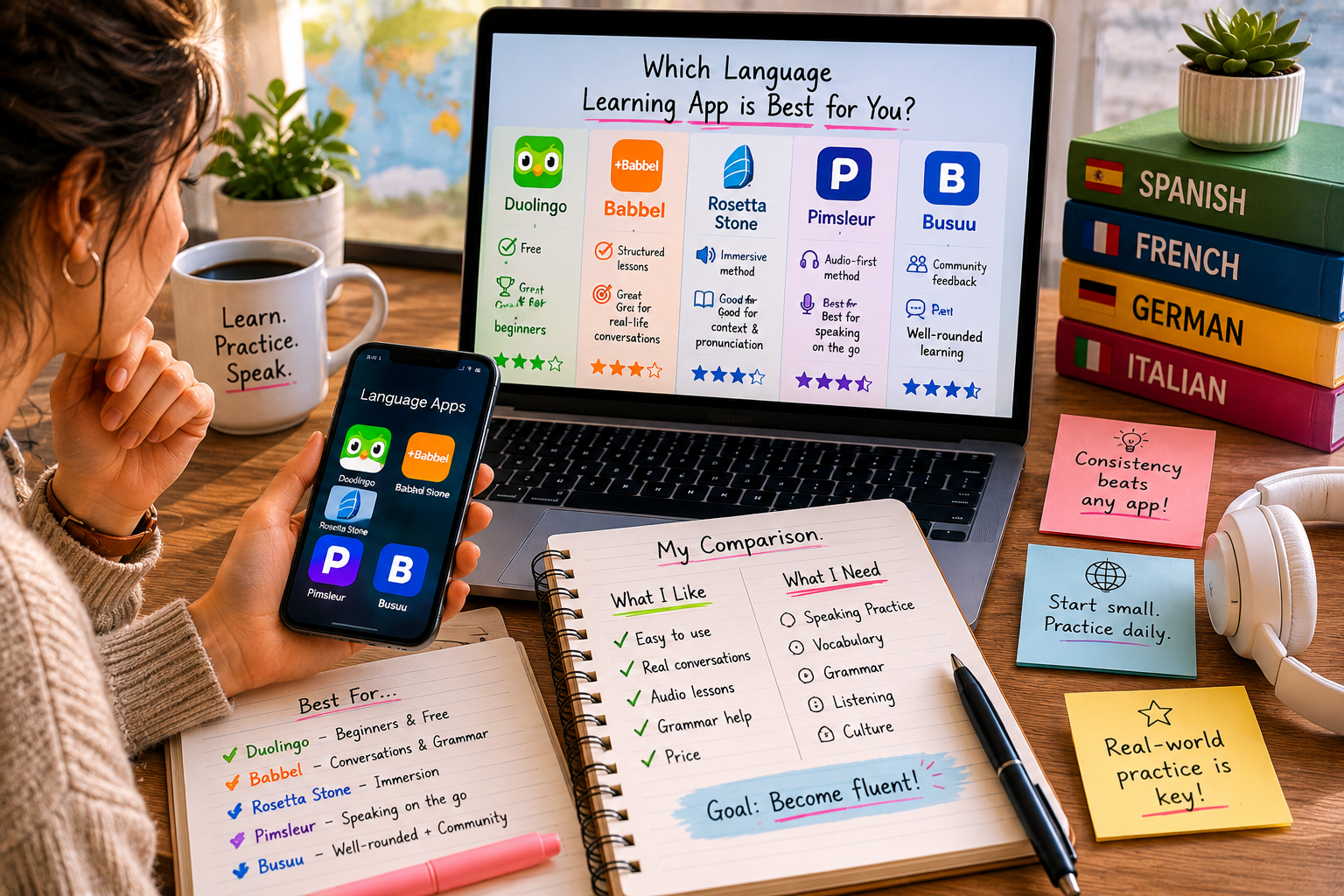
Learning a new language has never been more accessible — or more data-driven. Whether you’re aiming for professional fluency, travel confidence, or personal growth, today’s AI language learning apps offer personalized coaching that would have required an expensive private tutor just a decade ago. For more on broadening your skills through technology, explore WideJournal’s broader collection of Education articles covering tools, strategies, and research across every learning domain.
This guide breaks down what makes the best AI language learning apps stand out in 2026, how to choose the right one for your goals, and what the research actually says about their effectiveness.
Why AI Language Learning Apps Are Booming in 2026
The global language learning app market — valued at roughly $6.34–6.73 billion in 2024 — is projected to reach as high as $28.95 billion by 2033, driven largely by AI-powered personalization and surging demand for accessible, self-paced learning tools.
The numbers tell a clear story. According to market data, language learning apps generated $1.11 billion in revenue in 2024, a 9.9% year-over-year increase, with 316 million total app downloads recorded globally. Duolingo alone reported FY2025 revenue of $1.037 billion — the first time the company crossed the $1 billion threshold — representing 39% year-over-year growth.
Behind this momentum is a fundamental shift in how these platforms operate. 62% of language learning platforms now use AI-driven personalization, and platforms that have adopted adaptive AI report approximately 30% increases in user engagement. Natural language understanding accuracy in leading apps has surpassed 95%, meaning the gap between app-based and human conversation practice is narrowing meaningfully.
What Does “AI-Powered” Actually Mean in a Language App?
Not every app that markets itself as “AI-powered” offers the same depth of technology. In practice, AI features in language learning apps typically fall into a few categories: adaptive lesson sequencing (adjusting difficulty based on your performance history), speech recognition and pronunciation feedback, conversational AI tutors that simulate real dialogue, and generative AI for dynamic content creation. Speech recognition is now built into 85% of language learning apps, and conversation AI tutors are used by roughly 45% of online learners — a figure that has grown substantially over the past two years.
Top AI Language Learning Apps Worth Considering in 2026
The strongest AI language learning apps in 2026 distinguish themselves through adaptive personalization, high-accuracy speech feedback, and conversation practice features — though the best choice depends heavily on your target language, learning style, and budget.
No single app is the definitive winner for every learner. The table below compares major platforms across the features that matter most for AI-assisted language learning.
| App | Key AI Feature (2025–2026) | Languages Available | Free Tier? | Estimated Monthly Cost (Premium) | Notable Milestone |
|---|---|---|---|---|---|
| Duolingo | ‘Explain My Answer’ AI (Jan 2026); 148 AI-generated course configs | 40+ | Yes | ~$13–$17/mo | 50.5M daily active users (Q3 2025); $1.037B FY2025 revenue |
| Babbel | ‘Babbel Speak’ AI voice trainer (Sep 2025) | 14 | No (trial only) | ~$8–$14/mo | Strong emphasis on real-world conversation scenarios |
| Busuu | ‘Busuu Conversations’ AI feature (Feb 2026) | 12 | Yes (limited) | ~$10–$13/mo | Human community corrections alongside AI feedback |
| Speak | AI conversation tutor; real-time speaking feedback | English, Korean, others | Limited trial | ~$15–$25/mo | $1B valuation after $78M Series C funding |
| Praktika | Generative AI chatbot / virtual tutor for immersive dialogue | English-focused | Yes (limited) | ~$10–$20/mo | Among newer AI-first platforms gaining traction |
Pricing and feature availability are subject to change. Verify current plans directly with each provider before subscribing.
Which App Is Best for Speaking Practice?
If building conversational confidence is your primary goal, apps with dedicated AI conversation tutors — like Speak and Praktika — are worth prioritizing. Speak’s model focuses almost entirely on getting learners to talk from day one, using AI to simulate realistic exchanges and flag pronunciation errors in real time. Busuu’s February 2026 ‘Busuu Conversations’ feature takes a hybrid approach, pairing AI dialogue with feedback from native speakers in their community. Duolingo’s ‘Explain My Answer’ feature, rolled out in January 2026, helps learners understand the grammar reasoning behind corrections rather than simply moving on — a meaningful step toward deeper comprehension.
Is Duolingo Still Worth Using in 2026?
Duolingo remains the dominant platform by almost every metric. With 50.5 million daily active users as of Q3 2025 (up 36% year-over-year) and 11.5 million paid subscribers, it clearly resonates with a massive audience. Its gamification model excels at habit formation, and its expanding AI features add meaningful depth. That said, some language educators argue that gamification can optimize for streak-keeping over genuine retention, and Duolingo’s breadth of languages (40+) means depth varies considerably by course. It’s an excellent starting point, particularly for common languages, but serious learners often find value in pairing it with more immersive tools.
What Does Research Say About AI Language Learning Effectiveness?
Research suggests AI-powered language apps can meaningfully accelerate vocabulary acquisition and pronunciation accuracy, though outcomes depend significantly on how consistently and actively learners engage with the tools.
“According to a study cited by Duolingo’s own efficacy research, learners who completed a structured sequence of Duolingo Spanish content showed gains equivalent to a full university semester — though researchers and independent analysts note that results vary widely based on prior exposure, learning intensity, and individual motivation.”
“According to the European Commission’s research on multilingualism and digital tools, technology-assisted language learning is most effective when it supplements, rather than replaces, communicative practice with real speakers — a finding that aligns with the hybrid approaches now being adopted by several AI-first platforms.”
The broader market context reinforces the scale of demand: the global language learning market reached $122 billion in 2024, encompassing apps, tutoring, institutional programs, and self-study resources. Within that market, digital tools are capturing a growing share — particularly among younger adults, with 48% of adults aged 18–24 actively using language learning apps.
How Long Does It Actually Take to Learn a Language with an App?
This is one of the most searched questions in language learning — and one of the most misrepresented. No app can honestly promise fluency on a fixed timeline, because outcomes depend on your target language’s complexity relative to your native tongue, how many minutes per day you practice, whether you supplement app use with real conversation, and your prior language learning experience. Apps are most effective as daily consistency tools. Research suggests that even 15–20 minutes of focused, daily practice compounds meaningfully over months, particularly for vocabulary and listening comprehension. Speaking fluency, however, almost universally requires real conversational exposure beyond what any single app provides on its own.
Alternative Perspectives
Not everyone is enthusiastic about the AI language learning boom. Some linguists and educators argue that app-based learning, however sophisticated, risks reducing language acquisition to pattern recognition rather than genuine communicative competence. Critics point out that AI conversation tutors — however accurate — lack the social stakes and cultural nuance of real human interaction, which many researchers consider essential to deep fluency. There are also equity considerations: premium AI features are concentrated in paid tiers, meaning the most powerful tools remain out of reach for learners in lower-income contexts despite the apps’ broadly accessible image. On the other side, proponents argue that AI tutors democratize access to high-quality pronunciation feedback and personalized pacing that only wealthy learners could previously afford through private instruction. Both perspectives hold merit, and the ideal approach likely sits somewhere in between — using AI apps as a foundation while actively seeking real-world practice opportunities.
How to Choose the Best AI Language Learning App for Your Goals
Choosing the right AI language learning app comes down to matching the platform’s strengths — whether that’s gamified habit-building, speaking practice, or structured grammar — to your specific language, schedule, and learning style.
Before committing to a subscription, consider these practical factors. First, check whether your target language has a robust course — Duolingo’s Spanish and French content is far more developed than some of its newer offerings. Second, assess whether you need speaking feedback or primarily reading and listening practice, since platforms vary significantly in their speech recognition quality. Third, take advantage of free tiers and trials before paying; most major apps offer at least limited free access. Finally, think honestly about what keeps you consistent — if streaks and rewards motivate you, gamified platforms like Duolingo may serve you better than minimalist interfaces, regardless of which has more sophisticated AI underneath.
Are Free AI Language Apps Worth It?
For many learners, free tiers are a perfectly viable starting point. Duolingo’s free version covers a substantial portion of its curriculum, though ads and limited lives can interrupt flow. Busuu offers free access to basic lessons with community corrections. The honest trade-off is that the most advanced AI features — real-time voice coaching, extended conversation AI sessions, personalized review algorithms — tend to sit behind paywalls across most platforms. If budget is a constraint, starting free and upgrading selectively once you’ve confirmed a platform fits your style is a sensible approach.Final
Thoughts on AI-Powered Language Learning
The best AI language learning apps in 2026 are genuinely impressive tools — more adaptive, more conversational, and more accurate than anything available even three years ago. The language learning app market is projected to grow at a 17.6% CAGR through 2033, and the pace of AI feature development shows no sign of slowing. Whether you’re a beginner building your first vocabulary base or an intermediate learner working on conversational fluency, there’s likely an AI-powered tool that fits your needs and budget. The key is consistency: the best app is the one you’ll actually open every day. For more resources to support your learning journey, visit WideJournal’s collection of language learning guides covering methods, tools, and strategies for every stage of the process.
Frequently Asked Questions
There’s no single best answer, as the right app depends on your target language, learning goals, and preferred style. Duolingo leads in user base and breadth with 40+ languages and strong gamification. Speak and Praktika are worth considering if speaking practice is your priority. Babbel and Busuu offer more structured, conversation-focused curricula. Testing free tiers before committing is always advisable.
Research suggests they can be genuinely effective for vocabulary building, listening comprehension, and pronunciation feedback, particularly when used consistently over months. Results vary based on individual effort, the quality of the specific course, and whether learners supplement app use with real conversational practice. No app independently guarantees fluency, but they can meaningfully accelerate progress when used as part of a broader learning strategy.
Premium plans across major platforms generally range from about $8 to $25 per month depending on the app and subscription length (annual plans are typically cheaper per month than monthly billing). Many platforms offer free tiers with meaningful functionality, and some — like Duolingo — allow users to access most content for free with ads. Pricing changes regularly, so always verify current rates directly with the provider.
For many learners, AI apps can meaningfully reduce the need for frequent one-on-one tutoring by providing on-demand pronunciation feedback, grammar explanations, and conversation practice. However, most language researchers and educators suggest that human interaction remains valuable — especially for developing pragmatic competence, cultural understanding, and the ability to navigate unpredictable real-world conversations. AI apps and human tutors are more complementary than competitive.
Disclaimer: Pricing and feature availability are current as of the first half of 2026 and are subject to change by the respective platforms. Fluency outcomes depend on individual consistency, and app-based learning is best used as a supplement to real-world conversation. WideJournal is not affiliated with these providers unless otherwise noted.