AI agents crossed a critical threshold in 2026. According to Stanford HAI’s 2026 AI Index Report, real-world task success rates for AI agents jumped from 20% in 2025 to 77.3% in 2026. That leap is not a rounding error. It means the software can now complete complex, multi-step tasks reliably enough to use in daily life, not just in controlled demos. If you follow our AI coverage, you have watched this category build momentum for years. Now the payoff is real.
For most people, the practical question is simple: what does this actually do for me? The answer depends on which tools you pick and how much autonomy you hand over. AI agents for personal use range from inbox managers that draft and send replies on your behalf, to shopping assistants that compare prices, check return policies, and complete a purchase without you clicking through four screens. Some agents handle your calendar, book appointments, and reschedule conflicts while you sleep. The category is broad, and so are the risks. Bugs exist. Privacy trade-offs are real. And not every agent lives up to its marketing. We cover all of that in this piece, alongside the broader tech articles context you need to make an informed decision.
This guide breaks down exactly how AI agents work, what the best AI agents can realistically accomplish today, and where the technology still falls short. We name specific products, flag known limitations, and give you an honest 12-month outlook so you can decide whether to adopt now or wait.
Key Takeaways
- AI agent real-world task success rates reached 77.3% in 2026, up from 20% in 2025, according to Stanford HAI’s 2026 AI Index Report.
- Leading consumer AI agents now handle email triage, calendar management, online shopping, and travel booking with minimal human input, though accuracy varies by task complexity.
- NIST launched its AI Agent Standards Initiative in February 2026 to address interoperability and security gaps that currently affect how safely agents access personal accounts and data.
- Agentic AI differs from traditional chatbots by taking autonomous multi-step action rather than just generating text responses.
- Privacy, data access permissions, and error correction remain the three biggest practical risks for everyday users adopting AI agents in 2026.
Agentic AI Explained: How Is This Different From a Chatbot?
An AI agent does not just answer questions. It takes action in the world on your behalf, connecting to apps, browsing the web, and executing tasks across multiple steps without waiting for you to click “go” at each stage.
Most people have used a chatbot. You type a question, it generates a response. That is a single-turn interaction. An AI agent operates differently. As MIT Sloan Management Review explains in its agentic AI explainer, these systems “plan, decide, and act autonomously to complete multi-step workflows,” which means they can receive a high-level goal (“book me a flight to Chicago under $300 for the weekend of July 4th”) and handle every sub-task: searching travel sites, comparing prices, reading cancellation policies, and completing a purchase.
The technical architecture behind this involves three components working together: a large language model for reasoning, a set of tools the agent can call (web browsers, APIs, code interpreters, calendar integrations), and a memory layer that tracks what has happened across multiple steps. Microsoft (MSFT) Copilot with autonomous agent features, Google (GOOGL) Gemini Advanced with agent extensions, and OpenAI’s GPT-4o-based Operator product all use variations of this architecture. Apple (AAPL) Intelligence on iOS 18.4 and later adds a constrained version focused on device-level tasks.
What Does “Autonomy Level” Mean in Practice?
Not all agents operate at the same level of independence. A peer-reviewed study published in the AI Ethics journal (February 2026) by NIH/NIEHS and Northwestern University researchers maps AI agent autonomy across a spectrum from “human-in-the-loop” (every action confirmed) to “fully autonomous” (agent acts and reports back). Consumer products in 2026 sit mostly in the middle: they execute routine tasks autonomously but ask for confirmation before spending money, deleting data, or sending communications on your behalf. That boundary is configurable in most tools, and adjusting it carelessly is one of the most common user mistakes.
Financial & Data Safety Note: While consumer AI agents in 2026 can autonomously handle retail checkouts and organize document metadata, they do not possess financial fiduciary responsibility or legal awareness. Never share unencrypted credit card details, Social Security Numbers (SSN), or banking credentials directly within agent prompts. Always maintain human-in-the-loop confirmation for any transaction exceeding your comfortable loss threshold, especially during sensitive periods like tax season.
What Can AI Agents Do for You Right Now?
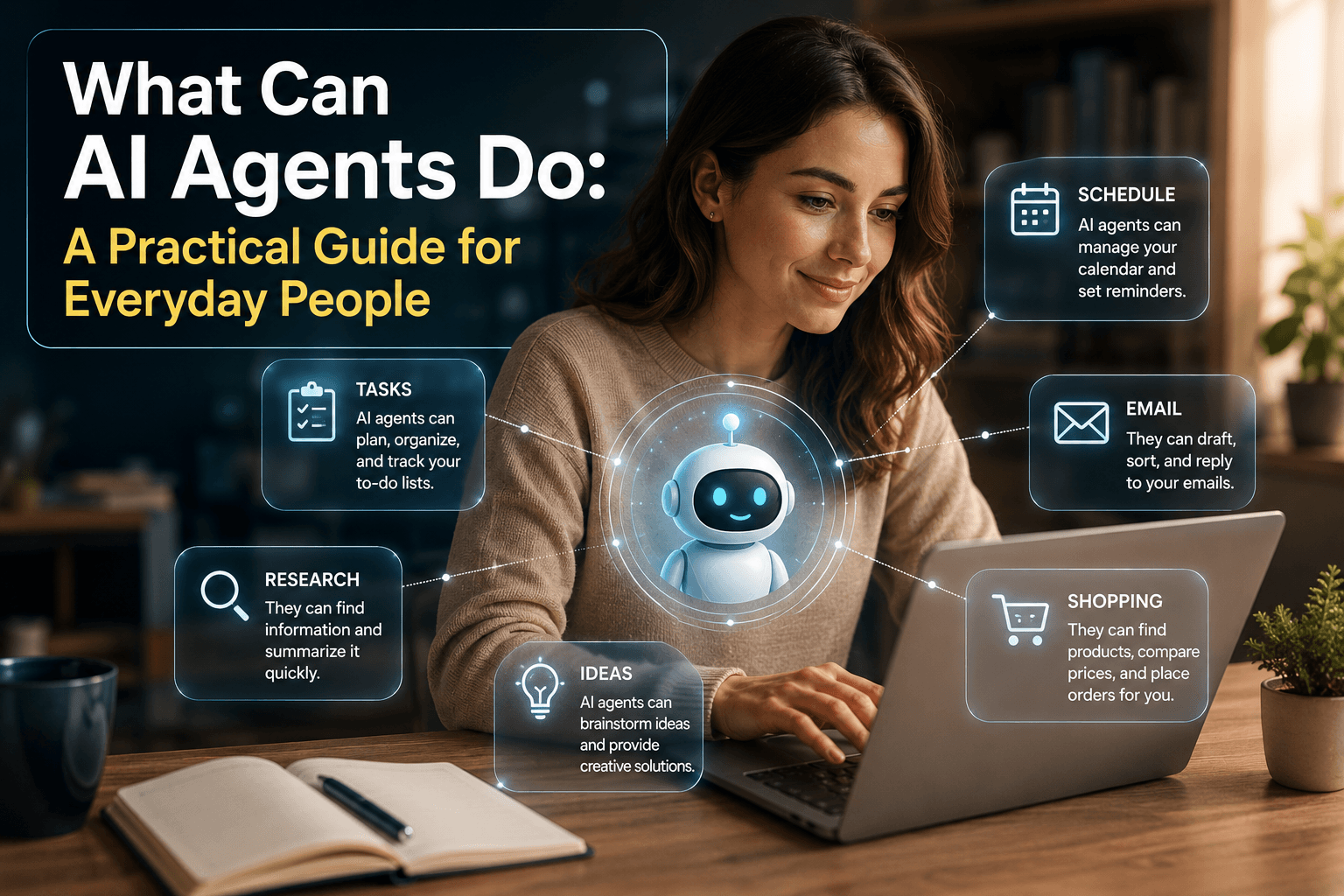
In 2026, the most capable consumer AI agents can manage your inbox, book appointments, compare and purchase products, summarize documents, and automate repetitive software tasks, with real but workable limitations on complex judgment calls.
Email and Calendar Management
This is the highest-adoption use case. Tools like Microsoft (MSFT) Copilot integrated into Outlook and Google (GOOGL) Gemini inside Gmail can triage incoming mail, draft context-aware replies, flag action items, and add events to your calendar without manual input. Real-world performance is strong for routine correspondence. Where these agents still struggle: nuanced social emails (condolences, sensitive negotiations), messages requiring institutional context the agent does not have, and multi-party scheduling across different calendar systems. Expect occasional double-bookings and misread priorities, especially during high-volume periods like back to school season. For tax season communications, rely strictly on manual verification rather than automated agent sorting to avoid missing critical government deadlines.
Shopping and Price Comparison
OpenAI’s Operator and similar browser-native agents can navigate retail sites, compare product specs, read reviews, apply coupon codes, and complete checkout. The Stanford HAI 2026 data shows agents succeeding at e-commerce tasks at roughly 80% accuracy. The 20% failure rate matters: agents occasionally apply incorrect promo codes, miss size/color specifications, or fail on sites with non-standard checkout flows. Always review the final invoice and delivery details before confirmation. To mitigate financial risks, ensure two-factor authentication (2FA) is enabled on all connected merchant accounts to prevent unauthorized automated purchases.
Research and Document Summarization
For students, professionals, and anyone who reads a lot, AI agents can pull information from multiple sources, cross-reference claims, and produce structured summaries in minutes. This works well for factual, technical, or business content. It is less reliable for legal documents, medical records, and financial disclosures, where precision is non-negotiable and errors carry real consequences.
Home and Device Automation
Apple (AAPL) Intelligence, Amazon (AMZN) Alexa+, and Google (GOOGL) Home with Gemini integration can now chain smart home commands with contextual reasoning (“turn on the AC an hour before I get home” parsed from calendar data). While the latest iOS 18.4 ecosystem heavily leverages the upgraded App Intents framework, allowing Siri to execute complex, multi-step tasks inside compliant third-party apps, it remains fundamentally different from web-native agents. Apple Intelligence acts as a secure coordinator of your on-device applications, rather than an unconstrained agent capable of navigating unknown web interfaces. These work best within a single ecosystem. Cross-platform reliability drops noticeably when mixing devices from different manufacturers.
Which Are the Best AI Agents for Personal Use in 2026?
The best AI agents for personal use depend on your existing software ecosystem, your tolerance for autonomous action, and whether you prioritize depth of capability or privacy of your data.
Here is a factual comparison of the leading options available to US and Canadian consumers as of May 2026:
| Agent / Product | Developer | Primary Use Cases | Monthly Cost (USD) | Known Limitation |
|---|---|---|---|---|
| Copilot (Agentic Mode) | Microsoft (MSFT) | Email, calendar, Office tasks, web research | $30 (Microsoft 365 Copilot) | Requires Microsoft 365 ecosystem; limited on non-MSFT apps |
| Gemini Advanced + Agent Extensions | Google (GOOGL) | Gmail, Calendar, Search, Docs, Maps | $19.99 (Google One AI Premium) | Agent extensions still in gradual rollout; inconsistent cross-app reliability |
| Operator | OpenAI | Web browsing, shopping, form-filling | $200 (ChatGPT Pro) | Expensive tier; fails on some non-standard checkout flows |
| Apple Intelligence (iOS 18.4+) | Apple (AAPL) | On-device tasks, Siri actions, notifications | Included with device | Locked to the OS layer; third-party automation is strictly limited to apps adopting the App Intents framework (no raw web-scraping/form-filling). |
| Alexa+ | Amazon (AMZN) | Smart home, shopping, entertainment, reminders | $19.99/month | Best on Amazon ecosystem; weaker for productivity or document tasks |
What Are the Real Risks of Using AI Agents?
The biggest risks to everyday users are data access permissions, autonomous errors that are hard to reverse, and security vulnerabilities in agents that connect to financial or health accounts.
In February 2026, NIST announced its AI Agent Standards Initiative specifically to address the security and interoperability gaps that come with agents accessing personal email, calendars, and shopping accounts. The initiative acknowledges the core tension: agents need broad data access to be useful, and that same access creates attack surfaces. Until standards are finalized and widely adopted, users should limit agent permissions to only what is necessary, review access logs regularly, and avoid connecting agents to financial accounts without fully reading the vendor’s data policy.
Error correction is the other underappreciated risk. A chatbot’s mistake costs you a bad answer. An agent’s mistake may cost you a duplicate Amazon order, a double-booked appointment, or a sent email you did not intend. The 77.3% success rate from Stanford HAI means roughly 1 in 4 complex tasks still goes wrong. For low-stakes tasks, that is acceptable. For anything involving money or professional relationships, human review before execution is still the right call.
What Will AI Agents Look Like in 6 to 12 Months?
The next phase of AI agent development is likely to bring multi-agent coordination, tighter platform integration, and the first wave of NIST-compliant security standards, though uneven rollout across ecosystems will persist.
Several UC Berkeley AI researchers, writing in an official Berkeley News feature on AI trends in 2026, highlighted personalized agents that learn individual preferences over time as the near-term frontier. The practical implication: agents that know you worked late last Tuesday and proactively reschedule your Wednesday morning meeting. The privacy implication: that same agent holds a detailed behavioral profile of your work and personal habits.
On the market side, Microsoft (MSFT) and Google (GOOGL) are most positioned to win the productivity segment because they already own the email and calendar layer. OpenAI faces a distribution challenge without a native operating system or device. Apple (AAPL) has the device layer but has moved more cautiously on autonomous action. Amazon (AMZN) is strongest in the home but weak in productivity. For users, this means the best agent in 12 months will likely be the one already embedded in the platform you use most, not a standalone app.
Alternative Perspectives
Not everyone believes the 77.3% task success figure translates directly to everyday consumer value. Some AI researchers argue that benchmark tasks are structured and predictable in ways that real-world use is not. A task that scores well in a lab may fail consistently in a specific user’s cluttered, multi-platform workflow. Critics of rapid AI agent adoption also point to the labor displacement angle: agents that handle scheduling, email triage, and research are the same tasks currently performed by administrative professionals and research assistants. The productivity gains for individuals come with real workforce implications at scale. Users who want to engage thoughtfully with this technology should weigh both sides, not just the personal efficiency upside.
“The question is not whether AI agents can complete tasks, but whether the humans supervising them understand enough about how they work to catch errors before they cause harm.” — UC Berkeley AI faculty, as quoted in Berkeley News, January 2026“Agentic AI systems that act autonomously in the world require a new framework for human oversight, one that goes beyond the prompting habits most users developed with conversational AI.” — MIT Sloan Management Review, February 2026
Editorial & Safety Disclaimer: Technology specifications, software capabilities, and subscription pricing are subject to rapid change. WideJournal.com does not provide financial, legal, or tax advice. The automation of purchases, financial planning, or account integration via third-party AI agents is done entirely at the user’s own risk. Always verify financial data and transactional finality through official banking or service provider platforms.
Frequently Asked Questions
What can AI agents do that regular chatbots cannot?
AI agents take multi-step autonomous action across apps and websites, such as booking a flight, sending a calendar invite, and following up with an email, without requiring human input at each step. Regular chatbots generate text responses but do not execute tasks in external systems.
Are AI agents safe to connect to personal accounts?
With caution, yes. The main risk is data access: agents that connect to email, calendar, or shopping accounts hold significant personal data. NIST’s 2026 AI Agent Standards Initiative is working to establish security baselines, but standards are not yet finalized. Limit permissions to what the agent needs, and review access logs periodically.
Which AI agent is best for someone who doesn’t use a lot of software tools?
For casual users with an iPhone, Apple Intelligence on iOS 18.4 or later offers the lowest friction entry point. Thanks to the App Intents rollout in iOS 18.4, it securely automates actions inside your favorite apps without the privacy risks or subscription costs of cloud-first web agents. For Android users or those in the Google ecosystem, Gemini Advanced is the most integrated option at $19.99 per month.
How accurate are AI agents at completing real-world tasks?
According to Stanford HAI’s 2026 AI Index Report, AI agents achieved a 77.3% success rate on real-world task benchmarks in 2026, up from 20% in 2025. That means roughly 1 in 4 complex tasks still fails or requires correction, so human review before irreversible actions (purchases, sent emails) remains advisable.