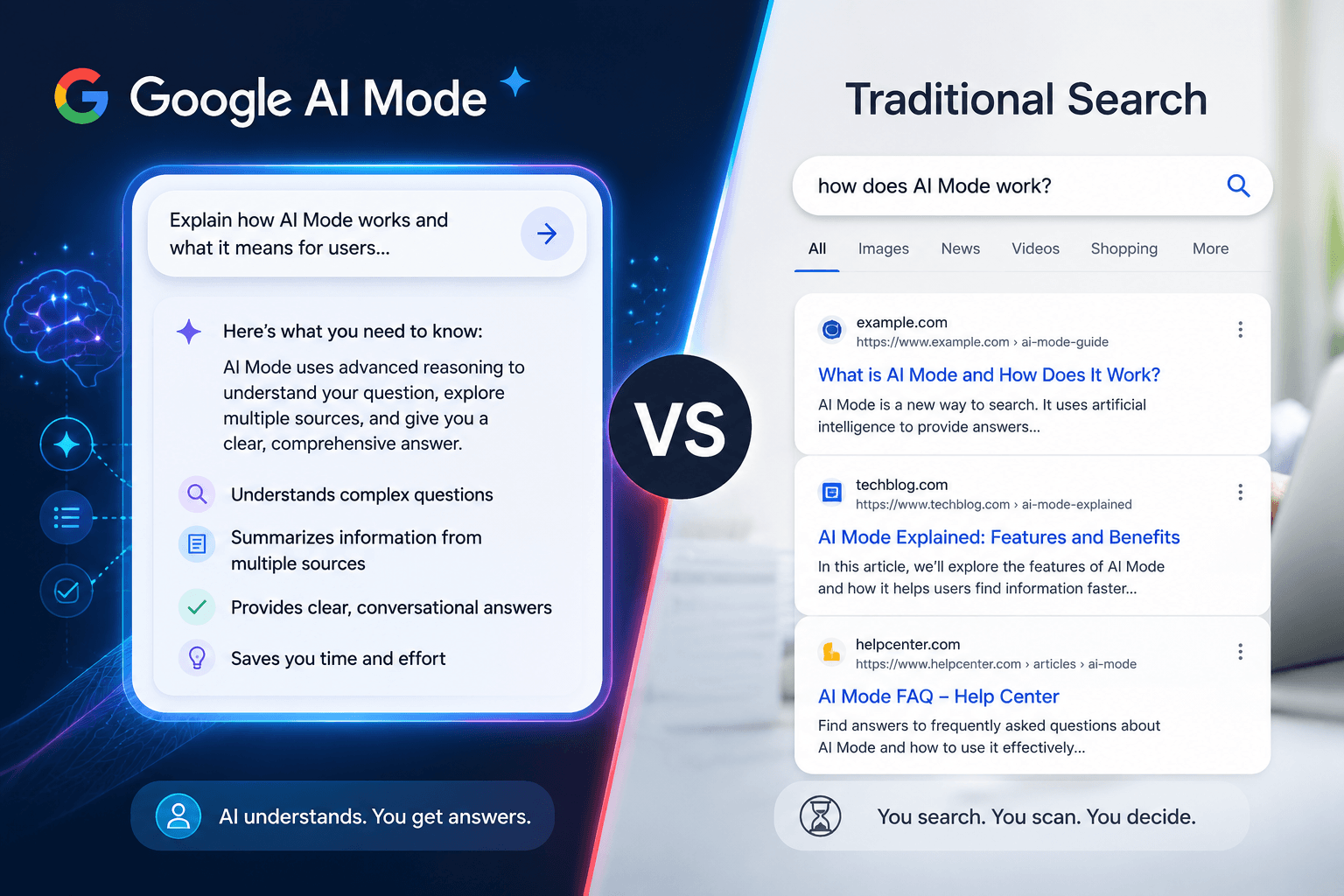
Google AI Mode replaces the traditional list of blue links with a conversational, AI-generated response that synthesizes information from multiple sources before showing any organic results. The shift changes how queries are interpreted, how results are ranked, and critically, how much traffic publishers and brands can expect from Google search. For SEO professionals and marketers, this is not a cosmetic update; it is a structural change to how Google surfaces and credits information.
Key Takeaways
- Google AI Mode reduces organic click-through rates by an estimated 34% compared to traditional search, according to early clickstream analysis from Similarweb covering Q1 2026 data.
- AI Mode draws citations from a narrower pool of sources than traditional search: SEMrush sensor data suggests the top cited domains in AI Mode overlap with only about 23% of the domains that rank in the standard top-10 organic results.
- Query intent interpretation is fundamentally different in AI Mode; multi-step and conversational queries that historically returned fragmented results now receive single synthesized answers, compressing what used to be a 3-5 search session into one response.
- Publishers who structure content around direct, quotable answer paragraphs and verifiable data points are capturing a disproportionate share of AI Mode citations, based on early content audits from Search Engine Land.
- Traditional search is still the default for most Google users as of mid-2026, but Google is actively expanding AI Mode availability, making it the likely dominant interface within 12 to 18 months for desktop users in the US.
What Is Google AI Mode?
Google AI Mode is a search interface that uses a large language model to generate a structured, conversational answer at the top of the results page, pulling from multiple indexed sources rather than simply ranking pages. It is designed to handle complex, multi-part questions that traditional keyword search was never built to answer cleanly.
Google launched AI Mode as a tab-based option within Google Search in the US in May 2025, initially rolling it out to Google One subscribers before broadening access through early 2026. By Q2 2026, it was available to the majority of signed-in US users across desktop and mobile. The interface looks different from anything Google has shown before. Instead of ten blue links, you see a generated answer, usually 150 to 400 words, with numbered citations linked inline. Below that, a set of follow-up question suggestions appears, designed to keep the user inside a conversation rather than prompting a new search. The traditional organic results are still present, but they appear below the fold in most cases, meaning a significant share of users never scroll to them. Technically, AI Mode is powered by a version of Google’s Gemini model, optimized specifically for search retrieval tasks. It performs what Google calls “query fan-out,” breaking a single user query into multiple sub-queries, retrieving results for each, and synthesizing a unified response. This is meaningfully different from Google’s earlier AI Overviews feature, which applied a simpler summarization layer to existing search results. AI Mode is a deeper architectural change, part of the broader wave of AI-driven product changes reshaping how users access information online.
How AI Mode Differs from Traditional Search
Traditional search ranks pages by relevance signals and serves them as a list; AI Mode synthesizes content from those pages into a direct answer, changing both the user experience and the underlying traffic economics for every site Google indexes.
The differences are layered and affect users, publishers, and advertisers in distinct ways.
How Results Are Generated
In traditional search, Google’s algorithm scores pages against hundreds of ranking factors: backlinks, page speed, topical authority, user engagement signals, and returns a ranked list. The user decides which link to click. In AI Mode, Gemini reads across those ranked pages and produces an answer. The user often gets what they need without clicking anything. This matters enormously for traffic. When a user searches “what’s the difference between a Roth IRA and a traditional IRA,” traditional search serves them a list of financial sites they can choose from. AI Mode serves them the answer directly, with citations that may or may not get clicked. Early data from Similarweb’s Q1 2026 tracking suggests click-through rates drop by roughly 34% in queries answered by AI Mode compared to equivalent queries in standard search.
How Queries Are Interpreted
Traditional search is optimized for short, high-intent queries. It works well for “best running shoes 2026” or “weather in Chicago.” It struggles with nuanced, multi-part questions like “I’m switching from Android to iPhone, what do I need to know about transferring my photos, contacts, and two-factor authentication apps?” AI Mode handles that second type of query naturally. It interprets conversational intent, follows context across a session, and gives a structured answer that would have previously required three to five separate searches. For SEO, this collapses what were once multiple ranking opportunities into a single AI-generated response. A site that ranked for four related sub-queries might now appear as one citation inside one AI answer, or not at all.
How Sources Are Cited and Credited
Traditional search shows ten organic results per page, each with a title, URL, and snippet. Every ranked site gets visibility proportional to its position. AI Mode cites far fewer sources. SEMrush sensor data from their AI Mode comparison study found that the domains cited in AI Mode responses overlap with only about 23% of the domains ranking in the standard top-10 organic results. That means a site can rank on page one of Google search and receive zero citations in AI Mode for the same query. The citation selection criteria appear to favor pages with clear, direct answer paragraphs, structured data markup, high E-E-A-T signals (Experience, Expertise, Authoritativeness, Trustworthiness as defined by Google’s quality rater guidelines), and consistent factual accuracy. Sites built around thin content or ad-heavy layouts are underrepresented in AI Mode citations even when they rank in traditional search.
How Google AI Mode Changes Keyword Intent and SEO Strategy
AI Mode does not just change which sites get clicked; it changes which queries SEO strategy should prioritize, because informational queries that once drove reliable traffic are now being absorbed into generated answers at scale.
Search intent has always been the foundation of keyword strategy. The traditional framework splits intent into four buckets: informational, navigational, commercial, and transactional. AI Mode disrupts that framework unevenly. Informational queries are the most exposed. “How does compound interest work,” “what causes inflation,” “how to connect AirPods to DualSense controller” — these are exactly the types of questions AI Mode was built to answer, and it answers them without sending the user to a publisher. For content-heavy sites that built traffic on informational articles, the impact is already measurable. Navigational queries (“Google Docs login,” “Chase Bank credit card”) are less affected. Users searching for a specific site still need to go to that site, and AI Mode does not interfere meaningfully with brand or destination searches. Commercial investigation queries (“best project management software for small teams”) occupy a middle ground. AI Mode often generates a comparison response, but users shopping for software, services, or high-consideration purchases tend to click through at higher rates than informational searchers, according to Search Engine Land analysis from early 2026. The AI-generated comparison may actually expose users to brands they would not have found otherwise, which creates an SEO and brand visibility opportunity. Transactional queries are largely unaffected for now. Google has been cautious about letting AI Mode generate purchase recommendations directly, partly due to advertiser concerns and partly because transaction-oriented searches still carry strong commercial intent signals that feed Google’s ad auction. For SEO professionals, the practical implication is a portfolio rebalancing. Content that exists purely to answer informational questions at scale may see significant traffic decline. Content that demonstrates original research, proprietary data, expert experience, or genuine product comparison is more likely to earn AI Mode citations and to drive clicks when cited.
AI Mode vs Traditional Search: Side-by-Side Comparison
The table below contrasts AI Mode and traditional search across the dimensions that matter most for publishers, SEO teams, and marketers making content and strategy decisions.
| Feature / Dimension | Traditional Google Search | Google AI Mode |
|---|---|---|
| Result format | Ranked list of 10 organic links per page | AI-generated answer with inline citations, organic results below |
| Click-through rate (informational queries) | Baseline (varies by query, averages 3-5% for positions 3-10) | Estimated 34% lower than traditional search baseline (Similarweb Q1 2026) |
| Source citation breadth | Up to 10 visible results per page, more on subsequent pages | Typically 3-6 cited sources per response; 23% overlap with top-10 organic (SEMrush) |
| Query types handled best | Short-tail, high-intent, navigational, transactional | Conversational, multi-part, informational, research-style |
| Session behavior | Multiple searches per session; users refine queries independently | Fewer searches per session; follow-up prompts keep users in one thread |
| Ad placement | Top and bottom of page, clearly labeled sponsored links | Ads integrated above and within AI response; format still evolving as of mid-2026 |
| SEO content signals favored | Backlinks, page speed, on-page keyword optimization, engagement metrics | Direct answer paragraphs, E-E-A-T signals, structured data, factual accuracy, citation-worthy claims |
| Publisher traffic impact | Traffic proportional to ranking position | Traffic concentrated in cited sources; unranked high-quality content may gain; ranked thin content may lose |
| Availability (US, mid-2026) | Universal, default for all Google users | Available to most signed-in US users; tab-based opt-in, expanding toward default |
How AI Mode Is Reshaping the Search Experience Day to Day
The most immediate change most people notice with Google AI Mode isn’t the technology behind it; it’s the rhythm of a search session. Traditional search has always been a relay race: you type a query, scan a results page, click a link, read a page, then come back and repeat. AI Mode collapses several of those laps into a single response. You ask a layered question, get a synthesized answer with source callouts, and follow up without starting over. The conversation stays alive.
That shift matters more than it might sound. Search has historically rewarded people who knew how to phrase queries. Power users learned to drop stop words, use quotation marks for exact phrases, and iterate until they got the page they wanted. AI Mode effectively absorbs that burden. A question like “what’s the difference between a Roth IRA and a traditional IRA if I’m self-employed and expect to earn more in retirement” used to require breaking into three separate searches and synthesizing the answers yourself. Now a single prompt handles the synthesis and lets you dig into any thread that needs more detail.
For routine informational searches, cooking substitutions, travel logistics, software troubleshooting, product comparisons, the speed gain is genuine. Where things get more complicated is in searches where currency, nuance, or high personal stakes are involved. AI Mode’s knowledge synthesis draws on indexed content up to a training window, and while Google supplements this with live web retrieval in some cases, the seams occasionally show. Users who ask about a developing news story or a recently changed regulation can receive a confident-sounding answer that lags the actual situation by weeks or months. Traditional search, by contrast, surfaces the publication date right on the results page, giving readers an immediate signal about freshness. That date stamp is a small thing, but it carries significant trust information that AI Mode’s conversational format can obscure.
What Content Publishers and Marketers Need to Rethink Right Now
If you produce content professionally, whether as a journalist, a brand marketer, or an independent publisher, AI Mode is not simply a new distribution channel sitting alongside traditional search. It is a restructuring of how your content gets consumed, credited, and monetized. The strategic implications differ depending on what kind of content you make and who funds it.
For publishers who depend on programmatic advertising revenue tied to page views, the model is under real pressure. When AI Mode synthesizes an answer from five sources and surfaces two of them as citations, the three uncited sources receive zero traffic from that query even if their underlying reporting was excellent. The citation mechanism rewards a particular kind of content, concise, factually specific, structured for direct extraction, rather than the long-form narrative reading experience that generates the page views ad networks pay for. Publishers who have built their economics around volume traffic face genuine exposure here, and the response cannot simply be to produce more of the same content faster.
For brands running content marketing programs, the recalibration is different but equally significant. The historical goal was ranking: appear in positions one through three for target keywords, capture click-through traffic, move users through a conversion funnel. That goal still applies to traditional search results, which Google continues to show alongside or below AI Mode responses. But capturing influence inside an AI Mode answer requires something closer to what public relations and thought leadership have always aimed for, producing specific, verifiable, citable claims on topics where your organization has genuine expertise. A brand that publishes a proprietary survey with concrete statistics, or an analysis grounded in original data, gives AI Mode something worth extracting and citing. A brand that publishes a generic “what is X” overview written to rank for a keyword gives it nothing it doesn’t already have from dozens of other sources.
Technical SEO is not irrelevant in this environment, but its emphasis shifts. Crawlability, canonical structure, and site speed remain baseline requirements. Structured data, particularly schema markup for articles, FAQs, product details, and how-to content, becomes more valuable because it makes content easier to parse and extract accurately. What loses ground is the optimization work that existed primarily to satisfy ranking algorithms rather than to serve readers: keyword density management, thin content designed to intercept long-tail queries, and interstitial-heavy page designs that maximized ad impressions per visit. AI Mode reduces the incentive for all of that while raising the value of content that is genuinely more useful than competing alternatives.
Why Users Trust AI Mode Less (But Use It More): The Verification Gap Brands Must Close
There is a paradox sitting at the center of AI Mode’s adoption curve that most coverage has missed. Usage of AI-generated search responses is climbing steadily; internal Google data, third-party engagement studies, and anecdotal reports from across the industry all point in the same direction. And yet surveys of user attitudes consistently find that trust in AI-generated answers has not kept pace with that usage growth, and in some measured populations has declined as the technology has become more visible and more discussed. People are using a tool they increasingly say they don’t fully trust. Understanding why that gap exists, and what it means for how brands and publishers build authority, is one of the more important strategic questions of the current moment in search.
The explanation for the usage side is straightforward: AI Mode is fast, convenient, and good enough for a wide range of queries. Convenience has always beaten caution in consumer technology adoption. People used early GPS navigation even when they knew it occasionally gave wrong directions because the aggregate value exceeded the occasional frustration. AI Mode offers the same calculus. The synthesis it delivers on low-stakes informational queries is genuinely useful most of the time, and the time saved compounds quickly across a day of searching.
The trust deficit, though, is developing for specific reasons that behavioral data is beginning to clarify. First, high-profile AI hallucinations have entered the cultural conversation. Even users who have never personally received a fabricated AI answer have read about the phenomenon, and that awareness creates a background skepticism that attaches itself to every AI response they see. Second, AI Mode does not display its reasoning transparently. Traditional search shows you what it found; AI Mode tells you what it concluded. The difference feels significant to users who want to evaluate a source, not just accept a summary. Third, and most subtly, the conversational format of AI Mode can create a false sense of dialogue with an agent that actually has no accountability for the accuracy of what it says. The interface implies understanding. The underlying system is pattern completion over text. That mismatch, once a user has experienced it in a jarring way, leaves a residue of wariness even for future accurate answers.
The behavioral pattern this creates has direct consequences for brands. Users who distrust an AI Mode answer increasingly do something specific: they verify it by searching traditionally or visiting a named source directly. Reuters and similar authoritative outlets have noted that direct navigation traffic — users typing a trusted domain directly rather than arriving via search — shows resilience even as referred search traffic fluctuates. What this means strategically is that brand authority has become a first-party asset in a new way. A user who distrusts an AI Mode answer and goes looking for confirmation will navigate to sources they already recognize. Brands and publishers that have invested in name recognition, consistent credibility signals, and genuine audience relationships are positioned to capture that verification behavior. Those who existed only as search-engine-optimized documents that users clicked without knowing or caring who published them are more exposed.
Closing the verification gap, then, is not primarily a technical challenge. It is a brand challenge. It requires producing content that AI Mode can cite accurately, displaying authorship and credentials visibly so that citations feel trustworthy, building enough name recognition that verification-seeking users think of you when they decide where to check an AI answer, and investing in the E-E-A-T signals, experience, expertise, authoritativeness, trustworthiness, that Google’s own quality evaluator guidelines describe as central to how it assesses content for both traditional and AI-driven results. According to Google’s Search Quality Evaluator Guidelines, these signals are not new requirements invented for AI Mode; they were always the foundation of durable search visibility. AI Mode has simply made them the dominant variable while reducing the weight of purely technical optimization. The brands that were building genuine authority were preparing for this moment without knowing it. The ones that were gaming signals now face a harder adaptation.
The practical upshot for content strategy is this: create content that a skeptical, verification-seeking reader would find reassuring when they land on it. Name your authors and show their credentials. Link to primary sources rather than secondary summaries. Publish original data, original reporting, or original analysis that gives AI Mode something specific to cite and gives human verifiers something specific to trust. Avoid the category of content that is confident in tone but thin in substance, exactly the category that AI Mode renders redundant by producing similar content at scale without any particular source credit. The verification gap is not a problem to be solved by appearing more in AI Mode responses. It is an opportunity to be seized by becoming the source that earns direct trust when AI Mode responses aren’t enough.
The transition from traditional search to AI Mode is neither instant nor complete. Both systems will coexist for years, and most users will move between them depending on the query. The opportunity in that coexistence is to build the kind of authority that serves you in both environments, not by chasing the algorithm of the moment, but by becoming a source that people seek out and that AI systems can accurately and credibly cite. That has always been the long-term case for quality. AI Mode has simply made it the short-term imperative as well.
Frequently Asked Questions
Is Google AI Mode replacing traditional search entirely?
Not in the near term, and possibly not at all in the way early coverage suggested. As of mid-2026, AI Mode operates as a tab-based option within Google Search rather than a wholesale replacement of the blue-link results page. Google has consistently described the two experiences as complementary, with AI Mode handling synthesis-heavy queries while traditional results remain available. Whether that balance shifts further toward AI-first defaults over the next few years depends on user adoption, advertiser response, and the pace of accuracy improvements in AI-generated answers.
Does Google AI Mode affect SEO rankings?
AI Mode and traditional organic rankings are related but distinct systems. Your ranking position in standard Google Search results does not directly determine whether AI Mode cites you, and being cited by AI Mode does not automatically improve your traditional ranking. That said, the content qualities that earn AI Mode citations — factual specificity, clear authorship, structured markup, genuine subject-matter depth — overlap significantly with the signals that support strong traditional rankings. A content strategy built around E-E-A-T and original insight tends to perform well in both environments, while content built primarily to intercept keyword traffic without adding distinctive value tends to underperform in both.
How should small publishers respond to AI Mode without a large content budget?
Small publishers are often better positioned than large ones in one respect: they can establish genuine, specific expertise in a defined subject area more easily than a generalist outlet trying to cover everything. AI Mode citations favor sources that demonstrate firsthand knowledge, cite primary data, and write with clear author attribution, none of which requires scale. The practical priorities are consistent author bylines with visible credentials, original reporting or data even at modest scope, strong structured data markup, and content focused on questions your audience actually asks rather than high-volume keywords. Doing a smaller number of things well tends to outperform doing a large volume of things adequately.
Can users fact-check what Google AI Mode tells them?
Yes, and AI Mode is designed to facilitate this. Responses include source citations that users can click to read the underlying content, and the interface allows follow-up questions that can surface additional sources. In practice, however, many users don’t consistently follow citations; the same behavioral tendency that made people trust the first Google result without reading the page applies here. That’s precisely why the verification gap discussed in this article matters: the users who do fact-check are disproportionately influential, often journalists, researchers, or highly engaged consumers, and reaching them with citable, trustworthy content carries outsized value relative to the effort required.