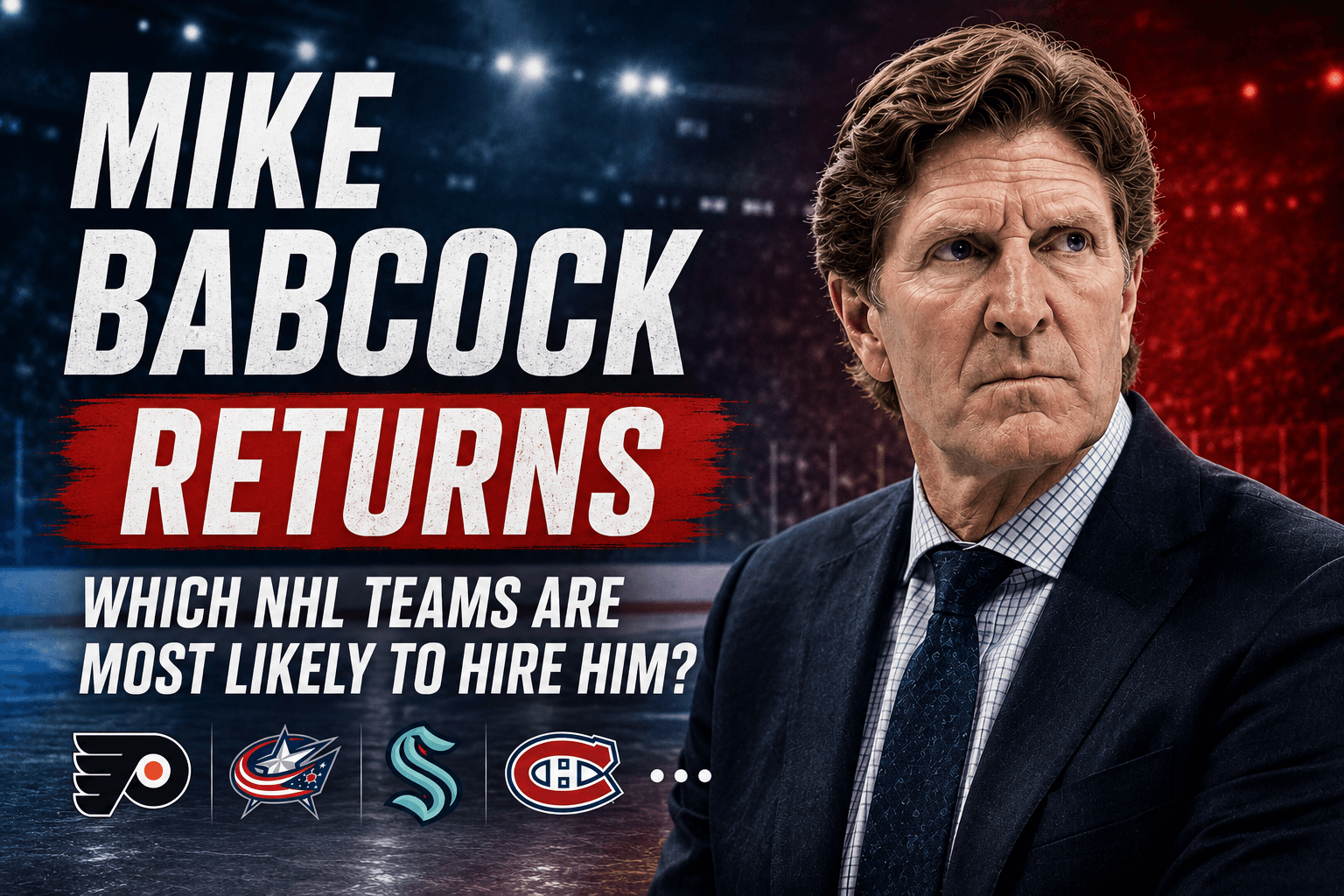
Mike Babcock has been cleared by the NHL to return to coaching following a review of the conduct allegations that led to his firing from the Columbus Blue Jackets in 2023. The Edmonton Oilers have emerged as the frontrunner to hire him, with multiple reports indicating the franchise views Babcock as a credible option to lead a roster that reached the Stanley Cup Finals in 2024. His return would mark one of the most scrutinized second-act stories in recent NHL history.
Key Takeaways
- The NHL has officially cleared Mike Babcock to resume coaching duties, ending a review process that began after his dismissal from Columbus in November 2023.
- The Edmonton Oilers are the most heavily reported destination, with the team in need of a head coach following Kris Knoblauch’s departure and a roster built around Connor McDavid and Leon Draisaitl in a defined Cup window.
- Babcock holds an all-time regular season coaching record of 784 wins, but his playoff record from 2014 onward deteriorated significantly, going 12-20 across his final seasons in Toronto before being fired 23 games into his Blue Jackets tenure.
- The Mitch Marner-Mike Babcock relationship remains a documented pressure point, with Marner publicly confirming that Babcock asked him to report on teammates’ habits during his rookie season in Toronto.
- Any Babcock hire will be watched closely for how NHL front offices weigh winning pedigree against workplace conduct history in the post-Kyle Beach era of league accountability.
The NHL Clears Babcock: What the Decision Actually Means
The NHL’s clearance of Mike Babcock does not erase the conduct record that ended his time in Columbus, but it does formally reopen the door for any franchise willing to absorb the public and locker-room risk of hiring him.
The NHL’s decision to clear Babcock came after a review process that evaluated the findings from the independent investigation commissioned by the Columbus Blue Jackets in 2023. That investigation concluded Babcock had engaged in conduct unbecoming of an NHL head coach, including the review of players’ personal photos on their phones, a practice that several players described as invasive and coercive. The league stopped short of issuing a formal suspension or ban at the time, and the clearance issued in 2026 signals the league does not intend to block him from employment.
What the clearance does not do is issue a verdict on character. The NHL’s process is largely procedural: the league determined Babcock served a period away from the game and that no criminal conduct was established. Teams are now free to make their own evaluations. That context matters, because it shifts the accountability entirely to whichever franchise writes Babcock a contract. If things go sideways in the locker room again, there will be no cover of “we didn’t know” available to the front office that hired him.
This is one of the most polarizing stories in our latest NHL news coverage this offseason, and it sits at the intersection of two forces that have been reshaping the sport for years: the pressure to win now, and the growing expectation that organizations maintain environments where players are treated with basic dignity. Browse our broader Sports articles for more context on how other leagues are navigating similar personnel decisions.
Why the Edmonton Oilers Are the Logical Frontrunner
Edmonton’s coaching vacancy, combined with the urgency of McDavid’s prime years and Babcock’s pre-existing relationship with the franchise’s culture, makes the Oilers the most structurally logical landing spot for his return.
The Oilers’ interest in Babcock is not accidental. Edmonton has been searching for the right fit at head coach since Kris Knoblauch’s exit, and the front office under president of hockey operations Jeff Jackson has shown a willingness to make aggressive, high-upside bets. Babcock coached the Detroit Red Wings to a Stanley Cup in 2008 and built one of the NHL’s most respected defensive systems during his Detroit tenure, qualities that appeal to a team that surrendered 285 goals against in the 2024-25 season.
Connor McDavid is 29 years old. Leon Draisaitl turns 31 before the 2026-27 season opens. The window is not closing yet, but it is measurably narrower than it was three years ago, and the Oilers know it. From a pure hockey-operations standpoint, Babcock’s reputation as a coach who gets maximum production from elite talent during the regular season is a legitimate asset. His teams in Detroit and early Toronto consistently outperformed their expected standings based on roster construction alone.
There is also a geographic and organizational familiarity element worth noting. Babcock coached Canada’s men’s hockey team to gold medals at the 2010 and 2014 Olympics, building relationships across the Canadian hockey infrastructure that Edmonton’s front office is deeply embedded in. He is not a stranger to this world. The question is whether those relationships still carry the weight they once did after everything that followed in Toronto and Columbus.
The Mitch Marner Problem: Can It Be Managed?
The Mitch Marner and Mike Babcock dynamic is not a rumor or an allegation that was later walked back. Marner confirmed publicly that Babcock asked him during his rookie season to report on which veterans were not working hard enough in practice, effectively asking a 19-year-old to surveil his teammates. Marner described the experience as uncomfortable and inappropriate. That account has never been disputed by Babcock’s camp in any substantive way.
Marner is now a free agent or trade candidate depending on the offseason’s direction, but the broader issue is what the story signals about Babcock’s management style with young players. The Oilers’ roster includes several players in their early-to-mid 20s who would be entering their most formative professional years under a Babcock system. How the organization manages that dynamic, specifically whether they put structural checks in place around player advocacy and communication, will be a direct test of whether the NHL has actually evolved its accountability standards or simply reset the clock on a controversial figure.
Which Other Teams Could Make a Move for Babcock?
While Edmonton leads the reported interest, at least two other franchises with coaching vacancies and win-now mandates have been connected to Babcock’s name this offseason.
The Boston Bruins and the San Jose Sharks represent two very different organizational profiles that have both surfaced in early offseason coaching speculation. Boston’s interest, if real, would be driven by the same logic as Edmonton’s: an aging core that needs a proven hand to squeeze production from a roster in transition. The Bruins have historically valued experienced coaches with championship pedigree, and Babcock fits that profile on paper despite everything that followed his Detroit peak.
San Jose is a more interesting case analytically. The Sharks are in the early stages of a rebuild centered around younger talent, and Babcock’s track record with developmental systems in Detroit (where he worked with a deep, well-scouted prospect pool) offers some relevant experience. However, the cultural environment of a rebuilding team populated by young players is precisely the context where the conduct concerns become most acute. It is difficult to imagine San Jose’s leadership making that particular calculus work publicly.
The reality is that Babcock’s market is narrower than his win total suggests. Teams in full rebuild mode have no incentive to absorb the controversy. Teams with stable, experienced rosters and a defined Cup window represent the only realistic fit, and that narrows the list considerably to Edmonton, and perhaps a second Canadian market willing to weather the public reaction, which in Canada tends to run considerably hotter than anywhere else in the league.
Mike Babcock Coaching History: A Snapshot of the Resume
Babcock’s career regular-season record of 784-430-115 places him among the most successful coaches in NHL history by raw wins, but the distribution of those wins tells a more complicated story about his trajectory.
The table below captures the key data points across Babcock’s head coaching career, allowing for a cleaner comparison of his performance by era rather than relying on the aggregate number that often dominates the conversation around his potential hire.
| Season Range | Team | Regular Season W-L-OTL | Playoff Record | Result |
|---|---|---|---|---|
| 2002-2004 | Mighty Ducks of Anaheim | 69-54-21 | 12-9 | Stanley Cup Finals (2003) |
| 2005-2015 | Detroit Red Wings | 458-223-79 | 56-54 | Stanley Cup Champion (2008) |
| 2015-2019 | Toronto Maple Leafs | 173-133-34 | 4-12 | First-round exits (2017, 2018, 2019) |
| 2019 (fired) | Toronto Maple Leafs | Dismissed 23 games into 2019-20 | N/A | Fired November 2019 |
| 2023 (fired) | Columbus Blue Jackets | 9-12-2 (23 games) | N/A | Fired following conduct investigation |
The aggregate regular-season record flatters Babcock considerably when his Detroit years carry the majority of the weight. His Toronto tenure produced three consecutive first-round playoff exits despite a roster that included a young Auston Matthews and a developing Marner, and his Columbus stint lasted less than two months. The pattern across his final years in the league is one of diminishing playoff returns against rising roster expectations, a trend that any analytics-focused front office should scrutinize carefully before committing to a multi-year deal.
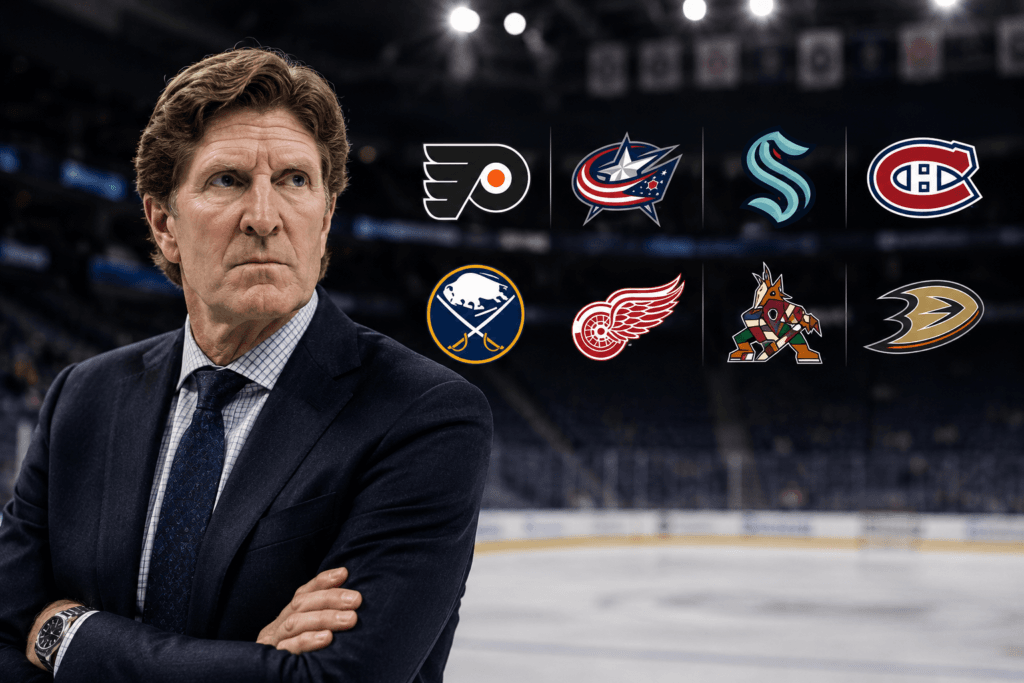
Which NHL Teams Are Actually in the Market for Mike Babcock?
Speculation about Babcock’s next employer has centered heavily on the Edmonton Oilers, and the logic is not hard to follow. Edmonton’s ownership group has demonstrated a willingness to make bold, occasionally polarizing decisions in the pursuit of a championship before Connor McDavid’s prime window closes. After missing the Stanley Cup Final in 2024 by the narrowest of margins and falling short again the following spring, the Oilers front office has reason to consider every available lever. Babcock, whatever his baggage, is a lever that comes with a Stanley Cup ring.
The fit is not obviously clean, however. Edmonton under Kris Knoblauch has embraced a fast, puck-possession model that relies heavily on player buy-in and trust between the coaching staff and the dressing room. McDavid has spoken publicly about the importance of open communication with coaches, and Leon Draisaitl operates best when given creative latitude in the offensive zone. Babcock’s reputation for top-down control and what several former players have described as an emotionally demanding environment sits in some tension with what the Oilers have built. A front office that introduces Babcock to a locker room led by two of the most powerful players in the game takes on real relationship risk in exchange for the credibility his name provides.
Beyond Edmonton, the San Jose Sharks are the team most frequently cited as a plausible landing spot. San Jose is deep in a rebuild, carrying little immediate playoff pressure and possessing a roster young enough that the psychological dynamics of a demanding head coach matter somewhat less in the short term. A multi-year contract there would give Babcock time to demonstrate that his methods have modernized before a higher-stakes opportunity becomes available. The Chicago Blackhawks represent a similar profile: a franchise with historic brand equity, a generational talent in Connor Bedard still developing his game, and an organizational culture that would benefit from a coaching voice with championship credibility even if that voice comes with complications.
The Buffalo Sabres, who have cycled through coaches at a disquieting rate without meaningfully improving their playoff chances, are another name that surfaces in league circles. Buffalo’s ownership has shown a preference for established hockey names over experimental hires, and Babcock’s profile fits the pattern of the kind of veteran presence the organization tends to pursue when patience with a rebuild wears thin. Whether any of these front offices will move past the conduct concerns and the questions about his adaptability remains the central variable, and it is one that only the hiring process itself will answer.
What a Babcock Return Would Mean for the NHL’s Ongoing Culture Reckoning
The league that Mike Babcock would be returning to is not the one he left in November 2019. The years since his resignation have seen a pronounced and ongoing shift in how NHL franchises talk about coaching culture, player mental health, and the acceptable boundaries of motivational pressure. Several organizations have invested meaningfully in sports psychology staff, restructured their approaches to player evaluation, and created formal channels for players to raise concerns about coaching conduct. The NHLPA has pressed teams on culture issues with greater consistency than at any previous point in the league’s history.
Hiring Babcock does not simply mean adding a coach with a complicated record. It means making a statement about how seriously a franchise takes those cultural commitments when a high-profile win-now option becomes available. That statement will be read carefully by current players around the league, by agents advising clients on where to sign, and by young players in the pipeline who are deciding which organizations feel safe. Front offices that have invested in building reputations as player-friendly environments take on reputational exposure they cannot entirely control once they bring Babcock through the door.
There is a counterargument that deserves honest engagement. Babcock completed whatever process the NHL required for clearance, and the principle that a person can address past misconduct and return to professional life carries real weight. The question for each franchise is not whether Babcock has a right to coach again but whether hiring him serves their specific players, their organizational values, and their competitive goals better than the available alternatives. Those are separate questions, and conflating them leads to analysis that is either reflexively punitive or carelessly dismissive of legitimate concerns.
The broader signal a successful Babcock hire would send is that results-driven franchises will ultimately prioritize the resume over the conduct record when the gap in perceived coaching quality is large enough. That signal matters beyond Babcock himself because it shapes how the next generation of coaches reads the incentive structure of the profession. If the lesson absorbed is that championship credentials provide sufficient insulation from accountability, the culture change the league has publicly committed to remains fragile in ways that will eventually surface again.
Babcock By the Numbers: Does His Actual Coaching Record Hold Up in the Modern NHL?
The popular narrative around Mike Babcock treats his credentials as essentially self-evident: a Stanley Cup, Olympic gold medals, and over 700 regular-season wins speak for themselves. A closer reading of the postseason data, particularly the record accumulated after his last championship run, complicates that picture in ways that analytics-oriented front offices have every reason to examine before committing eight figures to a comeback.
Babcock’s 2004 Stanley Cup came with an Anaheim roster built around a dominant defensive core and a goaltender, Jean-Sebastien Giguere, who was arguably the most valuable player of that entire playoff run. His 2008 Cup in Detroit arrived on the back of a team that had been assembled over years by Ken Holland and that ranked among the most structurally sound organizations in the sport’s history. In both cases, Babcock the coach operated with significant structural advantages that are difficult to separate from Babcock the tactician when evaluating his true coaching contribution.
From 2014 onward, the record becomes considerably harder to defend. His 12-20 postseason record across that period encompasses three consecutive first-round outings in Toronto, where a roster featuring Auston Matthews, Mitch Marner, and John Tavares was expected to advance deep into the playoffs. The Maple Leafs under Babcock won exactly one playoff series in four seasons. His in-series adjustments drew consistent criticism from analysts tracking deployment patterns, zone entry data, and line-matching decisions, with particular scrutiny directed at his reluctance to adapt line combinations when matchup problems became evident across multiple games.
The seven-year absence from the NHL is its own analytical variable. The game that Babcock would be walking back into operates on a substantially different tactical foundation than the one he coached in 2019. The pace of play has continued to increase. The emphasis on puck retrieval systems, structured breakouts, and transition speed as primary competitive differentiators has only intensified. Teams across the league now employ analytics departments whose influence over in-game decisions, roster deployment, and special teams structure would have been considered disruptive by many coaches of Babcock’s generation. According to the NHL, the average goals-per-game figure has risen meaningfully over the past five seasons, reflecting a league that has moved decisively away from the defensive structures Babcock built his reputation managing.
The player-empowerment dimension carries equal analytical weight. Research in organizational psychology has established consistent links between psychological safety in team environments and both individual performance and collective cohesion. A coaching model that generates fear or uncertainty among players does not merely create a difficult working environment; it produces measurable performance degradation at precisely the moments, late-season games and high-pressure playoff situations, when peak output is most critical. The former players who have spoken about their experiences under Babcock describe patterns that organizational science would predict to be performance-limiting rather than performance-enhancing, whatever short-term compliance they produced.
None of this constitutes a definitive verdict on whether Babcock can coach effectively in the current NHL. Coaches adapt, philosophies evolve, and a seven-year gap from the bench might plausibly have produced genuine reflection rather than mere surface-level acknowledgment. What the numbers do establish clearly is that the unqualified deference to his championship credentials that appears in much of the coverage around his comeback is not supported by a careful reading of his full coaching record. Any front office treating the Stanley Cup ring as sufficient justification for a major commitment is making a faith-based bet rather than an evidence-based one.
“Research by Harvard Business School professor Amy Edmondson shows that psychological safety helps high-performing teams by allowing members to speak up, share concerns, and report mistakes without fear of interpersonal consequences. “
Harvard Business School, organizational behavior research on team psychological safety and performance outcomes
“The transition back into high-performance coaching roles after extended absences presents documented challenges related to tactical currency, relationship-building with a younger generation of athletes, and the integration of data-driven decision frameworks that have become standard practice in professional sports organizations.”
According to sports management research cited by academic institutions studying professional coaching re-entry and organizational fit
Mike Babcock’s return to NHL coaching will generate more heat than almost any other storyline the league produces in the 2026-27 season regardless of which team ultimately signs him. The conduct history is real, the clearance process happened, and the debate about what both of those facts mean will not be resolved by any single article or any single hiring decision. What can be said with reasonable confidence is that the team which hires Babcock is not simply acquiring a proven coach but taking on a complex organizational variable whose net effect on a dressing room, a front office culture, and a public identity will depend enormously on how thoughtfully the integration is managed. The franchises most likely to get that balance right are those approaching the decision with clear eyes about both his genuine strengths and the substantial questions his record and his absence raise, rather than treating the Stanley Cup ring as an answer to questions it cannot actually settle.
Frequently Asked Questions
Babcock was cleared to return to coaching in the NHL following a review process conducted in connection with the league after misconduct allegations related to his time with the Columbus Blue Jackets and earlier tenures led to his resignation. The clearance indicates that the NHL determined he had satisfied the conditions required to be eligible for employment, though individual teams retain discretion over whether to hire him.
The Oilers are among the teams most frequently linked to Babcock given their championship urgency and ownership group’s history of aggressive moves, but the fit carries real risks. Connor McDavid’s dressing room influence and the team’s player-empowerment culture could be strained by Babcock’s historically top-down approach. Whether Edmonton’s front office views those risks as manageable is something only the hiring process will clarify.
From 2014 onward, Babcock compiled a 12-20 postseason record, including three consecutive first-round exits with the Toronto Maple Leafs despite a roster widely considered capable of deeper runs. That record, combined with criticism of his in-series adjustments and line-deployment decisions, has led analytics-focused observers to question whether his championship credentials from 2004 and 2008 accurately reflect his coaching quality in the contemporary game.
The San Jose Sharks and Chicago Blackhawks are most commonly cited as alternative landing spots. Both franchises are in rebuilding phases where playoff pressure is lower, giving Babcock time to demonstrate adaptation before pursuing a higher-stakes role. The Buffalo Sabres have also been mentioned given the organization’s tendency toward established coaching names when rebuild patience wears thin.