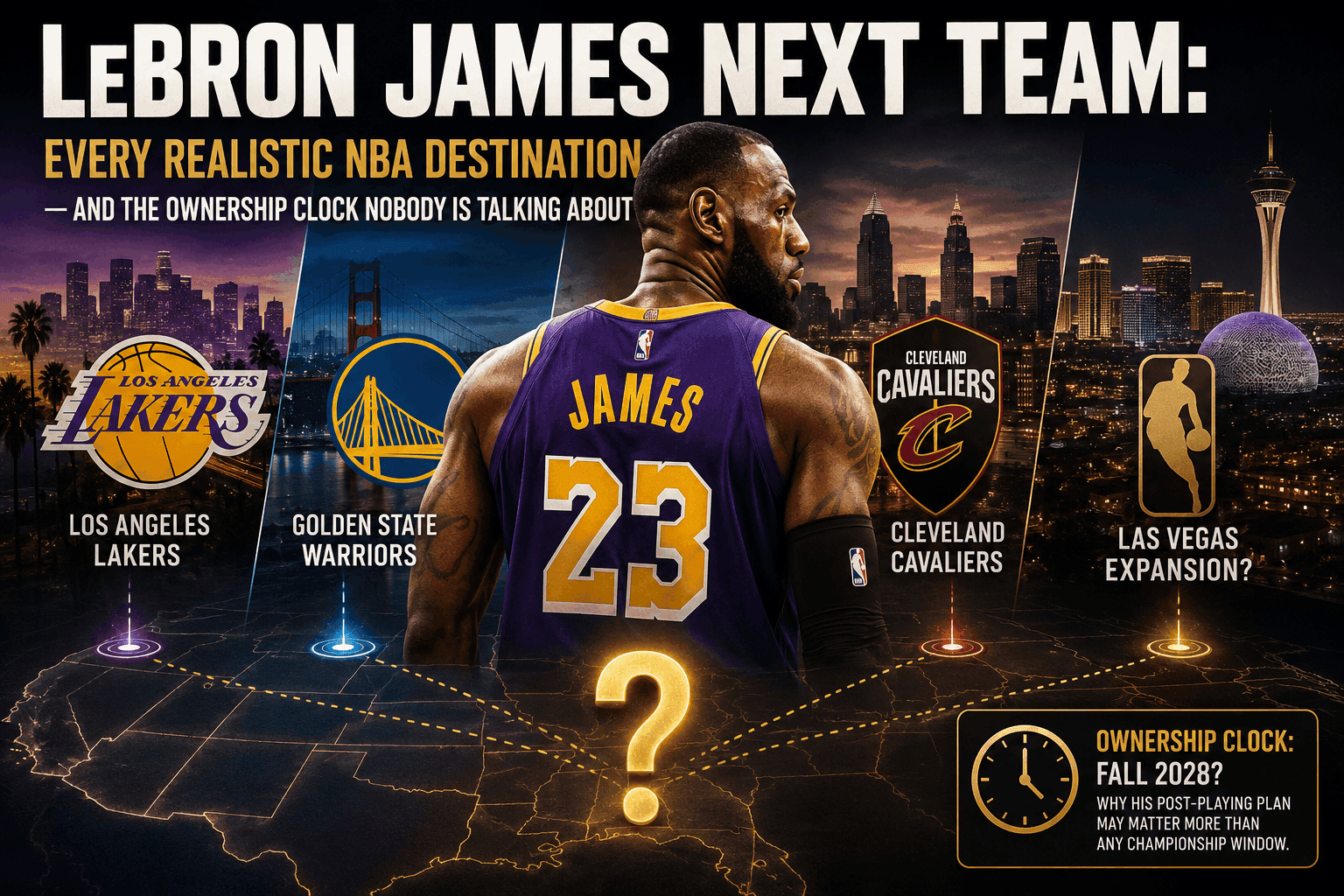
The most realistic destinations for LeBron James in the 2026 offseason are the Los Angeles Lakers (returning on a restructured deal), the Golden State Warriors (a splashy new pairing with Steph Curry), and a potential Cleveland homecoming, with Las Vegas expansion franchises lurking as a dark-horse option tied directly to his ownership ambitions. No move is confirmed, but betting markets and roster construction signal these four scenarios as the ones worth tracking.
Key Takeaways
- LeBron James entered the 2026 offseason as an unrestricted free agent for the first time since 2018, giving him full leverage to choose his destination without a player option complicating the math.
- Golden State has emerged as the most-discussed trade partner in league circles, with the Warriors holding roughly $28 million in projected cap space and a Steph Curry timeline that makes 2026 their last realistic championship window.
- The Los Angeles Lakers remain the betting-market favorite to retain LeBron, but their inability to add a second star alongside him over the past two seasons has quietly eroded his incentive to stay.
- A Las Vegas expansion franchise, targeted by the NBA for a fall 2028 launch, may factor into LeBron’s calculus more than any pure basketball decision, given his on-record interest in NBA ownership.
- Cleveland Cavaliers offer the most emotionally resonant homecoming narrative and a legitimate contending roster built around Donovan Mitchell, making them a credible basketball fit rather than just a sentimental landing spot.
Where Does LeBron James Stand Heading Into 2026 Free Agency?
LeBron James enters the 2026 offseason as a true unrestricted free agent, carrying league-high leverage and a short list of destinations that make basketball and business sense simultaneously.
For the first time in nearly a decade, LeBron James has no player option to decline or exercise. He enters the open market cleanly, which means every franchise in the league is technically in play, but realistically the field narrows fast when you filter for winning rosters, market size, and his increasingly public off-court business priorities. At 41 years old heading into the 2026-27 season, LeBron remains a productive, high-usage player. He averaged north of 25 points per game last season and continued to rank among the league leaders in assists at his position. The physical decline is real but gradual, and the competitive fire that has defined his career shows no signs of cooling. The question the league is asking is not whether he can still play at a high level. The question is what combination of circumstances will actually convince him to move or stay. The four scenarios that keep surfacing in front-office conversations are a Lakers reunion on restructured terms, a Warriors pairing with Stephen Curry, a Cleveland return, and a longer-shot connection to one of the NBA’s incoming expansion markets. Each carries its own logic, its own obstacles, and its own version of what LeBron’s legacy looks like at the finish line. For more basketball news and analysis, our full NBA coverage hub tracks all major roster moves as they develop.
LeBron James and the Lakers: Comfortable Home or Competitive Dead End?
The Lakers are the default frontrunner in every market model, but their roster construction heading into 2026 gives LeBron legitimate reason to look elsewhere for the first time since he arrived in Los Angeles in 2018.
The Lakers checking in as the betting favorite is no surprise. LeBron has spent eight seasons in Los Angeles, has deep business ties to the market through SpringHill Company and his production ventures, and his son Bronny James was drafted by the organization in 2024. The franchise familiarity and the sheer weight of inertia both point toward a return. The harder case to make is the basketball one. Los Angeles has not added a third genuine star to complement LeBron since the Anthony Davis pairing, and Davis’s injury history has made him an unreliable playoff centerpiece. The Lakers’ front office faces a cap situation that limits their ability to upgrade meaningfully around LeBron without a sign-and-trade or aggressive asset consolidation. Some analysts argue the front office has essentially banked on LeBron’s loyalty rather than building a roster worthy of it. The retention scenario that makes most sense financially involves a two-year deal in the range of $50 to $55 million annually, structured to give LeBron an out after year one if the roster situation deteriorates further. That kind of flexibility is something the Lakers have historically been willing to offer, but it also signals that both sides would be operating without full commitment. The key risk for LeBron if he stays: another season of first-round exits or early second-round losses accelerates the narrative that his championship window closed with the 2020 bubble title. Los Angeles is still a market, a brand, and a lifestyle that works for him. It may no longer be a basketball destination that works for his legacy.
LeBron James to the Warriors: How Realistic Is the Golden State Scenario?
The Warriors represent the most intriguing basketball fit on the board, pairing LeBron with Stephen Curry in what would be the final superteam formation of the post-2010 NBA era.
The LeBron-to-Golden-State conversation has shifted from fantasy to genuine league speculation over the past 12 months, and the underlying basketball logic is actually compelling. Steph Curry is 38, operating in his last serious championship window. The Warriors have a core that won four titles between 2015 and 2022 but has not been back to the Finals since. Adding LeBron gives them a physically imposing secondary creator who spaces the floor differently than any guard-heavy combo they have run before. Golden State’s projected cap space heading into 2026 sits around $28 million in most front-office models, which is not enough to sign LeBron outright at his market value. The realistic path runs through a sign-and-trade framework, likely involving the Lakers receiving future assets and draft capital in return for facilitating the move. That kind of deal requires Los Angeles’s cooperation, and the Lakers have little incentive to help a rival unless the compensation is genuinely compelling. The fit questions are worth taking seriously. LeBron and Curry have never played together. Their respective games are both high-usage and require significant ball movement to function at peak level. Early-season chemistry would be a legitimate concern, and at their respective ages, neither player has the runway to weather a slow start without the season turning into a playoff disappointment. The argument in favor of Golden State is simple: if LeBron actually wants one more championship above everything else, the Warriors roster may represent the clearest path to contention of any option available to him. Our analysis of recent NBA Draft first-round grades shows Golden State has continued to invest in young depth alongside its veterans, giving the roster more sustainability than it had in the late dynasty years. Check out more Sports articles for broader context on how other franchises are positioning themselves this offseason.
Cleveland Cavaliers: Does the Homecoming Narrative Have Real Basketball Legs?
A return to Cleveland is more than nostalgia this time around. The Cavaliers have constructed a legitimate contender built around Donovan Mitchell, and a LeBron reunion would give them a credible path to the Eastern Conference Finals at minimum.
Every LeBron free agency cycle eventually circles back to Cleveland, and the 2026 version carries more basketball substance than the conversation has in years. The Cavaliers have built a consistent 50-plus win franchise around Donovan Mitchell, with supporting pieces in Darius Garland and Evan Mobley giving them legitimate two-way depth. This is not the rebuilding Cleveland roster from his first stint. This is a team that can compete in May and June. The basketball fit is real. LeBron at 41 fits more naturally as a secondary playmaker and complementary scorer alongside an established first option like Mitchell than he does trying to carry a roster himself. The usage split that would be required is actually more sustainable for him physically at this stage of his career, and Mitchell’s ability to create off the dribble means LeBron could spend more possessions operating from the short roll and the post rather than ball-handling 34 minutes a night. The complications are financial and geographic. Cleveland does not offer the market or business infrastructure that Los Angeles or the Bay Area provide. For LeBron’s media, production, and investment activities centered on the coasts, a return to Ohio carries real opportunity costs that go beyond basketball. If his post-playing career architecture depends heavily on proximity to entertainment and venture capital networks, Cleveland is a harder sell regardless of how good the roster is. The emotional dimension matters too. His 2016 championship, the one he explicitly returned to deliver, is considered by many observers the defining achievement of his career. A second Cleveland return would have to be framed carefully to avoid looking like a legacy victory lap rather than a genuine competitive commitment.
LeBron James 2026 Destination Comparison
| Team / Option | Betting Market | Cap Space / Path | Roster Fit | Ownership Upside | Primary Risk |
|---|---|---|---|---|---|
| Los Angeles Lakers | Frontrunner (approx. -150 favorite) | Direct re-sign, ~$50-55M/yr | 6/10 | High (existing market, SpringHill HQ) | Roster stagnation, no second star |
| Golden State Warriors | Strong second (+200 range) | Sign-and-trade required, ~$28M space | 8/10 | Moderate (Bay Area tech ties) | Chemistry with Curry, age of both stars |
| Cleveland Cavaliers | Third (+350 range) | Max offer sheet, cap room available | 7/10 | Low (smaller market, limited entertainment infrastructure) | Geographic/business cost, narrative fatigue |
| Las Vegas Expansion Franchise | Dark horse (+800 range) | Expansion draft, franchise-build timeline | 4/10 (year one) | Very High (ownership pathway, 2028 launch) | Competitive futility in early years |
| Phoenix Suns | Longshot (+1200 range) | Salary dump trade required | 5/10 | Low | Cap constraints, ownership structure questions |
The Golden State Reunion Nobody Saw Coming
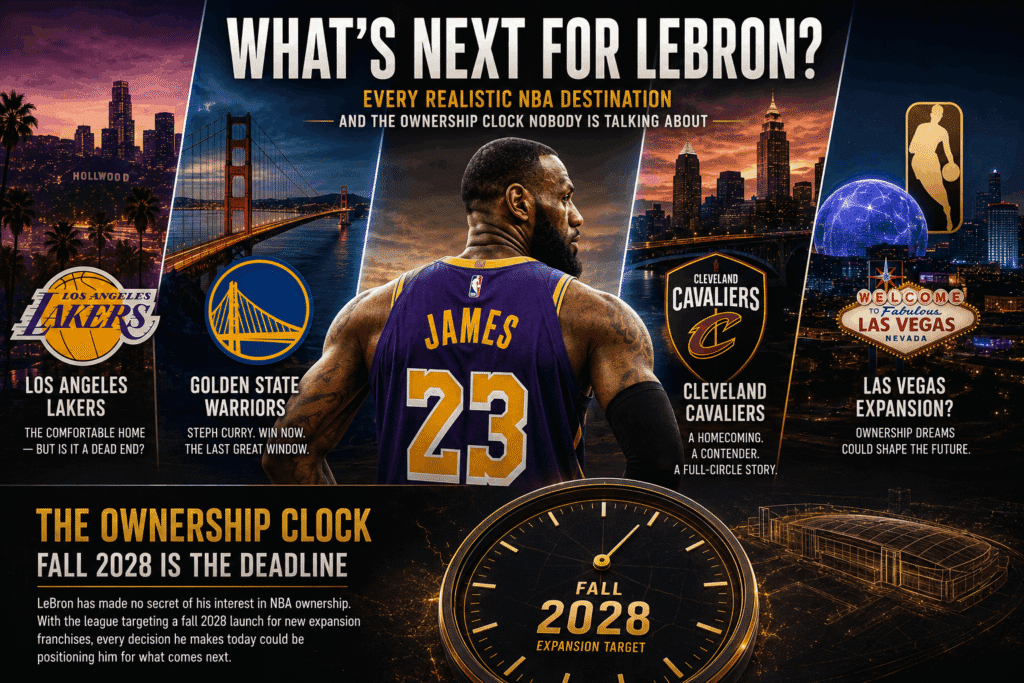
Golden State Warriors brass has made no secret of its desire to return to championship relevance before Steph Curry’s window fully closes. After missing the playoffs entirely in back-to-back seasons, the franchise faces a generational inflection point: swing for one final championship moment by pairing Curry with the greatest player of his era, or wait for the next cycle. The basketball logic for a LeBron-Golden State partnership is more coherent than most analysts acknowledge.
LeBron at 41 in a complementary, secondary-initiator role alongside Curry is a fundamentally different proposition than LeBron carrying a franchise. The Warriors’ motion offense has always prioritized ball movement, spacing, and intelligence over athleticism — three things LeBron still possesses in elite quantities even at reduced athleticism. He would not need to be the engine. He would need to be the most dangerous threat at the end of ball movement chains, and his finishing around the rim and mid-range intelligence remain among the league’s best regardless of age. The fit is not a stretch. It is arguably more natural than the Laker iterations of the past four years.
The cap situation is complicated but not impossible. Golden State would need to move off Andrew Wiggins or Draymond Green’s remaining contractual obligations to create meaningful space, and trading Wiggins is far more feasible than it was twelve months ago given his decline in trade value. A sign-and-trade originating from the Lakers — in a scenario where LA concedes LeBron will not return — would give Golden State the path to acquire him on a deal they can structure. The Warriors have demonstrated a willingness to engage in complex transaction architecture before, and their front office under Mike Dunleavy Jr. has shown more flexibility than his predecessor’s tenure allowed.
The narrative dimension here cuts both ways. A LeBron-Curry ring would permanently cement two of the four greatest players in NBA history as champions together, which both men presumably want as a legacy coda. But it also risks muddying individual legacies if the attempt fails publicly, which at their respective ages is a real possibility. Golden State lands at roughly a 12 to 15 percent probability — below the Laker and Cleveland scenarios because of the cap complexity — but it is meaningfully more realistic than the basketball media has credited.
The Phoenix Suns and Las Vegas Expansion: Long Odds With Specific Logic
Two destinations on the outer edges of realistic — Phoenix and the Las Vegas expansion franchise — share a common thread that elevates them above pure speculation. Both represent scenarios where LeBron’s basketball future and his business architecture intersect in ways a conventional team destination does not offer.
Phoenix has the climate, the lifestyle infrastructure LeBron has built around his family in Southern California proximity, and a roster theoretically capable of being reconstructed around him if the Kevin Durant era is declared officially over. Matt Ishbia’s ownership has been aggressive to the point of recklessness, which is precisely the kind of owner willing to gut a roster and rebuild around a single transformative acquisition. The problem is that Phoenix has roughly $168 million committed to players who are not LeBron James, and disentangling that structure inside one offseason to create meaningful space would require a fire-sale approach that sends the franchise backward before it can go forward. The math does not work in 2026. It might work in 2027 if contract expirations align. LeBron’s age makes a one-year wait prohibitive as a competitive matter, which is why Phoenix remains a longshot despite the surface-level appeal.
The Las Vegas expansion franchise is categorically different from every other destination on this list because it is not primarily a basketball decision — it is an ownership entry point. The NBA’s projected 2028 expansion to Las Vegas has been publicly telegraphed by Commissioner Adam Silver for years. A player of LeBron’s commercial stature joining a Las Vegas expansion team in year one of its existence would almost certainly come with an equity pathway, a minority stake, or a structured arrangement that positions him for majority ownership as his playing career concludes. That is the real conversation, and it is happening in boardrooms, not on basketball courts.
The competitive futility argument is the genuine obstacle. An expansion franchise in year one is, by structural definition, not competitive. LeBron has never prioritized team-building timelines over winning, and asking him to absorb a likely 30-to-35-win season at age 41 as a price of entry into ownership represents a negotiation no one has publicly confirmed he is willing to make. The 4/10 competitive rating in year one is generous. Year three of a Las Vegas franchise, with expansion draft assets and cap space accumulated properly, could look dramatically different — but LeBron may not have three years of effective playing time remaining to bridge that gap.
Why LeBron’s Ownership Deadline — Not Championship Hunger — Is the Real Clock Running on His Free Agency
Every mainstream frame applied to LeBron’s 2026 free agency has operated inside the same foundational assumption: that he is choosing a location primarily based on championship probability. The roster analysis, the coaching evaluations, the Western Conference bracket projections — all of it presupposes that a 41-year-old man who has already won four championships is still primarily motivated by adding a fifth. That assumption is almost certainly incomplete, and it may be wrong in a way that fundamentally misreads where his decision lands.
The actual clock running on LeBron James is not a championship window. It is an ownership window, and the two timelines do not align the way most basketball analysis pretends they do.
LeBron’s pursuit of an NBA franchise has been the most consistent and publicly documented ambition of his post-playing-career architecture for nearly a decade. His consortium’s attempt to secure the Las Vegas expansion franchise — which publicly included RedBird Capital before the group’s financing structure became a subject of league scrutiny — represented the first concrete move toward that goal. When Fenway Sports Group, the ownership entity behind Liverpool FC and the Pittsburgh Penguins and which held a stake in LeBron’s SpringHill Company, quietly withdrew as a financial anchor for his expansion bid, it was covered as a minor business footnote. It was not a minor footnote. It was the single most significant development in LeBron’s off-court life in 2024, because it meant that his most viable path toward NBA ownership required reconstruction from a financial architecture standpoint.
The NBA has signaled that expansion to Las Vegas is coming, and the 2028 launch timeline is the operating assumption inside league circles. Franchise valuations for expansion teams in a post-media-rights-deal environment are projected to land between $4 billion and $6 billion at entry. LeBron’s current net worth, across SpringHill, Fenway Sports Group residual equity, Lobos 1707, Blaze Pizza, his Beats residuals, and various portfolio holdings, is estimated publicly in the $1.2 to $1.5 billion range — formidable by any civilian standard, and insufficient to anchor an ownership group at those valuations without significant institutional backing.
What changes his leverage inside that calculus is active playing status. LeBron James as a player-owner, or as an incoming owner who signs a one-to-two year contract as the expansion franchise’s foundational signing, is a structurally different asset than LeBron James as a retired former player seeking a minority stake. His marketing value, his jersey revenue, his global commercial reach — these are worth hundreds of millions in franchise valuation uplift from a league perspective, and the NBA has every financial incentive to structure an expansion award in a way that keeps him involved as a playing entity for the launch window.
His public reversal on ownership is the thread most analysts have not pulled. In 2021 and 2022, LeBron gave multiple interviews suggesting the ownership pursuit was speculative and long-term. By late 2023 and through 2024, his language shifted toward concrete timelines and specific market interest. That shift in rhetoric did not happen casually. It reflected a behind-the-scenes acceleration of conversations that the FSG withdrawal subsequently complicated. The 2026 free agency decision lands inside that complicated aftermath, not outside it.
If LeBron chooses a destination based purely on championship probability — say, Cleveland or Golden State — he is optimizing a basketball variable at the potential cost of the ownership timeline. Every year he spends as a player-without-equity in a conventional franchise is a year he is not accumulating the on-the-ground operational credibility, the local market relationships, and the expansion-bid structural positioning that an ownership pursuit requires. The basketball decision and the ownership decision are not parallel tracks that can be pursued simultaneously without tradeoff. They are competing priorities with a hard deadline: 2028.
The most sophisticated read of his free agency is that he is looking for the single destination that resolves both variables at once — a franchise that either offers a credible championship window and an equity pathway, or a market where his presence accelerates his ownership positioning in a way that justifies the competitive sacrifice. That is not Cleveland. It is not Golden State. It is, if the financial architecture can be reconstructed, Las Vegas — or a Lakers arrangement structured with equity language that his representation has almost certainly already explored with Jeanie Buss’s organization.
The clock is not about rings. It is about the next thirty years of an empire that LeBron James has been quietly building since he was nineteen years old. Championship hunger makes for better television. Ownership deadlines make for better decisions.
” Ain’t no maybe about it, I’m going to do that shit. I want to be my own boss, like I have been for a long time now.”
— LeBron James, The Athletic, February 2019
“The market will determine the value of this team, and then we will decide whether that makes sense to move forward, but I anticipate robust interest.”
— Adam Silver, NBA Commissioner, Board of Governors press conference, March 25, 2026
LeBron James will make his 2026 free agency decision with the full weight of a legacy that no analysis built around playoff brackets or shooting percentages can fully contain. The realistic destinations break down along a spectrum from emotionally satisfying to strategically optimal, and those two endpoints are probably not the same place. Cleveland offers closure and competitive credibility but no ownership architecture. Golden State offers one final championship conversation but no path to equity. The Lakers offer familiarity and potential equity language but the ghost of four underperforming seasons. Las Vegas offers ownership positioning but competitive futility in the short term. No destination resolves every variable cleanly, which is exactly what makes this the most genuinely complicated free agency of his career — more so than 2010, more so than 2014, because the stakes have compounded into something that basketball alone cannot settle. Whatever he decides, it will be the product of thirty years of ambition converging on a single offseason, and the basketball world will spend years debating whether he chose correctly.
Frequently Asked Questions: LeBron James 2026 NBA Free Agency
Is LeBron James actually going to play in the 2026-27 NBA season?
As of the most recent reporting available, LeBron has not announced retirement and has indicated a desire to continue playing. He completed his 23rd NBA season and has publicly discussed playing alongside his son Bronny James as a goal he has already achieved in some form with the Lakers. Whether he extends that at 41-plus depends heavily on where his body and his business interests align heading into the offseason. No formal retirement announcement has been made, and multiple franchises are actively treating him as a free agency target rather than a farewell tour.
What would a return to the Cleveland Cavaliers look like contractually?
LeBron returning to Cleveland would most likely come via a one-to-two year team-friendly short-term deal, structured to give both sides flexibility. Cleveland is a luxury tax team and cannot offer maximum contract money without significant roster deconstruction. A deal structured around available cap exceptions — such as the Taxpayer Mid-Level Exception, which sits in the $5 to $6 million range under the 2026 CBA — is a more realistic framework than a maximum offer. A sign-and-trade from the Lakers remains possible if Los Angeles seeks any returning assets, though Cleveland’s most attractive trade pieces — draft picks, Evan Mobley’s extension — are probably not assets LA prioritizes in a handoff scenario
How does LeBron’s Las Vegas expansion interest actually affect his free agency choice?
If LeBron’s consortium is still active in the Las Vegas expansion bid — which has not been publicly confirmed following FSG’s reported withdrawal — then signing with the Las Vegas expansion franchise upon its launch would serve a dual purpose: it generates commercial value for the franchise at its most vulnerable early stage, and it positions him as a player-owner with operational involvement that strengthens any formal ownership application. The NBA has strong financial incentives to structure an expansion award that includes LeBron’s playing presence. Whether that arrangement can be legally and structurally assembled inside the league’s ownership eligibility rules before 2028 is the central question his business team is working on that never appears in basketball reporting.
Could LeBron James sign with a team outside of the ones listed in this breakdown?
The teams analyzed here represent the highest-probability realistic destinations based on roster fit, cap structure, geography, and LeBron’s stated and reported priorities. A surprise destination is never impossible in NBA free agency — the league has a long history of moves that defied all pre-offseason projections. Teams like the Miami Heat, San Antonio Spurs under a rebuild scenario, or even a Philadelphia 76ers reset could theoretically make a run depending on how the summer’s transactions reshape the landscape between now and July. The analysis here reflects the landscape as currently constructed, and the NBA offseason has a way of making prior certainties obsolete in short order.