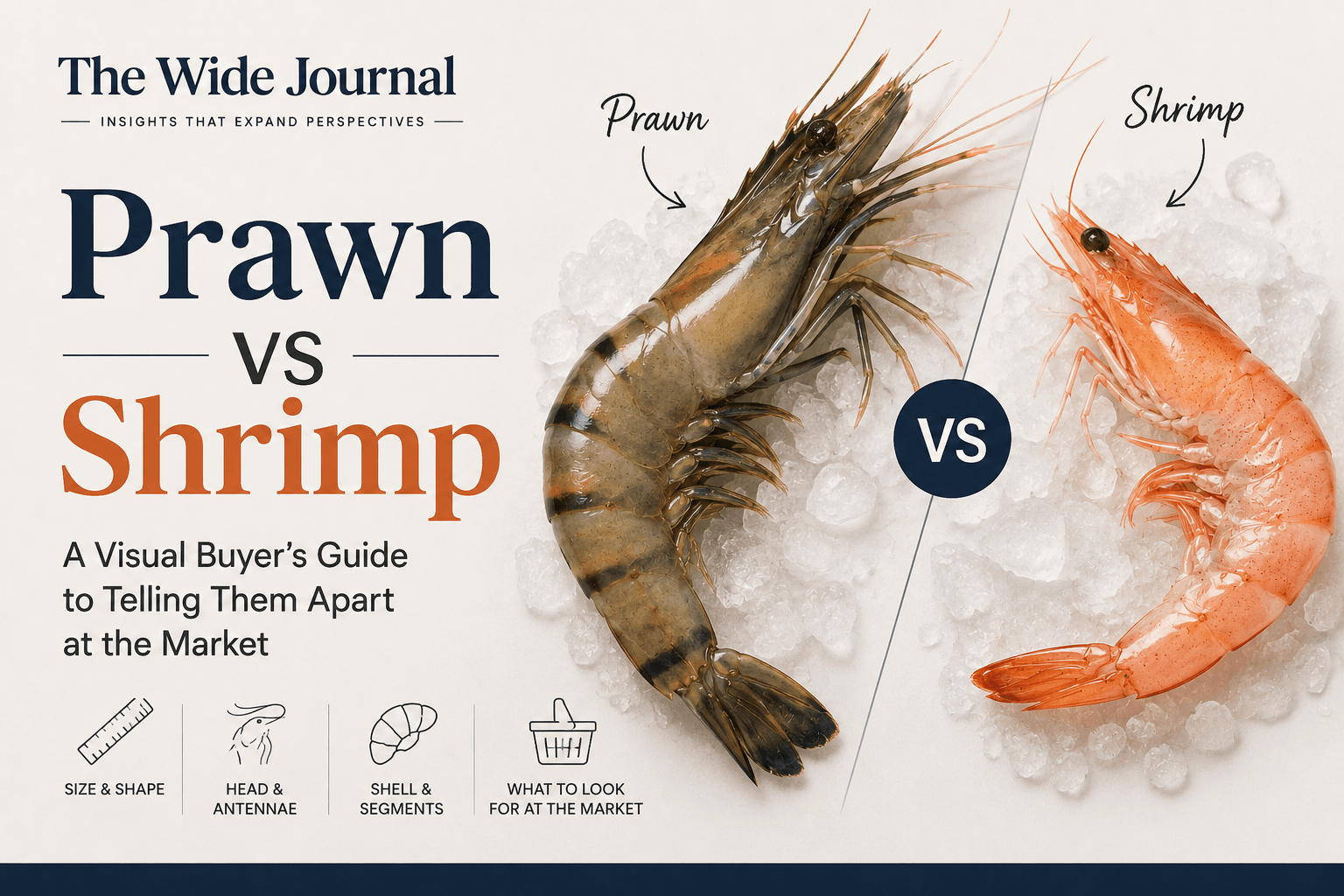
Prawns and shrimp are different crustaceans from distinct biological suborders, and you can tell them apart by looking at three physical features: body shape, leg structure, and the way their shell segments overlap. At the fish counter or seafood market, this distinction matters because each responds differently to heat, seasoning, and cooking time, which affects your results in specific recipes.
Key Takeaways
- Prawns belong to the suborder Dendrobranchiata while shrimp belong to Pleocyemata, a biological split that produces measurable differences in body structure, leg count, and shell overlap.
- True prawns have three pairs of claw-bearing legs versus shrimp’s two pairs, and their shell segments overlap front-to-back rather than back-to-front, making visual ID possible without any lab equipment.
- In the US and Canada, the terms are used almost interchangeably on packaging and menus, so the label alone tells you very little about what species you’re actually buying.
- Seafood mislabeling affects shrimp more than any other species globally, with investigative tests finding 82 to 90 percent of restaurant shrimp incorrectly labeled in recent studies.
- Size, shell color, and gill structure are the three fastest visual checkpoints a market shopper can use when the animal is still whole and unprocessed.
What Is a Prawn, Really? The Biology Behind the Confusion
Prawns and shrimp look nearly identical at a glance, but they come from separate crustacean suborders with structural differences you can see with the naked eye once you know what to look for.
When most people say “prawn,” they mean a large shrimp. That’s understandable, because in everyday American and Canadian grocery language, the two words have drifted so far into synonymy that seafood counters use them interchangeably. But biologically, a prawn is a specific type of crustacean belonging to the suborder Dendrobranchiata, while shrimp belong to Pleocyemata. These aren’t just naming conventions. The suborder split reflects real anatomical differences that a careful shopper can actually observe. The clearest place to start is the body plan. Prawns have a straighter, more elongated body. Their abdomen segments, the overlapping plates running down their back, are arranged so that each segment overlaps the one behind it. Shrimp have the opposite arrangement: the middle segment overlaps both the one in front and the one behind, which gives their body a slight curved or hunched appearance, especially when raw. If you hold a whole, uncooked animal and it curves naturally into a C-shape, you’re almost certainly looking at a shrimp. If it lies relatively flat, it’s more likely a prawn. The second visual checkpoint involves the legs. Prawns carry three pairs of claw-bearing legs (chelipeds), while shrimp have only two. You probably won’t count legs at a busy fish counter, but you may notice that prawns look slightly more “armed” around the head and thorax area. Their first pair of legs also tends to be noticeably longer than the others, which creates a slightly spindly, reaching appearance near the head. Finally, look at the gills if the animal is whole. Prawn gills are branched (the name Dendrobranchiata literally means “tree-branched gills”), while shrimp gills are plate-like or filamentous. This distinction is hard to see without handling the animal, but it does exist. For most shoppers, the practical takeaway is this: the curved body test and the shell-overlap test are the two fastest visual checks you can do at the counter, and they work on whole, shell-on specimens.
Difference Between Shrimp and Prawn: Side-by-Side Physical Traits
Laying the two animals side by side reveals consistent structural differences in body curve, leg configuration, and gill type that hold true across species, not just individual size variation.
Understanding the physical differences becomes much easier when you compare them systematically. The confusion at the market is compounded by size: large shrimp sold as “jumbo” can be bigger than smaller prawn species, so size alone is not a reliable distinguishing feature. What stays consistent are the structural traits listed below.
| Feature | Prawn | Shrimp |
|---|---|---|
| Biological suborder | Dendrobranchiata | Pleocyemata |
| Body shape (raw, whole) | Straighter, more elongated | Curved, C-shaped when raw |
| Shell segment overlap | Each segment overlaps the one behind it | Middle segment overlaps both neighbors |
| Claw-bearing legs (chelipeds) | 3 pairs | 2 pairs |
| Gill type | Branched (tree-like) | Plate-like or filamentous |
| Egg-carrying method | Releases eggs into open water | Carries eggs attached to legs |
| Common habitat | Freshwater and brackish environments | Saltwater, though some freshwater species exist |
| Typical flavor profile | Mildly sweeter, slightly earthier | Briny, more assertively “seafood” in flavor |
One thing the table can’t fully convey is how rarely you’ll encounter a true prawn at a standard American grocery store. The vast majority of what’s sold in US and Canadian supermarkets under any name is shrimp, most commonly white shrimp (Litopenaeus vannamei), which accounts for the dominant share of farmed shrimp imports. Species sold as “tiger prawns,” including the giant tiger prawn (Penaeus monodon), are technically in the Dendrobranchiata suborder and are genuine prawns, biologically speaking. The “spot prawns” common on the Pacific coast of Canada and the Pacific Northwest are also true prawns.
What Are Prawns vs. Types of Shrimp: What You’ll Actually Find at the Market
Knowing the biology is useful, but knowing which specific species are likely in front of you at the fish counter is what actually helps you shop and cook more confidently.
If you shop at a standard grocery chain in the US or Canada, here are the animals most likely to appear under the prawn or shrimp label, and how to visually identify them:
White Shrimp (Litopenaeus vannamei)
This is by far the most common shrimp in North American retail, accounting for the majority of the farmed shrimp supply. White shrimp have a pale, grayish-white shell when raw that turns pink-orange when cooked. Their bodies curve noticeably into that classic C-shape. They’re mild in flavor, widely farmed (primarily in Ecuador, India, and Vietnam), and sold in every size designation from small to colossal. If a package just says “shrimp” with no further species information, it is almost certainly white shrimp.
Gulf Brown and Gulf Pink Shrimp
These are wild-caught American shrimp from the Gulf of Mexico, and they carry a noticeably more complex, briny flavor than farmed white shrimp. Brown shrimp (Farfantepenaeus aztecus) have a brownish tint when raw and a slightly iodine-forward taste that some cooks love in gumbo or étouffée. Pink shrimp (Farfantepenaeus duorarum) are more delicate and sweet. Both are true shrimp (Pleocyemata) and both curve in the hand. If you see “Gulf shrimp” or “USA wild-caught” on a label, you’re likely looking at one of these two.
Tiger Prawns (Penaeus monodon)
Tiger prawns are genuine prawns, biologically, and one of the easier species to identify visually. They display distinctive dark stripes or bands across their shell when raw, which is where the name comes from. They’re large, often in the 16/20 or larger size range, and their bodies are notably straighter than white shrimp. When you see striped markings on a large, straight-bodied crustacean at the counter, you’re looking at a tiger prawn. Farmed tiger prawns come primarily from Southeast Asia, particularly Vietnam, Thailand, and Bangladesh.
Spot Prawns (Pandalus platyceros)
Spot prawns are the premium wild-caught option common in British Columbia, the Pacific Northwest, and increasingly in specialty markets across the US. They are true prawns, and they’re identifiable by the white spots at the base of their tail and near the middle of their body. Their flesh is sweet, rich, and notably more delicate than most shrimp, and they deteriorate quickly after death, which is why live spot prawns command a significant price premium. A live or freshly caught spot prawn will have vibrant color and firm texture; the quality drop after death is faster than with shrimp, so freshness matters more here than with nearly any other crustacean you’ll encounter.
How to Read Seafood Labels: From Supermarket Aisles to the Fish Counter
The numbers, abbreviations, and country-of-origin information on seafood packaging and counter tags carry real meaning. Knowing how to decode them helps you choose the right size, track authenticity, and avoid paying premium prices for mislabeled products.
The Core Specifications (Sizing and Species)
No matter where you buy your seafood, two metrics tell you exactly what is inside the package or sitting on the ice:
- The Size Number (Count per Pound): This is expressed as a range like 16/20 or 21/25, indicating how many individual animals make up one pound. A 16/20 count means larger specimens, while 51/60 denotes much smaller ones. The designation U/10 means “under 10 per pound” (colossal size). Informal marketing names (medium, large, jumbo) are not standardized and vary by retailer, so always trust the count number.
- The Scientific Name: Reputable retailers and fishmongers will display the genus and species alongside the common market name. If the label reads Litopenaeus vannamei, you are buying Pacific white shrimp—the workhorse of commercial aquaculture. If it reads Pandalus platyceros, it is a spot prawn, a genuine cold-water species with a distinctly different flavor profile and a price to match. The absence of a scientific name at a large retail chain is an immediate transparency red flag.
To combat commercial chaos, the U.S. government maintains strict naming laws. You can verify whether a product is legally marketed as a true shrimp or prawn by cross-referencing its biological genus in the FDA’s searchable Seafood List database, which dictates the exact acceptable market names permitted in interstate commerce to prevent economic fraud.
Packaged Goods: Deciphering Grocery Store Labels
When buying pre-packaged bags in the freezer aisle, focus on production methods and source transparency:
- Wild vs. Farmed: This mandatory disclosure helps you balance flavor profiles and budgets. Wild-caught domestic options (like Gulf brown or pink shrimp) offer a more complex, briny flavor but come at a higher price point. Farmed white shrimp from major exporters dominate lower price points and perform well in heavily sauced dishes.
- The IQF Advantage (Individually Quick-Frozen): Frozen-at-sea IQF products frequently outperform “fresh” counter seafood. These animals are flash-frozen within hours of harvest, preserving texture and preventing the degrade caused by standard thaw-refreeze cycles.
- Country of Origin: Under federal COOL (Country of Origin Labeling) regulations, retail packaging must state where the seafood was caught or farmed. India, Ecuador, Vietnam, and Indonesia are the dominant exporters to North America. If a package lacks a country-of-origin disclosure, avoid it.
For more deep dives into ingredient sourcing, grocery transparency, and culinary terms, explore The Wide Journal’s food articles.
Loose Seafood: Inspecting the Fresh Fish Counter
When standing in front of a live or iced fish counter, the rules change because you have the physical product available for visual inspection:
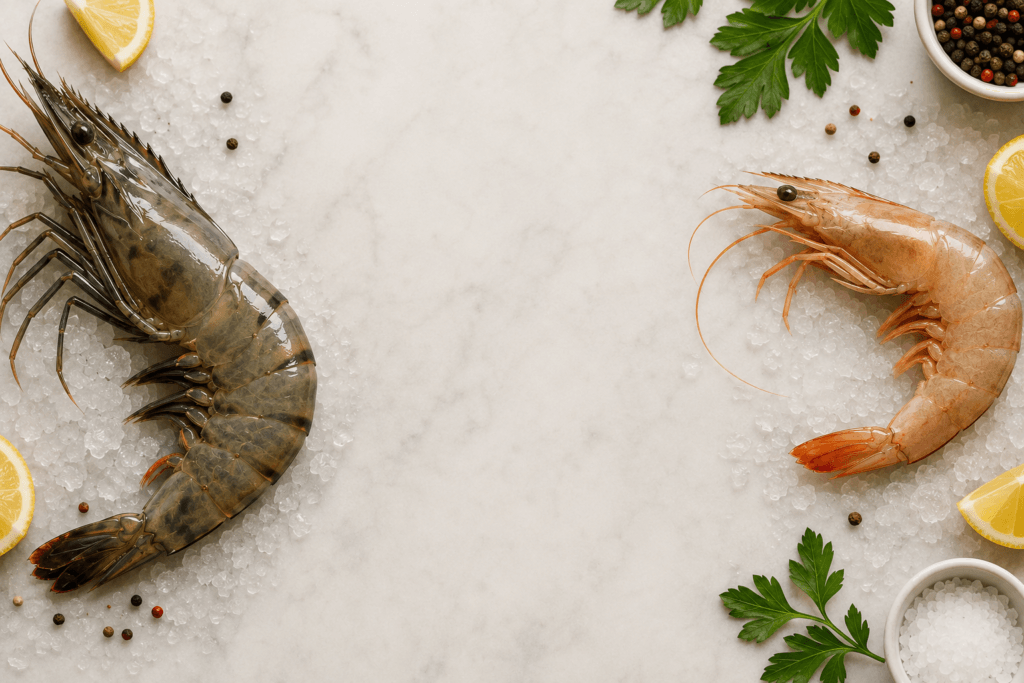
- Product Form and Traceability: Whole, head-on seafood is significantly harder to misrepresent than processed, peeled, and deveined tails. A whole prawn with its distinctive three-segmented shell overlap, branching gills, and paddle-shaped tail fan provides immediate anatomical proof of what you are buying.
- The “Previously Frozen” Reality: Most “fresh” display shrimp was frozen at sea and thawed at the store for presentation. There is nothing inherently wrong with this standard industry practice, but it means you should not refreeze this product at home. If the display ice looks melting or the label lacks a clear freezing disclosure, ask the fishmonger directly when the batch was thawed.
Texture, Flavor, and Cooking Behavior: What the Physical Differences Mean at the Stove
The anatomical differences between prawns and shrimp are not just a classification exercise. They translate directly into how each animal cooks and what it contributes to a finished dish, which is why getting the identification right at the market has real practical consequences in the kitchen.
True cold-water prawns, particularly species like spot prawns or langoustines, have a higher natural sugar content and a more pronounced sweetness than most warm-water shrimp. Their flesh is also denser and holds its texture under heat for slightly longer, making them more forgiving in preparations where precise timing is difficult. The larger body cavity relative to shell means each animal delivers a more substantial amount of edible meat, and the flavor of the meat is more complex, often described as somewhere between a lobster and a conventional shrimp. This is partly why they command a premium and why using them in a heavily spiced or sauced preparation that would mask their flavor is considered wasteful by most professional cooks.
Warm-water shrimp, whether farmed Penaeus vannamei or wild Gulf brown or white shrimp, have a milder, brinier flavor and a slightly softer texture that firms quickly under heat. They take on seasoning and sauce more readily, which is why they perform so well in dishes like shrimp scampi, étouffée, or stir-fries where the surrounding flavors are bold. They also release more moisture as they cook, which can be an advantage when you want to build a pan sauce from the released liquid but a disadvantage if you are trying to achieve a seared, caramelized exterior.
To see how these moisture and texture dynamics play out in specific dishes, check out our collection of tested seafood recipes.
The gill structure difference matters here too. Because prawns are gill-breathers with branching gills rather than the plate-like gills of shrimp, the area around the head retains more fat and flavor compounds. Cooks who use head-on prawns often press the heads into butter or oil at the start of cooking to release that concentrated flavor before adding the bodies. With head-on shrimp, the same technique works but yields a milder result. Knowing which animal you have tells you whether that extra step is worth the effort for the dish you are making.
Prawn as a Menu Tactic: The Marketing Ploy and Seafood Fraud Behind the Label
The word “prawn” carries no legal definition in the United States when it appears on a restaurant menu. There is no federal standard requiring that a dish listed as prawns contain any particular species, any genuine prawn at all, or even a crustacean larger or more premium than the cheapest farm-raised shrimp a kitchen can source. That regulatory gap is not an accident or an oversight that is being corrected. It is a stable condition that has persisted for decades and that a portion of the restaurant industry has learned to exploit with considerable financial success.
The mechanism is straightforward. A steakhouse or seafood chain prices a dish called “jumbo prawns” or “tiger prawns” at several dollars more than an equivalent shrimp dish on the same menu. The word prawn signals luxury, size, and a vaguely European or upscale provenance to most American diners. The kitchen sources standard Penaeus monodon tiger shrimp, a farmed warm-water species widely available at commodity prices, plates six of them with a sauce, and collects the premium. The diner who ordered believing they were receiving something categorically different from shrimp has no practical recourse because no law was technically broken. The menu said prawns. This is prawns as the establishment defines the term, which is to say, whatever they decided to put on the plate.
The problem extends well beyond marketing language into outright mislabeling. Oceana, a nonprofit ocean advocacy organization, has conducted multiple large-scale investigations into seafood fraud in the United States using DNA testing of retail and restaurant samples. Their findings have consistently shown mislabeling rates that should concern any seafood buyer. Shrimp and prawn species are among the most commonly substituted products, with cheaper farmed species sold under the names of more expensive wild-caught or cold-water varieties. A dish presented as wild Gulf shrimp may test as farmed imported shrimp. A restaurant’s “spot prawns” may be a species that has never come within a thousand miles of the Pacific Northwest.
The FDA’s seafood guidance outlines the acceptable market names that retailers and processors are expected to use, and the agency does conduct some enforcement on egregious mislabeling at the import and processing level. But that oversight does not reach the menu description at a restaurant table, and the resources dedicated to seafood fraud enforcement have never matched the scale of the problem. The result is a market where a buyer’s best defense is their own knowledge rather than any institutional guarantee.
For shoppers at the retail level, the fraud risk is somewhat lower than at restaurants because packaged seafood sold through grocery stores is subject to country-of-origin labeling requirements and FDA name standards. A package that calls a product by an FDA-accepted market name and includes species information is making a claim that can at least theoretically be audited. A restaurant menu has no equivalent obligation. This is a meaningful practical difference. Buying whole, identifiable animals from a reputable fishmonger with clear sourcing information is the closest a retail buyer can get to genuine confidence in what they are purchasing. At a restaurant, the honest answer is that the menu tells you what the establishment wants you to believe, and you are extending a degree of trust with no structural mechanism for verification.
“Seafood fraud is a genuine threat to consumers and to the fishing industry. Mislabeling allows cheap or illegal product to undercut law-abiding fishermen and misleads consumers who are trying to make informed choices about health, sustainability, and value.”
According to the National Oceanic and Atmospheric Administration (NOAA), which oversees domestic seafood import monitoring programs in coordination with federal partners
“When consumers purchase seafood they expect it to be what the label says it is. Seafood fraud not only cheats consumers, it also undermines the market for legally caught and honestly labeled fish and shellfish.”
According to the FDA Center for Food Safety and Applied Nutrition, in guidance on seafood identity standards and enforcement priorities
Bringing It Together at the Counter
The prawn versus shrimp distinction starts as a biology question and ends as a consumer literacy question. Physically, the differences are real and readable once you know what to look for: gill structure, body segmentation, claw arrangement, habitat origin, and the general size and density of the animal in front of you. Those physical markers give you a foundation for identifying what you are actually buying rather than relying on whatever label a supplier or restaurant has chosen to print. At the retail counter, a combination of scientific naming, country-of-origin disclosure, and whole-animal purchasing gives you the best chance of getting what you pay for. At a restaurant, the word prawn on a menu is marketing language first and biological description a distant second, and treating it accordingly will save you money and misplaced expectations. The practical upshot is simple: learn the physical differences, ask questions when sourcing matters to your recipe, and let the anatomy of the animal tell you more than the label ever will.
Frequently Asked Questions
Is there a visual test I can do quickly at a fish counter to tell a prawn from a shrimp?
The fastest check on a whole, head-on animal is to look at the first three segments of the body just behind the head. On a prawn, each segment overlaps the one behind it individually, giving the body a stacked, plate-like appearance from the side. On a shrimp, the second segment overlaps both the first and third, creating a slightly different layering pattern. You can also look at the legs: prawns have claws on three pairs of walking legs, while shrimp have claws on only two. Neither test requires any equipment, just a moment of close looking at the animal before you buy.
Are prawns healthier than shrimp, or is that a marketing claim?
Nutritionally, prawns and shrimp are closely comparable. Both are high in protein, low in fat, and provide selenium, iodine, and B vitamins. Cold-water prawn species may carry slightly more omega-3 fatty acids due to their diet and habitat, but the difference is not large enough to drive a dietary choice on health grounds alone. The premium price of genuine prawns reflects their flavor, size, and often their wild-caught or sustainable sourcing status more than any measurable health advantage over shrimp.
Why do British and Australian recipes use “prawn” where American recipes say “shrimp”?
This is a regional naming convention rooted in dialect and culinary tradition rather than biology. In British English and the English spoken across Australia, New Zealand, and much of South Asia, “prawn” is the default word for the entire category of edible shrimp-like crustaceans regardless of size or species. American English settled on “shrimp” as the standard term for the same category. Neither convention maps precisely onto the biological distinction between true prawns and true shrimp. When you see “prawn” in a British or Australian recipe, it almost always means what an American cook would call a medium to large shrimp, and you can substitute accordingly without concern.
How can I avoid paying for mislabeled seafood at restaurants?
No method is foolproof without laboratory testing, but several habits reduce your exposure. Ask your server where the prawns or shrimp are sourced and whether they are wild-caught or farmed. A kitchen with genuine pride in its sourcing will usually have a ready answer; vague or deflecting responses are informative in their own way. Look at the size and uniformity of the animals when the dish arrives: genuine wild-caught spot prawns or cold-water prawns tend to vary somewhat in size, while farmed shrimp sold as a premium product often display the very uniform size grading characteristic of commercial aquaculture. Restaurants that list the specific species or region of origin on the menu are making a claim that signals, though does not guarantee, a higher standard of sourcing transparency.