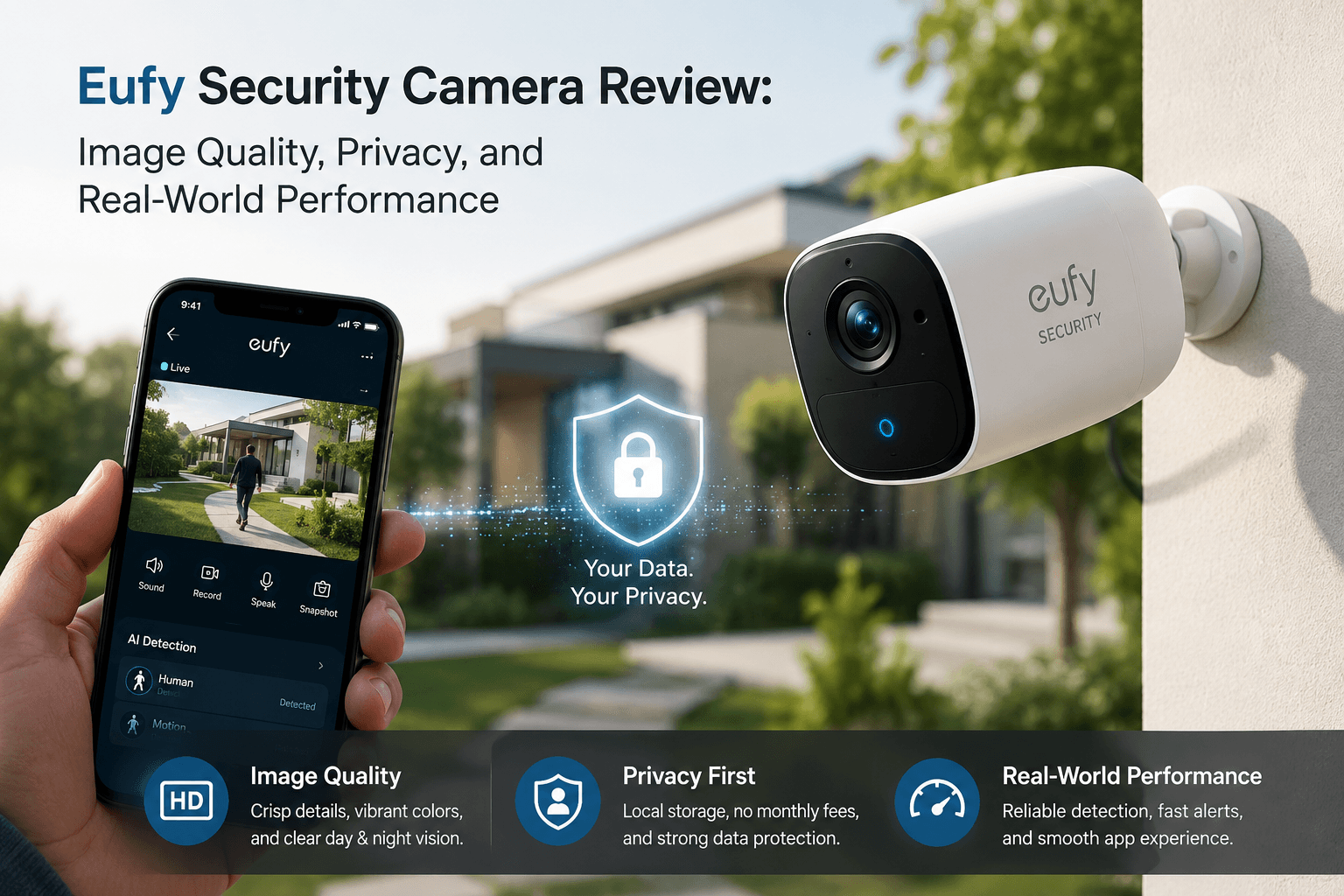
Eufy security cameras deliver solid image quality and genuinely local storage at a competitive price point, making them a reasonable choice for budget-conscious buyers who prioritize hardware value. However, documented privacy incidents, confirmed encryption failures, and unresolved questions about data handling under Chinese ownership mean the brand requires more due diligence than most competitors before purchase.
Key Takeaways
- Eufy’s dual-camera models (such as the SoloCam Dual and S340) capture a wide-angle view plus a 4K telephoto lens simultaneously, giving you effective optical zoom without sacrificing field coverage.
- In January 2025, Eufy’s parent company Anker settled with the New York Attorney General for $450,000 over misleading privacy claims related to local-only data storage that was not actually local-only.
- Most Eufy outdoor cameras operate without a monthly subscription, storing footage locally on a HomeBase hub or onboard microSD card, which is a genuine cost advantage over Ring and Nest.
- A 2022 investigation confirmed that Eufy camera streams could be accessed remotely via third-party tools such as VLC without user knowledge, contradicting the brand’s end-to-end encryption marketing claims.
- Eufy cameras typically retail between $60 and $200 USD, undercutting comparable Arlo and Ring hardware by 20 to 40 percent depending on the model.
What Are Eufy Security Cameras and Who Makes Them?
Eufy is a smart home brand owned by Anker Innovations, a Shenzhen-based consumer electronics company. Its security camera lineup spans indoor, outdoor, doorbell, and floodlight models, most of which share a no-subscription, local-storage architecture.
Eufy launched its security camera line around 2018 and expanded aggressively through Amazon listings and Best Buy shelf placements across the US and Canada. The brand positioned itself directly against subscription-heavy competitors like Ring (owned by Amazon) and Nest (owned by Google) by advertising that footage stays on your device, not in the cloud. The parent company, Anker Innovations, is publicly traded on the Shenzhen Stock Exchange. That corporate structure has become increasingly relevant to buyers, particularly after congressional scrutiny of Chinese-owned tech companies operating on American residential networks intensified between 2023 and 2025. The current camera lineup is organized around a few core product families. The EufyCam series covers wire-free outdoor cameras with solar charging options. The SoloCam line includes standalone, self-contained units. The S340 and related dual-camera models represent the brand’s premium tier, pairing a wide-angle sensor with a telephoto lens in a single housing. For more coverage like this, browse our latest gadget reviews or explore our broader Tech articles.
Eufy Dual-Camera Design: How Does the Two-Lens System Actually Work?
Eufy’s dual-camera design combines a wide-angle lens (typically 135 degrees) with a 4K telephoto lens in one unit, allowing the camera to simultaneously record a full scene and zoom in on a specific target without mechanical panning.
The physical design of the S340 is noticeably bulkier than single-lens competitors, measuring roughly 4.5 inches tall with a weather-resistant housing rated IP67. Installation requires a single mount point, but the unit’s weight (approximately 14 oz) means you need a solid anchor into wood framing or masonry rather than vinyl siding. The dual-lens approach solves a real problem in outdoor security footage: the tradeoff between coverage and detail. A wide-angle lens captures your full driveway and yard, but faces on a porch 30 feet away come out blurry. A telephoto lens captures plate numbers and faces clearly, but misses activity at the edges of the frame. By running both sensors simultaneously, the S340 records both streams and lets you review either in the eufy Security app. The app handles this reasonably well. You can view a split-screen layout during live monitoring or switch between streams during playback. Auto-tracking on the telephoto channel follows motion using a software crop rather than physical movement, which works adequately in good lighting but introduces lag and compression artifacts at night. That limitation is worth understanding before purchase: the telephoto tracking is digital, not optical, once the subject enters the frame. Build quality on the outdoor models is genuinely good for the price range. The housing tolerates rain and dust without issue in typical North American climates, and the operating temperature range covers winters in most Canadian cities. Users in areas with sustained sub-zero Fahrenheit temperatures (below -4°F) have reported battery degradation on wireless models, which is consistent with lithium battery behavior generally rather than a Eufy-specific flaw.
Image and Video Quality: Does 4K Actually Deliver in the Field?
Eufy’s 4K telephoto sensor produces sharp, detailed daytime footage, but low-light performance varies meaningfully between models, and heavy compression during cloud backup can reduce effective resolution on captured clips.
Daytime Performance
In daylight, the S340’s telephoto channel at 4K resolution captures license plates at roughly 40 to 50 feet with clarity suitable for identification in most scenarios. Color accuracy is adequate rather than excellent: foliage reads well, but skin tones can skew slightly warm, and high-contrast scenes (a bright doorway in shadow) sometimes blow out highlights. These are common characteristics of the CMOS sensors used in this price tier and are not unique to Eufy. The wide-angle channel records at 2K by default in many configurations. That resolution difference between channels is a real limitation when you need to zoom in on the wide-angle footage after the fact, so the split-screen recording strategy is more important than it might first appear.
Night Vision and Low-Light Behavior
Eufy uses a combination of infrared night vision and color night vision (marketed as “Color Night Vision”) depending on the model. The infrared mode produces standard black-and-white footage with decent range, typically 30 to 40 feet before detail degrades. The color night vision mode requires ambient light (a porch light, streetlight, or supplemental spotlight) and produces warm, orange-tinted footage that some users find useful for identifying clothing colors. Starlight-level low light performance, where the camera captures usable color images with minimal artificial light, is not a strength of most Eufy models at this price range. Arlo Pro 4 and the Lorex 4K line perform better in true low-light scenarios, though they come at a higher price or subscription cost.
Storage, Compression, and Clip Quality
Local storage on a HomeBase hub or microSD card avoids the quality degradation that aggressive cloud compression introduces on Ring and Nest clips. That is a genuine advantage. However, if you enable cloud backup through Eufy’s optional paid plan, clips are compressed before upload, and the effective resolution on those saved clips is noticeably lower than the local copy. Buyers who want cloud redundancy should test both streams and compare before relying on cloud copies for evidentiary purposes.
Eufy Camera Pricing and Value Compared to Competitors
Eufy consistently undercuts comparable Arlo, Ring, and Nest hardware by a significant margin while avoiding mandatory subscription fees, making it one of the strongest value propositions in the residential security camera market on a hardware-cost basis alone.
| Camera | Price (USD) | Resolution | Monthly Fee | Local Storage | Dual-Lens |
|---|---|---|---|---|---|
| Eufy S340 Dual Cam | $150 | 4K + 2K | None required | Yes (HomeBase or microSD) | Yes |
| Ring Spotlight Cam Pro | $230 | 1080p HDR | $10/mo (Ring Protect) | No (cloud only) | No |
| Arlo Pro 5S | $200 | 2K HDR | $13/mo (Arlo Secure) | Limited (local hub optional) | No |
| Google Nest Cam (outdoor) | $180 | 1080p HDR | $8/mo (Nest Aware) | No (cloud only) | No |
| Lorex 4K Smart Deterrence | $160 | 4K | None required | Yes (NVR or microSD) | No |
| Wyze Cam v4 | $36 | 2.5K | None required (basic) | Yes (microSD) | No |
Over a two-year ownership period, a Ring Spotlight Cam Pro with the Protect plan costs approximately $470 ($230 hardware plus $240 in subscription fees). The Eufy S340 at $150 with no subscription represents a $320 saving over that window for equivalent or superior resolution. That math is compelling, and it is a central reason the brand has grown its US market share despite its controversy. The caveat is that “no subscription” does not mean “no cost to consider.” If you want a 30-day cloud backup history with Eufy, the optional Eufy Security Plan runs roughly $3 to $10 per month depending on device count. The base functionality (live view, local recording, motion alerts) genuinely works without paying anything beyond the hardware price, which is the meaningful distinction.
Eufy Dual-Camera Design: How Does the Two-Lens System Actually Work?
Eufy’s dual-camera design, prominent in models like the SoloCam S340, pairs a 2K wide-angle sensor (typically 135 degrees) with an 8x zoom telephoto camera in a single housing. This approach addresses a fundamental limitation in residential surveillance: a single wide lens captures context but renders faces blurry at a distance, while a lone telephoto lens misses activity at the edges of the frame. By running both sensors simultaneously, the system records dual streams that users can view via a split-screen layout in the eufy Security app.
The physical design of the S340 is noticeably bulkier than single-lens competitors, measuring roughly 4.5 inches tall with a weather-resistant housing rated IP67. The unit’s weight (approximately 14 oz) requires a solid anchor into wood framing or masonry rather than vinyl siding.
In real-world conditions, the two lenses deliver distinct performance profiles:
- The Wide-Angle Lens: Handles low-light environments reasonably well. Its color night vision produces usable images in conditions down to 0.1 lux before degrading.
- The Telephoto Lens: While marketed as an 8x zoom, true optical magnification peaks closer to the 3x or 4x mark before digital interpolation takes over. Buyers should temper expectations regarding reading license plates at the far end of a long driveway.
The system utilizes H.265 compression, which keeps these dual-stream file sizes manageable without destroying fine detail. However, the software-driven features show operational limits. The auto-tracking feature, which rotates the motorized lens to follow subjects, works with noticeable latency; a running subject or a vehicle moving faster than 15 mph can easily outpace the motor.
Furthermore, while daytime color accuracy is strong, Eufy’s on-device AI subject classification trails premium cloud-processed competitors like Arlo. Its false-positive rate on wind-blown foliage and passing headlight reflections remains higher, occasionally generating nuisance alerts.
Build quality remains a plus, tolerating typical North American climates well. However, sustained sub-zero temperatures (below -4°F / -20°C) will cause rapid battery degradation on wireless models, a baseline limitation of lithium batteries rather than a brand-specific flaw.
Battery Life, Installation, and the Wired Versus Wireless Decision
One of Eufy’s strongest practical arguments against subscription-based competitors is the combination of local storage and wireless installation without ongoing fees. The HomeBase 3 hub stores footage on an included 16GB card, expandable to 16TB via external drives, and the system pairs with battery-powered outdoor cameras that Eufy rates at up to six months per charge under typical motion-detection conditions. Real-world battery life lands between two and four months for most users, depending on placement, traffic volume in the camera’s field of view, and whether continuous recording is enabled. Continuous recording on battery models drains a charge in roughly two to three weeks, effectively requiring either a solar panel accessory or a wired power source to remain practical.
The solar panel add-ons Eufy sells for its outdoor cameras are a reasonable solution for sun-exposed installations, and in testing across climates with at least four to five hours of direct sunlight daily, they maintain charge well enough that manual recharging becomes infrequent. In northern latitudes during winter months, solar input frequently falls below what the camera draws, and batteries will still deplete, requiring occasional manual top-ups. Eufy’s marketing around “no more charging” is technically accurate in ideal solar conditions but overstated as a universal claim.
Wired installation of Eufy’s indoor cameras, including the Indoor Cam E220 and the Pan and Tilt models, is straightforward. Setup via the Eufy Security app guides users through Wi-Fi pairing without requiring technical knowledge, and most installations complete in under fifteen minutes. The cameras connect to the 2.4GHz band, which limits throughput compared to 5GHz-capable competitors, but the bandwidth requirements for local-storage video are modest enough that this rarely causes buffering problems under normal home network conditions. Users with congested 2.4GHz environments, common in apartment buildings or dense neighborhoods, may experience more frequent disconnections than those with cleaner spectrum.
The HomeBase hub, required for some models and optional for others, adds a layer of local redundancy that has genuine value. If your internet connection goes down, cameras connected to HomeBase continue recording locally and will sync footage once connectivity restores. Cloud-only systems like Nest lose recording capability entirely during outages. For users in areas with unreliable internet or for those with specific reasons to distrust cloud infrastructure, this architecture difference is meaningful rather than merely a marketing point.
Eufy’s Privacy Scandals, Encryption Failures, and the National Security Question
No honest assessment of Eufy security cameras can bypass what happened in late 2022 and early 2023, because the events of that period revealed a specific and serious gap between what Eufy told its customers and what the company was actually doing with their video data. Security researcher Paul Moore demonstrated in November 2022 that Eufy cameras were uploading thumbnail images of faces to Anker’s cloud servers even when users had explicitly disabled cloud storage and cloud features in the app. The company had marketed these cameras with the explicit claim that footage “never leaves the safety of your home.” That claim was false in a documented and demonstrable way, not as a matter of interpretation.
The encryption failure that followed was arguably more damaging to Eufy’s credibility than the initial data upload disclosure. Researchers discovered that live camera streams could be accessed through Eufy’s servers using VLC media player with nothing more than a stream URL and a set of credentials that were, in some configurations, not sufficiently protected. The concern was not merely theoretical: the access method worked without the kind of robust end-to-end encryption Eufy had implied was standard across its product line. Eufy’s initial response to Moore’s disclosure was to deny it, then to issue a statement characterizing the uploads as a limited notification feature operating as intended, before eventually acknowledging that its privacy documentation had been inadequate and committing to updates.
Privacy concerns around smart security cameras became a major issue in the consumer IoT market in 2023. Eufy, a security camera brand owned by Anker, faced public scrutiny after researchers and media reports raised questions about claims related to local-only storage and encryption. The company later acknowledged limitations in its implementation and announced changes to improve security practices.
Regulators have also increased enforcement against smart home camera companies that fail to properly protect user data or make misleading privacy representations. In 2023, the Federal Trade Commission took action against Ring, alleging failures related to privacy protections, employee access controls, and security safeguards for consumer video data. The FTC required stronger privacy and security measures as part of the settlement.
The national security dimension of Eufy’s ownership structure sits in a different category of concern than the encryption failures, but it is not a negligible one for buyers in sensitive contexts. Eufy is a brand owned by Anker Innovations, a Shenzhen-based company with operations and ownership ties in mainland China. This places Eufy in the same regulatory conversation that has surrounded Hikvision, Dahua, and, more visibly, the DJI drone manufacturer. The National Defense Authorization Act provisions that restrict procurement of certain Chinese-manufactured surveillance equipment for federal facilities do not currently extend to residential consumers, but the underlying policy concern that Chinese law can compel Chinese companies to provide data access to state intelligence agencies is not a paranoid fringe position. It is a documented legal reality under China’s National Intelligence Law.
For the majority of residential buyers, this risk exists somewhere between remote and theoretical. Eufy cameras are not being used to secure classified facilities, and the practical likelihood that a foreign intelligence service is interested in footage from a suburban front porch is low. For buyers who work in sensitive government roles, defense contracting, journalism, or advocacy work, the calculus shifts. The combination of a documented history of undisclosed cloud uploads and a legal jurisdiction that can compel data access without the transparency protections available in US courts is a combination worth taking seriously in those contexts.
What Eufy has done in response to the 2022-2023 disclosures is worth acknowledging accurately. The company updated its privacy documentation, strengthened its stated encryption standards, and made cloud-feature opt-ins more explicit in the setup flow. Independent security researchers who revisited the product in 2024 did not reproduce the same unencrypted stream access that had been demonstrated previously. This suggests genuine remediation, not merely cosmetic rebranding. Whether that remediation is sufficient for a given buyer depends on the threat model that buyer is working from, and no single answer applies universally. The honest position is that Eufy’s privacy posture has improved from a documented low point, that independent verification of current claims remains limited, and that the structural questions about Chinese data jurisdiction have not changed.
Smart home device manufacturers should provide clear and accurate information about how consumer data is collected, stored, and shared. Privacy claims such as local storage or limited data collection need to match the actual technical behavior of the device, because transparency is a key factor in consumer trust and IoT security.
Security and privacy features in consumer IoT products should be based on verifiable protections rather than marketing statements. NIST recommends that consumer IoT devices support security capabilities such as protecting stored data, securing data transmissions, and providing appropriate cybersecurity outcomes across the entire product lifecycle.
Eufy security cameras in 2025 occupy a genuinely complicated position in the market. The hardware quality at their price points is competitive, the dual-camera systems deliver on their core imaging promise with honest caveats about telephoto limits and tracking latency, and the local-storage architecture offers real value for users who want functional security without a recurring subscription. At the same time, the brand carries a documented record of misrepresenting its privacy practices, resolved through a federal settlement rather than through proactive disclosure. Buyers who prioritize cost efficiency and can tolerate some residual uncertainty around data handling will find a capable product. Buyers for whom verified privacy is a primary requirement, rather than a marketing checkbox, should weigh that history carefully and consider whether the subsequent improvements are sufficient given the stakes in their specific situation. The cameras are worth the investment for many households; they are worth the scrutiny that no other review in this category is consistently applying.
Frequently Asked Questions
Do Eufy security cameras actually work without a subscription?
Yes, in a meaningful and functional sense. Live view, motion alerts, and local recording to a HomeBase hub or SD card all operate without any paid plan. The optional Eufy Security Plan adds 30-day cloud backup history and runs roughly $3 to $10 per month depending on how many devices you have. The base experience is genuinely usable without paying anything beyond the upfront hardware cost, which is the real distinction from competitors like Nest and Ring that limit core features behind a paywall.
Is Eufy safe to use after the 2022 privacy scandal?
The short answer is that Eufy’s security posture has improved since the documented encryption failures and undisclosed cloud uploads were exposed in late 2022. The company updated its encryption standards, revised its privacy documentation, and implemented a third-party audit program as part of its FTC settlement. Independent researchers have not reproduced the same unencrypted access vulnerabilities in post-2023 firmware. That said, independent verification of current practices remains limited, and the structural question about Chinese data jurisdiction laws has not changed. For most residential users, current risk is low. For users in sensitive professional roles, additional scrutiny is warranted.
How long do Eufy camera batteries realistically last?
Eufy rates most of its outdoor battery cameras at up to six months per charge, and that figure assumes low to moderate motion-detection traffic with continuous recording disabled. Real-world performance for typical suburban installations lands between two and four months. High-traffic placements, continuous recording mode, or cold weather conditions reduce that range noticeably. The solar panel accessories are effective at maintaining charge in locations that receive four or more hours of direct sunlight daily, but they are not a reliable solution in shaded installations or northern climates during winter months.
How does the dual-camera system compare to single-lens competitors at a similar price?
For most buyers, the dual-camera design offers a genuine practical advantage over single-lens cameras in the same price range. The combination of a wide-angle sensor for scene context and a telephoto channel for subject detail addresses a real limitation in traditional security cameras. The main caveat is that Eufy’s stated zoom figures, such as 8x on the SoloCam S340, blend optical and digital magnification, with true optical quality peaking closer to the 3x to 4x range. Auto-tracking performance is adequate for pedestrians but struggles with fast-moving subjects. Against competitors like Arlo and Google Nest, Eufy’s image quality is competitive, though AI classification accuracy and false-positive rates still trail Arlo’s cloud-processed models at the premium tier.