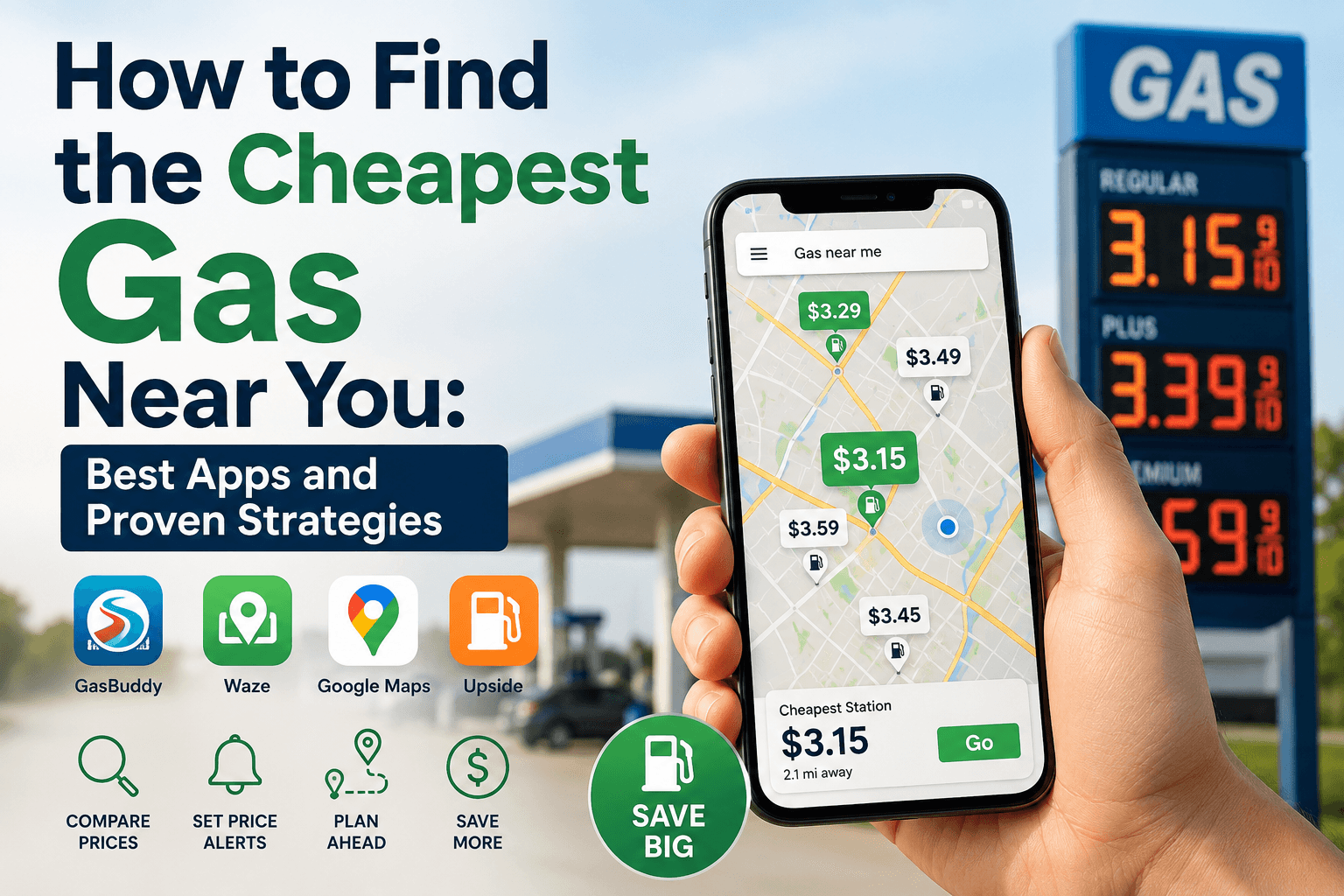
The fastest way to find the cheapest gas is to use a crowd-sourced fuel price app like GasBuddy or GasBuddy’s main competitor, Waze, which pull real-time price reports from drivers in your area and show the lowest-priced stations on a map. Pairing one of these apps with a gas-branded credit card or warehouse club membership can reduce your per-gallon cost by an additional 5 to 25 cents beyond the posted price. Several free apps surface real-time or near-real-time fuel prices reported by other drivers, and the best ones go further by integrating loyalty discounts, route planning, and cashback offers into a single interface. Modern consumer tech has made it shifting from guessing to data-driven saving.
Key Takeaways
- GasBuddy covers more than 150,000 stations across the US and Canada and consistently surfaces prices 10 to 20 cents per gallon below the neighborhood average when you sort by lowest price.
- Waze and Google Maps both display gas prices inline during navigation, making them the most convenient option if you are already routing a trip.
- Tribal gas stations, exempt from state fuel taxes that can exceed 70 cents per gallon in states like California, routinely post prices 50 to 75 cents lower than nearby commercial stations.
- GasBuddy’s Pay with GasBuddy debit card saves an average of 25 cents per gallon with no annual fee, though it drafts directly from your checking account.
- Combining a gas price app with a cashback credit card and a warehouse club membership represents the most reliable three-layer savings strategy available to most US and Canadian drivers.
The Best Cheap Gas Apps Available Right Now
Several free apps surface real-time or near-real-time fuel prices reported by other drivers, and the best ones go further by integrating loyalty discounts, route planning, and cashback offers into a single interface.
Gas prices can vary by as much as 50 cents per gallon within a two-mile radius of each other, according to pricing data aggregated across major US metro areas. That gap is large enough that a 15-gallon fill-up at the wrong station could cost you $7.50 more than necessary. The apps below attack that problem in slightly different ways, so the right choice depends on how you drive and what you already have on your phone.
GasBuddy: The Most Comprehensive Gas Price App
GasBuddy remains the most purpose-built option in this category. The app, owned by PDI Technologies, pulls from a network of more than 150,000 stations across the US and Canada, with prices updated by a community of drivers who earn points redeemable for gift cards each time they report a price. That incentive structure keeps data fresher than most competitors. The free tier lets you search by lowest price, filter by fuel grade, and set price alerts for your home area. The Pay with GasBuddy card, a debit card linked to your checking account, layers on an average savings of 25 cents per gallon at participating stations with no annual fee. The tradeoff is real: because it is a debit card, pre-authorization holds of $100 or more can temporarily tie up funds, which is worth knowing before you sign up. GasBuddy’s map view is cleaner than what you get from general navigation apps, and the station detail pages include amenities like car wash availability and whether diesel or ethanol-free fuel is stocked, useful information for truck owners and flex-fuel drivers.
Waze: Best Gas Price App for Active Navigation
Waze, owned by Google, integrates fuel prices directly into its turn-by-turn navigation interface. When you start a route, Waze can surface nearby stations ranked by price and factor in a short detour to the cheapest option. For drivers who want savings without switching between apps, this is the most frictionless approach. The limitation is coverage. Waze relies on the same community-reporting model as GasBuddy, but its station database is smaller and price reports can go stale faster in lower-traffic areas or at off-peak hours. In dense urban markets like Chicago, Los Angeles, or Toronto, Waze price data tends to be reliable. In rural stretches, it is less dependable.
Google Maps: Good Enough for Most Drivers
Google Maps added fuel price display to its iOS and Android apps and now shows prices on gas station pins directly on the map, no special mode required. For anyone who already uses Google Maps as a primary navigation tool, this is a zero-friction option. Google pulls its price data from a combination of GasBuddy reports, Google Business Profile updates from station operators, and user-submitted corrections. That hybrid sourcing makes it reasonably accurate in most markets, though it lags behind dedicated apps in refresh rate. Think of Google Maps gas pricing as a solid starting point rather than a precision tool.
GasBuddy vs. Waze vs. Google Maps: Which Should You Use?
If your primary goal is finding the single cheapest station within a defined radius, GasBuddy wins on coverage depth and data freshness. If you want price information layered into an active navigation session without any extra steps, Waze is the cleaner experience. Google Maps is the right default for casual users who do not want to install another app and are fine with slightly older price data. One practical strategy: use GasBuddy to identify the cheapest station in your area, then open Google Maps or Waze to route there. That two-app approach takes about 30 seconds and captures the best of both tools.
Other Resources Worth Having: AAA, Membership Clubs, and Gas Price Aggregators
Beyond the big three apps, several institutional and membership-based resources consistently surface prices that crowd-sourced apps may not capture, particularly for warehouse club stations and fleet-linked programs.
AAA and GasPriceWatch
AAA publishes daily average fuel price data by state and metro area at its public-facing fuel gauge report page. This is not a station-finder tool; it is a market-rate reference that helps you understand whether the prices in your area are high, average, or low relative to regional norms. If the station down the street is showing $3.85 and AAA’s metro average is $3.60, you know you are being overcharged. GasPriceWatch.com is an older, less polished alternative to GasBuddy that some drivers in smaller markets find more accurate because its community skews toward users in those areas. It is worth checking if GasBuddy data in your town seems sparse or outdated.
Warehouse Clubs: Costco, Sam’s Club, and BJ’s
Warehouse club gas stations, particularly Costco, operate some of the cheapest per-gallon prices in the country. Costco fuel is consistently 15 to 30 cents below the street average in most US markets, and the savings alone can justify the $65 annual membership fee if you fill up a moderate-sized tank twice a month. Sam’s Club runs similarly priced fuel, and members can use the Sam’s Club app to check current prices at their local club before making the trip. The catch is wait time. Costco gas stations frequently have lines of 10 to 20 minutes during peak hours, and the locations are anchored to warehouse stores, which are not always convenient to daily commutes. If your time has real dollar value, factor that in.
Rewards Programs and Cashback Apps That Cut Your Per-Gallon Cost
Finding a cheap posted price is only one layer of savings; loyalty programs, co-branded credit cards, and cashback platforms can reduce your effective cost per gallon by an additional 5 to 30 cents on top of whatever the app finds.
Gas Station Loyalty Programs
Most major fuel chains run their own loyalty programs. Shell’s Fuel Rewards program offers a baseline 3 cents per gallon discount on every fill-up, with the ability to stack grocery purchase rewards for up to 25 cents off per gallon. BP’s BPme Rewards operates similarly. These programs are free to join and the discounts apply automatically when you scan your app at the pump, so there is no reason not to use one if you fill up at the same brand regularly. The important editorial caveat: a loyalty discount at a higher-priced station does not always beat a no-discount price at a cheaper independent station. Always cross-check the discounted price against what GasBuddy is showing at competitors nearby.
Credit Cards with Gas Cashback
Several credit cards offer 3 to 5 percent cashback on gas purchases, effectively reducing your cost by 11 to 19 cents per gallon at a $3.75 price point. The Costco Anywhere Visa by Citi returns 4 percent on eligible gas purchases up to $7,000 per year. The Blue Cash Preferred card from American Express returns 3 percent at US gas stations. Neither card charges an annual fee tied to the gas benefit alone (though the Blue Cash Preferred has a broader annual fee). Stacking a cashback card on top of a cheap price found via GasBuddy, at a station also running a loyalty program, represents the most aggressive savings posture most drivers can realistically maintain.
Upside: Cashback at the Pump Without a Co-Branded Card
The Upside app (formerly GetUpside) partners with independent and regional gas stations to offer cashback of 2 to 25 cents per gallon, claimed after your fill-up by uploading a receipt or paying through the app at participating stations. Coverage is uneven but strong in the Southeast and Midwest. Savings vary by station and day, so Upside works best as a complement to GasBuddy rather than a replacement.
Gas Price App Comparison: Features at a Glance
| App / Resource | Coverage (US/CA) | Real-Time Prices? | Navigation Integration | Extra Savings Tool | Cost |
|---|---|---|---|---|---|
| GasBuddy | 150,000+ stations | Yes (crowd-sourced) | Basic map, no turn-by-turn | Pay with GasBuddy card (avg. 25¢/gal off) | Free (card optional) |
| Waze | Large but smaller than GasBuddy | Yes (crowd-sourced) | Full turn-by-turn with detour suggestions | None built-in | Free |
| Google Maps | Broad US/CA coverage | Near real-time (hybrid sourcing) | Full turn-by-turn | None built-in | Free |
| Costco Gas (Sam’s Club) | Club locations only | App-listed daily price | None | 15–30¢/gal below street avg. | Membership required ($65/yr Costco) |
| Upside | Thousands of US stations | Varies by partner | None | 2–25¢/gal cashback | Free |
| Shell Fuel Rewards | Shell stations only | Discount applied at pump | None | 3–25¢/gal off with stacking | Free |
Smarter Habits That Cut Your Fuel Costs Beyond the App
Finding a cheaper price per gallon is only half the equation. How and when you fill up can quietly add up to meaningful savings over the course of a year, independent of which app you’re running. These habits layer on top of your price-hunting strategy rather than replacing it.
Fill up on Tuesdays or Wednesdays. Gas prices follow a weekly pattern in most U.S. markets, climbing toward the weekend as station owners anticipate higher demand from leisure drivers. Monday through Wednesday consistently shows lower average prices in most metro areas, and pairing that timing with a quick GasBuddy check before you leave the house costs you nothing extra.
Avoid filling up when a tanker is resupplying the station. When a fuel delivery truck stirs up the sediment at the bottom of underground storage tanks, that particulate can make it into your vehicle and accelerate fuel filter wear. It is a minor issue in modern cars with good filtration, but worth skipping if you have the option.
Keep your tank above a quarter full. Repeatedly running near empty puts extra strain on your fuel pump, which uses the gasoline itself for cooling. A failed fuel pump costs several hundred dollars to replace, which quickly erases months of gas savings. Top-up behavior also keeps you from having to stop wherever is convenient rather than wherever is cheap.
Check your tire pressure monthly. According to the U.S. Department of Energy’s fueleconomy.gov, underinflated tires can reduce fuel economy by roughly 0.2 percent for every 1 PSI drop in average pressure across all four tires. On a vehicle that gets 30 MPG, consistent underinflation by 5 PSI costs you the equivalent of paying several extra cents per gallon every single fill-up. A tire gauge costs about two dollars.
Pair loyalty rewards with the cheapest local price rather than defaulting to a loyalty station. This is where most drivers leave money on the table. If GasBuddy shows a non-partner station at $3.10 and your rewards station is at $3.38, the math rarely closes the gap unless you are earning well above standard reward rates. Use your loyalty program when the base price is already competitive, not as a reason to ignore a cheaper option two blocks away.
Credit Cards, Memberships, and Reward Stacking
The drivers who consistently pay the least at the pump are usually running multiple discount layers at once. This is called stacking, and done correctly it is entirely legitimate and available to anyone willing to organize a few accounts.
The most accessible stack for most people combines a gas-back credit card with a fuel loyalty program and a warehouse club membership. A card like the Costco Anywhere Visa from Citi returns 4 percent on gas purchases at non-Costco stations up to $7,000 per year, while Costco’s own pumps typically run 15 to 30 cents per gallon below the street average. If you are already a Costco member for groceries, the gas benefit alone often covers the annual membership fee within a few months.
Shell Fuel Rewards offers some of the most aggressive stacking options among national chains. The base program gives you 3 cents per gallon off as a free member, but stacking a linked credit card offer, a grocery partner reward, and a promotional bonus can push savings to 25 cents per gallon or more on a single fill-up. The program is free to join and the savings post automatically once your accounts are linked.
The Upside app operates differently from loyalty programs in that it functions as cashback on purchases you were going to make anyway. After claiming an offer in the app, you fill up normally and submit your receipt. Cashback averages 2 to 25 cents per gallon depending on the station and the day, and it deposits to your bank account, PayPal, or as gift cards. Because Upside works at thousands of independent stations, it often applies at the cheapest location GasBuddy already pointed you toward, meaning you stack a low base price with a cash return on top.
Grocery reward programs deserve a mention here because they are underused. Kroger, Safeway, Fred Meyer, and several other chains let you earn fuel points on grocery and pharmacy purchases, often at a rate of 1 point per dollar spent. Promotions on gift cards or specific products can accelerate earnings dramatically. Many members report filling up for 50 cents or more per gallon off during a strong promotional cycle, applied at the chain’s affiliated fuel stations. If your household already shops at one of these grocers, enrolling in the fuel rewards program is a straightforward way to turn spending you were already doing into pump savings.
Save Big at Tribal Gas Stations: Why Prices Are So Much Lower
If you have ever driven past a gas station on or near a Native American reservation and done a double-take at the price sign, the discount you saw was real and it is not a temporary promotion. Tribally owned and operated gas stations are among the most consistently cheap fuel sources in the United States, and the reason comes down to tax law rather than any gimmick.
State fuel taxes are the largest component of above-cost pricing at most gas stations. As of 2024, California’s state excise tax on gasoline sits above 57 cents per gallon, Pennsylvania’s exceeds 58 cents, and when you layer in additional fees and underground storage tank charges, the effective state-level burden in high-tax states can exceed 70 cents per gallon. Tribal lands exist under a unique legal framework in which federally recognized tribes hold sovereign status. Sales made to tribal members on tribal land are generally exempt from state taxation, and in many states the exemption extends to non-member customers purchasing fuel at tribally operated stations as well, depending on the specific compact or agreement between the tribe and the state.
The result is a structural price advantage that no app-based coupon can replicate. A tribal station in a high-tax state is not offering a promotion. It is simply operating outside the tax layer that inflates every other pump in the region. Savings of 30 to 70 cents per gallon compared to nearby non-tribal stations are not unusual in states like California, Washington, Arizona, and New Mexico, where both fuel taxes and the density of tribal nations make the effect especially pronounced.
The legal basis for these exemptions has been affirmed through a series of federal decisions and tribal-state compacts that define the boundaries of tribal sovereignty over commercial activity. According to guidelines on tribal sovereignty from the Bureau of Indian Affairs, federally recognized tribes maintain governmental authority over their lands, which underlies the tax treatment that produces these savings.
Finding tribal stations requires a slightly different approach than standard price apps. GasBuddy lists many tribally operated stations but does not filter by ownership type. The most reliable method is to search Google Maps for the name of a federally recognized tribe in your area followed by “gas station” or “travel plaza.” Many tribes operate branded travel centers under names that include the tribe’s name or a specific brand like “One Stop” or “Nation Fuels.” If you live or drive within 30 to 40 miles of reservation land, adding a tribal station stop to your regular route can produce savings that dwarf anything available through loyalty apps, with no membership required at most locations.
It is worth noting that some tribal stations do charge non-member customers state tax rates as part of their compact agreements, so prices vary by tribe and state. The savings are still frequently significant even where full exemptions do not apply, and the only way to know for certain is to check the price board when you arrive or call ahead.
“The federal trust relationship between the United States and Indian tribes is one of the most important and complex in American law. Tribal sovereignty includes the authority to govern economic activity within Indian country, including commercial enterprises such as fuel sales.”
Bureau of Indian Affairs, U.S. Department of the Interior, Overview of Tribal Governance
“State fuel taxes are structured as excise taxes collected at the point of distribution. When sales occur within the boundaries of Indian country to or by tribal entities, the state’s jurisdiction to impose those taxes is constrained by federal law and varies significantly based on the specific facts of each transaction.”
National Conference of State Legislatures, State Motor Fuel Taxes: Notes Summary
Knowing how to find the cheapest gas near you is ultimately a skill built from several overlapping habits rather than a single app or trick. The most effective drivers combine real-time price tracking through GasBuddy or Waze with a cashback credit card, at least one loyalty program that fits their regular shopping patterns, and an awareness of structural discounts like warehouse clubs and tribal stations that sit beneath the market floor. Route planning your fill-up the same way you might plan a grocery run, checking prices the night before and confirming on the morning of, turns what feels like a small effort into savings that compound into hundreds of dollars over a year of driving.
Knowing how to find the cheapest gas near you is ultimately a skill built from several overlapping habits rather than a single app or trick. Leveraging everyday mobile tech solutions turns what feels like a small effort into savings that compound into hundreds of dollars over a year of driving.
Frequently Asked Questions
What is the best free app to find the cheapest gas near me?
GasBuddy is the most widely used option and covers the largest number of stations across the United States and Canada. Its prices are crowd-sourced and updated frequently, making it reliable for real-time comparisons within a few miles of your location. Waze is a strong alternative if you want gas prices integrated directly into your navigation without switching apps.
Are tribal gas stations open to the public?
Most tribally owned gas stations and travel plazas are open to the general public, not just tribal members. While the tax exemption that produces lower prices may apply differently to non-member purchases depending on the state and tribe, non-members are almost universally welcome to purchase fuel. Check the price sign before you commit, as savings vary by location.
Is it worth paying for a Costco membership just for cheaper gas?
For many households, yes. Costco gas typically runs 15 to 30 cents per gallon below surrounding street prices. A household that buys 50 gallons per month would save $90 to $180 annually on fuel alone at the lower end of that range, which exceeds the $65 annual membership fee without counting any grocery or merchandise savings. The calculus depends on how close a Costco station is to your regular routes.
Can you stack GasBuddy, a credit card reward, and a loyalty program together?
Yes, and this is the most effective way to maximize savings. GasBuddy helps you identify the cheapest base price in your area. A gas-back credit card earns a percentage on the purchase regardless of where you fill up. A loyalty program like Shell Fuel Rewards or a grocery fuel reward applies a per-gallon discount at the pump. All three can apply to the same transaction, meaning your effective cost per gallon reflects all three discounts simultaneously.