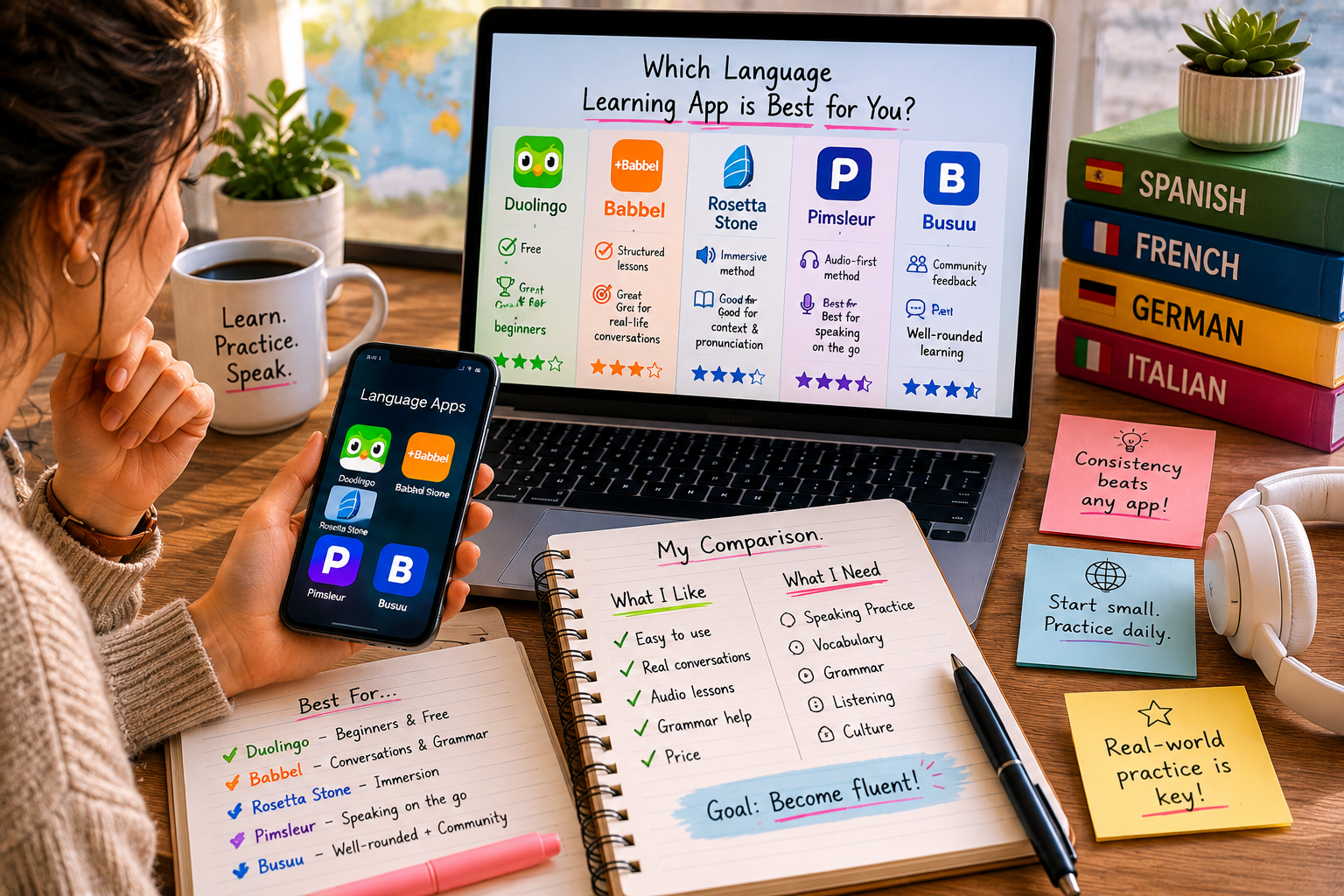
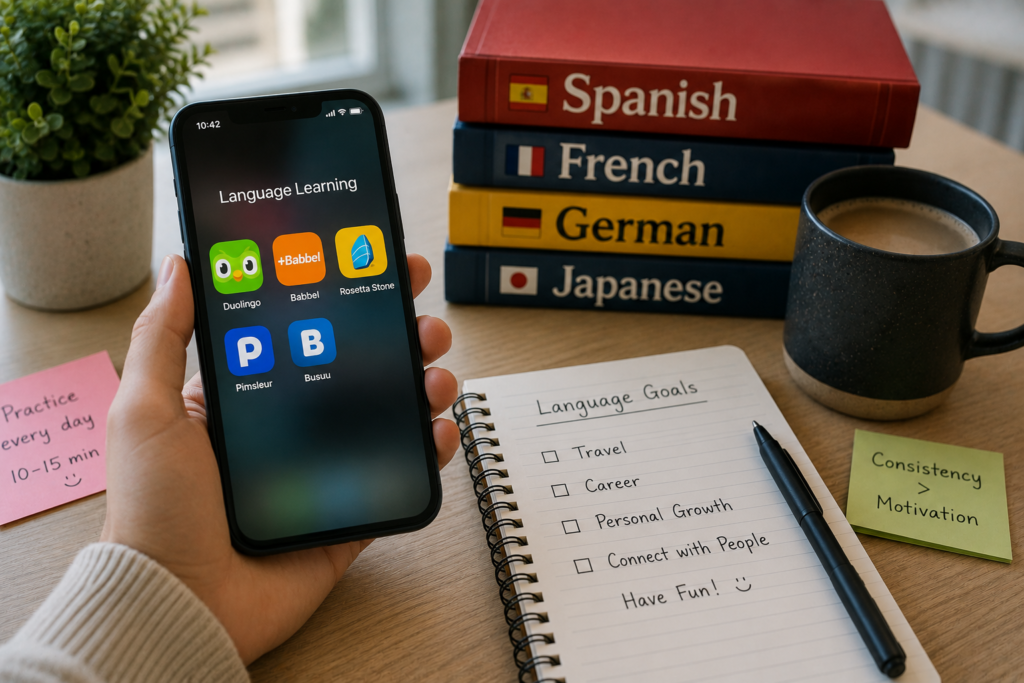
Picking up a second language as an adult is one of the most practical things you can do, whether you are preparing for a trip to Mexico, supporting a bilingual household, or simply keeping your brain sharp in retirement. The challenge is that the app market is crowded, loudly marketed, and full of conflicting promises. This guide, part of our broader Education articles coverage at Wide Journal, cuts through the noise with research-backed comparisons of the five platforms US and Canadian adults reach for most: Duolingo, Babbel, Rosetta Stone, Pimsleur, and Busuu.
The global language learning market was valued at roughly $62 billion in 2023 and continues to expand, according to market research firm Grand View Research. That growth has attracted heavy investment and marketing budgets that sometimes outpace actual pedagogical results. Understanding what the evidence actually says about each platform helps you spend your time and money more carefully.
For Canadian readers, the stakes around language learning are especially high. According to Statistics on Official Languages in Canada, about 18% of Canadians reported being able to conduct a conversation in both English and French as of the 2021 Census, and provincial bilingualism requirements continue to shape career opportunities from Ottawa to Moncton. The right app can be a meaningful first step, but it is never the whole journey.
Key Takeaways
- A peer-reviewed meta-analysis of 23 studies found mobile-assisted language learning apps show a moderate-to-strong effect (Hedges’ g = 0.88) on second-language achievement compared to traditional instruction, though study quality varied.
- A Michigan State University study on Babbel found 59% of participants improved oral proficiency by at least one sublevel on the ACTFL scale after roughly 10 hours of use, with more hours correlating directly with better outcomes.
- Duolingo is free and highly engaging but primarily builds vocabulary and reading recognition; independent research consistently finds it less effective than Babbel or Pimsleur for spoken proficiency.
- Pimsleur’s audio-first method makes it the strongest choice for commuters and auditory learners targeting conversational speech, but it offers minimal reading or writing practice.
- No app alone produces fluency. University of Wisconsin-La Crosse faculty research identifies real-world communication practice as the critical gap all current apps share.
What Does the Research Actually Say About Language Learning Apps?
Independent academic research shows apps can meaningfully accelerate vocabulary and basic grammar acquisition, but consistent evidence for conversational fluency remains limited across all platforms.
Before comparing individual apps, it helps to understand the research landscape. A peer-reviewed meta-analysis covering 23 studies from 2007 to 2019 found that mobile-assisted language learning apps produced a moderate-to-strong overall effect size (Hedges’ g = 0.88) on second-language achievement compared to traditional methods. However, the authors noted significant variability in study quality, small sample sizes in several included trials, and a publication bias toward positive results. That g = 0.88 figure is genuinely encouraging, but it should be read with appropriate caution rather than treated as a guarantee.
Professor Shawn Loewen and colleagues at Michigan State University conducted some of the most frequently cited North American research on this topic. Their work, summarized by MSU Today, examined Duolingo, Babbel, and Busuu across vocabulary retention, grammar comprehension, oral proficiency, and learner retention rates. The findings were nuanced: all three apps improved discrete language skills to varying degrees, but oral proficiency gains were modest across the board, and dropout rates were high. Motivation, consistency, and study time mattered far more than which specific app a learner chose.
The Real-World Communication Gap
Faculty research at the University of Wisconsin-La Crosse evaluated Duolingo, Rosetta Stone, and Pimsleur against four practical criteria: accessibility, quality of feedback, interactivity, and cultural content. Their 2025 findings confirmed what many adult learners already suspect: apps are effective scaffolding tools, not replacement classrooms. Every platform showed notable limitations when it came to preparing learners for the spontaneous, culturally embedded demands of real conversation. Apps that incorporate speech recognition and cultural context fared better, but none fully closed the gap.
Duolingo: The Free Option That Keeps You Coming Back
Duolingo (privately held) is the most downloaded language app in the world and is genuinely free, but its gamified structure optimizes for daily streaks more than speaking ability.
Duolingo’s core strength is accessibility. The free tier covers over 40 languages, requires no subscription, and uses a streak-based reward system that keeps casual learners engaged. Its bite-sized lessons work well on a commute or during a lunch break, making it easy to build a daily habit. For North American adults starting with Spanish, French, or Japanese, it is a reasonable zero-cost entry point.
The limitations are real, though. Duolingo’s exercises lean heavily on translation and multiple-choice recognition tasks, which build reading vocabulary faster than speaking ability. Sentence structures in early lessons are often unnatural (“The bear drinks milk”), and the gamification can create a false sense of progress where a learner holds a 200-day streak but struggles to order coffee in the target language. Duolingo’s Super subscription ($6.99/month as of early 2026) removes ads and adds offline access, but the core pedagogical approach does not change with a paid tier.
Who Should Choose Duolingo?
Duolingo works best for beginners who need a free, low-pressure introduction, travelers building basic phrase recognition, or learners supplementing a class or tutor. It is a weaker choice for adults who need functional conversational ability within a specific timeframe.
Babbel: The Research-Backed Middle Ground
Babbel has the strongest body of independent academic evidence supporting its effectiveness for adult learners, particularly for oral proficiency gains tied to consistent use.
Babbel stands out in the research literature more than any other consumer app. The MSU-conducted Babbel study, published with detailed methodology, found that 59% of participants improved oral proficiency by at least one sublevel on the ACTFL scale, with outcomes directly correlated to hours spent in the app. That is a meaningful, verifiable finding. Babbel’s curriculum is developed by professional linguists, lessons are structured around real dialogue scenarios, and the app targets 14 languages with particular depth in European options.
Pricing runs approximately $13.95/month or $83.40/year (around $6.95/month) as of early 2026. That cost is modest for what amounts to a structured curriculum, but it is worth noting that Babbel’s speech recognition is functional rather than exceptional, and its cultural content, while better than Duolingo’s, still falls short of immersive programs.
Rosetta Stone: Immersive but Expensive
Rosetta Stone’s immersion method avoids translation entirely, which suits some learners but frustrates adults who want grammatical explanations and faster early progress.
Rosetta Stone is the oldest brand in consumer language software, and its approach has barely changed in 30 years: images, audio, and target-language text only, no translations, no English explanations. For visual learners who absorb context naturally, this can feel intuitive. For most adult learners accustomed to explicit grammar instruction, the early stages feel slow and opaque.
Subscription pricing sits around $11.99/month for a single language or $179 for a lifetime subscription covering all 25 languages, prices that have fluctuated with seasonal promotions. Rosetta Stone offers live tutoring sessions as an add-on, which the UW-La Crosse research suggests is exactly the kind of real-world interaction that meaningfully improves outcomes. Without those sessions, the core app earns mixed reviews for adult learners with time constraints.
Pimsleur: The Best Option for Spoken Language
Pimsleur’s spaced-repetition audio method consistently outperforms other apps for conversational pronunciation and speaking confidence, making it the top pick for commuters and auditory learners.
Pimsleur (owned by Simon and Schuster, a subsidiary of KKR-held companies) uses 30-minute audio lessons built around spaced repetition and prompt-response speaking drills. Learners listen, repeat, and respond without looking at a screen, which means the method transfers directly to speaking situations rather than reading recognition. For adults who spend 30 minutes or more commuting each day, Pimsleur converts dead time into productive practice in a way no screen-based app can match.
The tradeoff is real: Pimsleur teaches almost no reading or writing, and lessons can feel repetitive after the first level. Pricing runs approximately $14.95/month or $150/year per language. It covers over 50 languages, with strong depth in Spanish, French, Mandarin, Japanese, and several less-commonly taught options. For Canadian learners targeting French oral proficiency specifically, Pimsleur is worth serious consideration.
Busuu: The Underrated Option for Grammar and Community
Busuu combines structured grammar lessons with a native-speaker correction community, offering a social learning layer that most competing apps lack entirely.
Busuu is frequently overlooked in popular comparisons but appears favorably in the MSU research alongside Duolingo and Babbel. Its distinguishing feature is a community of native speakers who review and correct user writing exercises, adding a real human feedback loop. Grammar explanations are clear and sequenced logically, making Busuu a strong option for learners who found Rosetta Stone too opaque but want more structure than Duolingo provides. Premium pricing is approximately $9.99/month or $59.99/year, making it the most affordable paid option in this comparison.
| App | Price (Monthly) | Languages | Best For | Weakest Area | Key Research Finding |
|---|---|---|---|---|---|
| Duolingo | Free / $6.99 Super | 40+ | Beginners, casual learners | Speaking proficiency | High engagement; modest oral gains (MSU, 2020) |
| Babbel | ~$13.95 / $6.95 annual | 14 | Adults wanting structured progress | Speech recognition quality | 59% improved ACTFL oral sublevel (MSU, 2019) |
| Rosetta Stone | ~$11.99 / $179 lifetime | 25 | Visual, immersive learners | Slow early progress for adults | Mixed outcomes; live tutoring improves results (UW-La Crosse, 2025) |
| Pimsleur | ~$14.95 | 50+ | Commuters, auditory learners, speaking focus | Reading and writing skills | Strong spaced-repetition evidence for oral retention |
| Busuu | ~$9.99 / $59.99 annual | 12 | Grammar-focused learners wanting feedback | Smaller community than Duolingo | Positive outcomes in MSU multi-app comparison (2020) |
Alternative Perspectives
Some language acquisition researchers argue that all consumer apps, regardless of marketing claims, share a fundamental design problem: they are built to maximize daily active users and subscription renewals, not learning outcomes. Steven Krashen’s influential Input Hypothesis suggests that comprehensible, contextually rich input (books, podcasts, conversations, films) drives acquisition more efficiently than drilled exercises. From this perspective, spending $10/month on a Netflix subscription in your target language and pairing it with a weekly conversation partner on a platform like iTalki may outperform any paid app for intermediate learners.
A contrasting view, supported by the meta-analysis evidence, holds that structured app-based practice meaningfully supplements other learning inputs, particularly for absolute beginners who need systematic vocabulary and pronunciation foundations before they can benefit from immersion content. The debate is not fully settled, and the honest answer is that the optimal approach almost certainly combines app-based work with human interaction and real media consumption.
“We found that all three apps (Duolingo, Babbel, and Busuu) had some positive effects on language learning, but the effects were relatively modest and were much more pronounced for vocabulary than for speaking ability.” — Professor Shawn Loewen, Department of Linguistics and Germanic, Slavic, Asian and African Languages, Michigan State University, as reported by MSU Today (2020)”Mobile-assisted language learning applications produced a moderate-to-strong overall effect (g = 0.88) on second language learning achievement compared to traditional methods, though the authors noted the need for caution given variability in study quality and potential publication bias.” — Peer-reviewed meta-analysis of 23 studies, published in PMC/NCBI (2022)
Which App Should You Actually Choose?
The best language learning app for most US and Canadian adults is the one that fits your daily routine, matches your learning style, and includes speaking practice from the first week.
Match the App to Your Goal
If your goal is conversational Spanish or French before a trip or a move, Babbel or Pimsleur will get you further faster than Duolingo. If you have a 30-minute daily commute, Pimsleur is the clearest recommendation. If budget is the deciding factor and you are a motivated self-starter, Duolingo’s free tier is a legitimate starting point, provided you supplement it with real speaking practice, such as a language exchange partner, a community class at a local library or YMCA, or a low-cost tutor through a platform like iTalki.
The 12-Month Outlook for Language Apps
AI-powered speech feedback is the most significant development likely to reshape this category over the next year. Duolingo has been integrating large language model features into its Max subscription tier (approximately $29.99/month), which includes AI roleplay conversation practice. If that feature matures into reliable, natural feedback, it could close the speaking proficiency gap that currently makes Pimsleur and Babbel stronger choices. Babbel and Rosetta Stone are both developing similar AI conversation features. The learner who starts with a strong app foundation today and transitions to AI-assisted conversation practice within six to twelve months may see outcomes meaningfully better than what current research reflects.
Disclaimer
Educational outcomes vary based on individual effort and circumstances. Course availability, pricing, and curriculum are subject to change. Verify current details with the provider.
Frequently Asked Questions
Duolingo is effective for building vocabulary and reading recognition, particularly in the early stages of learning. Independent research from Michigan State University found positive but modest outcomes, especially for oral proficiency. It works best as a free starting point or daily habit supplement, not as a standalone path to conversational fluency.
Pimsleur is generally the strongest choice for adults prioritizing spoken proficiency, particularly those who can practice during a commute. Babbel is a close second, with independent research showing 59% of learners improved oral proficiency by at least one ACTFL sublevel after roughly 10 hours of use. Both outperform Duolingo for speaking outcomes.
The MSU Babbel study found that outcomes improved directly with hours spent in the app, and most researchers suggest a minimum of 20 to 30 minutes of daily, consistent practice to see measurable progress within three to six months. Sporadic use, even at longer session lengths, produces weaker retention than shorter daily sessions.
Apps can help build foundational vocabulary, grammar, and listening comprehension, which are useful for formal bilingualism testing. However, Canadian workplace French requirements, such as those for federal positions assessed under the Public Service Commission’s Second Language Evaluation, require oral interaction proficiency that no app currently delivers reliably on its own. Combining an app like Babbel or Pimsleur with a qualified tutor or French-language community program is the more effective path.