Learning Spanish is one of the most practical language goals you can set in 2026. Whether you’re aiming to connect with family, advance your career, or simply navigate a trip to Mexico or Colombia more comfortably, the question nearly every beginner asks is the same: how long does it take to learn Spanish? The honest answer depends on your starting point, your daily study habits, and what “learned” actually means to you. This guide breaks it all down using verified data and real proficiency frameworks. For more language learning resources, browse our Languages section or explore all our education articles.
KEY TAKEAWAYS
- Spanish is one of the fastest major languages for English speakers to learn, with U.S. FSI estimates placing professional working proficiency at roughly 600–750 total study hours.
- The meaning of “learning Spanish” matters: basic travel conversations may require only 150–200 hours, while conversational fluency often starts around B2 (500–600 hours).
- CEFR milestones provide a practical roadmap: A1–A2 for beginner communication, B1–B2 for everyday fluency, and C1+ for professional or academic use.
- Daily consistency changes everything: 30 minutes a day can produce A2–B1 in a year, while 1–2+ hours daily can accelerate progress dramatically.
- Study quality matters as much as study time; speaking practice, active recall, and spaced repetition outperform passive exposure.
- Intensive courses can speed up short-term gains, but research suggests long-term retention improves when learning is spread over time with regular practice.
- AI language apps work best as a support system rather than a complete solution; combining apps with conversation, tutoring, and immersion creates faster results.
- Treat fluency timelines as guidelines, not guarantees—progress varies based on motivation, prior language experience, and access to real-world Spanish use.
What the Research Actually Says About Spanish Learning Hours
According to the U.S. Foreign Service Institute, Spanish requires roughly 600 to 750 total hours of study for English speakers to reach professional working proficiency, making it one of the fastest languages for Americans to learn.
The most widely cited benchmark for language learning timelines comes from the U.S. government’s own training program. According to the Foreign Language Training overview from the U.S. Department of State, Spanish falls into Category I, meaning it is among the languages most similar to English and requires the fewest hours to reach a usable level of proficiency. The FSI estimates 552 to 690 classroom hours over 24 to 30 weeks to reach ILR Level 3, which corresponds to professional working proficiency. That training model runs at approximately 23 hours per week in class plus 17 hours of self-study, totaling around 40 hours per week.
That pace is designed for full-time diplomatic trainees, not everyday learners juggling jobs and families. But the total-hour target is still a useful anchor for anyone building a personal study plan.
According to the U.S. Department of State’s Foreign Service Institute, Spanish is classified as a Category I language alongside French, Italian, and Portuguese, reflecting its structural similarities to English and its relatively accessible learning curve for native English speakers.
CEFR Spanish Levels: How Long Does Each Stage Take?
The CEFR framework divides Spanish proficiency into six levels, from A1 beginner to C2 mastery. Each level requires progressively more hours, and most learners find conversational fluency falls around the B2 mark.
The Common European Framework of Reference (CEFR) gives learners a consistent way to measure progress. According to the Institut français and broadly accepted language education benchmarks, the approximate guided learning hours per level for Spanish look like this:
| CEFR Level | Description | Cumulative Hours (Estimate) | Real-World Ability | Equivalent Milestone |
|---|---|---|---|---|
| A1 | Beginner | 60-80 hours | Basic greetings, simple questions | First few months of casual study |
| A2 | Elementary | 150-200 hours | Short conversations, travel phrases | Roughly one semester of college Spanish |
| B1 | Intermediate | 300-400 hours | Handles most everyday situations | Two to three semesters; passing DELE B1 |
| B2 | Upper Intermediate | 500-600 hours | Fluent conversation, understands TV/film | What most people mean by “fluent” |
| C1 | Advanced | 700-900 hours | Near-native expression, nuanced topics | Professional or academic use |
| C2 | Mastery | 1,000+ hours | Essentially indistinguishable from native | Rare; requires years of immersive use |
Note that these are guided learning estimates. Independent study, immersion, and prior knowledge of related languages like Italian, French, or Portuguese can all shift these numbers significantly.
Spanish Fluency Timeline by Daily Study Hours
Your daily commitment is the single biggest factor controlling your timeline. Studying 30 minutes a day produces very different results than studying two hours, even if you use identical materials.
What Can You Achieve in One Year?
At 30 minutes per day (about 180 hours in a year), most learners reach a solid A2 to B1 level, enough to handle travel and simple conversations. At one hour per day (365 hours), reaching B1 to low B2 in 12 months is realistic for a motivated, consistent learner. At two or more hours daily, hitting B2 conversational fluency within 10 to 12 months is achievable, especially with structured input like tutoring or an immersive program.
Does Study Quality Matter as Much as Hours?
Yes, significantly. Active recall, spaced repetition, and speaking practice produce better results than passive exposure hour for hour. Data from the University of Colorado Boulder’s Anderson Language and Technology Center shows that candidates who achieved Advanced Low proficiency on Spanish oral assessments reported studying approximately 19 hours per week outside of class, compared to only 6 hours per week for candidates who did not reach that benchmark. The gap between those two groups is not talent; it is structured time investment.
How Intensive Courses Affect Your Spanish Fluency Timeline
Intensive and immersive Spanish programs can compress timelines dramatically, but research suggests that long-term retention depends on consistent practice after the course ends.
According to a peer-reviewed study published in PubMed in November 2024, an online medical Spanish course taught by native speakers produced measurable proficiency gains in medical students, with findings suggesting that structured, instructor-led formats can be effective even in non-traditional delivery models.
A related study from Harvard Medical School, published in NIH PMC in November 2025, compared intensive versus longitudinal medical Spanish courses using validated ALTA CCLA proficiency assessments scored from 0 to 100. Researchers found that both course formats produced statistically significant proficiency improvements, but longitudinal courses, spread over more time with sustained practice, were associated with stronger long-term retention. This aligns with what language educators have long observed: cramming hours into a short window builds initial skill, but spacing practice over time cements it.
How to Learn Spanish Faster in 2026
Combining structured learning tools with real conversational practice is the most efficient approach for modern learners, and today’s AI-powered apps make that combination more accessible than ever before.
Use AI-Powered Apps as a Daily Foundation
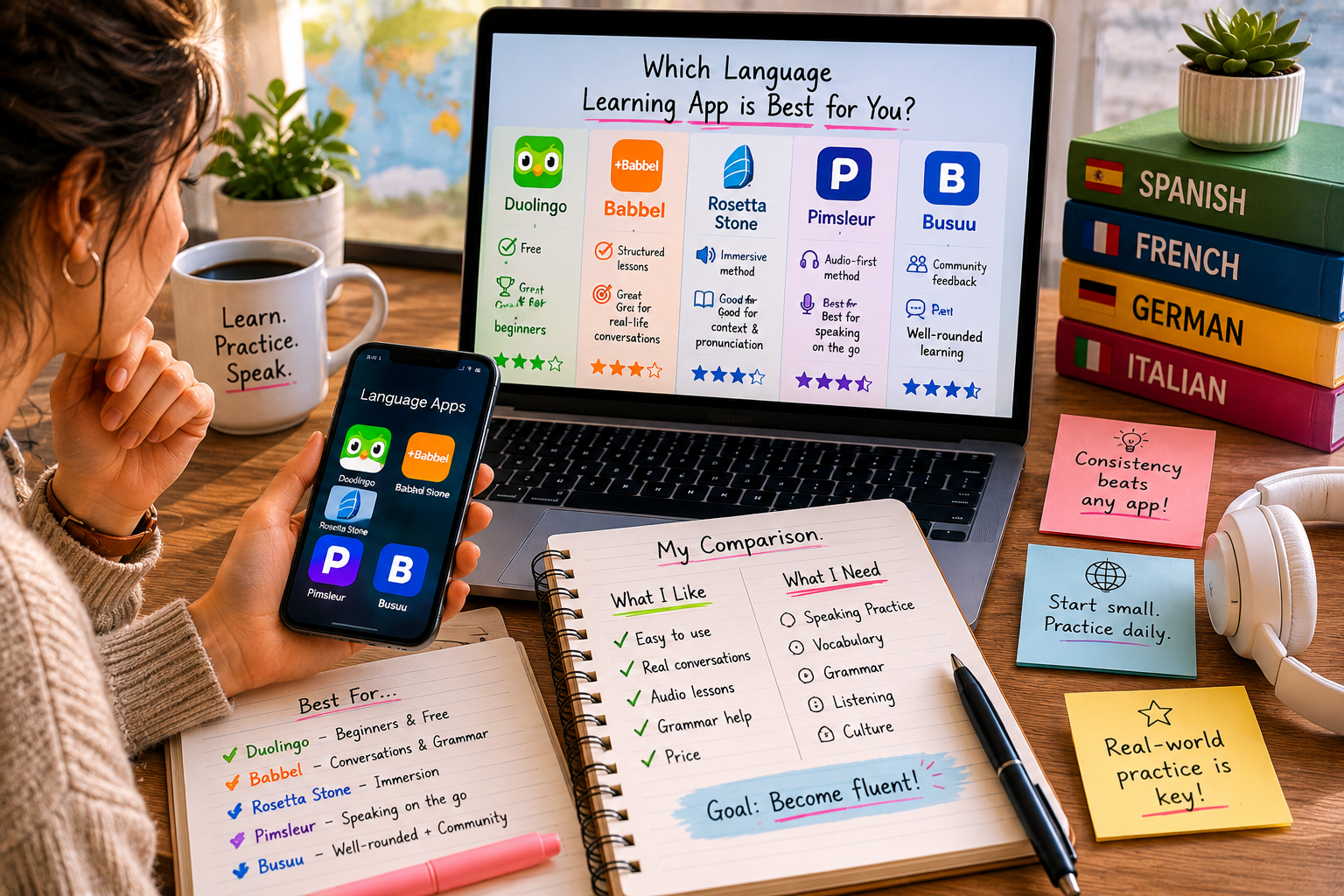
Consistency is easier when your tools meet you where you are. Today’s AI-driven language apps adapt to your pace, highlight weak spots, and gamify repetition in ways that support daily habit formation. For a detailed breakdown of what’s available right now, check out our guide to the best AI language learning apps, which covers platforms like Duolingo, Pimsleur, and Babbel with side-by-side comparisons. Apps work best as a foundation, not a ceiling: pair them with conversation practice, TV shows in Spanish, or a tutor to move through CEFR levels more quickly.
Prioritize Speaking Early and Often
Many learners delay speaking until they feel “ready,” which can slow overall progress. Speaking forces active recall, highlights gaps faster than passive reading, and builds the real-time processing speed that defines conversational fluency. Even short sessions with a language exchange partner or an online tutor a few times per week can accelerate progress noticeably.
Is Immersion Realistic for Most Americans?
Full immersion in a Spanish-speaking country remains one of the fastest routes to fluency, particularly for reaching B2 and above. That said, domestic immersion options have expanded considerably. Major U.S. cities with large Spanish-speaking communities, Spanish-language media, podcasts, and workplace exposure can approximate many immersion benefits without the cost of relocation. Summer break, a sabbatical, or even a week-long language camp during a holiday can serve as a concentrated boost.
Alternative Perspectives
Not everyone agrees that hour counts and proficiency frameworks tell the full story. Some language educators argue that emotional investment and cultural connection accelerate acquisition in ways that are difficult to measure in hours alone. Others point out that CEFR and FSI benchmarks were developed for classroom or diplomatic contexts, which may not reflect the experience of self-taught learners, heritage speakers reconnecting with the language, or adults using immersive media-based methods. The research base for certain app-driven approaches is still maturing, and learner outcomes vary widely based on motivation, native language background, and access to conversation partners. Treat timelines as useful guides rather than hard guarantees.
Disclaimer: Educational outcomes vary based on individual effort and circumstances. Course availability, pricing, and curriculum are subject to change. Verify current details with the provider.
Frequently Asked Questions
At one hour of focused daily study, most English-speaking adults can reach conversational fluency (B2 on the CEFR scale) in roughly 18 to 24 months. Studying two or more hours daily with speaking practice and structured input may shorten that to 10 to 12 months. The FSI estimates 600 to 750 total hours to reach professional working proficiency, so your daily hours are the primary lever you control.
Spanish is considered one of the easiest languages for native English speakers. The U.S. State Department’s Foreign Service Institute classifies it as a Category I language, meaning it shares significant vocabulary, alphabet, and sentence structure patterns with English. Most learners find early progress faster than with languages like Mandarin, Arabic, or Japanese.
Three months of consistent, high-intensity study (two or more hours daily) can bring a complete beginner to A2 or early B1, which covers basic conversation and travel situations. Reaching full conversational fluency (B2) in three months is not realistic for most adults without prior exposure to the language. Be cautious of programs that promise fluency in 90 days without defining what “fluency” means.
Spanish proficiency can broaden job options in healthcare, education, social services, government, and international business, particularly in U.S. states with large Spanish-speaking populations. According to the U.S. Bureau of Labor Statistics, demand for interpreters and translators is projected to grow, and bilingual professionals in fields like nursing or social work often qualify for bilingual pay differentials. Individual outcomes vary based on industry, location, and proficiency level.