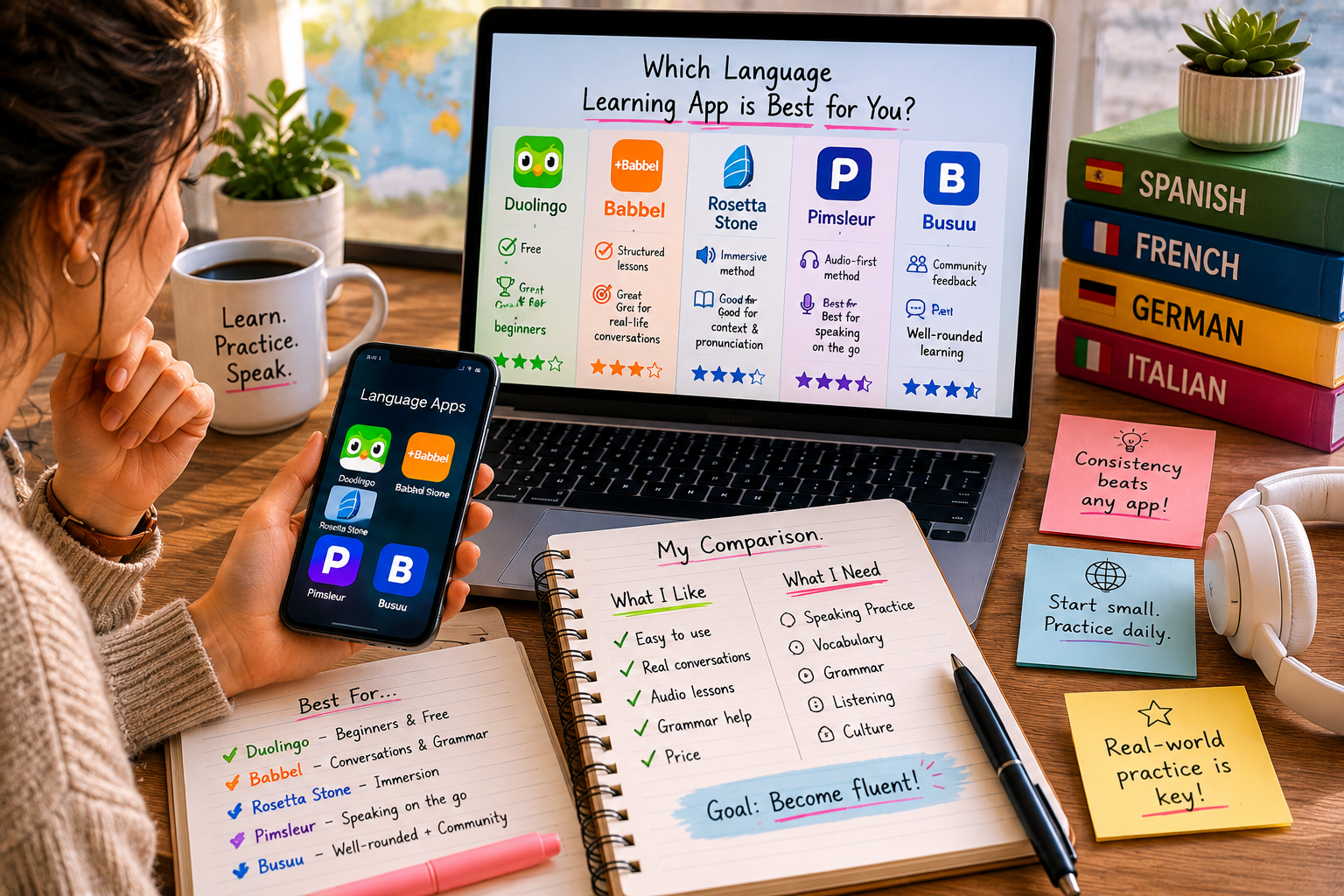
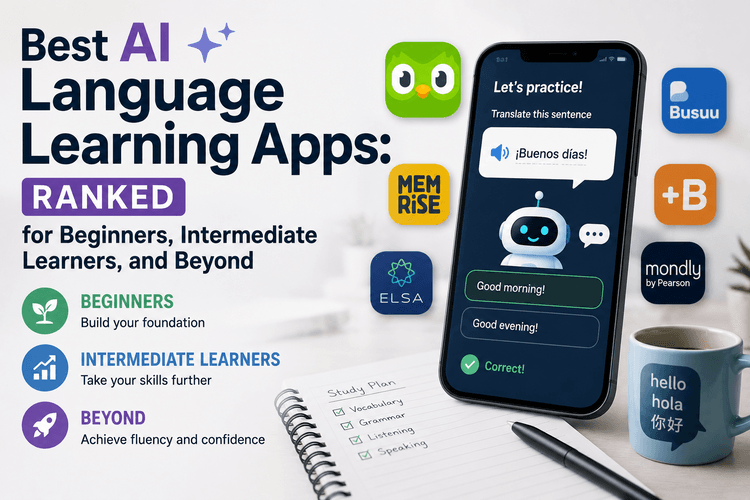
The best AI language learning apps in 2026 are Duolingo Max, Babbel, Rosetta Stone, Pimsleur, and Mondly, each strongest in different areas: Duolingo leads on beginner accessibility, Babbel on structured conversation, and Pimsleur on audio-first learners. Most learners will see measurable vocabulary and basic sentence gains within 4 to 8 weeks of consistent daily use, though fluency requires pairing any app with real speaking practice.
Key Takeaways
- Duolingo Max’s AI conversation feature (powered by GPT-4) lets beginners practice open-ended dialogue in over 40 languages, the widest selection among consumer apps in 2026.
- Babbel’s lesson design is built around real-life scenarios and produces measurable conversational gains in as few as 15 hours of study, according to research commissioned by Babbel and conducted by City University of New York.
- Pimsleur remains the top audio-only option for commuters and visual learners who struggle with screen-based apps, covering 51 languages with no reading requirement in early levels.
- Free tiers on most apps plateau learners at roughly the A1–A2 level; unlocking AI conversation tools consistently requires a paid plan ranging from $7 to $20 per month.
- No single app covers all three criteria equally: beginners should prioritize accessibility, travelers should prioritize breadth, and serious learners should prioritize apps with structured grammar progression.
What to Look for in AI Language Learning Apps
Not every app that calls itself “AI-powered” uses that technology in a way that actually helps you speak faster or remember more. Before picking one, it helps to know what separates genuine AI integration from a marketing label.
The phrase “AI-powered” covers a wide range in 2026. Some apps use AI only to personalize quiz difficulty. Others, like Duolingo Max and Mondly, use large language models to generate real-time conversation simulations where you can type or speak freely and receive contextual feedback. That difference matters enormously for anyone past the pure beginner stage. When evaluating any app, four criteria make the biggest practical difference. First, beginner accessibility: how fast can someone with zero experience start producing real sentences? Second, language breadth: does the app offer the specific language you need, and does it go deep enough to get you past tourist phrases? Third, learning modalities: does the app support your learning style, whether that is listening, reading, speaking aloud, or writing? Fourth, pricing transparency: is the feature you actually need locked behind a paywall that isn’t obvious at sign-up? For a broader look at AI language learning tools and guides, our Languages section covers everything from app reviews to learning strategies.
The Best AI Language Learning Apps, Ranked
These five apps represent the strongest options across beginner friendliness, language selection, and AI feature depth, based on documented feature sets, independent reviews, and pricing verified as of mid-2026.
Duolingo Max
Duolingo is the most downloaded language app in history, and the Max tier adds two features that genuinely change what the app can do. “Explain My Answer” uses GPT-4 to walk you through why your response was right or wrong in plain language rather than a generic error message. “Roleplay” drops you into simulated conversations, say, ordering coffee in Paris or negotiating a hotel check-in in Tokyo, with an AI character that responds naturally to whatever you type. The gamification model (streaks, XP, leaderboards) is polarizing: some learners find it motivating for months, others find it hollow after the first few weeks. The free tier is genuinely useful, but Roleplay and Explain My Answer require Max at $29.99 per month or $167.99 per year. That’s the steepest price point on this list, which is a real consideration. **Pros:** Widest language selection (over 40 languages), best beginner onboarding, strongest AI conversation features, large community. **Cons:** Expensive Max tier, gamification can feel like a substitute for actual learning, weak grammar explanation in free tier. **Pricing:** Free tier available. Duolingo Plus at $6.99/month. Duolingo Max at $29.99/month or $167.99/year.
Babbel
Babbel takes a more academic approach than Duolingo, which is either a pro or a con depending on your personality. Lessons are structured around real conversational scenarios with deliberate grammar scaffolding built in. The AI features are less flashy than Duolingo’s but arguably more useful for intermediate learners: speech recognition grades your pronunciation on a phoneme-by-phoneme basis, and the review system adapts to surface vocabulary you’re likely to forget before you actually forget it. City University of New York researchers found in a study commissioned by Babbel that 15 hours of Babbel instruction produced conversational gains equivalent to a college semester of introductory Spanish. That’s a specific, citable result, though it’s worth noting the research was funded by the company. Babbel covers 14 languages, which is narrower than Duolingo but goes considerably deeper in each one. If you’re learning Spanish, French, German, or Italian, Babbel’s curriculum arguably outpaces Duolingo’s in grammar depth by the intermediate stage. **Pros:** Strong grammar scaffolding, good speech recognition, evidence-backed results, more affordable than Duolingo Max. **Cons:** Only 14 languages, less engaging for learners who need gamification, AI conversation features are less developed than Duolingo’s. **Pricing:** Plans start at $13.95/month, with discounts for longer commitments (around $6.95/month on a 12-month plan).
Rosetta Stone
Rosetta Stone has been around since 1992, which makes it the grandfather of language learning software, though it has updated its approach significantly. The core methodology remains immersive: you learn by associating images and audio with words rather than through translation, which mimics how children acquire language. The AI layer in 2026 adds TruAccent speech recognition, which is among the most accurate pronunciation feedback available in a consumer app. Where Rosetta Stone stands out is lifetime access pricing. A one-time purchase of around $299 covers all 25 languages indefinitely, which is genuinely unusual in a subscription-dominated market. For learners who plan to study multiple languages over several years, the math often works in their favor compared to monthly competitors. The trade-off is that the immersive method is slower at producing conversational output in the early weeks. Learners who want to say useful phrases fast tend to feel frustrated. Learners who enjoy the puzzle-like quality of figuring out meaning from context tend to love it. **Pros:** TruAccent pronunciation feedback, lifetime plan available, 25 languages, strong for learners who prefer immersive methods. **Cons:** Slower early progress, minimal grammar explanation by design, monthly plan pricing is competitive but lifetime value depends on long-term commitment. **Pricing:** Subscription from $11.99/month. Lifetime access at approximately $299 (one-time, all languages).
Pimsleur
Pimsleur is built almost entirely around audio. Each lesson is 30 minutes of spoken instruction with no screen required, designed specifically for listening during a commute, a workout, or any activity where your eyes are occupied. The spaced repetition system prompts you to recall and produce phrases at increasing intervals, which research on memory consolidation supports as an effective retention method. Pimsleur covers 51 languages, the widest range on this list, including less common options like Tagalog, Swahili, and Hindi. Each language is broken into levels with 30 lessons per level, and the AI integration is primarily in adaptive pacing rather than open-ended conversation. For learners who have struggled with screen fatigue or who simply absorb information better through listening, Pimsleur is the clearest recommendation on this list. The weakness is that Pimsleur produces strong listeners and speakers but slower readers and writers. If reading comprehension in your target language is a goal, you’ll need a supplementary resource. **Pros:** 51 languages, genuinely audio-first, strong for commuters, excellent pronunciation training, good for absolute beginners. **Cons:** Minimal reading/writing instruction, no gamification, AI features limited to adaptive pacing. **Pricing:** $14.95/month for one language, $19.95/month for all-access (all 51 languages and premium features).
Mondly
Mondly occupies an interesting middle position: it has broader language coverage than Babbel (41 languages), more affordable pricing than Duolingo Max, and AI conversation features that hold up well in head-to-head comparison. The chatbot dialogue system lets you practice speaking through scripted scenarios with enough flexibility that responses don’t feel robotic after the first use. The AR (augmented reality) feature, which lets you label objects in your environment in your target language through your phone camera, is genuinely novel and useful for visual learners building vocabulary. It’s the kind of feature that sounds gimmicky but turns out to be one of the stickier daily habits the app creates. Mondly’s weakness is depth. The curriculum covers conversational basics and common vocabulary efficiently, but learners aiming for B2 or beyond will find the structured progression running thin before they hit their goals. **Pros:** 41 languages, AR vocabulary feature, affordable pricing, solid AI conversation practice. **Cons:** Curriculum depth drops off at intermediate level, less polished UX than Duolingo or Babbel. **Pricing:** $9.99/month, $47.99/year, or a lifetime plan at approximately $99.99.
Quick Comparison: Best AI Language Learning Apps at a Glance
This table summarizes the five apps across the criteria that matter most: language count, AI features, beginner rating, and pricing, so you can find the right fit without reading every section above.
| App | Languages | Key AI Feature | Beginner Rating | Best For | Starting Price |
|---|---|---|---|---|---|
| Duolingo Max | 40+ | GPT-4 Roleplay, Explain My Answer | ★★★★★ | Absolute beginners, conversation practice | Free / $29.99/mo (Max) |
| Babbel | 14 | Adaptive speech recognition, smart review | ★★★★☆ | Structured learners, grammar focus | $6.95/mo (annual) |
| Rosetta Stone | 25 | TruAccent pronunciation AI | ★★★☆☆ | Immersive learners, long-term multi-language study | $11.99/mo or $299 lifetime |
| Pimsleur | 51 | Adaptive audio pacing | ★★★★☆ | Audio learners, commuters, rare languages | $14.95/mo (one language) |
| Mondly | 41 | AR vocabulary, AI chatbot dialogue | ★★★★☆ | Visual learners, budget-conscious users | $9.99/mo or $99.99 lifetime |
The Specialists: AI Apps Built for Specific Goals and Learning Styles
Most language app roundups treat every learner as identical to someone who wants to order coffee in Paris or survive a two-week vacation. But a significant portion of serious language learners have narrower, more demanding goals: passing a JLPT exam, reading business contracts in Mandarin, or maintaining heritage language fluency. A handful of AI-powered platforms have moved deliberately into these specialized lanes, and for the right learner, they outperform the general-purpose giants by a wide margin.
Speechling targets pronunciation obsessives with a human-coach hybrid model that no fully automated app can match. You record yourself speaking, and a combination of AI phoneme analysis and actual human coaches flags errors and explains them in plain language. At $19.99 per month, it is not cheap, but for learners whose accent is the bottleneck job interviews, language proficiency certifications, speaking-heavy careers the feedback loop is meaningfully different from anything an algorithm alone provides. The downside is narrow language coverage and no grammar curriculum whatsoever, so Speechling works best as a complement rather than a standalone program.
Clozemaster occupies a niche that almost no other app acknowledges: the post-beginner plateau. Its entire design philosophy centers on vocabulary in context, presenting thousands of fill-in-the-blank sentences pulled from real text rather than constructed textbook examples. The AI adapts the difficulty curve based on your error patterns, and the sheer volume of authentic input is unmatched at its price point (free tier is genuinely robust; Pro is $8 per month). Beginners will find it overwhelming, but intermediate learners who already have a grammar foundation and need to break through a vocabulary ceiling will find it almost uniquely suited to them.
Lingvist takes a data-driven approach rooted in spaced repetition and corpus frequency analysis, showing you vocabulary in the order statistical models suggest you are most likely to encounter it in real speech. The AI tracks not just whether you got an answer right, but how quickly and confidently, adjusting interval timing accordingly. Coverage is limited to eight languages, and the interface is sparse compared to Duolingo’s gamified polish, but learners with a specific target French for a work transfer, Spanish for a graduate program report faster practical vocabulary gains than with broader platforms. Pricing sits at $14.99 per month or $179.99 annually.
Kimchi Learn and LingoDeer deserve mention for Asian language depth that the major apps consistently underprovide. Both offer structured grammar progressions for Japanese, Korean, and Mandarin that treat the script systems seriously rather than romanizing everything into approachability. LingoDeer’s AI review engine resurfaces characters and grammar points based on your individual error history, and at $11.99 per month it undercuts most competitors. Neither app is as polished or feature-rich as the top tier, but for a learner committed to an Asian language, the structural seriousness matters more than a streak counter.
Honest Pricing Breakdown: What You Actually Pay in 2026
Pricing in the language app space has become deliberately confusing. Annual plans are divided by twelve to produce misleadingly low monthly figures in marketing copy, lifetime deals appear and disappear without notice, and free tiers are regularly stripped of features after an app crosses a subscriber threshold. This section quotes what a new subscriber would actually pay today at standard rates, without promotional pricing.
Duolingo’s free tier remains the most complete among major apps, covering full curriculum access with ads and a limited heart system that throttles mistakes. Duolingo Max, which adds the AI conversation and roleplay features that make it genuinely competitive in 2026, runs $29.99 per month or $167.99 annually, a significant jump from the older Super Duolingo tier at $84 per year, and one the company has not heavily publicized. For most casual learners, the free tier is sufficient; Max is worth the cost only if you plan to use the conversational AI features weekly.
Babbel’s subscription model has stabilized at $13.95 per month, $83.40 for a full year, or a lifetime option that surfaces periodically around $299. The lifetime deal represents reasonable value if you plan to study two or more languages over several years, since the subscription is per-account rather than per-language. Rosetta Stone’s lifetime license at $299 is similarly structured and occasionally discounted to $179 during sale periods; given the app’s depth of content, the lifetime path is the more defensible purchase compared to its $11.99 monthly rate.
Pimsleur remains the outlier in pricing philosophy, charging per language rather than per account. At $14.95 per month for a single language, a learner studying two languages simultaneously pays $29.90 more than most competitors’ all-access plans. The all-access tier at $20.95 per month corrects this, but casual browsers rarely see it prominently. For commuters and audio-first learners the value holds; for anyone who switches languages frequently, the per-language model is a quiet tax worth knowing about before subscribing.
Mondly remains the most aggressive on price among mid-tier apps. Its $9.99 monthly rate and $99.99 lifetime license are among the lowest in the category, and the AR features and AI chatbot are included at all tiers. Lifetime access to all 41 languages for under $100 is a legitimate bargain for budget-conscious learners who can tolerate a less polished experience than Duolingo or Babbel.
2026 AI Language App Pricing at a Glance
| App | Free Tier | Monthly (Standard) | Annual Total | Lifetime Option |
|---|---|---|---|---|
| Duolingo Max | Yes (full curriculum) | $29.99 | $167.99 | No |
| Babbel | No (trial only) | $13.95 | $83.40 | ~$299 (periodic) |
| Rosetta Stone | No | $11.99 | $143.88 | $299 (often $179 on sale) |
| Pimsleur (one language) | Limited trial | $14.95 | $179.40 | No |
| Pimsleur All Access | Limited trial | $20.95 | $251.40 | No |
| Mondly | Very limited | $9.99 | $47.99 | $99.99 |
| Clozemaster Pro | Yes (robust) | $8.00 | $60.00 | No |
| Lingvist | Limited | $14.99 | $179.99 | No |
| LingoDeer | Partial | $11.99 | $59.99 | No |
| Speechling | Limited (5 submissions/mo) | $19.99 | $179.99 | No |
Why You’ve Plateaued and Which AI Apps Actually Push You Past It
The most common language learning story in 2026 goes like this: someone downloads an app, completes lessons faithfully for sixty to ninety days, earns their streak badge, and then quietly realizes they still cannot hold a real conversation. The app did not fail them in any obvious way. They just stopped improving. This is not a personal failure, and it is not bad luck. It is a structural problem baked into how almost every popular language app is designed and understanding it is the only reliable way to choose a tool that will actually work past the beginner stage.
Most language apps are optimized for retention, not acquisition. These are not the same thing. Retention in a business sense means keeping users opening the app every day. The most reliable way to do that is to keep lessons achievable, reward streaks generously, and never make the experience feel genuinely hard. The result is what linguists sometimes call the illusion of progress: you are completing lessons, your numbers are going up, but the cognitive demand required for real language acquisition, the kind that transfers to unscripted speech and unfamiliar text is never actually triggered.
The research literature on second language acquisition has been consistent on this point for decades. Comprehensible input at i+1 (material just beyond your current level), meaningful output with feedback, and spaced retrieval of vocabulary in varied contexts are the conditions under which adults acquire language most efficiently. Data from the National Center for Education Statistics on adult learner outcomes consistently shows that structured, progressive challenge not gamified repetition predicts long-term proficiency gains. Most apps are designed to minimize exactly that kind of challenge because challenge increases churn.
The plateau typically arrives between A2 and B1 on the Common European Framework of Reference scale. At this stage, a learner knows enough vocabulary and grammar to sail through beginner-level app content without real effort. The app’s AI, designed to keep the experience positive, interprets your high accuracy as a signal to keep difficulty steady or advance you to content that is still within your comfort zone. What you actually need is the opposite: exposure to material that breaks your existing patterns, forces error, and requires genuine reconstruction of meaning. Very few apps are built to deliver this.
Before subscribing to any app that claims to get you past a plateau, apply this four-part test. First, does the app expose you to unscripted or authentic language, real speech, real text, real conversation or only to content its team designed? Apps that never take you outside their own constructed examples cannot expose you to the variability real language requires. Second, does the AI actually adapt to your errors in a meaningful way, or does it simply reshuffle flashcards? A genuine adaptive system changes what it teaches you next based on the specific nature of your mistake, not just whether you got the answer right or wrong. Third, does the app create any pressure to produce language, not just recognize it? Recognition and production are different cognitive skills, and recognition-only apps leave learners who can read a menu but cannot order from one. Fourth, is there a ceiling? Many apps run out of content at a B1 or B2 level and simply loop their existing material. An app with no advanced content cannot take you to advanced proficiency, regardless of how good its AI is at the beginner stage.
Applying this framework to the apps in this roundup yields some honest distinctions. Duolingo Max now passes tests one and three more convincingly than it did two years ago, thanks to its AI conversation feature, but its content ceiling remains at roughly B1 for most languages. Babbel’s grammar explanations are the strongest in the mass-market tier and its content reaches B2 in Spanish and French, making it a better plateau-breaker for European languages specifically. Clozemaster is the only app reviewed here that is architecturally designed for the post-beginner stage from the ground up: its authentic-text sentences, massive vocabulary depth, and difficulty controls are built precisely for learners who have already stalled elsewhere. Pimsleur’s audio methodology forces productive recall in a way that many visual apps never do, which is why commuters who do nothing but Pimsleur often report conversational gains that app-only learners miss. Rosetta Stone’s immersive methodology resists translation shortcuts in a way that builds genuine comprehension muscle, though its pace feels slow to intermediate learners who already have a grammar foundation.
The honest answer for most intermediate learners is that no single app is sufficient. The most effective learners in 2026 are using a combination: a structured grammar resource for i+1 input (Babbel, LingoDeer, or a textbook), an authentic output tool for speaking pressure (Speechling or a conversation exchange), and a high-volume vocabulary tool for breadth (Clozemaster or Lingvist). Treating one app as a complete solution is the single most common reason learners plateau and it is exactly what app marketing is designed to encourage you to believe.
Recognizing the plateau for what it is a design consequence, not a personal limitation is the first step toward choosing tools that actually respect where you are and where you need to go.
The best AI language learning apps in 2026 are genuinely better than anything available five years ago. AI conversation partners, adaptive phoneme feedback, and real-time grammar correction have compressed the early stages of language acquisition in ways that are real and measurable. But the ceiling question matters more than the marketing. Beginners should prioritize accessibility and consistency and start with Duolingo’s free tier or Babbel without hesitation. Intermediate learners who have stalled should resist the urge to switch to another beginner-friendly app and instead look hard at Clozemaster, Lingvist, and Speechling tools built for the stage most apps quietly ignore. Anyone with a specific proficiency goal, a certification to pass, or a professional context to prepare for will find the specialist apps worth the narrower focus. The right app is always the one matched honestly to where you actually are, not where you wish you were.
Frequently Asked Questions
Duolingo’s free tier remains the most accessible starting point for most beginners, with a complete curriculum across dozens of languages, no upfront cost, and an AI system that keeps early lessons manageable without overwhelming new learners. Babbel is a strong paid alternative if you prefer structured grammar instruction from the first lesson rather than Duolingo’s more gamified approach. Both are designed to build early confidence and daily habit, which matter more at the beginner stage than any specific feature set.
AI apps in 2026 can reliably take most learners to a solid intermediate level (roughly B1 on the CEFR scale) when used consistently, which is meaningful progress by any measure. Getting to genuine fluency the ability to operate comfortably in unscripted, high-stakes conversation almost always requires human interaction at some point, whether a tutor, a language exchange partner, or immersion. Apps are best understood as a foundation and a maintenance tool, not a complete path. Speechling’s hybrid AI-plus-human-coach model is the closest any app currently comes to bridging that gap.
Pimsleur leads the field for rare language coverage, with 51 languages including choices like Tagalog, Swahili, Hindi, and multiple Arabic dialects that most other apps do not support seriously. Mondly covers 41 languages with a lower price point and adds AR and chatbot features that other rare-language options lack. For learners focused on Asian languages specifically, LingoDeer provides more structural depth in Japanese, Korean, and Mandarin than any other app at a comparable price. The honest caveat is that content depth drops significantly for rarer languages on every platform; Spanish and French always receive the most development attention.
Lifetime deals are worth the math only if you are confident you will use the platform for at least three to four years and if the company has a strong track record of continued development. Rosetta Stone and Mondly both have histories that make lifetime purchases defensible Rosetta Stone has been in operation for over thirty years and Mondly’s lifetime price is low enough that even two years of use justifies it. Duolingo does not currently offer a lifetime option. The main risk with any lifetime purchase is that app companies can deprioritize older products, shift to new platforms, or restructure features in ways that devalue legacy access. For most learners, starting with an annual subscription and converting to a lifetime deal if the app proves genuinely useful over twelve months is the lower-risk approach.