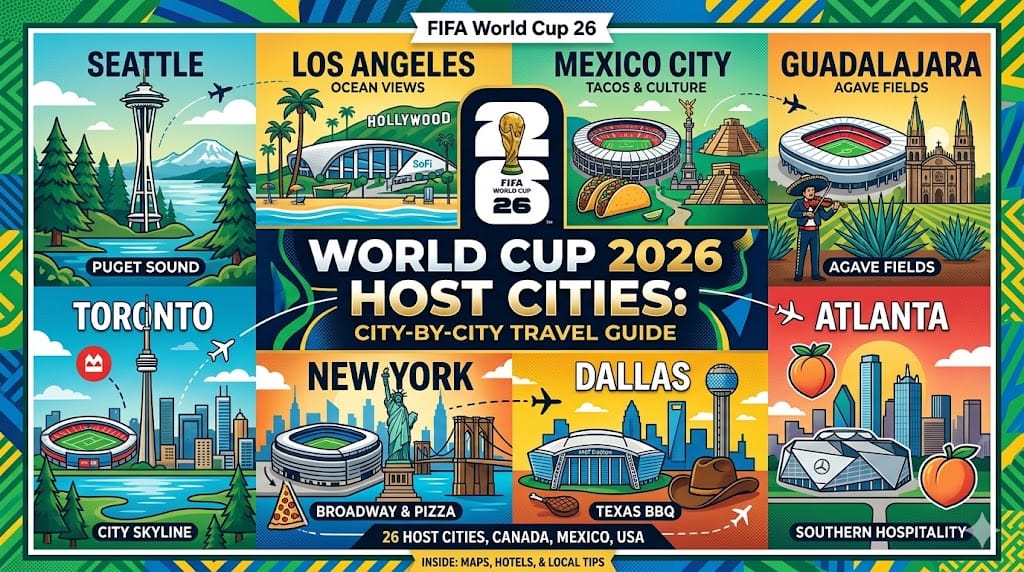
Sixteen cities across three countries will host the largest FIFA World Cup in history, with 48 teams competing across 104 matches, making the 2026 tournament roughly 40% bigger than any previous edition. That scale creates an extraordinary travel opportunity, but it also means flight prices, hotel demand, and crowd density will vary dramatically depending on which city and which match week you target. Whether you are planning around the opening match in Mexico City or chasing a semifinal slot in New York, understanding each host city’s logistics before you book could mean the difference between a trip of a lifetime and a very expensive regret.
The US leg of the tournament features eleven American host cities, two Canadian cities (Toronto and Vancouver), and three Mexican host cities (Mexico City, Guadalajara, and Monterrey). For American and Canadian travelers browsing our US destinations guide or scanning our broader travel articles, the sheer variety is both exciting and overwhelming. Dallas, Los Angeles, New York, Seattle, Boston, San Francisco Bay Area, Kansas City, Atlanta, Miami, and Philadelphia each bring a different character, climate, cost level, and stadium situation. Picking the right city for your budget and travel style matters as much as picking the right match.
This guide breaks down the eleven US host cities by what actually shapes the visitor experience: stadium location and transit access, typical accommodation costs during tournament windows, realistic crowd and weather conditions, and the honest downsides no highlight reel will show you. Prices and entry requirements are subject to change, so verify with official sources before booking.
Key Takeaways
- FIFA World Cup 2026 uses 11 US host cities, spanning climates from Miami’s humid summer heat to Seattle’s moderate Pacific Northwest conditions, which directly affects spectator comfort and packing strategy.
- New York/New Jersey’s MetLife Stadium has the largest seating capacity among US venues at roughly 82,500, making it the likely home for the highest-stakes knockout matches and the most competitive ticket market.
- Dallas-Fort Worth is projected to see some of the highest accommodation surges during match weeks, given limited luxury hotel inventory relative to expected international visitor volume.
- Non-US citizens traveling to the United States for the tournament must hold a valid US entry document, either a visa or an approved ESTA under the Visa Waiver Program, which requires advance application and a fee.
- Canada’s two host cities, Toronto and Vancouver, fall under Canadian entry requirements entirely separate from US rules, meaning a multi-city itinerary crossing the border requires verifying both countries’ current travel documentation rules.
Which US Host Cities Are Hosting World Cup 2026 Matches?
The eleven US host cities for World Cup 2026 are New York/New Jersey, Los Angeles, Dallas, San Francisco Bay Area, Miami, Atlanta, Seattle, Boston, Kansas City, Philadelphia, and Houston, each using an existing NFL or MLS stadium adapted for international football.
FIFA selected all eleven US venues based on existing stadium infrastructure, which keeps construction costs down but creates some notable quirks for soccer fans. American football field dimensions sit inside a larger oval footprint, and FIFA has required temporary pitch configurations and seating adjustments to meet international standards. The practical result: some seats will have sightlines that feel off compared to purpose-built soccer stadiums in Europe or South America. That is not a dealbreaker, but it is worth knowing before you pay a premium for a specific section.
Stadium Locations and Transit Access by City
Transit access varies widely. SoFi Stadium in Los Angeles sits in Inglewood and is reachable via the Metro K Line, a significant upgrade from the car-dependent situation fans faced at the 2023 Gold Cup. MetLife Stadium in East Rutherford, New Jersey, is served by NJ Transit trains from Penn Station, which will be the single most critical transit link in the entire tournament given New York’s expected visitor volume. AT&T Stadium in Arlington, Texas, sits between Dallas and Fort Worth in a suburb with limited public transit options, meaning most attendees will drive or use rideshare, and traffic management around match days will be a serious logistical challenge. Levi’s Stadium in Santa Clara is accessible via the VTA light rail, but service frequency during peak events has historically been a pain point for Bay Area sports fans.
What Does Weather Actually Mean for Spectators?
The tournament runs June through July 2026, which places every host city in peak summer conditions. Miami’s Hardrock Stadium in late June sits in heat index territory that regularly exceeds 105°F, and the stadium has limited shade in upper sections. Dallas in July is similarly brutal, with afternoon temperatures routinely above 100°F. Both cities schedule evening kickoffs where possible, but not all group stage matches will have that luxury. Seattle and San Francisco offer the most temperate conditions during tournament weeks, with average highs in the upper 60s to low 70s°F, which is a real competitive advantage if your priority is comfort over spectacle.
How Much Should You Budget for a World Cup Trip?
A realistic budget for a single World Cup match in a major US host city ranges from roughly $500 to over $3,000 per person per day of travel, depending on ticket tier, accommodation type, and how far in advance you book.
Match tickets through official FIFA channels are priced in tiers, with group stage seats starting lower and knockout round seats significantly higher. The secondary market will amplify those prices considerably as the tournament progresses. Accommodation is where many travelers get caught off guard. Hotels within two miles of MetLife Stadium and SoFi Stadium were already showing inflated rates for tournament-adjacent weekends well before official packages went on sale. Kansas City and Philadelphia tend to offer slightly more accessible accommodation pricing than New York or Los Angeles simply because their overall hotel inventory relative to demand is different, though that gap narrows sharply during actual match weeks.
| US Host City | Stadium | Approx. Capacity | Primary Transit Option | Typical July High Temp (°F) |
|---|---|---|---|---|
| New York/New Jersey | MetLife Stadium | ~82,500 | NJ Transit from Penn Station | 85°F |
| Los Angeles | SoFi Stadium | ~70,000 | Metro K Line (Inglewood) | 83°F |
| Dallas | AT&T Stadium | ~80,000 | Rideshare/Drive (limited rail) | 97°F |
| Miami | Hard Rock Stadium | ~65,000 | Rideshare/Drive (limited rail) | 91°F |
| Seattle | Lumen Field | ~69,000 | Link Light Rail / Sounder Train | 75°F |
| San Francisco Bay Area | Levi’s Stadium | ~68,500 | VTA Light Rail | 72°F |
| Atlanta | Mercedes-Benz Stadium | ~71,000 | MARTA Rail (direct) | 89°F |
| Boston | Gillette Stadium | ~65,878 | Commuter Rail from South Station | 81°F |
| Kansas City | Arrowhead Stadium | ~76,416 | Rideshare/Drive (limited bus) | 91°F |
| Houston~ | METRORail Red Line | 92°F | NRG Stadium | 72,220 | METRORail Red Line | 92°F |
| Philadelphia | Lincoln Financial Field | ~69,176 | SEPTA Broad Street Line | 86°F |
What Are the Visa and Entry Requirements for International Visitors?
International visitors attending World Cup 2026 matches in the US must hold either a valid US visa or an approved ESTA, and must meet Canadian entry requirements separately for any matches in Toronto or Vancouver.
The US State Department processes visa applications and Electronic System for Travel Authorization (ESTA) requests for the Visa Waiver Program. Citizens of VWP-eligible countries can apply for ESTA online, but approval is not guaranteed and applications should be submitted well before travel, not at the last minute. Citizens of countries not in the VWP must apply for a B-2 tourist visa at a US embassy or consulate, a process that can take weeks to months depending on appointment availability and country of origin. FIFA’s official communications have urged international fans to begin visa processes as early as possible given the expected volume of applications.
For the Canadian host cities, entry requirements are entirely separate. Canadian visas or Electronic Travel Authorization (eTA) requirements apply regardless of US documentation status. A fan traveling from Buenos Aires to see a group stage match in Toronto and a knockout round match in New York faces two distinct sets of entry requirements. Note that this applies to land border crossings as well—driving between close host cities like Seattle and Vancouver still requires passing through full international checkpoints with both valid documents in hand. Travelers should consult both the US State Department guidance and Canada’s Immigration, Refugees and Citizenship Canada (IRCC) website.
What Are the Honest Downsides of World Cup Travel in the US?
The biggest practical frustrations for World Cup travelers in the US tend to be transit gaps outside major downtowns, accommodation price spikes during match weekends, and heat-related discomfort at southern and inland venues during peak summer.
Several host stadiums sit in locations that require a car, which creates a friction point for international visitors unfamiliar with American suburban geography. Arlington, Texas is the clearest example: AT&T Stadium is a massive and impressive venue, but getting there without a vehicle or rideshare requires planning that many European or South American fans will not anticipate. Rideshare surge pricing during major match days will add real cost. Kansas City’s Arrowhead Stadium presents a similar situation.
The CDC travel health guidelines for large crowd events note the elevated risk of respiratory illness transmission in dense, enclosed spaces. Stadium settings with limited ventilation, combined with summer heat pushing attendees toward air-conditioned concourse areas, create conditions where illness can spread. Travelers with health considerations should factor this into their planning.
Alternative Perspectives
The case for smaller host cities: Many fans default to booking New York or Los Angeles without considering that Kansas City or Philadelphia may offer a richer, more accessible fan experience. Smaller cities typically have shorter Uber wait times post-match, more available hotel rooms at lower premiums, and a local fan culture that embraces the novelty of hosting world-class soccer. The tradeoff is fewer direct international flights and a smaller tourist infrastructure for non-English-speaking visitors.
The case for watching from a fan zone, not the stadium: Official FIFA Fan Festivals will operate in each host city, offering free or low-cost match viewing on large screens with food, entertainment, and a communal atmosphere. For travelers on a tighter budget, or those who simply cannot secure affordable tickets, fan zones may deliver a more relaxed and social World Cup experience than the stadium itself, particularly in cities like Atlanta, which has a strong soccer culture and a downtown fan zone location near the Mercedes-Benz Stadium MARTA stop.
According to a 2023 report by the Urban Land Institute, major sporting events in US cities with strong existing transit infrastructure generate measurably lower traffic incident rates and higher visitor satisfaction scores compared to car-dependent host venues, underscoring the practical significance of stadium transit access for event planning.The CDC states that travelers attending large international gatherings should ensure their routine vaccinations are current and consider destination-specific health precautions, particularly when events draw attendees from dozens of countries simultaneously.
Disclaimer: Travel information including prices, visa requirements, and entry rules is subject to change. Always verify current requirements with official government and airline sources before booking.
Frequently Asked Questions
Which World Cup 2026 US host city is easiest to reach by public transit?
Atlanta’s Mercedes-Benz Stadium has a direct MARTA rail connection, making it one of the most transit-accessible venues in the tournament. Seattle’s Lumen Field also offers strong light rail and commuter train access. Both cities allow fans to arrive from downtown hotels without a car, which is a practical advantage during high-traffic match days.
Do I need a US visa to attend World Cup 2026 matches in American cities?
Yes, all international visitors to the US require either a valid US visa or an approved ESTA under the Visa Waiver Program, depending on their nationality. ESTA approval is not guaranteed and should be obtained well in advance. Check current requirements directly with the US State Department at travel.state.gov, as policies can change.
Which US host cities have the hottest conditions during the tournament?
Dallas and Miami are the most heat-intensive venues, with average July highs above 90°F and heat index values that can exceed 105°F in humid conditions. Kansas City and Atlanta also see significant summer heat. Seattle and the San Francisco Bay Area offer the coolest and most comfortable match-day conditions among US host cities.
Can I attend matches in both US and Canadian host cities on the same trip?
Yes, but you must meet entry requirements for both countries independently. A US visa or ESTA does not grant entry to Canada, and a Canadian eTA or visa does not grant US entry. Travelers planning a multi-city itinerary across the border should verify requirements for both countries through official government sources before booking, as processing times can vary significantly by nationality.