Eliud Kipchoge finished 16th at the Cape Town Marathon on May 24, 2026, clocking 2:13:29 on a course that Ethiopia’s Huseyidin Mohamed Esa just tore apart in 2:04:55, a new continental record. By every conventional measure, Kipchoge had a rough day. By the measure he actually cares about right now, he’s exactly on schedule. His project, “Eliud’s Running World,” is a two-year mission to run seven marathons on all seven continents, and its stated purpose has nothing to do with winning. Olympics.com reported that Kipchoge designed the tour primarily to inspire people to lead healthier lives and unite the world through running. That framing lands differently when you look at the Cape Town start line: more than 27,000 runners showed up, the largest field in the race’s history.
That number is not a coincidence. The 2026 race calendar is producing data points that suggest something structural is happening in the sport, not just a post-pandemic bounce. The London Marathon ballot drew 1,133,813 applications this year, which RunRepeat data cited by UpbeatRun identifies as a world record for any marathon lottery. The 2026 Chicago Marathon pulled over 200,000 applicants for roughly 53,000 finisher spots. The Sydney Marathon ballot saw a 56% surge in applications compared to 2025, based on figures cited by Aspire PR. These aren’t elite numbers. These are beginner and recreational numbers, people who have never run a race in their lives trying to get into events they may be years away from being ready for. That gap between ambition and preparation is exactly where most beginner running attempts go sideways, and closing it is what this piece is built around. For more from our running section at WideJournal, the full coverage hub covers everything from training guides to race results across the calendar year.
If you are searching for how to start running in 2026 and want a plan that actually holds up past week three, the answer is less complicated than the running industry makes it sound. But it requires getting a few foundational decisions right before you lace up for the first time.
Key Takeaways
- Eliud Kipchoge’s seven-continent “Eliud’s Running World” tour launched at the 2026 Cape Town Marathon, drawing 27,000-plus runners to the start line and directly fueling global beginner interest in the sport.
- Global road race finishers grew 17.1% in 2024, with half-marathon finishers up 20.9% and marathon finishers up 14.6%, based on RunRepeat industry data cited by UpbeatRun.
- The run/walk method remains the consensus beginner entry point: start with walking, add short timed run intervals, and increase total weekly mileage by no more than 10% per week.
- Signing up for a specific upcoming race, whether a local 5K or a mass-participation event like the World Athletics Road Running Championships in Copenhagen (September 19-20, 2026), is consistently cited by running coaches as a critical anchor for building a lasting habit.
- The 2026 race calendar offers a dense slate of beginner-accessible events through October, including the Sydney Marathon (August 30), the Chicago Marathon (October 11), and several mass 5K and half-marathon options tied to major championships.
Why 2026 Is a Particularly Good Year to Start
The 2026 running calendar is unusually dense with events that double as beginner motivation anchors, from Kipchoge’s ongoing world tour to accessible mass-participation races at the World Athletics Road Running Championships in Copenhagen.
The structural conditions for starting a running habit in 2026 are better than they have been in most recent years, and the data reflects that. Running and jogging exceeded 50 million U.S. participants in 2024, per industry figures cited by UpbeatRun. Half-marathon finishers rose 20.9% globally in the same year. That growth is not concentrated at the elite level; it is being driven by first-timers and recreational runners entering the sport and finding their way toward race finish lines for the first time.
Kipchoge’s world tour adds a cultural layer that is harder to quantify but easy to observe. His next stop is the Porto Alegre Marathon in Brazil on July 12, 2026, followed by Melbourne on October 11. Each stop generates a fresh news cycle, another wave of social media content, another moment where someone who has never run a mile watches footage of the Cape Town start and wonders whether they could do something like that. The tour is functioning as a slow drip of inspiration across a full calendar year, which is exactly the kind of sustained nudge that habit formation research suggests actually works.
For beginners in North America, the calendar provides a series of realistic target dates. The World Athletics Road Running Championships in Copenhagen on September 19-20, 2026 include mass-participation 5K and half-marathon races where recreational runners can register and earn an official championship medal, based on information from the 2026 World Athletics Road Running Championships page. That is a rare opportunity to run in a championship-branded event without qualifying standards. Closer to home, Chicago on October 11 and Sydney on August 30 serve as spectator and motivational anchors even for runners not yet ready to enter those specific fields.
The Actual Beginner Running Plan: What Works in Practice
The run/walk method, capped weekly mileage increases, and early race registration are the three pillars of a beginner plan that builds toward a sustainable habit rather than a four-week burst followed by an injury.
Start with the run/walk method. This is the near-universal recommendation across running coaching resources including Fleet Feet, None to Run, and Trail and Kale: begin with walking, add short run intervals measured in minutes rather than miles, and build from there. The specific ratios vary by program, but the underlying logic is consistent. Your cardiovascular system adapts faster than your tendons, ligaments, and bones. That gap is where injuries happen. Running coaches broadly recommend the run/walk approach precisely because it slows down your mileage accumulation to match your structural adaptation, not just your aerobic fitness.
The 10% rule governs weekly mileage increases once you establish a base. If you run 10 miles total in week one, cap week two at 11 miles. This is standard guidance from Trail and Kale and other running specialty sources, and it sounds conservative until you do the math: at 10% weekly growth, a runner starting from near zero can realistically reach a consistent 25-mile week within a few months without exceeding the structural load their body can handle. Rushing past that threshold is the primary reason new runners end up dealing with shin splints or runner’s knee, the two most commonly cited beginner injuries in running coaching literature.
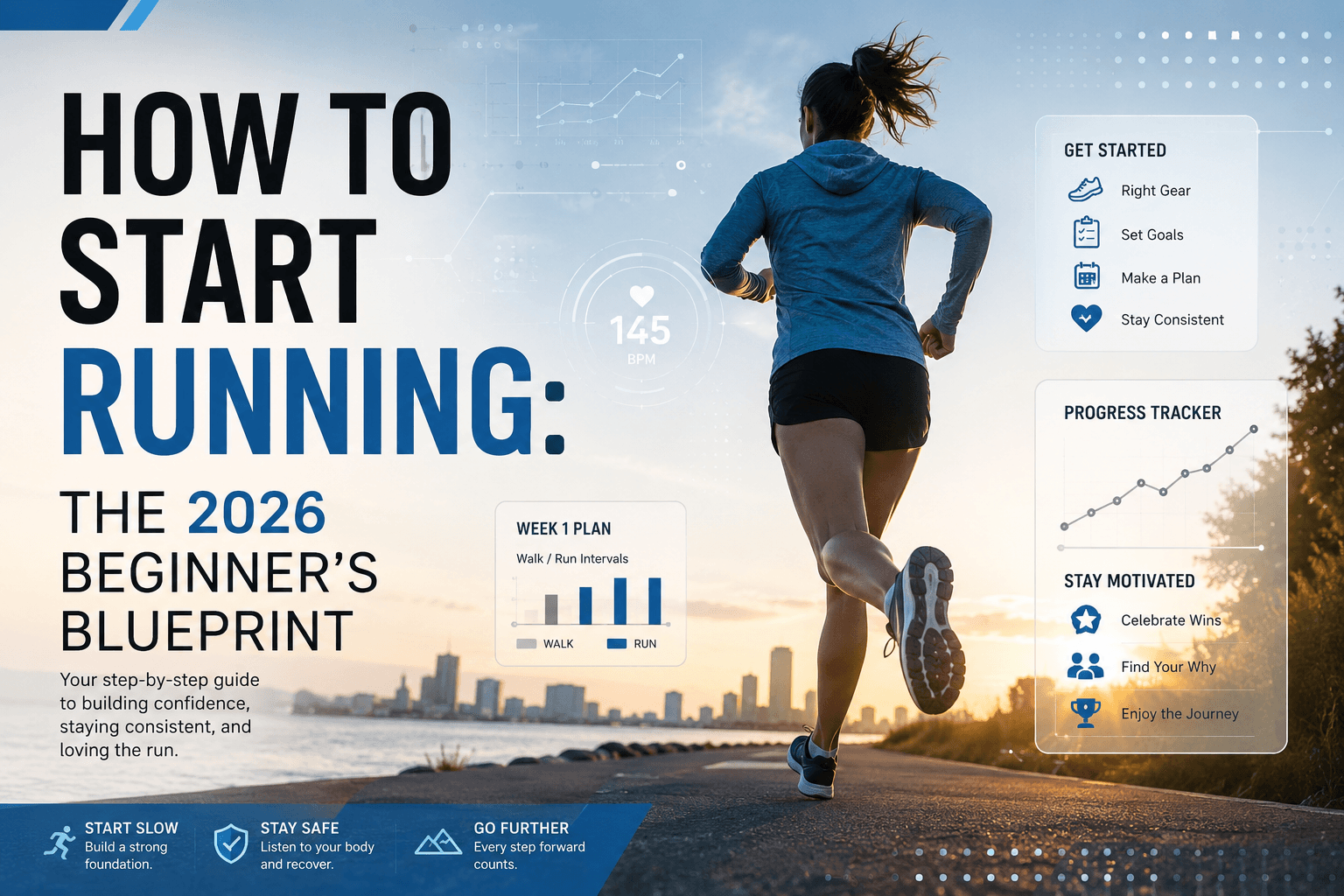
1.Weeks 1–2: Base Adaption:3 days/week, 20–25 mins.
Focus entirely on time, not distance. Perform a 5-minute brisk warm-up walk, followed by intervals of 1 minute of easy jogging and 2 minutes of walking. Repeat for 6–7 cycles. Keep your pace conversational; if you cannot speak a full sentence without gasping, slow down.
2.Weeks 3–4: Shifting the Ratio:3 days/week, 25–30 mins.
Transition to a 1.5-minute run and 1.5-minute walk split. Your cardiovascular system will begin feeling efficient here, but your tendons remain highly vulnerable. Maintain strict adherence to your 48-hour rest windows between running days.
3.Weeks 5–6: Continuous Load:3 days/week, 30 mins.
Move to 3 minutes of running and 1 minute of walking for 6 cycles. Introduce your first absolute distance baseline at the end of Week 6 by tracking total mileage. This collective mileage serves as the baseline for your future 10% incremental increases.
Building Strength Before You Need It
Strength training is not optional for beginners. It closes the adaptation gap between cardiovascular fitness and structural durability, which is the window where most early running injuries occur.
The cardiovascular side of running adapts quickly. Four weeks into a consistent beginner plan, most new runners find that the breathing gets easier, the perceived effort drops, and the urge to add more mileage grows. That feeling is real, but it is also misleading. Bones, tendons, and ligaments operate on a longer adaptation timeline, and they do not send clear warning signals until they are already stressed. Running coaching resources including None to Run consistently frame strength training as the mechanism that closes this gap, not as a supplement to running but as a structural requirement for beginner runners who want to stay healthy past the first few months.
The practical execution requires zero gym infrastructure and can be completed in 15 minutes twice a week, ideally on non-running days. To actively counter the 57.6% beginner injury rate cited by SportCoaching.com.au, your routine must isolate single-leg stability and kinetic chain tracking through three foundational movements:
- Single-Leg Glute Bridges: Lie on your back, bend your knees, lift one leg straight into the air, and drive your hips upward using the heel of the planted foot. This fires the gluteus maximus, preventing your lower back from taking the impact of your stride. Perform 3 sets of 12 reps per leg.
- Eccentric Calf Raises: Stand on the edge of a step, raise up onto both toes, then lift one foot and slowly lower your heel below the step level over a strict 4-second count. This builds eccentric strength in the Achilles tendon, the primary defense against shin splints. Perform 3 sets of 15 reps per leg.
- Side-Lying Clamshells: Lie on your side with hips stacked and knees bent at 90 degrees. Keeping your feet glued together, raise your top knee without rotating your pelvis. This targets the gluteus medius, stopping your knee from collapsing inward (valgus collapse) during the landing phase of your running gait. Perform 3 sets of 20 reps per side.

2026 Race Calendar: Beginner Target Events at a Glance
The second half of 2026 offers a structured ladder of beginner-accessible race targets, from mass 5Ks in September to the Chicago and Sydney Marathons in the fall.
Race registration as a habit anchor only works if the target event is realistic. For a beginner starting in June 2026, a local 5K in late August or September is the most defensible first goal. The World Athletics Road Running Championships in Copenhagen (September 19-20) include official 5K mass races open to recreational runners, which gives that first race a genuine context beyond just finishing. From there, a half-marathon in early 2027 becomes a logical second target, with the 2027 Chicago or Sydney ballots serving as longer-range motivators.
The table below maps the key 2026 events against their relevance for beginner runners, using verified dates and entry data from official sources.
| Event | Date | Location | Beginner Relevance | Key Stat |
|---|---|---|---|---|
| Porto Alegre Marathon (Kipchoge Stop 2) | July 12, 2026 | Porto Alegre, Brazil | Inspiration / spectator anchor | Kipchoge World Tour Stop 2 |
| World Athletics U20 Championships | Aug. 5-9, 2026 | Eugene, OR (Hayward Field) | Track inspiration; local spectator option | U.S.-hosted championship |
| 2026 Sydney Marathon | Aug. 30, 2026 | Sydney, Australia | World Marathon Major; ballot motivation | 123,000+ ballot applications (56% increase) |
| World Athletics Road Running Championships | Sept. 19-20, 2026 | Copenhagen, Denmark | Mass 5K race open to recreational runners | Official championship medal available |
| Melbourne Marathon (Kipchoge Stop 3) | Oct. 11, 2026 | Melbourne, Australia | Kipchoge World Tour inspiration | World Tour Stop 3 |
| 2026 Chicago Marathon | Oct. 11, 2026 | Chicago, IL | World Marathon Major; long-range goal | 200,000+ applicants; ~53,000 finishers |
What the 2026 Race Boom Means for New Runners
The numbers behind the 2026 race calendar are not just impressive for elite athletes; they tell a broader story about who is choosing to run. The 2026 London Marathon ballot drew 1,133,813 applications, setting a world record, while the New York City Marathon received over 240,000 applicants for its drawing. These figures are not flukes. Global road race finishers grew 17.1% in 2024, and running and jogging exceeded 50 million U.S. participants that same year, according to industry data aggregated by RunRepeat. Half-marathon finishers rose 20.9% in 2024 alone, the steepest single-discipline jump on record. For anyone wondering whether the window to join the running community is still open, the participation data offers a clear answer: the sport is in an expansion phase, and the infrastructure of local races, training plans, and community groups has grown alongside it.
What makes 2026 distinctive is the convergence of elite spectacle and grassroots access. The 2026 World Athletics Road Running Championships in Copenhagen (September 19-20) includes mass-participation 5K and mile races open to recreational runners, with an official championship medal available to finishers. That structure, a world championship event with a genuine beginner entry point, is rare and represents a concrete target for anyone who starts training today. A person who laces up for the first time in June 2026 has roughly 14 weeks to build comfortably to a 5K – well within the standard 8-to-10-week beginner timeline most running coaches recommend.
Race organizers are clearly responding to demand at every level. The 2026 Sydney Marathon ballot drew more than 123,000 applications, a 56% increase over the 2025 edition, and the event carries World Marathon Major status. Even the Cape Town Peace Run, a lower-key companion event to the Cape Town Marathon on May 24, sold out its 11,500-entry 10K and drew approximately 4,500 participants for its 5K. These companion and feeder races are where most beginners will realistically start, and their growth signals that race directors are building ecosystems, not just elite competitions.
The Science of Starting: Building a Running Habit That Sticks
Enthusiasm is the most renewable resource new runners have, and it is also the one most likely to cause early injury if it is not channeled into a structured plan. The run/walk method remains the universally recommended entry point across beginner running programs: begin with brisk walking, introduce short running intervals of 30 to 60 seconds, and extend those intervals gradually over several weeks. The goal in the first four to six weeks is not pace or distance – it is consistency and tissue adaptation. Tendons, ligaments, and bones adapt to load considerably more slowly than cardiovascular fitness improves, which creates a deceptive gap where a new runner feels capable of doing more than their connective tissue can safely absorb.
The 10% weekly mileage increase rule exists precisely to manage that gap. Exceeding it is among the most common reasons beginners develop shin splints, runner’s knee (patellofemoral pain syndrome), or IT band syndrome – the three most frequent injuries cited across beginner running guidance. Industry data aggregated by secondary running research sites suggests that 57.6% of runners sustain an injury within their first 1,000 kilometers, a figure that underscores how routine early injury actually is and why a conservative build matters more than weekly mileage totals. Incorporating two sessions of lower-body strength work per week from the beginning, rather than waiting until pain arrives, is consistently flagged by running coaches as a preventive measure beginners most often skip.
Behavioral research cited through running coaching sources reinforces a point that is easy to overlook: people are more likely to form lasting exercise habits when they genuinely enjoy the activity during its early stages. Running at a comfortable, conversational pace where you can speak in full sentences without gasping is not a beginner’s compromise. It is the physiologically correct zone for building aerobic base, and it is also the zone where running stops feeling like punishment. Registering for a specific upcoming race, even a local 5K, creates what habit researchers call an “implementation intention” : a concrete future commitment that anchors daily training decisions and dramatically improves follow-through.
Alternative Perspectives
It is worth noting that Kipchoge’s world tour, however inspiring in its stated mission, is a professionally organized and heavily sponsored athletic endeavor. Critics of the “inspiration narrative” in elite running point out that beginner runners can feel more alienated than motivated by the gap between their experience and that of a two-time Olympic champion, even one who finishes 16th. For some new runners, hyperlocal community running groups, neighborhood 5Ks, and peer-level social accountability are more effective motivators than any global celebrity athlete campaign, and those resources deserve equal emphasis in any honest guide to building a running habit in 2026.
For anyone weighing how to start running in 2026, the most practical takeaway from the current moment is that the timing is genuinely favorable. The race calendar is dense with accessible entry-level events, the global running community is in a documented expansion phase, and the cultural conversation around the sport is being led by figures who are actively arguing that running belongs to everyone. The remaining confirmed stops on Kipchoge’s world tour Porto Alegre in July and Melbourne in October along with the Copenhagen Road Running Championships in September and the Chicago Marathon on October 11, create a structured sequence of motivational markers between now and the end of the year. Whether the goal is a 5K finish, a half-marathon ballot entry, or simply 30 minutes of continuous running without stopping, the infrastructure, the community, and the moment are all pointing in the same direction.
The Motivation Debate: Elite Triggers vs. Hyperlocal Habits
While the sheer scale of the 2026 calendar offers undeniable energy, sports scientists and sports psychologists caution against anchoring a lifestyle change entirely to mass spectacles or professional icons. The commercial narrative surrounding global events can occasionally introduce optimization pressures that distort a beginner’s internal relationship with movement.
There are two distinct psychological frameworks to consider when initiating a running habit this year:
| Framework | Primary Driver | Risk Factor | Best Suited For |
| Event-Anchored | External deadlines (e.g., Copenhagen 5K registration) | Performance anxiety, post-race drop-off | Extrinsically motivated individuals who need a concrete goal to enforce discipline. |
| Routine-Anchored | Internal metrics (e.g., morning mental clarity, local social runs) | Early-stage monotony, vulnerability to scheduling conflicts | Intrinsically motivated individuals focusing on long-term identity modification. |
Relying solely on the “inspiration narrative” of an elite athlete like Kipchoge can sometimes create an alienation gap for a novice navigating their first continuous 10-minute mile. For a substantial subset of runners, joining a neighborhood crew or utilizing peer-level accountability structures proves significantly more durable than matching the milestones of professional campaigns. The most effective strategy typically synthesizes both: utilizing the global energy of the 2026 boom to spark initial momentum, while anchoring daily execution in localized, non-competitive routines.
Conclusion
The question of how to start running in 2026 has a clearer and more compelling answer than it has had in years. Participation records are being broken at the ballot stage before races even begin. A living legend of the sport is running on six continents to prove that the act of finishing matters more than the act of winning. A first-time runner who starts today with a walk/run interval program has a realistic path to a 5K finish at the Copenhagen World Athletics Road Running Championships in September, to a Major ballot entry for Sydney or Chicago, and to a year that ends with a running habit rather than a resolution abandoned by February. The practical steps, starting slow, protecting connective tissue, registering for a race, running at a pace where conversation is still possible, are unglamorous but they are the ones that work. In a sport where more than half of all beginners sustain an injury in their first 1,000 kilometers, patience is not a soft suggestion. It is the competitive advantage available to every new runner, regardless of age, background, or starting fitness level.
Medical & Editorial Disclaimer: The training frameworks and injury prevention strategies detailed below are for informational and educational purposes only. While based on consensus running biomechanics and historical data from the Road Runners Club of America (RRCA), you should consult a healthcare professional before starting any high-impact cardiovascular exercise regimen, especially if you have a history of joint, metabolic, or cardiac conditions.
Frequently Asked Questions
Is 2026 a good year to start running for the first time?
Yes, by most measurable indicators. Global road race finishers grew 17.1% in 2024, and participation has continued accelerating into 2026, with the London Marathon ballot alone drawing over 1.1 million applications. The 2026 race calendar includes a rare mass-participation 5K at the World Athletics Road Running Championships in Copenhagen (September 19-20) that is open to recreational runners and awards an official championship medal, making it one of the most accessible prestige entry points in recent memory. Community running infrastructure, from local clubs to app-based training plans, has grown alongside the participation boom, meaning new runners have more support options than any previous generation.
How many days per week should a beginner runner train?
Three days per week is the most widely recommended starting frequency for new runners, with at least one full rest day between each session to allow the body to recover. At this stage, the risk is not undertrained cardiovascular fitness; it is overloaded tendons and ligaments, which adapt to running stress more slowly than the heart and lungs do. Two of those three weekly sessions can follow a run/walk interval format, while the third can be a longer, easy-effort walk or a gentle cross-training session such as cycling or swimming. Most beginner programs add a fourth running day only after six to eight weeks of consistent, injury-free training.
What is the most common mistake new runners make in the first month?
Running too far, too fast, too soon is the most consistent mistake identified across beginner running guidance. New runners typically feel strong enough within the first two to three weeks to push pace or distance significantly, but connective tissue — tendons, ligaments, and the protective cartilage around joints — has not yet caught up to that cardiovascular improvement. This mismatch is the primary driver of the three most common beginner injuries: shin splints, runner’s knee, and IT band syndrome. The 10% weekly mileage increase rule exists as a guardrail against this pattern. Following it feels conservative, particularly in the early weeks, but it is the single most evidence-consistent way to reach a first race start line healthy.
Can a complete beginner participate in any of the 2026 World Athletics events?
Yes. The 2026 World Athletics Road Running Championships in Copenhagen, Denmark (September 19-20) includes official mass-participation races at the 5K and mile distances that are open to recreational runners of all ability levels. Finishers of these mass races receive an official championship medal. A person starting a run/walk program in June 2026 has approximately 14 to 15 weeks before the Copenhagen event, which is sufficient time to complete a standard beginner 5K training program and arrive at the start line prepared. Registration details are available through World Athletics and the event’s official Copenhagen channels. No qualifying time is required for the mass-participation races.