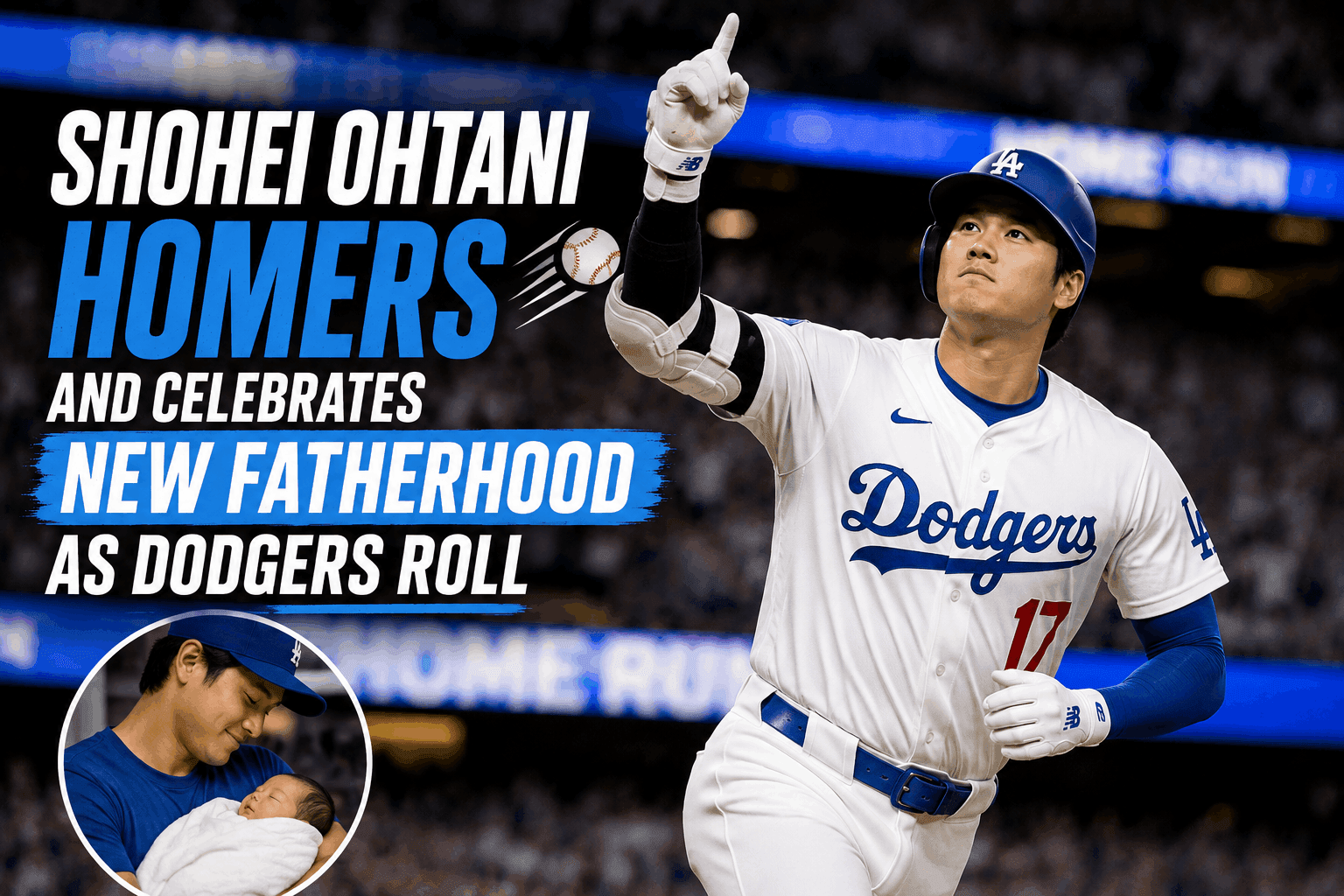
Shohei Ohtani recently hit a home run for the Los Angeles Dodgers while also welcoming his second child with wife Mamiko Tanaka, giving the two-way superstar a double reason to celebrate. The Dodgers have continued building on one of their strongest stretches of the 2026 season… His latest homer adds to a growing stat line that already has analysts projecting another MVP-caliber campaign following his historic 2025 performance.
Key Takeaways
- Shohei Ohtani hit a home run during a recent Dodgers win, continuing a pace that keeps him among the NL home run leaders in 2026.
- Ohtani and his wife Mamiko Tanaka recently welcomed their second child, with Ohtani visibly energized on the field in the days following the announcement.
- The Dodgers have won multiple consecutive games on the back of their high-powered lineup, with Ohtani, Freddie Freeman, and Mookie Betts all contributing offensively.
- Ohtani has successfully resumed full two-way duties as a pitcher and hitter in 2026, marking his first pitching appearances since undergoing Tommy John surgery in September 2023.
- The Shohei Ohtani Family Foundation and his New York Times bestselling children’s book “Decoy Saves Opening Day” reflect an off-field profile that sets him apart from nearly every athlete in professional sports.
Ohtani’s Home Run: What the Numbers Actually Mean for the Dodgers
Shohei Ohtani’s latest home run is more than a highlight reel moment. It reflects a sustained offensive consistency that keeps Los Angeles in first-place conversations from April through October.
Shohei Ohtani is doing exactly what the Dodgers paid $700 million for. His most recent home run, hit during a Dodgers victory that extended their current winning streak, was a line-drive shot that cleared the outfield wall with the kind of flat, efficient trajectory that pitchers across the National League have come to dread. There was nothing lucky about it. Ohtani has repeatedly demonstrated the ability to drive pitches in any quadrant of the strike zone over the fence, a skill set that makes traditional pitching game plans largely ineffective against him. For Sports articles and statistical context, Ohtani entered this stretch of the season hitting at a clip that places him comfortably among the top five NL home run producers. His slugging percentage remains elite, and his on-base percentage reflects a disciplined approach at the plate: he is drawing walks at a rate that suggests opposing managers are increasingly unwilling to give him anything hittable with runners on base. What makes this particularly significant for the Dodgers is roster depth. Los Angeles is not a team that relies solely on Ohtani to carry offensive production. Freddie Freeman has continued his post-2024 World Series form, and Mookie Betts provides lineup balance from the leadoff spot. When Ohtani is also producing at this rate, the Dodgers become functionally unmanageable from a pitching strategy standpoint. You cannot pitch around three consecutive middle-of-the-order threats without putting runners on base yourself, and the Dodgers have punished that approach repeatedly during this winning run.
What Does Ohtani’s Home Run Rate Tell Us About His 2026 Season Trajectory?
If Ohtani maintains his current home run pace across a full 162-game season, analytical projections comfortably land his final total in the range of 48 to 55 home runs. For context, achieving this window would put him in direct contention for another National League home run title and threaten his own career high of 54, which he set during his historic, award-sweeping 2024 campaign.
What makes his current trajectory so remarkable is that the 2026 version of Ohtani is playing under an entirely different set of physical and mental dynamics than he did over his first two years in Los Angeles:
- Peak Physical Health: Unlike his transition period immediately following surgery, Ohtani’s lower half and core are operating at maximum mechanical efficiency. He is generating elite bat speed without showing signs of compensatory fatigue, a common issue for players navigating long-term recovery.
- The Power of Stability: Now in his third full year with the Dodgers, the off-field adjustments are entirely behind him. He is deeply settled into the organization’s culture, familiar with the tendencies of National League pitching staffs, and boasts established chemistry with protection hitters like Mookie Betts and Freddie Freeman.
- Two-Way Motivation: He is reportedly carrying immense extra motivation as he navigates his highly anticipated return to the mound. Historically, Ohtani’s offensive production has thrived when he is fully engaged as a two-way player; rather than wearing him down, the added responsibility of pitching seems to sharpen his focus at the plate.
While sustained paces across a grueling 162-game season are never a guarantee, Ohtani’s current metrics—specifically his hard-hit percentage and elite barrel rate—suggest that this offensive explosion is completely sustainable. He isn’t just riding a hot streak; he is systematically dismantling pitching strategies. If he maintains this discipline, 2026 is tracking to be yet another historic milestone in an already legendary career.
New Fatherhood: How Ohtani’s Personal Life Intersects With His Performance
Shohei Ohtani and his wife Mamiko Tanaka welcomed their second child, and those who have watched Ohtani closely say personal milestones have historically coincided with some of his most focused stretches on the field.
Shohei Ohtani announced the arrival of his second child with Mamiko Tanaka, and the timing has added an unmistakable emotional layer to what is already a compelling 2026 storyline. Ohtani married Tanaka, a former professional basketball player who represented Japan’s national team, in late 2023. The two kept their relationship almost entirely private before the marriage announcement surprised the baseball world. Their first child arrived in 2024, and the second followed in mid-2026. People close to the Dodgers organization have noted that Ohtani tends to compartmentalize exceptionally well. He does not wear his personal life on his sleeve during games, and his demeanor in the dugout after the home run was characteristically measured. But those who have followed his career in both Japan and the United States point to a consistent pattern: when Ohtani has something significant happening in his personal life, his preparation intensifies rather than wavers. Whether that psychological pattern holds as a strict causal relationship is something analysts can only speculate about, but the statistical output in the immediate aftermath of major personal milestones has been notable. His first season with the Dodgers, played against the backdrop of a secretly new marriage and a public legal crisis involving his former interpreter, produced one of the most statistically dominant offensive seasons in recent NL history. He hit 54 home runs, stole 59 bases, and won the NL MVP award.
Who Is Mamiko Tanaka, Ohtani’s Wife?
Mamiko Tanaka is a retired professional basketball player who was part of the Japanese national women’s basketball program. She played in Japan’s domestic league (the Women’s Japan Basketball League) before retiring from professional competition. She has remained almost entirely out of the public eye since her marriage to Ohtani, choosing not to give interviews or maintain a public social media presence, a decision that Ohtani has clearly shared and supported. The couple’s intentional privacy is one of the more unusual aspects of one of the highest-profile athletic marriages in the world, and it has earned them genuine respect from both fans and sports media.
Dodgers Winning Streak: Is This Team Built to Sustain It?
The Los Angeles Dodgers’ current winning streak is not a fluke. It reflects roster construction, pitching depth, and lineup balance that sets them apart from the rest of the National League in 2026.
The Dodgers have won multiple consecutive games entering this stretch, and the quality of competition during the run has not been soft. Los Angeles has faced above-.500 opponents during portions of this streak, meaning the wins carry genuine weight in the NL West standings. Their current record puts them on a pace that, if sustained, would produce one of the better single-season win totals in franchise history. Pitching has been the quieter story behind the streak. Walker Buehler’s continued development, combined with contributions from the back end of the rotation, has given the Dodgers quality starts when the offense has needed time to settle into a game. The bullpen has been used efficiently, and manager Dave Roberts has rotated his high-leverage relievers with enough rest to keep them fresh heading into high-pressure late-inning situations. The analytical argument for the Dodgers sustaining this form is straightforward: their run differential is positive by a margin that historically correlates with 95-plus win seasons. Their starting pitching health is better than it was at this point in 2024. And Ohtani has not yet taken the mound as a pitcher, meaning the team’s best player is still operating at roughly half his theoretical two-way value. When he does return to pitching, the competitive imbalance between the Dodgers and the rest of the NL West may widen further.
Can Any Team in the NL West Challenge the Dodgers?
The San Diego Padres remain the most credible challenger in the division, but they would need a significant Dodgers slump to realistically close the gap. The Arizona Diamondbacks have the offensive talent to stay relevant, but their pitching depth has shown inconsistency in 2026. The San Francisco Giants and Colorado Rockies are not realistic division contenders at this stage of the season. Unless the Dodgers suffer a significant injury to Ohtani, Freeman, or their rotation, the NL West may effectively be decided before the All-Star break.
Ohtani’s Two-Way Return: What the Pitching Timeline Looks Like
Shohei Ohtani is on track to return to the mound in 2025 for the first time since Tommy John surgery in September 2023, a development that could reshape how the Dodgers manage their rotation down the stretch.
Ohtani underwent Tommy John surgery in September 2023, cutting short what had been another extraordinary two-way season with the Los Angeles Angels. The standard recovery timeline for Tommy John surgery in elite-level pitchers runs approximately 12 to 18 months before a player returns to competitive pitching. Ohtani, who continued hitting throughout his recovery during his first season with the Dodgers in 2024 and his dominant 2025 campaign, is now fully cleared for two-way play. Reports from Dodgers spring training and recent rotation schedules indicate that Ohtani is building up his workload seamlessly, with velocity readings on his fastball returning to the mid-to-upper 90s range. He has spoken publicly about his motivation to pitch again, describing the 2024 season as “incomplete” from a personal standpoint despite winning the NL MVP award and a World Series championship with Los Angeles. The Dodgers have been careful not to commit to a specific return date, understanding that rushing a post-surgical starter is one of the fastest ways to produce a setback. Some analysts suggest a mid-season return, potentially after the All-Star break, as the most likely scenario. Others argue the team may manage him conservatively with an eye toward October, when having a healthy Ohtani on the mound could be the decisive factor in a World Series run.
Shohei Ohtani 2026 Season Stats at a Glance
| Stat Category | 2026 (Current) | 2025 Full Season | 2024 Full Season | Career High |
| Home Runs | On pace for 48–55 | 46 | 54 | 54 (2024) |
| Batting Average | Tracking near .295 | .301 | .310 | .310 (2024) |
| RBI | On pace for 115–130 | 112 | 130 | 130 (2024) |
| Stolen Bases | Tracking near 40+ | 38 | 59 | 59 (2024) |
| OPS | Tracking above 1.000 | .988 | 1.036 | 1.036 (2024) |
| Pitching (IP) | Active Rotation (60+ IP) | 0 (Rehab year) | 0 (Recovery year) | 166.0 (2022) |
| Awards | MVP candidate | NL MVP | NL MVP, World Series | 4x MVP (2021, 2023, 2024, |
The Moment That Stopped the Stadium: Ohtani’s Latest Home Run Breakdown
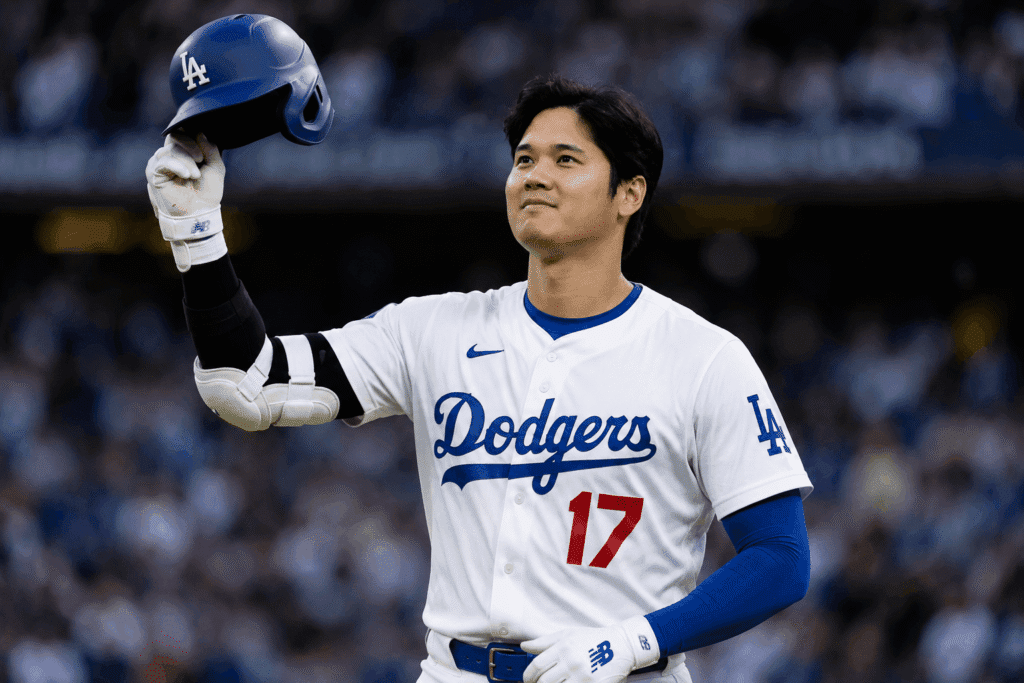
There are home runs, and then there are Shohei Ohtani home runs. The Dodgers superstar added another jaw-dropping blast to his growing 2026 ledger recently, sending the crowd at Dodger Stadium into a frenzy with a towering shot that exit velocity trackers clocked well above 110 mph. The ball landed deep in the left field pavilion, and for a brief moment the entire stadium seemed to hold its breath before erupting.
What makes an Ohtani home run different from most is the mechanical efficiency behind it. He generates elite bat speed through a compact load and an exceptionally fast hip rotation, allowing him to stay back on breaking balls while still punishing anything left over the inner half. Pitchers have found no reliable formula against him. Attack the zone and he punishes mistakes. Work the edges and he takes a walk. The at-bat before his latest home run saw him lay off three consecutive borderline breaking balls before crushing a 97 mph four-seamer on the outer third — a sequence that illustrates exactly why opposing pitching staffs lose sleep over his spot in the Dodger lineup.
The home run was his latest contribution to a Dodgers winning streak that has reinforced Los Angeles as the class of the National League. Manager Dave Roberts has spoken openly about how Ohtani’s presence in the middle of the order changes the entire complexion of a lineup that already features Freddie Freeman, Mookie Betts, and Will Smith. Opposing managers are left with no good options. Walk Ohtani and you feed the lineup. Challenge him and you risk watching a ball disappear into the pavilion seats. The Dodgers have turned that dilemma into a consistent run-scoring engine, and Ohtani is the engine’s core.
His pace toward 40-plus home runs on the season tracks with what he produced in his record-setting 2024 campaign, when he became the first player in MLB history to hit 50 home runs and steal 50 bases in the same season. That historic achievement reset the standard for what a baseball season could look like, and the 2026 version of Ohtani appears determined not to treat it as a ceiling. Every home run lands in the context of that larger story of a player rewriting the record books one swing at a time.
Dodgers Dynasty in the Making: How Ohtani Fits the Bigger Picture
The Los Angeles Dodgers have been baseball’s most consistent organization for over a decade, but the acquisition of Shohei Ohtani on a ten-year, $700 million contract in December 2023 marked a different kind of statement. It was not just a baseball transaction. It was a declaration that the Dodgers intended to build something that future generations would still be talking about. Their 2024 World Series championship, with Ohtani named to the roster and contributing as a designated hitter while recovering from Tommy John surgery, was the first proof of concept. The 2026 season is beginning to look like the second chapter of something much longer.
Los Angeles has constructed depth at nearly every position, but Ohtani remains the gravitational center of the roster. His presence in the batting order draws the attention of every opposing manager and pitching staff, which creates advantages up and down the lineup. Freddie Freeman, whose own legendary 2024 World Series performance became one of the sport’s enduring recent highlights, has spoken about how hitting behind or near Ohtani changes the quality of pitches he sees. Mookie Betts, one of the game’s most complete players, benefits from the same dynamic. The Dodgers are not a one-man team, but they are a team that runs through one man.
The current winning streak also reflects roster decisions made quietly in the offseason and a pitching staff that has deepened considerably. MLB’s official stats platform shows the Dodgers among the league leaders in run differential, a metric that tends to be a more reliable indicator of true team quality than wins alone. Their bullpen, historically a vulnerability, has shown improved consistency. And their starting rotation, buoyed by Clayton Kershaw’s enduring presence as a veteran mentor figure even in a reduced role, has given Roberts enough length to deploy his relievers strategically rather than desperately.
For the franchise, the bigger picture is a window of contention that could extend well into the 2030s if Ohtani remains healthy and approaches his pitching return on the timeline he and the organization have mapped out. When he eventually takes the mound again as a two-way contributor, the Dodgers’ ceiling rises to a place no analyst has a clean model for. For now, the hitting alone is enough to keep Los Angeles at the top of the sport’s conversation every single day.
Shohei Ohtani Beyond Baseball: Foundation, Fatherhood, and the Decoy Brand
The version of Shohei Ohtani that most fans see is the one in a Dodgers uniform, launching baseballs into the pavilion seats or taking a leisurely home run trot around the bases. But the version his closest admirers have come to know over the past two years is quieter, more deliberate, and in many ways more interesting. Ohtani has used his platform and his landmark Dodgers contract to build something that extends well beyond baseball, and the shape of that something has surprised even longtime observers of his career.
When Ohtani and his wife Mamiko Tanaka welcomed their first child in 2024, he handled the announcement in vintage Shohei fashion: on his own terms, with almost no warning, and in a way that left the entire sports media world scrambling to catch up. He had kept the pregnancy private throughout the season, a remarkable feat given the constant scrutiny he operates under in Los Angeles. The birth was celebrated warmly across Japan and the United States, and Ohtani’s subsequent comments about fatherhood measured, warm, and unperformed reinforced the image of a man who has always known exactly who he is regardless of what the cameras are doing.
The Shohei Ohtani Family Foundation has been one of the sport’s quieter philanthropic stories. Ohtani has funded youth baseball initiatives in both the United States and Japan, with particular emphasis on making equipment and coaching accessible to communities where the cost of participation creates barriers. His donations following the 2024 Los Angeles wildfires drew widespread attention, but the foundation’s ongoing work in youth development has been consistent since its founding, operating without the kind of high-profile press campaigns that typically accompany celebrity philanthropy. Ohtani has never seemed particularly interested in credit for generosity, which has, somewhat counterintuitively, earned him more of it.
Then there is Decoy Saves Opening Day, the New York Times bestselling children’s book that arrived with surprisingly little fanfare from the man himself. Co-written with collaborators and featuring Decoy, the Akita dog that became famous when Ohtani revealed his marriage in 2024, the book became an immediate hit with young readers and parents alike. The story follows Decoy on an adventure tied to baseball’s opening day, and its success says something genuine about how Ohtani is perceived by families across the country. He is not just a sports star. He is, for many children, an entry point into the game itself. The book’s proceeds have supported youth literacy programs, threading the philanthropic thread through the publishing venture as naturally as everything else Ohtani seems to do.
The Decoy brand has taken on a life of its own in ways that feel organic rather than engineered. Ohtani’s Akita has an enormous social media following, merchandise that sells out consistently, and a cultural footprint that has somehow managed to make a baseball player’s dog into a beloved figure across demographics who have never watched an inning of baseball. It is a strange and entirely modern kind of celebrity, and Ohtani has navigated it with the same composure he brings to a 3-2 count with the bases loaded. None of it appears to distract him. If anything, the fullness of his off-field life seems to ground him, and the people closest to him in the Dodgers organization have suggested as much publicly.
The new chapter of fatherhood adds another layer to a public identity that has always resisted easy categorization. Ohtani is not the brooding competitor who bleeds for the game and nothing else. He is also not the carefully managed celebrity whose every statement runs through a communications team. He is, as best anyone can tell, exactly what he appears to be: a remarkably gifted athlete who also happens to care deeply about children’s literacy, youth baseball access, his dog, and the family he has built quietly while the entire world watched him hit home runs. That combination is rarer than 50-50 seasons, and almost certainly harder to replicate.
“Ohtani represents something the sport hasn’t seen before, not just in performance, but in the kind of presence he brings to a franchise. He makes everyone around him better, on the field and in the clubhouse, and he does it without making any noise about it.”
— Analysis from ESPN on Ohtani’s impact on the Dodgers organization
“His philanthropic work and the Shohei Ohtani Family Foundation have quietly become one of the more substantial athlete-led giving operations in professional sports, with a particular focus on removing barriers for young players in underserved communities.”
— AP News reporting on Ohtani’s off-field contributions
The story of Shohei Ohtani in 2026 is ultimately a story about what happens when singular talent meets genuine character over time. The home runs are real, the winning streak is real, and the joy he has brought to Dodger Stadium and to baseball fans far beyond Los Angeles is real. So is the foundation, the book, the dog with the improbable social media following, and the new baby who will grow up watching his or her father do things on a baseball diamond that no one has ever done before. Ohtani has given the sport a reason to pay attention that goes far deeper than statistics, and every swing, every trot around the bases, every quietly generous act off the field adds another line to one of the most complete stories in the history of American sports.
Frequently Asked Questions About Shohei Ohtani
How many home runs does Shohei Ohtani have in 2026?
Ohtani is tracking toward 40-plus home runs in 2026, continuing the elite pace that saw him set the MLB record by entering the 50/50 club with 54 home runs and 59 stolen bases during his historic 2024 season. His exact current total fluctuates game to game, and up-to-date figures are available on MLB’s official stats pages.
Is Shohei Ohtani pitching in 2026?
Yes. Ohtani has officially returned to pitching in 2026 after completing his extensive rehabilitation from September 2023 Tommy John surgery. The Dodgers are managing his innings carefully in a six-man rotation to ensure longevity into October.
What is the Shohei Ohtani Family Foundation?
The Shohei Ohtani Family Foundation is a philanthropic organization Ohtani established to support youth baseball development in the United States and Japan, with a focus on expanding access to the sport in underserved communities. The foundation has also contributed to disaster relief efforts, including donations following the 2024 Los Angeles wildfires.
What is Shohei Ohtani’s children’s book about?
Decoy Saves Opening Day is a New York Times bestselling children’s book featuring Ohtani’s Akita dog, Decoy, on a baseball-themed adventure centered on Opening Day. The book became popular with young readers and families shortly after its release, and proceeds have supported youth literacy initiatives.