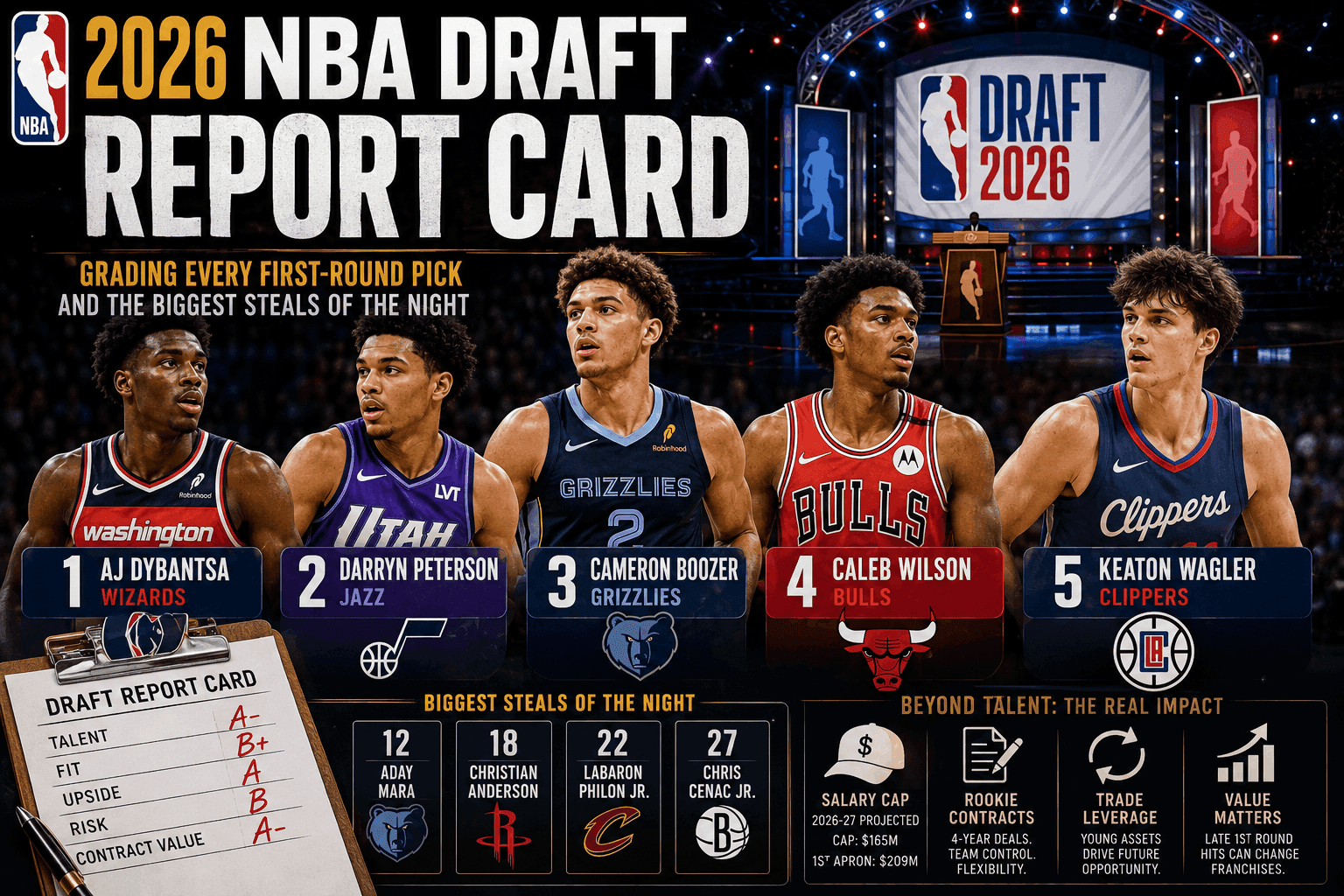
The 2026 NBA Draft gave the league a clean star-power headline at the top and a much more complicated value debate after that. The Washington Wizards started the night by taking BYU wing AJ Dybantsa at No. 1, followed by the Utah Jazz selecting Kansas guard Darryn Peterson at No. 2 and the Memphis Grizzlies adding Duke forward Cameron Boozer at No. 3. After that, the first round became less about obvious talent and more about fit, patience, medical risk, rookie-scale value, and how much each front office trusted its own board.
This report card grades every first-round pick from the perspective that matters most after draft night: not just who the team selected, but whether the player’s upside, contract slot, roster fit, and trade value made sense for that franchise. A good pick in 2026 is not only a future starter. It is a cost-controlled asset in a league shaped by the 2023 CBA, rising apron pressure, and a projected 2026-27 salary cap around $165 million.
The strongest grades go to teams that matched talent with timeline. The lowest grades go to franchises that reached for need, duplicated existing roster problems, or used valuable first-round salary slots on players with limited upside. From Dybantsa’s franchise-cornerstone case in Washington to the late-first-round names who could become the steals of the night, here is how the full 2026 NBA Draft first round grades out.
Key Takeaways
- The Wizards made the cleanest franchise-cornerstone pick of the night by selecting AJ Dybantsa at No. 1. His size, scoring versatility, and two-way upside make this an A-level selection for a Washington team that needed a true rebuild anchor.
- The top three picks all made sense, but for different reasons: Dybantsa gives Washington star upside, Darryn Peterson gives Utah a primary guard to build around, and Cameron Boozer gives Memphis a high-IQ frontcourt piece with immediate physicality and long-term leadership value.
- The first real debate starts at No. 5, where the LA Clippers selected Keaton Wagler. The talent is real, but the grade depends heavily on whether his shot creation and defensive translation justify taking him ahead of several higher-upside perimeter options.
- The best value zone of the first round came outside the top 10. Aday Mara at No. 12, Christian Anderson at No. 18, Labaron Philon Jr. at No. 22, and Chris Cenac Jr. at No. 27 all stand out as picks with strong surplus-value potential if their NBA roles translate quickly.
- The 2026 draft should not be judged only by talent. With the 2026-27 salary cap projected around $165 million and the first apron projected around $209 million, every first-round rookie-scale contract matters. Teams that found starter-level players in the teens and twenties gained more than prospects — they gained cheap, controllable roster flexibility.
2026 NBA Draft First Round: How the Picks Stack Up
Opening-night draft grades are not final career judgments. They are snapshots of value: what a team did with the pick it had, how that player fits the roster, whether the selection matched the board, and how much flexibility the rookie-scale contract gives the franchise over the next four seasons.
For this 2026 NBA Draft report card, each first-round pick is graded on five factors: prospect value, roster fit, upside, risk, and contract efficiency. A rebuilding team earns more credit for chasing star upside. A contender earns more credit for finding a defined rotation player who can help quickly. A reach gets punished when the team passes on cleaner value or creates a roster overlap that could limit future trade leverage.
The first round split into four clear tiers. Picks 1 through 5 delivered the highest-end talent, led by AJ Dybantsa to the Wizards, Darryn Peterson to the Jazz, Cameron Boozer to the Grizzlies, Caleb Wilson to the Bulls, and Keaton Wagler to the Clippers. Picks 6 through 14 formed the swing zone, where teams had to choose between upside guards, versatile forwards, and safer frontcourt pieces. Picks 15 through 22 produced some of the night’s best value, especially for teams that stayed patient. Picks 23 through 30 were more volatile, with contenders and cap-conscious teams trying to find cheap contributors at the end of the first round.
That structure matters because the 2026 first round was not just about talent. It was about asset management. Under the modern CBA, a late-first-round hit can become one of the most valuable contracts on a roster, while a missed pick in the same range can clog flexibility for years. That is why the grades below weigh salary slot and team timeline almost as heavily as raw prospect ranking.
Picks 1 Through 5: The Crown Jewels
The top five picks gave the 2026 NBA Draft its star-power foundation, but not every selection in this range carries the same level of certainty. Washington, Utah, and Memphis all came away with clear franchise-building pieces. Chicago made a strong value play at No. 4. The Clippers, however, created the first real debate of the night by taking Keaton Wagler at No. 5.
No. 1 — Washington Wizards: AJ Dybantsa, F, BYU
Grade: A
This was the cleanest pick in the draft. Dybantsa gives Washington the kind of high-end wing creator every rebuilding team is trying to find: size, scoring versatility, defensive tools, and enough playmaking upside to eventually function as the center of an offense. The Wizards needed a true identity piece, not another complementary young player, and Dybantsa gives them exactly that. There is always pressure attached to the No. 1 pick, but this was the right blend of talent, timeline, and franchise need.
No. 2 — Utah Jazz: Darryn Peterson, G, Kansas
Grade: A
Utah did not overthink the board. Peterson gives the Jazz a lead-guard prospect with real shot-creation equity, scoring craft, and the confidence to organize an offense. The fit is especially strong because Utah needed a young perimeter engine who can grow with the rest of the roster instead of forcing the franchise to build through stopgap guards. Peterson may need time to adjust to NBA physicality and defensive pressure, but the upside justifies the pick.
No. 3 — Memphis Grizzlies: Cameron Boozer, F, Duke
Grade: A-
Boozer is not the flashiest pick in the top three, but he may be the safest high-level player in the class. Memphis gets a physical, intelligent forward who can rebound, pass, finish, and stabilize lineups without needing the offense to be built entirely around him. The only reason this is not a full A is the ceiling debate: Boozer projects as a winning frontcourt piece, but the Grizzlies are betting that his feel and production translate into star-level impact rather than just elite complementary value.
No. 4 — Chicago Bulls: Caleb Wilson, F, North Carolina
Grade: B+
Wilson gives Chicago a long, versatile forward with the tools to defend multiple spots and grow into a major transition threat. For a Bulls team that needed athleticism and frontcourt upside, the pick makes sense. The grade stops short of an A because Wilson’s half-court scoring package still needs refinement. If the shot creation develops, this could look like one of the best selections in the lottery. If it does not, Chicago may have drafted a very good connector rather than a true offensive building block.
No. 5 — LA Clippers: Keaton Wagler, G, Illinois
Grade: B-
This is the first pick that invites real second-guessing. Wagler has clear NBA traits as a tough guard with shot-making ability and competitive edge, but the Clippers took him in a range where several higher-upside perimeter options were still available. For an older roster trying to balance win-now pressure with long-term planning, the logic is understandable: Wagler looks closer to contributing than some of the bigger swings on the board. Still, at No. 5, the standard is higher. Unless he becomes more than a useful rotation guard, this pick could age as a conservative reach.
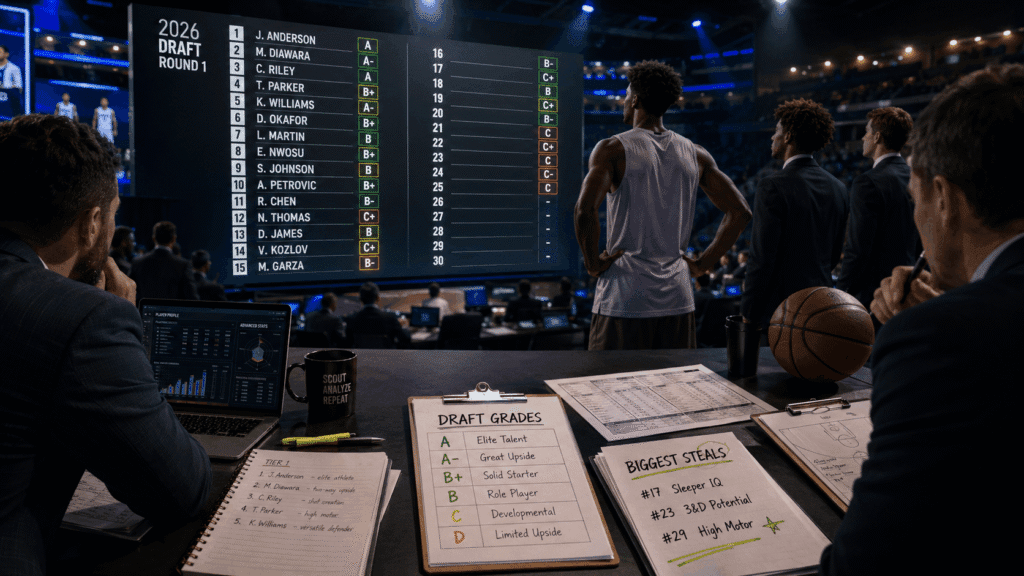
Full 2026 NBA Draft First-Round Grades
For traded picks, “Drafted By” shows the team that made the selection on draft night. “Final Rights Team” shows the team that acquired the player’s draft rights.
| Pick | Drafted By | Final Rights Team | Player | School / Club | Grade | Quick Take |
| 1 | Washington Wizards | Washington Wizards | AJ Dybantsa | BYU | A | Franchise-cornerstone wing and the cleanest pick in the draft. |
| 2 | Utah Jazz | Utah Jazz | Darryn Peterson | Kansas | A | Lead-guard upside for a team that needed a young offensive engine. |
| 3 | Memphis Grizzlies | Memphis Grizzlies | Cameron Boozer | Duke | A- | Safe, polished frontcourt piece with winning traits. |
| 4 | Chicago Bulls | Chicago Bulls | Caleb Wilson | North Carolina | B+ | Versatile forward with major defensive upside, but the offense still needs work. |
| 5 | LA Clippers | LA Clippers | Keaton Wagler | Illinois | B- | Tough guard, but a slightly conservative choice at No. 5. |
| 6 | Brooklyn Nets | Brooklyn Nets | Mikel Brown Jr. | Louisville | B+ | Real guard-creation bet for a rebuilding roster. |
| 7 | Sacramento Kings | Sacramento Kings | Darius Acuff Jr. | Arkansas | A- | Strong lottery value with speed, pressure, and shot creation. |
| 8 | Atlanta Hawks | Atlanta Hawks | Kingston Flemings | Houston | A- | Burst, playmaking feel, and long-term backcourt upside. |
| 9 | Dallas Mavericks | Dallas Mavericks | Morez Johnson Jr. | Michigan | B | Physical frontcourt fit, though the offensive ceiling is less clear. |
| 10 | Milwaukee Bucks | Milwaukee Bucks | Brayden Burries | Arizona | B+ | Practical young guard addition for a team needing controllable talent. |
| 11 | Golden State Warriors | Golden State Warriors | Yaxel Lendeborg | Michigan | A- | Mature, tough, high-feel forward who fits Golden State’s system. |
| 12 | Oklahoma City Thunder | Oklahoma City Thunder | Aday Mara | Michigan | A- | Unique size-and-skill swing for a team that can develop him patiently. |
| 13 | Miami Heat | Milwaukee Bucks | Nate Ament | Tennessee | A- | Milwaukee gets a long forward with shooting upside and real developmental value. |
| 14 | Charlotte Hornets | Charlotte Hornets | Hannes Steinbach | Washington | B+ | Strong frontcourt fit with rebounding, touch, and physicality. |
| 15 | Chicago Bulls | Chicago Bulls | Dailyn Swain | Texas | B | Sensible versatility pick, but Chicago needs more half-court creation. |
| 16 | Memphis Grizzlies | Oklahoma City Thunder | Bennett Stirtz | Iowa | A- | Polished guard who can shoot, move the ball, and fit quickly. |
| 17 | Oklahoma City Thunder | Detroit Pistons | Ebuka Okorie | Stanford | B+ | Worthwhile creation swing if the shooting and decision-making stabilize. |
| 18 | Charlotte Hornets | Charlotte Hornets | Christian Anderson | Texas Tech | A- | One of the best value picks if his scoring translates. |
| 19 | Toronto Raptors | Toronto Raptors | Allen Graves | Santa Clara | B | Developmental frontcourt bet with tools, but role clarity matters. |
| 20 | San Antonio Spurs | San Antonio Spurs | Jayden Quaintance | Kentucky | A- | Strong upside swing around Victor Wembanyama. |
| 21 | Detroit Pistons | Memphis Grizzlies | Karim Lopez | New Zealand Breakers | A- | Smart international upside play outside the lottery. |
| 22 | Philadelphia 76ers | Philadelphia 76ers | Labaron Philon Jr. | Alabama | A- | Late-first guard value for a team needing youth, pace, and scoring. |
| 23 | Atlanta Hawks | Atlanta Hawks | Zuby Ejiofor | St. John’s | B+ | Physical, productive frontcourt piece with energy and toughness. |
| 24 | New York Knicks | Los Angeles Lakers | Cameron Carr | Baylor | C+ | Athletic wing tools, but the value at this slot is debatable. |
| 25 | Los Angeles Lakers | Dallas Mavericks | Sergio De Larrea | Valencia | B+ | Creative international guard with size and feel. |
| 26 | Denver Nuggets | San Antonio Spurs | Tarris Reed Jr. | Connecticut | B+ | Strong frontcourt body who adds depth and physicality. |
| 27 | Boston Celtics | Boston Celtics | Chris Cenac Jr. | Houston | A- | Excellent late-first value with size, skill flashes, and upside. |
| 28 | Minnesota Timberwolves | Brooklyn Nets | Joshua Jefferson | Iowa State | B | Useful forward bet with defensive tools and rotation potential. |
| 29 | Cleveland Cavaliers | Sacramento Kings | Alex Karaban | Connecticut | B+ | Shooting, experience, and a clean role fit late in the round. |
| 30 | Dallas Mavericks | Phoenix Suns | Koa Peat | Arizona | C+ | Interesting local story, but the offensive fit raises questions. |
Biggest Steals of the 2026 NBA Draft
The best value picks came after the lottery, where rookie-scale contracts become especially useful for teams trying to manage payroll and roster flexibility.
Christian Anderson at No. 18 is one of the cleanest steals of the first round. Charlotte needed more guard creation, and Anderson gives the Hornets a scorer with enough on-ball ability to grow into a real rotation piece.
Labaron Philon Jr. at No. 22 is strong value for Philadelphia. The 76ers needed youth, pace, and cheaper guard scoring, and Philon gives them all three without forcing the team into another veteran contract.
Chris Cenac Jr. at No. 27 may be the best late-first value. Boston does not need him to become a star right away. If he develops into a playable frontcourt piece, the Celtics get useful size and upside at a manageable salary slot.
Biggest Reaches of the 2026 NBA Draft
Keaton Wagler at No. 5 is the first pick that invites real second-guessing. He has toughness and shot-making ability, but the Clippers took him ahead of several higher-upside perimeter options.
Cameron Carr at No. 24 is more of a risk pick than a clear mistake. The athletic tools are real, but the Lakers are betting heavily on development. If the shot and decision-making do not come along, the value could be difficult to justify.
Koa Peat at No. 30 is not a disaster, but it is a fit question. Phoenix needs cheap contributors, yet Peat’s half-court role and shooting development will determine whether this pick helps quickly enough.
Why Rookie-Scale Value Matters
First-round picks matter because they give teams controlled contracts at fixed salary slots. For rebuilding teams, that means time to develop young players without rushing the timeline. For expensive contenders, it means a chance to add cheap rotation help while staying flexible around the luxury tax and apron rules.
That is why the best picks in this draft are not only the biggest names. A late-first player who becomes a starter, sixth man, or reliable rotation piece can create more roster value than a lottery pick who needs the ball but does not fit the team’s timeline.
Final Verdict
The 2026 NBA Draft was strongest at the top and surprisingly valuable in the late first round. Washington, Utah, and Memphis made the cleanest early picks, while Charlotte, Philadelphia, Boston, Oklahoma City, and Memphis found some of the best value later in the round. The biggest questions belong to teams that paid a premium for safer or less obvious fits.
The real winners will be the franchises that turn rookie-scale contracts into rotation production before those players become expensive.
Frequently Asked Questions
What is a 2026 NBA Draft report card?
A 2026 NBA Draft report card grades each first-round pick based on value, team fit, upside, risk, and how well the selection matches the franchise’s roster timeline.
How are NBA Draft grades different from prospect rankings?
Prospect rankings focus on the player. NBA Draft grades focus on the pick. A team can draft a talented player and still receive a lower grade if the fit, draft slot, or opportunity cost does not make sense.
Which NBA Draft picks offered the best value in 2026?
Some of the best value came later in the first round, where players such as Christian Anderson, Labaron Philon Jr., and Chris Cenac Jr. landed in spots where their upside could outperform their draft position.
How do rookie contracts affect NBA salary cap flexibility?
Rookie contracts matter because they give teams cost-controlled players for several seasons. If a first-round pick becomes a rotation player quickly, the team gains useful production without using major NBA salary cap space.
Can NBA Draft picks affect offseason trades?
Yes. First-round picks can affect NBA offseason trades because they become young, controllable assets. A strong pick can increase a team’s trade flexibility, while a questionable pick may be harder to move later.