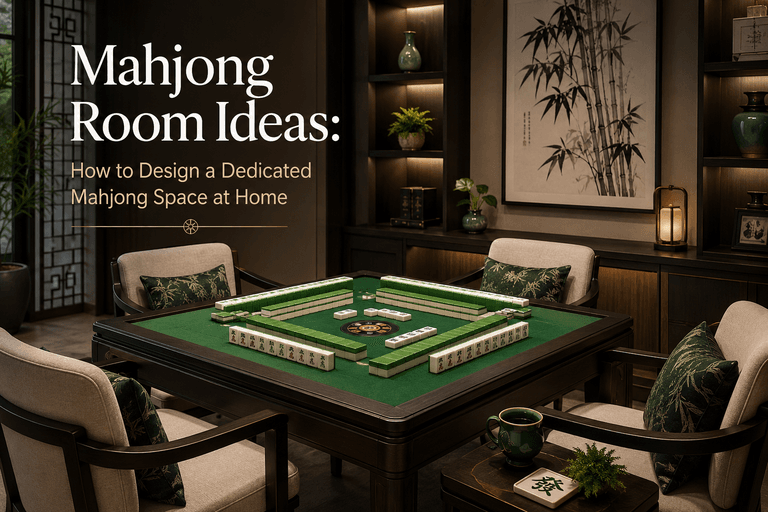
Designing a dedicated mahjong room at home starts with choosing the right table (ideally 36 to 40 inches square), four comfortable chairs, focused overhead lighting, and smart tile storage within arm’s reach of every player. From there, the space comes together through thoughtful seating, acoustic-friendly surfaces, and décor that reflects the game’s cultural roots or your own personal style.
Key Takeaways
- A dedicated mahjong table typically runs between $200 and $1,500, with automatic shuffling tables starting around $800 and offering significant time savings during long sessions.
- Four feet of clearance around the table on all sides is the practical minimum for comfortable play and chair movement.
- Hard mahjong tiles on a bare wood table can reach noise levels comparable to light construction work; a thick felt or rubber-backed mat reduces that significantly and is one of the highest-impact upgrades you can make.
- Warm-white light in the 2700K to 3000K range positioned directly over the table reduces tile misreads and eye fatigue during long sessions.
- Purposeful home game rooms are among the fastest-growing interior design trends of the mid-2020s, driven by a renewed interest in in-person social play.
Why More Homeowners Are Building Dedicated Mahjong Spaces
A dedicated mahjong room is no longer just a nice-to-have for serious players. It has become a genuine interior design category, shaped by the same impulse that made home offices and reading nooks mainstream.
Mahjong has seen a remarkable surge in popularity across North America over the past several years, drawing in both players with family ties to the game and entirely new hobbyist communities. That growth has pushed the game out of the living room and into rooms designed specifically around it. The appeal is practical as much as aesthetic. Mahjong requires four players seated at a square table with tiles, racks, dice, and sometimes scoring sheets all within reach. Setting up and tearing down in a shared living space gets old quickly. A dedicated room solves that problem and doubles as a social anchor in the home, a place where friends and family gather for hours at a time. From a broader design perspective, this fits squarely into a larger movement toward purposeful spaces. You can find that same thinking across interior design ideas for every room, whether it’s a craft studio, a vinyl listening room, or a home cinema. The mahjong room is simply the latest expression of designing around how you actually want to spend your time.
Choosing the Right Space for Your Mahjong Room
The best mahjong room is the one that fits four players comfortably without compromising traffic flow in the rest of your home. Spare bedrooms, finished basements, and converted dining rooms are the most common starting points.
Before you buy a table or hang a single piece of art, measure your available square footage. A mahjong table with four chairs in use needs a room that is at least 10 by 10 feet. That is the absolute floor. A 12 by 12 room gives you breathing room, and anything larger gives you space for extra seating, a side table for drinks, and storage furniture. Spare bedrooms work especially well because they already have doors (important for noise containment, which we cover in depth later) and often have closets that can be repurposed for tile and accessory storage. Finished basements are popular for the same reason: they’re naturally separated from sleeping areas and can absorb more sound. Avoid rooms with heavy foot traffic passing through, like hallways or open-plan living spaces that double as circulation routes. Players need to focus, and a steady stream of people walking by breaks concentration and disrupts the social atmosphere that makes mahjong enjoyable. One common mistake is underestimating how much clearance chairs need. A chair pushed back from the table travels roughly 24 inches. Add the chair depth of around 20 inches and you need close to four feet of open floor behind every seat before you hit a wall or another piece of furniture.
Picking the Right Mahjong Table for Home Play
The table is the functional heart of every mahjong room design, and the choice you make here shapes everything else, from room layout to noise levels to how long sessions comfortably last.
Manual vs. Automatic Shuffling Tables
Standard manual mahjong tables are square, typically 36 to 40 inches per side, and come with a felt or padded surface, cup holders, and sometimes built-in tile racks. These run from around $200 to $600 and are perfectly capable for regular home play. Automatic shuffling tables are a category unto themselves. These use a motorized mechanism below the table surface to shuffle and distribute tiles between rounds, cutting setup time from several minutes down to about 60 seconds. Brands like Moxian and LoveyDay offer popular models in the $800 to $1,500 range. The noise from the shuffling motor is brief (30 to 60 seconds per round) but noticeable, which is worth considering if the room shares a wall with a bedroom.
Surface Material Matters More Than You Think
Felt surfaces are the most common and the most forgiving. They dampen tile noise, protect the tiles from scratching, and give players a comfortable surface to work on for hours. Leatherette or vinyl tops look sleeker and are easier to wipe down, but they return more sound. Bare wood or glass tops amplify tile clack significantly and are generally not recommended for home setups. If you fall in love with a table that has a hard surface, a separate play mat solves the problem. High-density rubber-backed felt mats in the 36-inch square size are widely available on Amazon and other retailers for $20 to $60.
Table Height and Ergonomics
Standard dining table height (28 to 30 inches) works well for most players. If your group includes older players or anyone with limited shoulder mobility, a slightly lower surface around 27 inches reduces arm fatigue over a long session. Pair the table with chairs that have adjustable seat height when possible.
Seating, Lighting, and Layout: Getting the Fundamentals Right
After the table, seating and lighting have the biggest impact on how comfortable and functional your mahjong room actually feels during play.
Seating That Supports Long Sessions
Four players sitting for two to four hours need real support. Dining chairs with padded seats and low backs are a common choice because they allow free arm movement while still offering lumbar support. Avoid deep lounge chairs or anything with wide arms that crowd the table edge. Swivel chairs with moderate cushioning are increasingly popular in dedicated game rooms because they allow players to turn naturally when reaching for tiles or interacting across the table. If budget allows, look at task chairs without wheels, which offer ergonomic shaping without the rolling instability that catches players off guard. Keep chair upholstery practical. Fabric holds up to long-term use but can absorb spills from the inevitable cup of tea or coffee. Leatherette wipes down easily and ages reasonably well. Avoid light-colored upholstery in a room used for food and drink.
Lighting That Reduces Mistakes
Tile misreads are frustrating and often come down to bad lighting. A central overhead fixture positioned directly above the table is non-negotiable. Recessed cans or a pendant light with a diffuser spread light evenly across all four sides without casting shadows on any player’s tiles. Color temperature matters here. Warm white light in the 2700K to 3000K range is easy on the eyes during long sessions. Cool white or daylight-spectrum bulbs (5000K and above) feel clinical and cause more fatigue over time. Dimmer switches are worth the modest installation cost. They let you set a brighter level for active play and drop the light slightly for breaks or ambiance when the session winds down. Many players also add a secondary light source, a floor lamp or a small table lamp on a sideboard, to keep the room from feeling like an interrogation room when the overhead is at full brightness.
Traffic Flow and Layout
Place the table toward the center or slightly off-center of the room, never pushed against a wall. All four players need equal space behind their chairs, equal access to tile walls in front of them, and clear sight lines to one another. A sideboard or credenza along one wall handles drinks, snacks, scoring pads, and extra accessories without cluttering the table itself. If the room is large enough, a small loveseat or a pair of occasional chairs in a corner creates a natural spot for observers or for players waiting between games.
Mahjong Room Design at a Glance: Table Comparison
| Table Type | Price Range (USD) | Surface | Noise Level | Best For |
|---|---|---|---|---|
| Basic manual table (felt top) | $200 to $400 | Felt | Low | Casual players, tight budgets |
| Mid-range manual table (leatherette) | $400 to $600 | Leatherette or vinyl | Moderate | Regular players who want durability |
| Entry-level automatic shuffling table | $800 to $1,000 | Felt or padded | Low (brief motor noise) | Frequent players, larger households |
| Mid-range automatic shuffling table | $1,000 to $1,500 | Padded felt, adjustable | Low (brief motor noise) | Serious players, gift-worthy setups |
| Convertible dining/mahjong table | $300 to $700 | Reversible top (wood + felt) | Low (felt side) | Multipurpose rooms, smaller homes |
| Custom or imported table (hardwood) | $1,500 and up | Lacquered wood or inlay | High without a mat | Design-forward rooms, display pieces |
Lighting Your Mahjong Room: Ambiance Meets Functionality
Lighting is one of those details that separates a room you want to spend hours in from one that quietly wears you down. Mahjong tiles are small, detailed, and often read in quick succession under mild time pressure so the quality and placement of light directly affects how well players can see suits, honors, and bonus tiles without squinting or leaning forward.
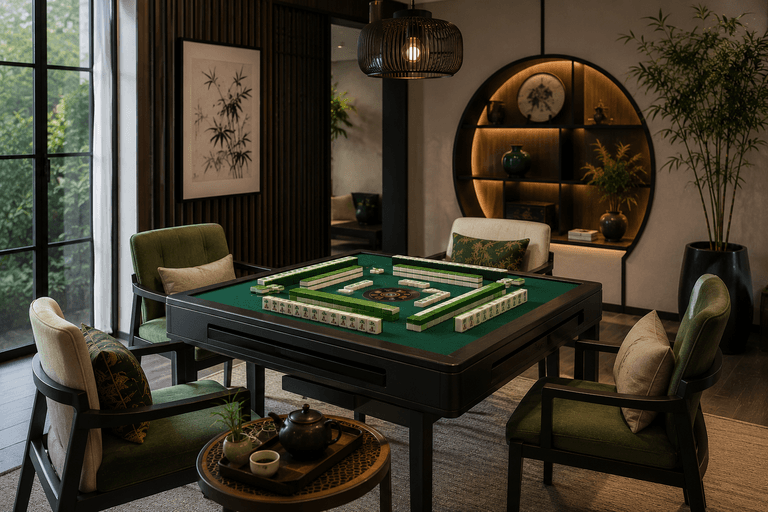
The gold standard for a dedicated mahjong room is a pendant or hanging fixture positioned directly over the table. You want the light source centered above the play surface, low enough to illuminate all four sides evenly without throwing shadows across any one player’s hand. A fixture hung roughly 28 to 34 inches above the tabletop works well for most standard ceiling heights, though you can adjust that range depending on the bulb spread. Aim for a color temperature between 2700K and 3500K warm enough to feel welcoming, cool enough to read tile characters without eye strain. Full, harsh daylight-spectrum LEDs at 5000K and above create a clinical feel that undercuts the social atmosphere most players are after.
Dimmer switches are worth installing even if you think you won’t use them often. Mahjong nights can run long, and the ability to lower the ambient brightness slightly while keeping the table well-lit helps the room feel relaxed rather than fluorescent. Pair the overhead pendant with at least one secondary light source: a floor lamp in a corner, a buffet lamp on a sideboard so the space doesn’t feel like a single harsh spotlight in an otherwise dark room.
If your mahjong room doubles as a study or living area, track lighting gives you the flexibility to direct one or two heads toward the table while leaving the rest of the room at a different intensity. Just make sure none of the track heads are positioned to shine directly into any player’s line of sight, which creates glare and fatigue over a long session. Sconces on adjacent walls also work well as ambient fill, especially in rooms with darker paint colors or rich wood tones.
Natural light is pleasant during daytime games but introduces its own complications. Direct sunlight creates glare on lacquered tiles, heats up the room unevenly, and shifts dramatically over a two-hour session. Layered window treatments, a sheer for diffusion and a heavier panel or Roman shade you can draw fully give you control across the day without committing to a permanently dark room.
Storage, Organization, and Display: Keeping Your Mahjong Supplies Accessible
A well-designed mahjong room handles storage in a way that feels intentional rather than improvised. The supplies involved a full set of tiles, dice, racks, chips or coins, score sheets, wind markers, and sometimes multiple sets for different rule variants add up quickly, and leaving them stacked on a corner chair or crammed into a drawer chips away at both the tiles and the room’s atmosphere.
The most practical approach is dedicated closed storage within arm’s reach of the table. A low credenza or sideboard placed along one wall serves this purpose beautifully: it holds sets in their cases flat without stacking pressure, provides a surface for drinks and snacks during play, and can be styled with objects that reinforce the room’s aesthetic when not in use. Drawers within the credenza can store chips organized by denomination in small divided trays, spare score pads, and extra dice all separated so nothing rattles loosely or goes missing before guests arrive.
For households with a serious collection, an open display can be its own design statement. A set displayed in its open case on a shelf, particularly a vintage or carved set in a lacquered box reads as a collectors’ object rather than sporting equipment. Glass-front cabinets let you display sets while protecting them from dust, which matters for tile surfaces that pick up oils and grime over time. If you go the open-display route, avoid placing sets in direct sunlight, which can fade dyed or painted tile faces and warp older bamboo and bone pieces.
Tile racks deserve their own consideration. Folding racks store flat and stack efficiently, making them the default for most households. Fixed or weighted racks tend to be bulkier but stay in place more reliably during energetic play, a small but real advantage when the table gets lively. Either way, a shallow basket or tray dedicated to rack storage keeps them from sliding around in a drawer and makes setup faster when guests are already arriving.
Score tracking has moved partly to phones and tablets, but keeping a dedicated pad and two or three pens near the table prevents the interruption of searching for something to write mid-game. A small ceramic cup or weighted pen holder on the credenza surface is enough. If you prefer digital tracking, a small tablet stand positioned off to the side never in a player’s sightline across the table keeps it accessible without becoming a distraction.
Sound Management: How to Reduce Tile Noise and Soundproof Your Mahjong Room
Anyone who has played mahjong in a quiet apartment building or near a sleeping household knows the problem: the shuffle, draw, and discard of hard tiles produces a sharp, repetitive clacking that carries surprisingly well through walls and floors. Managing that sound is not a luxury consideration; it is often what determines whether a dedicated mahjong room is actually usable during evening hours or whenever other people are home.
The most immediate intervention happens at the table surface itself. A thick felt mat or a neoprene-backed table pad placed over a hard tabletop reduces tile impact noise dramatically at the source, which is always the most efficient place to address sound. Many players who own hardwood or lacquered tables use a purpose-made mahjong mat typically 3mm to 5mm thick, with a non-slip backing as a standard part of setup. The difference in noise level between bare hard surface and a quality mat is audible from the next room. Automatic mahjong tables address this differently: the padded felt surface built into the turntable area handles most of the in-play noise, though the shuffle mechanism itself produces a brief mechanical hum during each automated wash.
Beyond the table, the flooring in the room plays an outsized role in how sound travels to lower floors or adjacent rooms. Hard flooring tile, hardwood, laminate transmits impact noise efficiently, which means every drawn tile and shifted rack communicates through the subfloor. A large area rug with a thick pad underneath is the single highest-impact room-level intervention you can make. A rug sized to reach well beyond the chairs on all sides of the table, backed with a dense rubber or felt underlayment, absorbs both airborne sound and structural vibration. According to the U.S. Environmental Protection Agency, controlling noise at or near the source is consistently the most effective strategy, a principle that applies just as clearly at the household scale as in industrial settings.
Walls are the next layer. A room with hard, bare walls reflects sound back into the space and outward through shared surfaces. Soft furnishings help substantially: upholstered seating, curtains that reach from ceiling to floor, and wall-mounted textiles all add absorption. Acoustic panels which are available in fabric-wrapped designs that look like artwork can be placed on the wall behind each player or on the two side walls without advertising their function. Bookshelves filled with books are genuinely effective diffusers that most people already have and rarely think of in acoustic terms.
The door is often the weakest link in a mahjong room’s sound envelope. Hollow-core interior doors, which are standard in most residential construction, transmit sound with minimal resistance. Replacing the room’s door with a solid-core door is a straightforward swap that costs $150 to $400 for the door slab, plus installation makes a measurable difference in how much sound escapes into hallways and adjacent rooms. Adding a door sweep to the bottom gap and acoustic foam weatherstripping around the frame closes the remaining air gaps that carry high-frequency sound most efficiently.
For players in multifamily buildings with sensitive neighbors directly below, a floating floor or resilient underlayment beneath the finished floor is the more permanent solution typically addressed during a renovation rather than added to an existing room. If a full renovation is not in scope, a combination of thick rug, padded underlayment, and strategic furniture placement achieves meaningful reduction without construction. Placing heavier furniture, the credenza, bookshelves against shared walls adds mass that resists sound transmission passively.
White noise or low background music also plays a role, not by eliminating tile clacking but by raising the ambient noise floor in adjacent spaces so the peak sounds from play are less perceptually distinct. A small speaker in the hallway or the adjacent room running a consistent low-level sound, a fan, ambient music, or a dedicated white noise device is a low-effort complement to the structural solutions above, particularly during late-night sessions when household contrast between quiet and game noise is at its sharpest.
Bringing It Together: Making the Room Feel Like the Game It’s Meant For
The best mahjong rooms are not expensive ones, they are considered ones. A spare bedroom with a quality mat on an inexpensive table, a well-placed lamp, a rug thick enough to soften the floor, and enough storage to set up in five minutes will outperform a beautifully furnished room where players spend half the evening searching for dice and squinting in overhead glare. Start with the table and the acoustics, because those two things affect every session. Add lighting next, since it shapes how long guests comfortably stay. Storage and display come after they reinforce the intention behind the room and make the space feel ready rather than improvised. Style the room around what you love about the game itself: the ritual of the wash, the social rhythm of the draw, the tactile pleasure of good tiles in a well-lit room. Those are the things a thoughtfully designed space preserves and amplifies, session after session.
Frequently Asked Questions
What is the ideal room size for a dedicated mahjong room?
A room of roughly 10 by 12 feet is workable for a standard four-player mahjong table with comfortable seating clearance on all sides. The minimum clearance from the edge of the table to any wall or piece of furniture is around 36 inches, which allows players to pull chairs back, stand, and move freely without feeling confined. Larger rooms give you space for a sideboard and additional seating, which improves the room’s usability for hosting. Smaller rooms can work if you choose a compact table and keep furniture minimal, but anything below about 9 by 10 feet will feel tight during active play.
Can I use a regular dining table for mahjong, or do I need a dedicated table?
A regular dining table works perfectly well for mahjong, especially with a quality felt mat placed over the surface to reduce noise and protect both the tiles and the table. The main limitations of a standard dining table are height; most dining tables are 29 to 30 inches, which suits mahjong play and shape. Square tables in the 36-by-36 to 40-by-40 inch range are ideal for four players. A large rectangular dining table can work but tends to create uneven reach distances for the players sitting along the long sides. Convertible tables with a reversible top that flips between wood and felt are a practical middle-ground for households that don’t want to dedicate a table exclusively to the game.
How do I reduce the noise of mahjong tiles without replacing my table?
The most effective no-replacement solution is a thick felt or neoprene-backed mahjong mat placed directly on the existing table surface. These mats are inexpensive, store flat, and reduce tile impact noise significantly at the source. Beyond the table, adding a large area rug with a dense underlayment beneath the play area addresses floor transmission, which is the primary path for noise reaching lower levels or adjacent rooms. Soft furnishings, upholstered chairs, floor-length curtains, and filled bookshelves absorb airborne sound that would otherwise reflect off hard walls. For the room’s door, a door sweep along the bottom gap and foam weatherstripping around the frame close the air gaps that let the most sound escape into adjacent spaces.
What kind of lighting works best over a mahjong table?
A centered pendant or hanging fixture positioned 28 to 34 inches above the table surface is the most effective choice for dedicated mahjong lighting. This placement delivers even light across all four sides of the table without casting shadows on any player’s tiles. A color temperature of 2700K to 3500K balances warmth and legibility warm enough to feel relaxed, clear enough to read tile characters comfortably during a long session. Installing a dimmer switch lets you adjust intensity as the session goes on. Avoid positioning any light source directly in a player’s line of sight across the table, since glare accumulates quickly and contributes to eye fatigue during extended play.