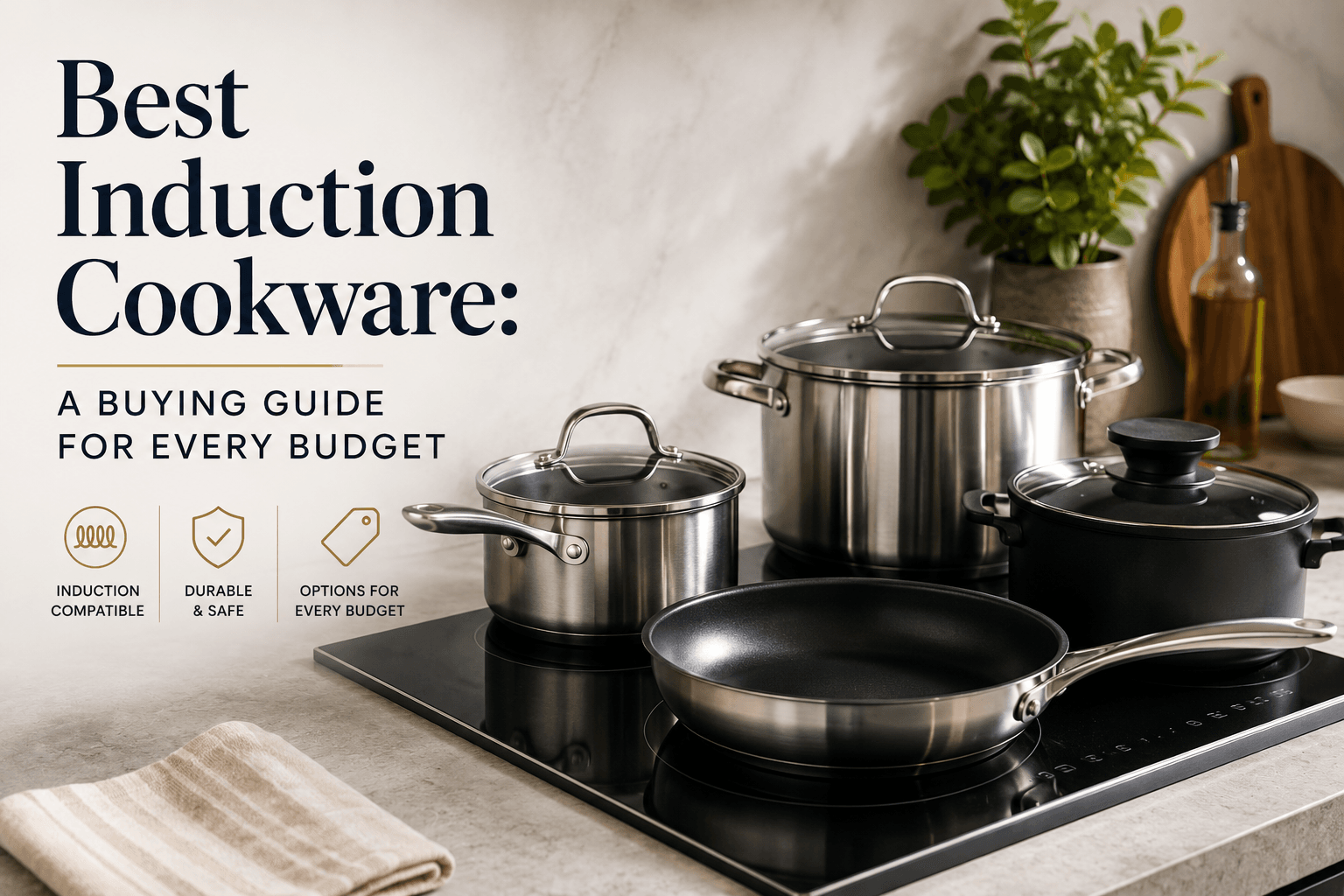
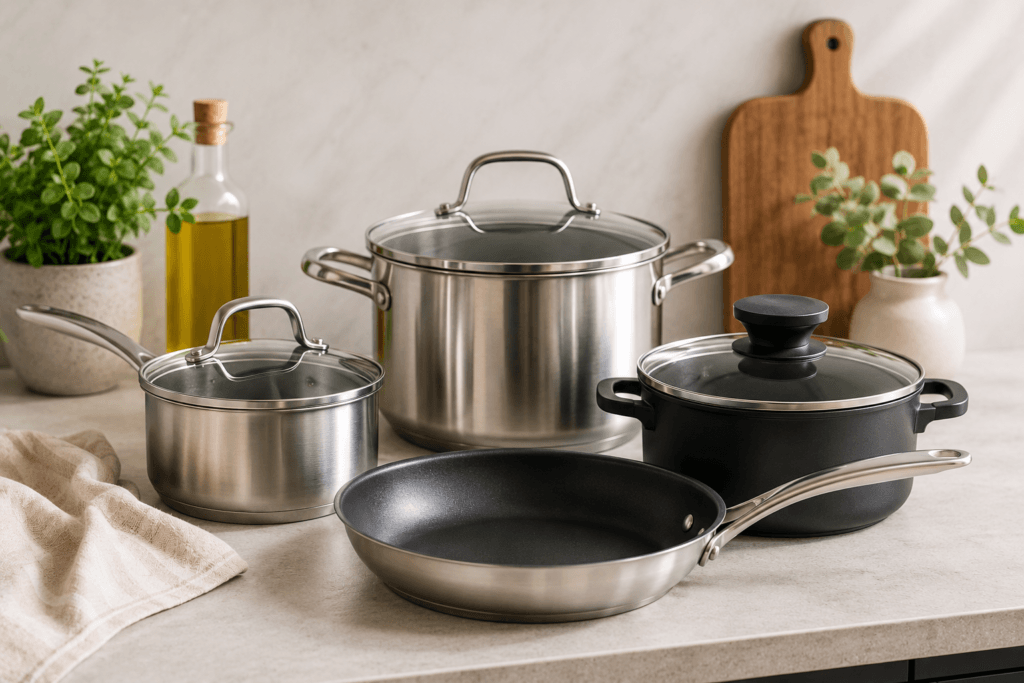
The best induction cookware combines a flat, magnetic base with even heat distribution across the full cooking surface, with tri-ply stainless steel and enameled cast iron consistently outperforming other materials in independent testing. Budget-friendly options like Tramontina’s tri-ply sets deliver solid performance starting around $80, while premium lines from All-Clad and Le Creuset justify their higher price tags with superior construction and longer warranties. Confirming compatibility is simple: if a magnet sticks firmly to the pan’s base, it will work on any induction cooktop.
Key Takeaways
- Induction cooktops require cookware with a ferromagnetic base, meaning aluminum, copper, and some stainless steel pans will not work without an induction-compatible disk bonded to the base.
- Tri-ply and five-ply clad stainless steel sets offer the best balance of performance, durability, and value, with quality options available from $80 to over $700 depending on piece count and brand.
- Carbon steel and cast iron are highly compatible with induction but require careful handling on glass-ceramic cooktop surfaces to avoid scratching or cracking the cooktop.
- Oven-safe temperature ratings vary significantly by cookware line, ranging from 350°F for some nonstick sets to 600°F or higher for fully clad stainless steel.
- Base flatness matters as much as material: a warped or convex pan base reduces contact with the induction element, cutting heating efficiency by up to 30% in some tests.
What Makes Cookware Induction Compatible?
Induction cooking works by generating a magnetic field that heats the pan directly, so only cookware containing ferromagnetic metals will function on an induction cooktop. Understanding which materials qualify helps you avoid expensive mistakes when building or upgrading your kitchen.
Induction cooktops generate an alternating magnetic field through a copper coil beneath the glass surface. When a pan with a ferromagnetic base is placed on top, that field induces an electric current in the metal, which generates heat directly within the cookware itself rather than transferring heat from a burner or element. This is why the cooktop surface stays relatively cool even during high-heat cooking. For a pan to work on induction, its base must contain iron or a material with similar magnetic properties. Cast iron, carbon steel, and most stainless steel alloys with higher iron content (typically 18/0 stainless rather than 18/10) are naturally compatible. Aluminum and copper are not magnetic on their own, but manufacturers often solve this by bonding an induction-compatible steel disk to the base of otherwise non-magnetic pans. The magnet test remains the most reliable compatibility check: place a standard kitchen or refrigerator magnet against the bottom of the pan. A strong pull indicates full compatibility. A weak or partial attraction may mean the base layer is thin, which can result in slower or uneven heating. No attraction at all means the pan will not work. One important nuance: “induction ready” and “induction optimized” are not the same thing. A pan with a thin impact-bonded disk on an aluminum body will work on induction, but it will heat unevenly compared to a fully clad tri-ply pan where the magnetic layer runs through the entire base and up the sides. For serious cooking, the construction method matters, not just basic compatibility.
Best Induction Cookware Sets by Price Point
Induction cookware sets are available across a wide price range, and spending more does not always mean better performance for everyday cooking. The right choice depends on how frequently you cook, what techniques you rely on, and how long you expect the set to last.
Best Budget Pick: Tramontina Tri-Ply Clad Stainless Steel (Around $80 to $130)
Tramontina’s tri-ply clad line is consistently the top recommendation in this price range, and for good reason. The three-layer construction (stainless steel over an aluminum core over magnetic stainless steel) runs the full length of the pan rather than just the base, giving it performance characteristics closer to sets costing twice as much. A typical 10-piece set includes a mix of saucepans, a stockpot, and skillets that cover most everyday cooking needs. Real-world testing regularly shows Tramontina heating within 10 to 15 seconds on a standard induction burner and distributing heat evenly enough to eliminate most hot spots. The lids seal well, handles stay cool on the stovetop, and the interior surface is polished smooth enough for deglazing without residue buildup. The main trade-off at this price is thinner gauge metal compared to premium brands, which means slightly less thermal mass for tasks like searing large cuts of meat.
Best Mid-Range Pick: Cuisinart Multiclad Pro or Calphalon Premier (Around $150 to $300)
In the mid-range, Cuisinart’s Multiclad Pro and Calphalon’s Premier stainless steel lines both deliver noticeably heavier construction than budget options while stopping well short of All-Clad pricing. Cuisinart’s Multiclad Pro uses a similar tri-ply construction with a brushed stainless exterior and a polished interior, and the line is fully oven-safe to 500°F. Calphalon’s Premier series uses a five-layer construction that adds extra aluminum to the core for improved thermal retention. Both lines are widely available at major retailers and include manufacturer warranties of at least a limited lifetime guarantee. The step up from budget cookware is most noticeable in the weight and rigidity of the pans, which reduces the likelihood of warping over time, and in the tighter fit of lids, which matters for braising and steaming.
Best Premium Pick: All-Clad D3 or D5 (Around $400 to $800 for a set)
All-Clad’s D3 (three-ply) and D5 (five-ply) lines are the standard against which most stainless steel cookware is measured in professional and serious home cooking contexts. Made in the United States in Canonsburg, Pennsylvania, both lines use fully clad construction with magnetic stainless steel on the exterior. The D5 adds two more layers for slower, more even heat buildup, which some cooks prefer for sauces and delicate proteins. The price premium is substantial, but All-Clad’s construction quality is measurably different: heavier gauge steel throughout, riveted handles with a more ergonomic grip profile, and a polished interior that develops a better cooking patina over time. The brand’s limited lifetime warranty covers manufacturing defects, and the pans routinely last decades with proper care. For buyers who cook daily and expect their cookware to outlast multiple home upgrades, the per-year cost of ownership often compares favorably to replacing mid-range sets every five to seven years.
Best Nonstick Option for Induction: GreenPan Valencia Pro or Zwilling Madura Plus
Nonstick pans require extra scrutiny for induction compatibility because many are made with aluminum bodies that need a bonded magnetic base. GreenPan’s Valencia Pro line uses a hard-anodized aluminum body with a reinforced induction-compatible base and a ceramic nonstick coating (marketed as Thermolon) that is PFAS-free and rated to 600°F before degradation. Zwilling’s Madura Plus uses a traditional PTFE nonstick coating with a five-layer construction and is oven-safe to 400°F. Both perform well for eggs, fish, and other delicate foods that benefit from nonstick surfaces. The key limitation with any nonstick pan on induction is that the high heat efficiency of induction cooktops can accelerate coating wear if pans are preheated empty or used at maximum power settings. Medium heat is almost always sufficient, and this habit extends coating life significantly.
Induction Cookware Comparison: Key Specs at a Glance
The table below compares verified specifications for the most commonly recommended induction cookware sets across budget, mid-range, and premium categories to help you assess value side by side.
| Set / Line | Price Range (USD) | Construction | Oven-Safe Temp | Pieces (Typical Set) | Induction Type | Warranty |
|---|---|---|---|---|---|---|
| Tramontina Tri-Ply Clad | $80 to $130 | 3-ply fully clad | 500°F | 10 to 12 pieces | Fully clad magnetic SS exterior | Limited lifetime |
| Cuisinart Multiclad Pro | $150 to $200 | 3-ply fully clad | 500°F | 10 to 12 pieces | Fully clad magnetic SS exterior | Limited lifetime |
| Calphalon Premier Stainless | $200 to $300 | 5-ply fully clad | 450°F | 10 to 11 pieces | Fully clad magnetic SS exterior | Limited lifetime |
| All-Clad D3 | $400 to $600 | 3-ply fully clad | 600°F | 10 to 12 pieces | Fully clad magnetic SS exterior | Limited lifetime |
| All-Clad D5 | $550 to $800 | 5-ply fully clad | 600°F | 10 to 14 pieces | Fully clad magnetic SS exterior | Limited lifetime |
| GreenPan Valencia Pro | $100 to $180 | Hard-anodized aluminum + bonded base | 600°F | 10 to 11 pieces | Impact-bonded induction base | Limited lifetime |
| Zwilling Madura Plus | $80 to $160 | 5-layer aluminum + bonded base | 400°F | Individual or sets | Impact-bonded induction base | Limited lifetime |
| Le Creuset Enameled Cast Iron | $300+ (individual pieces) | Solid cast iron, enamel coated | 500°F (with lid) | Individual pieces | Naturally magnetic cast iron | Limited lifetime |
What to Look for When Choosing Induction Cookware?
Beyond basic compatibility, several construction and design details separate cookware that performs well on induction from cookware that merely works on it. Knowing what to look for prevents common buying mistakes that only become apparent after you start cooking.
Base Thickness and Flatness
The base of an induction-compatible pan needs to be both thick enough to distribute heat evenly and flat enough to maintain consistent contact with the cooktop surface. Most quality sets use a base thickness of at least 2.5mm in the magnetic layer alone. Thinner bases are more prone to developing a slight convex warp after repeated heating and cooling cycles, which reduces the contact area with the induction element and slows heating times noticeably. When evaluating cookware in person, place the pan base-down on a flat surface and check for any rocking. A pan that wobbles slightly on a flat counter will perform poorly on an induction cooktop from day one.
Handle Design and Oven Compatibility
Riveted stainless steel handles are the most durable option and are standard across mid-range and premium lines. Welded handles (which appear seamless with no visible rivets) are sometimes found on lower-cost sets and may be more prone to loosening over years of use. Long handles provide better leverage for heavier pans like stockpots, but can be awkward in smaller kitchens. Oven-safe ratings vary from 350°F for sets with silicone handle grips to 600°F or higher for bare stainless designs. If you rely on the oven-to-stovetop technique common in roasting and braising, prioritize sets with metal handles and oven ratings of at least 500°F.
Lid Materials and Fit
Most sets include tempered glass lids, which allow you to monitor cooking without lifting the lid and losing heat. Some premium lines offer stainless steel lids, which are more durable but eliminate visibility. A well-fitting lid matters more on induction than on gas because induction burners cycle on and off to regulate temperature, and a poor seal allows more heat to escape during off cycles, extending cooking times. For more cooking guides and equipment breakdowns, browse our kitchen tips and tool guides or explore more Food articles on WideJournal.
Nonstick vs. Stainless Steel vs. Cast Iron on Induction: Which Surface Is Right for You?
The coating or surface material of your cookware is a separate decision from whether it works on induction, and it matters just as much for cooking outcomes. Each material has a genuine use case, and the “best” surface depends entirely on what ends up in your pan most often.
Nonstick is the easiest surface to cook on and the easiest to ruin. PTFE-based coatings (Teflon is the most recognized brand name) release food effortlessly and clean up quickly, making them ideal for eggs, fish, crepes, and anything delicate. On induction, nonstick pans work well as long as you respect medium heat. One of the more common misconceptions is that induction won’t overheat a nonstick pan because the cooktop itself stays relatively cool. It won’t. The pan gets just as hot from induction as it would from gas or electric,and overheating accelerates coating breakdown. The chemical threshold depends heavily on the technology used: traditional PTFE-based coatings (like Teflon) begin to degrade and can release fumes harmful to birds if they exceed 500°F (260°C). In contrast, modern ceramic nonstick coatings (like Thermolon) are structurally stable up to 600°F (315°C), though chronic exposure to maximum induction heat will still degrade their release properties over time.
Stainless steel is the workhorse of the professional kitchen and the surface most forgiving of high heat, metal utensils, and dishwasher cycles. It won’t release food the way nonstick does unless you preheat it properly and use adequate fat, but it builds the kind of fondness that makes pan sauces worth making. Stainless steel is the default choice for searing proteins, deglazing, and any application involving high heat or acidic ingredients like tomatoes or wine. On induction, clad stainless heats predictably and responds quickly to temperature adjustments.
Cast iron delivers exceptional heat retention, goes from stovetop to oven without issue, and lasts generations with basic care. On induction, all traditional cast iron and most enameled cast iron is compatible. However, cast iron introduces some practical concerns on induction cooktops that most buying guides gloss over, and those concerns deserve their own dedicated discussion below.
Carbon steel sits between cast iron and stainless in practical terms: lighter than cast iron, naturally nonstick once seasoned, and responsive enough to handle the quick temperature cycling that characterizes induction cooking. It’s underused in home kitchens relative to its performance, and worth considering for anyone who wants the sear of cast iron without the weight.
How Your Induction Cookware Affects Your Cooktop: Scratching, Noise, and Warping Explained
Most buying guides hand you a list of induction-compatible pans and consider the job done. What they rarely explain is what happens after you bring those pans home and start cooking with them daily. The interaction between your cookware and the glass-ceramic surface of your induction cooktop is ongoing, and some of the most-recommended pans are also the most likely to cause damage over time. Understanding three specific phenomena, scratching, buzzing noise, and warping, lets you make a smarter purchase and take better care of the equipment you already own.
Surface Scratching and Abrasion
The smooth top of an induction range is a tempered glass-ceramic blend—highly resilient under pressure but vulnerable to localized abrasion. Cast iron is the primary offender here. Its raw, granular base acts like low-grit sandpaper against the glass whenever the pan is slid or repositioned. Even a minor grain of salt trapped underneath a heavy skillet can cause deep micro-scratches under pressure.
- The Fix: Always lift cast iron or enameled pans completely off the surface; never drag them. For maximum glass preservation, choose stainless steel clad cookware with a machined, completely smooth base.
Buzzing, Humming, and Clicking Noises
If your pan buzzes on an induction burner, it isn’t broken. Induction coils use alternating current to create a rapidly shifting magnetic field. When this field passes through a multi-ply pan, the layers of dissimilar metals (like aluminum sandwiched between steel) physically vibrate against each other at microscopic levels.
- The Nuance: This noise is louder at maximum power settings and with lighter, impact-bonded base plates. Solid, heavy-gauge materials like cast iron or high-end 5-ply clad stainless steel damp this vibration and run significantly quieter. Additionally, using a pan that is smaller than the marked induction zone forces the element to modulate its frequency irregularly, which often exacerbates high-pitched whistling.
Base Warping and Thermal Shock
Warping ruins a pan’s utility on induction faster than on any other heat source. Induction relies on tight, uniform proximity to the coil; a warped pan with a concave or convex bottom creates an uneven air gap, cutting energy transfer efficiency by up to 30%.
- The Cause: Warping is caused by rapid, uneven thermal expansion—typically from pouring cold water into a scorching hot pan or running a thin pan at maximum power while empty. Stick to heavy-gauge fully clad bases, preheat on medium, and allow pans to cool naturally before washing.
“Cookware materials and construction significantly affect cooking performance and food safety outcomes. Consumers should look for cookware with a flat, stable base, as uneven heat distribution from a warped or poorly fitting pan can lead to inconsistent cooking temperatures and uneven food preparation results.”
According to the U.S. Food and Drug Administration, guidance on cookware safety and food contact materials
“The electromagnetic frequency and power level used by induction cooktops produce localized heating confined to the ferromagnetic cookware itself. The glass-ceramic surface transmits virtually no electromagnetic energy and remains cool except by conduction from the pan, which reduces the risk of contact burns but does not reduce the risk of burns from the cookware itself.”
According to IEEE Access research on induction heating technology, induction cooktops operate by generating electromagnetic fields that induce currents in compatible ferromagnetic cookware, producing heat directly within the cookware rather than through a conventional heating element.
Choosing the best induction cookware set ultimately comes down to three honest questions: what you cook most often, how much daily use your cookware will see, and how much you’re willing to spend without rationalizing a purchase you’ll regret. Budget tri-ply sets are genuinely capable. Mid-range clad stainless or hard-anodized options cover nearly every need a home cook has. Premium lines reward the cooks who will use them enough to notice the difference. Whatever price point you choose, prioritize a thick, flat base, verify ferromagnetic compatibility before you buy, handle your pans on the glass-ceramic surface with care, and avoid the thermal shock habits that warp even expensive cookware ahead of its time. A well-chosen set, treated reasonably well, will outlast the cooktop it sits on.
Frequently Asked Questions
How do I know if my existing cookware works on an induction cooktop?
The simplest test is the magnet test: hold a kitchen magnet against the base of the pan. If it sticks firmly, the pan contains enough ferromagnetic material to work on induction. A weak attraction usually means the magnetic layer is thin, which can result in slow or uneven heating. If the magnet slides off entirely, the pan is not induction compatible. Some pans are labeled with an induction symbol on the base, which looks like a coil of wire, but the magnet test is more reliable than relying solely on labeling, especially for older cookware.
Can I use cast iron on my induction cooktop without damaging it?
Yes, but with precautions. Cast iron is fully induction compatible and heats well, but its rough base texture can scratch the glass-ceramic surface if you slide it rather than lift it. Always lift cast iron cleanly on and off the cooktop, keep the base free of debris, and never drag it across the surface. Start on a low heat setting and increase gradually, since cast iron’s mass makes it slow to heat and slow to cool, and rapid temperature cycling on high power can stress the glass surface from the concentrated weight of the pan.
Why does my induction pan make a buzzing or humming noise?
The noise comes from the magnetic vibration of the pan’s ferromagnetic material responding to the oscillating electromagnetic field produced by the cooktop’s induction coil. This is normal and harmless. Multi-ply pans with bonded dissimilar metals tend to buzz more noticeably than single-material pans. The noise is usually louder at higher power settings and quieter at medium heat. If the buzzing is severe, try reducing the power level. Some cooktops operate at frequencies that minimize audible noise, so the amount of sound also varies by cooktop model.
Is induction cookware safe from a health standpoint?
The main health considerations with induction cookware relate to the surface coating rather than the induction technology itself. PTFE-based nonstick coatings are considered safe for cooking at normal temperatures, but degraded coatings on old or damaged pans should be replaced. PFOA, a chemical formerly used in manufacturing PTFE coatings, has been phased out by major brands. Stainless steel and cast iron surfaces present no known dietary health concerns for the vast majority of people. Anyone with specific sensitivities, such as hemochromatosis in relation to iron leaching from cast iron, should consult a healthcare provider for guidance specific to their situation.