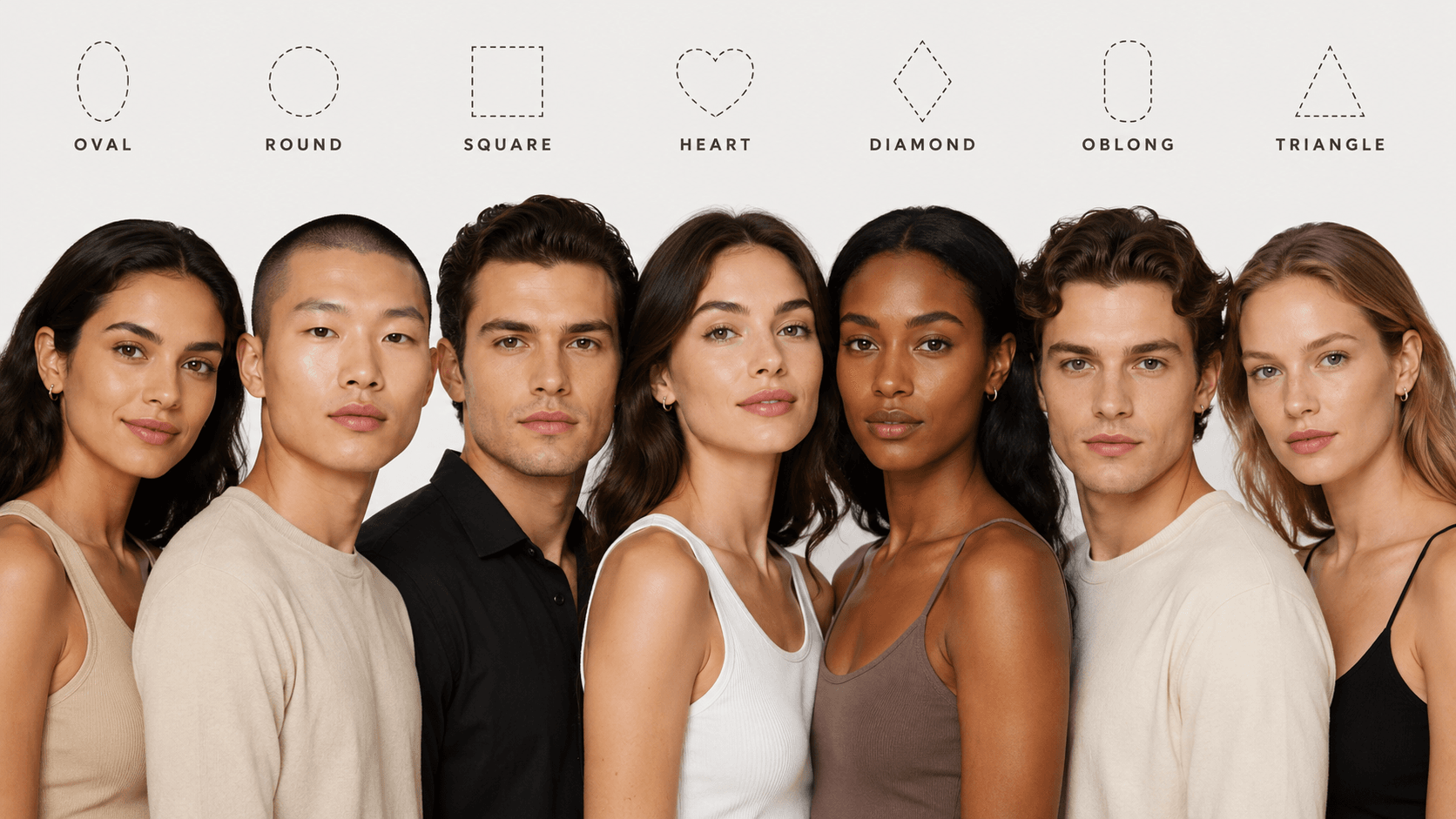
There are seven commonly recognized face shapes: oval, round, square, heart, diamond, oblong, and triangle. You can identify yours by measuring your forehead width, cheekbone width, jawline width, and face length, then comparing which dimensions are widest and how your jaw and forehead taper. Knowing your face shape helps you make smarter decisions across makeup tips and techniques, hairstyling, and eyewear.
Key Takeaways
- Four measurements determine your face shape: forehead width, cheekbone width, jawline width, and face length from hairline to chin.
- Oval is considered the most symmetrical shape because cheekbones are the widest point and the face is roughly 1.5 times longer than it is wide.
- Most people fall between two shapes, so measuring matters more than relying on a mirror impression alone.
- Face shape can visibly shift with age due to bone resorption, fat pad descent, and collagen loss, particularly between your 30s and 50s.
- Heart and diamond shapes are often confused because both feature a wide upper face, but diamond has a narrow forehead while heart has a wide one.
What Are the Different Face Shapes?
Most face classification systems recognize seven distinct shapes: oval, round, square, heart, diamond, oblong, and triangle. Each is defined by the relationship between four key measurements and the angle of the jaw.
The seven shapes you will encounter across beauty, hairstyling, and eyewear guides are not arbitrary categories. They reflect genuinely different geometric relationships between the forehead, cheekbones, jaw, and overall face length. That said, few people are a textbook example of any single shape. Most faces sit somewhere on a spectrum, which is exactly why learning to measure rather than just guess pays off. One common mistake readers make is relying entirely on a mirror impression. Lighting, hair placement, and even the angle you hold your phone at can dramatically shift which shape seems right. Taking four quick measurements removes that guesswork and gives you a reliable answer you can actually use across all your beauty articles and routines.
Oval Face Shape
An oval face is longer than it is wide, with cheekbones as the widest point and a gently rounded jaw and forehead. It is widely regarded as the most versatile shape for hairstyles and makeup.
- Widest Point: Cheekbones
- Forehead vs. Jaw: Forehead slightly wider than jaw
- Face Length: ~1.5x the width
- Jaw Type: Softly rounded
If your face length is roughly 1.5 times your cheekbone width, your forehead is slightly wider than your jaw, and both taper gently without strong angles, you likely have an oval face. The forehead and jaw are both softer in proportion to the cheekbones, giving the face a balanced, egg-like silhouette. Oval faces tend to work well with nearly any hairstyle, eyewear frame, and contouring approach because there are no particularly dominant or recessive features to balance out. That said, very heavy blunt bangs can sometimes make an oval face appear shorter, so people with this shape who prefer fringe often opt for side-swept or wispy styles. Celebrities frequently cited as examples of oval faces include Rihanna and Bella Hadid, though celebrity face shape identification varies across sources and is best treated as illustrative rather than definitive.
Round Face Shape
A round face has roughly equal width and length, soft curves throughout, and a rounded chin with no sharp jawline angles. Cheekbones are the widest point, and the overall silhouette is circular rather than elongated.
- Widest Point: Cheekbones
- Forehead vs. Jaw: Forehead and jaw similar width
- Face Length: Similar to width
- Jaw Type: Soft, curved, no angles
If your cheekbone width and face length are close in measurement, your forehead curves gently rather than featuring a strong horizontal line, and your jaw is soft and rounded without visible corners, you have a round face. Think of the proportions as closer to a circle than an oval. The most common misidentification mistake with round faces is assuming that “round” means chubby or undefined. Many people with very strong bone structure have round faces simply because their proportions are width-equal. The key marker is that soft, curved jaw combined with similar width and length numbers. Contouring techniques for round faces typically focus on adding visual length, often by applying a deeper shade beneath the cheekbones and along the sides of the forehead, while a highlighting stripe down the center of the nose creates an elongating effect.
Square Face Shape
A square face has a strong, angular jaw that is nearly as wide as the forehead and cheekbones, creating a face where all three horizontal measurements are close together. The jawline’s sharpness is the defining feature.
- Widest Point: Forehead, cheekbones, and jaw all similar
- Forehead vs. Jaw: Forehead and jaw nearly equal
- Face Length: Similar to width
- Jaw Type: Strong, angular corners
If your forehead, cheekbone, and jaw measurements are all similar in width, but your jaw has a noticeably sharp or angular corner rather than a curved one, you have a square face. Face length is typically similar to or only slightly greater than face width, keeping the overall shape compact and structured. Square faces are often described as having a “strong” appearance because of the jaw’s definition. The visual effect is geometric and bold compared to the softer curves of oval or round shapes. From a makeup perspective, the goal with square faces is usually to soften the jaw corners slightly. A blended bronzer or contour applied to the outer corners of the jaw, combined with a rounder blush placement on the apples of the cheeks, can create a more oval-like impression without looking heavy-handed. Hairstyle-wise, layers and soft waves around the jaw are commonly recommended to introduce some curve.
Heart Face Shape
A heart face features a wide forehead and high cheekbones that taper down to a narrow, often pointed chin. A widow’s peak hairline is a common (though not universal) accompanying feature.
- Widest Point: Forehead
- Forehead vs. Jaw: Forehead much wider than jaw
- Face Length: Moderate to long
- Jaw Type: Narrow, pointed chin
If your forehead is the widest measurement, your cheekbones are slightly narrower, your jaw is noticeably the narrowest, and your chin comes to a soft point, you have a heart-shaped face. The overall impression is an inverted triangle, wide at the top and narrow at the bottom. Heart and diamond faces are the pair most commonly mixed up. The key difference: heart faces have a wide forehead relative to everything else, while diamond faces have a narrow forehead and narrow chin with cheekbones as the dominant widest point. If you are unsure which you are, your forehead measurement is the deciding factor. Makeup guidance for heart faces often centers on visually widening the lower face. A slightly stronger lip color draws attention to the chin area, and contouring lightly across the temples can reduce the visual width of the forehead. Blush swept horizontally across the cheeks rather than angled up toward the temples also helps balance the proportions.
Diamond Face Shape
Diamond faces have high, dramatic cheekbones as the widest point, with both the forehead and chin noticeably narrower. The silhouette creates a pointed, angular look at both the top and bottom of the face.
- Widest Point: Cheekbones (dramatically)
- Forehead vs. Jaw: Narrow forehead, narrow jaw, similar width
- Face Length: Longer
- Jaw Type: Narrow, may be pointed
If your cheekbones are clearly your widest measurement, your forehead is narrow (often the narrowest measurement), and your chin is also narrow and may come to a soft point, you have a diamond face. Face length tends to be longer relative to width, giving diamond faces a striking, angular quality. Diamond is one of the less common face shapes, which may be why it is frequently left out of older face shape charts that cover only four or five types. Its defining feature is the dramatic width difference between the cheekbones and everything above and below them.
Oblong Face Shape
An oblong face (sometimes called rectangular) is noticeably longer than it is wide, with the forehead, cheekbones, and jaw all similar in width but with significant overall face length. There are minimal curves and a straighter overall silhouette.
- Widest Point: No clear single widest point
- Forehead vs. Jaw: All three measurements close together
- Face Length: Significantly longer than width
- Jaw Type: Straighter, minimal curve
If your face length measurement is considerably greater than your width measurements, and all three horizontal measurements (forehead, cheekbones, jaw) are relatively similar to each other without a standout widest point, you have an oblong or rectangular face. The distinction from oval is that the sides of the face appear straighter rather than gently curved. Hairstyle advice for oblong faces typically focuses on adding width at the sides to create the impression of a shorter face. Volume at the cheeks and avoiding very long, straight styles that add even more length are common recommendations.
Triangle Face Shape
A triangle face shape features a prominent, wide jawline that is noticeably wider than the forehead and cheekbones. This shape creates a solid, structured lower face that tapers upward toward a narrower hairline.
- Widest Point: Jawline
- Forehead vs. Jaw: Forehead is significantly narrower than the jaw
- Face Length: Moderate to short
- Jaw Type: Wide, strong, and highly defined
If your jaw width measurement is the largest of all four numbers, and your forehead is the smallest, you have a triangle (sometimes called pear-shaped) face. The key distinction from a square face is that a square face has a forehead and jaw of equal width, while a triangle face narrows sharply as you move upward toward the temples.
From a styling and makeup perspective, guidance for triangle faces usually focuses on balancing the lower face by drawing visual attention upward. Contouring along the widest points of the jawline softens its prominence, while applying a highlighter to the forehead and below the eyes adds visual width to the upper third of the face. When it comes to hairstyles, fringe, layers with volume at the temples, and jaw-skimming bobs that end just below the chin work exceptionally well to balance the silhouette.
Face Shape Chart: Quick Comparison
The table below summarizes how the four key measurements relate to each face shape, giving you a quick visual reference to compare your own numbers against each type.
| Face Shape | Widest Point | Forehead vs. Jaw | Face Length | Jaw Type |
|---|---|---|---|---|
| Oval | Cheekbones | Forehead slightly wider than jaw | ~1.5x the width | Softly rounded |
| Round | Cheekbones | Forehead and jaw similar width | Similar to width | Soft, curved, no angles |
| Square | Forehead, cheekbones, and jaw all similar | Forehead and jaw nearly equal | Similar to width | Strong, angular corners |
| Heart | Forehead | Forehead much wider than jaw | Moderate to long | Narrow, pointed chin |
| Diamond | Cheekbones (dramatically) | Narrow forehead, narrow jaw, similar width | Longer | Narrow, may be pointed |
| Oblong | No clear single widest point | All three measurements close together | Significantly longer than width | Straighter, minimal curve |
| Triangle | Jaw | Jaw much wider than forehead | Moderate | Wide, strong, prominent |
How to Measure Your Face Shape at Home
Getting an accurate read on your face shape does not require a professional or any special equipment. A flexible measuring tape, a mirror, and about five minutes are all you need. The goal is to record four key measurements, analyze the relationships between them, and land on a confident answer.
Step 1: Prep and Position
Start by pulling your hair back completely so your hairline is visible. Stand or sit directly in front of a well-lit mirror. Relax your face into a neutral expression rather than smiling, since smiling can subtly shift the apparent width of your jaw and cheeks.
Step 2: Take the 4 Key Measurements
- Forehead Width: Place the tape measure across the widest part of your forehead, which typically falls about halfway between your eyebrows and your hairline. Record the number.
- Cheekbone Width: Measure straight across from the outer corner of one eye to the outer corner of the other, pressing gently against the skin. This approximates where your cheekbones are widest.
- Jawline Width: Start at the tip of your chin, angle the tape toward the corner of your jaw (the point where your jawline angles upward toward your ear), and double that measurement. This gives you the total jaw width as if measured straight across.
- Face Length: Measure from the center of your hairline straight down to the tip of your chin.
Step 3: Analyze Your Proportions
Write all four numbers down and look for the relationships between them rather than the raw values:
- If your cheekbones are the widest point and length and width are roughly equal, your face points toward oval or round.
- If all three width measurements are nearly identical and length is notably greater than width, your face points toward oblong.
- If your jaw measurement significantly exceeds the others, you are looking at a triangle shape.
- If your cheekbones are dramatically wider than both a narrow forehead and a narrow jaw, that is a diamond.
Note: If you are caught between oval and oblong, face length is your deciding factor (oval length is roughly 1.5 times the width, while oblong is much more elongated). If you are unsure between round and square, the jawline angle settles it; a round jaw curves softly, while a square jaw has a sharp, angular corner.
Visual Cues That Work Without a Tape Measure
Measurements are the most reliable method, but not everyone has a flexible tape within reach, and some people simply find visual recognition more intuitive. A set of repeatable visual checks can get you to the right answer with reasonable accuracy even without any tools.
The first visual cue is the forehead-to-jaw relationship. Look straight into the mirror and ask whether your forehead looks wider, narrower, or roughly the same width as the line of your jaw. A forehead that is clearly wider than your jaw suggests an inverted triangle or heart shape. A jaw that is clearly wider points to a triangle. Similar widths open up the round, oval, square, or oblong categories and send you to the next check.
The second cue is overall face outline. Step back slightly from the mirror and let your eyes go slightly soft so you are perceiving the silhouette of your face rather than individual features. Does the outline look closer to a circle or a rectangle? Circular outlines with soft edges typically indicate round. More rectangular silhouettes, with a sense of parallel sides, suggest square or oblong. A face that narrows gently from cheekbones down to a moderate chin reads as oval.
The third cue is cheekbone prominence. Place your index fingers lightly on the outer edges of your cheeks just below your eyes. Now look at how far those points extend compared to your forehead corners and your jaw corners. If your fingers sit significantly wider than both of those reference points, cheekbones are your dominant feature, which is either oval or diamond territory. If the difference is minimal or your jaw is the widest point your eye is drawn to, you are dealing with a different category.
The fourth cue is jawline texture. Without a tape, you can still categorize your jawline as one of three types: soft and curved (round or oval), gently angled with moderate definition (oval or oblong), or sharply angled and strong (square, triangle, or diamond). Run a finger along your jawline from chin to ear and notice where the angle is most pronounced. A very gradual, smooth curve reads as soft. A clear corner, where your jaw turns upward at a distinct angle, reads as defined or sharp. Combining this jawline read with your silhouette impression and your forehead-to-jaw comparison will get most readers to within one shape of the correct answer.
If after both the measurement method and the visual method you still sit between two shapes, oval and oblong being the most common pairing, consider asking someone else to look at a straight-on, unfiltered photo of your face and describe the first geometric shape that comes to mind. Outside perspectives, uninfluenced by your own preconceptions, are often surprisingly accurate.
Can Your Face Shape Change Over Time?
Many people identify their face shape once in their twenties and assume that answer is permanent. The reality is more nuanced. Face shape is not a fixed trait in the way eye color is. It is the visible result of bone structure, soft tissue volume, and skin integrity working together, and all three of those factors shift meaningfully across decades.
The skeletal changes are the most fundamental. Research published through institutions studying craniofacial anatomy has documented a process called bone resorption, in which the facial skeleton gradually loses volume and density starting in the mid-thirties and accelerating after age forty. This affects specific bones differently. The orbital rim (the bony rim around your eye socket) retracts slightly, making the under-eye area appear more hollow. The maxilla, the bone forming your mid-face, loses volume in ways that allow the overlying soft tissue to descend. The jawbone itself can lose height and projection, making a once-prominent jaw appear less defined over time. These are not dramatic overnight shifts, but cumulatively across a decade they can meaningfully alter the proportional relationships that define face shape categories.
Alongside bone changes, the face’s fat pads, the discrete compartments of subcutaneous fat that give the young face its convex, lifted contours, migrate downward under the influence of gravity and begin to deflate as overall facial fat volume decreases with age. The malar fat pad, which sits high on the cheek in younger faces and contributes significantly to apparent cheekbone width and prominence, descends toward the nasolabial fold region. This movement does two visible things simultaneously: it reduces apparent cheekbone width (narrowing the face in the mid-zone) and adds width and weight to the lower face. A person who measured as a clear oval at twenty-five may find that by their late forties their face reads closer to rectangular or even triangular because the lower face has relatively more visual weight than it once did.
Collagen and elastin loss compounds these effects. According to the American Academy of Dermatology, the skin produces less collagen beginning in a person’s mid-twenties, with the rate of loss increasing notably after menopause due to the role estrogen plays in collagen synthesis. As skin loses its structural scaffolding, it conforms less tightly to the underlying architecture, meaning the sharp angles of a square jaw may soften visually, and the crisp oval outline of a young face may develop a less defined edge that looks rounder or less categorically distinct.
Weight fluctuations across a lifetime also play a role, though they are reversible in a way that bone and collagen changes are not. Significant weight gain tends to add volume to the lower face and cheeks, potentially shifting a perceived narrow or angular shape toward rounder appearances. Weight loss has the opposite effect, sometimes revealing angularity and definition that was present in the bone structure but obscured by tissue volume.
The practical takeaway is that re-evaluating your face shape every decade, or after a significant life change like substantial weight loss, pregnancy, or menopause, is worth doing. The style guidance built around face shapes (haircuts, eyeglass frames, contouring) will be more relevant and useful if it is based on your face as it currently exists rather than a self-identification made fifteen years ago. Treat face shape as a current-state description rather than a fixed identity, and you will get more accurate results from any advice that depends on it.
“The facial skeleton undergoes significant remodeling with age, including changes in bone volume and position that alter the overlying soft tissue contours. These skeletal changes are a primary driver of the visible signs of facial aging and directly affect the proportional relationships between facial thirds.”
— As summarized from craniofacial anatomy research reviewed by the American Society of Plastic Surgeons
“Gravitational descent of facial fat compartments, combined with volumetric deflation, results in predictable changes to facial shape across decades. The malar fat pad in particular plays a major role in perceived cheekbone prominence and mid-face width in younger individuals.”
— Findings consistent with anatomy literature reviewed by the American Academy of Dermatology
Understanding your face shape is ultimately about giving yourself a useful starting point, not a box to stay in permanently. The seven shapes covered in this guide represent the most widely recognized categories, but real faces exist on a spectrum, and most people will find they sit closer to one shape while sharing characteristics with one or two others. Use the measurement method for the most objective read, supplement it with the visual checks, and revisit your assessment as your face evolves. The goal is self-knowledge that actually helps you make decisions about hair, makeup, and accessories with confidence rather than guesswork. Your face shape is a tool for understanding your features, and like any tool, it works best when it reflects reality accurately.
Frequently Asked Questions
What is the most common face shape?
Oval is frequently cited as the most common face shape, followed by round and oblong. Oval faces appear across a wide range of ethnic backgrounds and bone structures because the proportions it describes, slightly longer than wide, with cheekbones as the widest point and a gently tapering jaw, represent a middle range rather than an extreme. That said, precise population-level data on face shape frequency is limited, and the boundaries between categories mean that many people classified as oval in one system might be classified as oblong or round in another.
Can I have two face shapes at once?
Yes, and this is actually very common. Real faces rarely fit one geometric category with perfect precision. It is entirely possible to have the overall length-to-width ratio of an oval face combined with the angular jaw definition of a square face, or the wide cheekbones of a diamond shape paired with a face length that reads more oblong. In practice, most style guidance based on face shape can be applied by identifying your dominant shape (the one your measurements point to most strongly) and then considering the secondary characteristic that most clearly applies to you.
Do photos accurately show my face shape?
Standard smartphone photos introduce some distortion that can affect how your face shape reads. Wide-angle lenses, which most phone cameras use, tend to exaggerate the size of features closest to the camera, typically the nose and forehead, while compressing the apparent width of the face at the sides. For the most accurate visual assessment, use a photo taken from a distance of at least four to five feet with a slight optical zoom, with your face centered in the frame, in even lighting, and with a neutral expression. Selfies taken at close range are among the least reliable reference images for face shape assessment.
Does ethnicity affect face shape?
Facial bone structure does vary across populations, and some research in published craniofacial anatomy studies via PubMed has documented population-level differences in measurements like bizygomatic width, mandibular angle, and facial height ratios. However, all seven major face shape categories appear across all ethnic backgrounds. Ethnicity may influence which shapes are statistically more prevalent within a given population, but it does not determine an individual’s face shape, and the measurement method described in this guide applies equally regardless of background.