
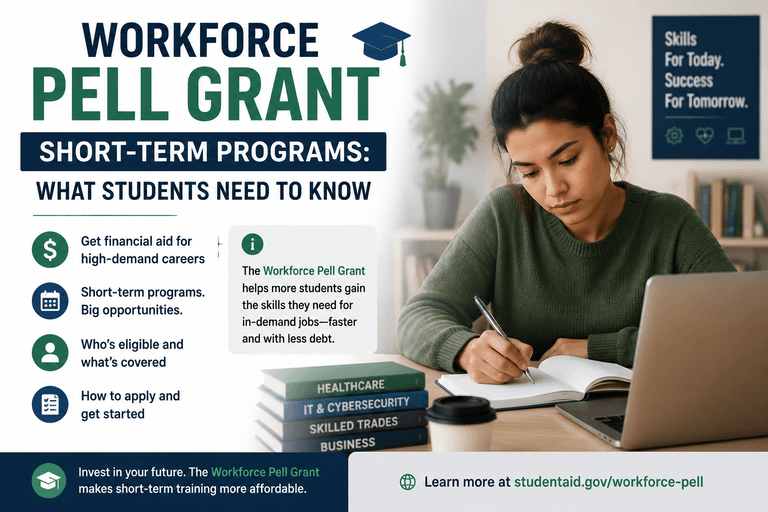
The Workforce Pell Grant extends federal Pell Grant funding to short-term workforce training programs at eligible colleges, covering credentials that typically run between 8 and 52 weeks. Students enrolled in qualifying certificate programs in high-demand fields can receive up to the full annual Pell Grant award, which is $7,495 for the 2026–2027 award year. To qualify, both the program and the institution must meet specific federal criteria established under the final rule issued by the U.S. Department of Education.
Key Takeaways
- Workforce Pell Grants cover short-term programs between 8 and 52 weeks that lead to a recognized credential in an in-demand occupation, with awards prorated based on program length.
- Programs must be approved by the state workforce agency and the accrediting body, and must demonstrate that graduates earn wages above a federally defined threshold.
- Using Workforce Pell draws from a student’s lifetime Pell eligibility (capped at 600% of one full award), which can reduce funding available for a future degree.
- Community colleges, technical colleges, and some for-profit institutions may qualify as eligible schools, provided they meet the new institutional requirements in the final rule.
- The program was authorized under the FAFSA Simplification Act and is expected to affect hundreds of thousands of new students annually once fully implemented.
What Is the Workforce Pell Grant?
The Workforce Pell Grant is a new category of federal financial aid that makes short-term workforce credentials eligible for Pell Grant funding for the first time in the program’s history.
The standard Pell Grant has existed since 1972 and has traditionally required enrollment in a degree or diploma program lasting at least one academic year. The Workforce Pell Grant changes that baseline. Under the final rule published by the U.S. Department of Education, eligible students can now receive Pell funding for programs as short as 8 weeks, provided those programs meet a defined set of quality and labor market standards. The authorization for this expansion came from the FAFSA Simplification Act, which was signed into law in December 2020. That legislation directed the Department of Education to create a regulatory framework allowing short-term programs to access Pell funding, and the final rule represents the Department’s implementation of that mandate. Award amounts under the Workforce Pell Grant are prorated based on program length, meaning a student in a 16-week program receives a smaller award than a student in a full-year program. The proration formula ties the award to the proportion of an academic year the program represents, using credit hours or clock hours as the measuring unit depending on how the institution measures academic progress.
Which Programs Qualify for Workforce Pell Grant Funding?
A program qualifies for Workforce Pell funding only if it meets specific length, labor market, and approval requirements set by federal regulation and confirmed by both the state and the institution’s accreditor.
Not every short certificate or bootcamp qualifies. The federal rules establish a multi-layer approval process that screens programs on several dimensions simultaneously.
Program Length Requirements
Programs must be at least 8 weeks long and no more than one academic year (52 weeks) in length. Programs shorter than 8 weeks remain ineligible regardless of their content or labor market alignment. The upper bound of 52 weeks is significant because programs at or beyond one academic year were already eligible under the existing Pell framework, so the new rule specifically targets the gap below that threshold.
Credential and Labor Market Standards
To qualify, a program must lead to a recognized postsecondary credential, which can be a certificate, a license, or an industry-recognized credential. The program must also prepare students for an occupation that pays at or above a wage threshold tied to the regional or national median wage for workers without a postsecondary degree. This wage floor is designed to prevent institutions from routing Pell dollars toward credentials with limited real-world earning potential. The institution must certify that graduates of the program achieve these wage outcomes and must document that evidence during the approval process. Accrediting bodies play a role in verifying that programs meet educational quality standards, and state workforce agencies must also approve programs before they can become eligible for Workforce Pell funding.
Online and Hybrid Programs
The final rule does not restrict Workforce Pell eligibility to in-person programs. Online and hybrid short-term programs offered by eligible institutions can qualify, provided the program otherwise meets the length, credential, and labor market standards. This is a meaningful expansion for students in rural areas or those balancing work and family obligations, since access to short-term online courses and workforce credentials is no longer limited by geography, as long as students enroll at an eligible school. For students exploring online learning resources and program guides, confirming that a specific online program carries Workforce Pell eligibility requires checking directly with the institution’s financial aid office, since not every online short-term program at an otherwise eligible school will have gone through the required approval process.
Workforce Pell Grant Eligible Schools: Who Can Participate?
Eligible schools include community colleges, technical colleges, and some proprietary institutions, but only those that already participate in federal Title IV aid programs and meet new institutional accountability requirements.
Institutional Eligibility Criteria
To offer Workforce Pell Grants, an institution must already be a Title IV-participating school. This means the institution holds current accreditation from a recognized accrediting agency and is in good standing with the Department of Education’s financial responsibility and administrative capability standards. Beyond the existing Title IV baseline, the new rule adds requirements specific to Workforce Pell participation. Institutions must demonstrate that they have processes in place to certify program-level labor market outcomes and must provide accurate information to students about expected wages and job placement rates before enrollment. Schools that already operate robust career and technical education programs, including most community colleges and many technical and vocational colleges, are well positioned to meet these standards. For-profit institutions can potentially qualify, but they face closer scrutiny under the accountability framework because of historic concerns about student outcomes at some proprietary schools. The rule does not bar for-profit participation outright but builds in verification requirements that raise the bar for any institution seeking to offer Workforce Pell programs.
State Agency Role in School Participation
State workforce agencies serve as an additional approval layer. A program cannot be designated as eligible unless the relevant state agency has reviewed and approved it as aligned with state and regional workforce needs. This means that even a fully accredited institution offering a technically sound program may face delays if the state approval process moves slowly or if the program does not fit within the state’s defined high-demand occupation list. Students should be aware that Workforce Pell eligible schools will vary by state, and a program available at a college in one state may not carry the same eligibility at a comparable college across the state line if the second state’s workforce agency has not yet completed its approval process.
How to Apply for a Workforce Pell Grant
The application process for a Workforce Pell Grant runs through the same FAFSA form used for all federal student aid, with no separate application required from the student.
Students do not file a different or additional form to access Workforce Pell funding. The process begins with the Free Application for Federal Student Aid (FAFSA), which determines a student’s Expected Family Contribution and overall Pell Grant eligibility. If the student then enrolls in a qualifying Workforce Pell program at an eligible school, the institution’s financial aid office applies the appropriate prorated Pell award automatically.
Step-by-Step Process for Students
First, complete the FAFSA at studentaid.gov. Students who have never filed before should create a Federal Student Aid account in advance. Second, confirm that the specific program and institution you are considering have received Workforce Pell approval. The institution’s financial aid office can verify this directly. Third, review your financial aid award letter after enrollment to confirm the prorated Pell amount, since the award will reflect the program’s length relative to a full academic year rather than the full annual maximum. The prorated award calculation can produce awards well below the annual maximum. A student in a 16-week program receives roughly 30% of the annual maximum award, which works out to approximately $2,200 to $2,400 depending on the student’s individual eligibility level. Students who need to supplement this award with additional funding should explore whether the institution participates in other grant or workforce training programs, since Workforce Pell alone may not cover total program costs.
Pell Grant History and Prior Eligibility
Students who have previously received Pell Grants need to check their remaining Lifetime Eligibility Units (LEU) before enrolling. The federal government caps total Pell Grant use at 600% of one annual award across a student’s lifetime. Prior Pell use counts against this cap regardless of whether it was used for a degree program or a short-term credential, so students with significant prior Pell history may have limited remaining eligibility to draw from. Understanding this tradeoff is covered in detail in the section below on lifetime eligibility.
Workforce Pell Grant Program Requirements at a Glance
The following table summarizes the key federal criteria that govern both program and institutional eligibility under the Workforce Pell Grant final rule.
| Requirement Category | Specific Standard | Who Verifies |
|---|---|---|
| Program Length (Minimum) | 8 weeks (150 clock hours or equivalent credit hours) | Institution / Accreditor |
| Program Length (Maximum) | 52 weeks (one academic year) | Institution / U.S. Dept. of Education |
| Credential Type | Certificate, license, or industry-recognized credential | Accrediting Agency |
| Wage Threshold | Graduates must earn above regional/national median for non-degree workers | State Workforce Agency |
| Labor Market Alignment | Program must prepare for an in-demand occupation in the region | State Workforce Agency |
| Institutional Eligibility | Must be an accredited Title IV-participating school | U.S. Dept. of Education |
| State Approval | Program must be approved by the relevant state workforce agency | State Government |
| Consumer Disclosure | Institution must provide wage and job placement data before enrollment | Institution / Accreditor |
How Workforce Pell Grant Amounts Are Calculated for Short-Term Programs
Because short-term programs are measured in clock hours or condensed credit hours rather than full academic years, the Workforce Pell Grant award is prorated from the standard annual Pell maximum. The Department of Education calculates the award by dividing the program’s hours by the hours in a full academic year (typically 900 clock hours or 30 credit hours), then multiplying that fraction by the student’s expected annual award based on their Student Aid Index (SAI).
A student with a zero SAI who qualifies for the maximum Pell Grant $7,495 for the 2026–27 award year would receive a proportionally smaller amount if their program is shorter than a full academic year. For example, a 450-clock-hour program would generate roughly half that maximum, or approximately $3,747.50. The actual disbursement also depends on whether the student enrolls full-time or part-time within the program’s structure, since enrollment intensity affects the final calculation just as it does in traditional degree programs.
Institutions must complete enrollment and cost-of-attendance reporting before funds are disbursed, and they are required to apply any Workforce Pell award toward tuition and fees first. Any remaining balance may be issued to the student as a refund to cover related costs such as books, tools, or transportation. Students should confirm their school’s refund timeline during orientation, as disbursement schedules vary by institution and program start date.

Eligible Program Areas and Industry Sectors Under Workforce Pell
The FAFSA Simplification Act and subsequent Workforce Pell guidance do not prescribe a fixed list of approved occupations; instead, they tie eligibility to local labor market demand, meaning program approval is partly dynamic based on regional workforce data. That said, several broad industry categories have consistently appeared in approved or anticipated program frameworks, and understanding these clusters helps students identify where short-term credentials are most likely to carry Workforce Pell funding.
Healthcare support occupations make up one of the largest clusters, covering programs in medical billing and coding, pharmacy technician training, clinical medical assisting, and phlebotomy certification. These programs typically run between 150 and 600 clock hours, placing them squarely within the eligible range. Skilled trades programs including electrical technology, HVAC, welding, industrial maintenance, and plumbing represent another major group, particularly in community college systems that already have relationships with regional employers and state workforce boards.
Information technology programs focused on cybersecurity fundamentals, cloud computing, and help desk support are also well-represented, especially as workforce agencies in most states have formally identified technology talent gaps as priority areas. Early childhood education certificates, commercial driver licensing preparation, and supply chain logistics training round out the commonly approved program types, though availability depends heavily on whether a specific institution has completed the state approval process for each credential.
Students searching for eligible programs should work directly with their college’s financial aid office rather than assuming a program qualifies based on subject area alone. Approval is program-specific and institution-specific, not category-wide, so a cybersecurity certificate at one school may carry Workforce Pell eligibility while a similar program at another school does not at least until that school completes the required workforce agency review.
The Pell Lifetime Tradeoff: What Students Need to Know Before Enrolling in a Workforce Pell Program
The detail that most short-term program marketing materials underemphasize and that prospective students rarely encounter until after enrollment is this: using a Workforce Pell Grant draws from the same lifetime eligibility pool as traditional Pell Grants. Every student who receives any form of Pell funding accumulates usage against a lifetime limit of 600 percent of the annual award, equivalent to six full academic years of maximum funding. A short-term credential that consumes 50 percent of a full-year award reduces a student’s remaining lifetime eligibility by that same 50 percent.
This matters most for students who are younger, who have not yet completed a degree, or who plan to pursue an associate’s or bachelor’s program within the next several years. Consider a 24-year-old who earns a medical billing certificate using Workforce Pell, consuming roughly 25 percent of an annual award. That draw is modest on its own, but if the same student later pursues a healthcare administration degree over four years, they will exhaust their remaining Pell eligibility before completing the degree arriving at their final semesters without access to the grant funding they would otherwise have had. The gap can translate to thousands of dollars in additional loans.
The decision-making framework a student or advisor should apply before committing eligibility involves three sequential questions. First, what is the student’s current Pell lifetime usage percentage, which is visible in their Federal Student Aid account under Lifetime Eligibility Used (LEU)? A student who has already used 400 percent of their eligibility has only two equivalent years remaining, and spending a partial year on a short-term credential compresses that window meaningfully. Second, is the student realistically likely to pursue a longer-term degree program within the next ten years? If the answer is yes even tentatively the calculus shifts toward preserving eligibility for the longer program, which typically yields higher lifetime earnings and broader credential flexibility. Third, does the short-term credential itself lead quickly to wage gains that offset the financial gap a student would face if Pell ran out mid-degree? For some healthcare and trades programs, the answer is genuinely yes: graduates enter jobs within months and can self-fund later coursework. For others, the income bump is modest or delayed, making the eligibility tradeoff harder to justify.
Students who are returning adults with no realistic degree plans in their future face a different calculation entirely. If a 45-year-old with 300 percent of LEU already used wants a welding certificate to change careers, the Workforce Pell tradeoff is far less consequential; they will likely never use the remaining three equivalent years anyway. For these students, Workforce Pell is straightforwardly beneficial and the eligibility concern is largely theoretical.
Financial aid advisors at community colleges and technical schools are the right resource for running this analysis in a student’s specific situation. Advisors can pull a student’s exact LEU percentage, model the impact of a short-term enrollment on remaining eligibility, and flag whether degree programs the student is considering would be affected. Students should request this conversation explicitly before signing enrollment agreements for any Workforce Pell-funded program not after disbursement has already occurred.
One additional consideration for students weighing this tradeoff is stacking. Some short-term Workforce Pell programs are designed as stackable credentials, meaning the certificate earned in the first program counts toward a later degree or advanced certificate at the same institution. In these pathways, using Workforce Pell at the certificate level is not necessarily a sacrifice; it is the first rung of a structured ladder in which both the credential and the credit hours carry forward. Students should ask institutions directly whether their program is stackable and whether the credits articulate to any associate or bachelor’s degree, because not all programs marketed as stackable actually transfer into degree pathways without significant credit loss.
The core principle for any student or advisor navigating this decision is straightforward: Workforce Pell is a finite resource being spent against a finite lifetime supply, and the value of spending it depends entirely on what else that eligibility might have funded. No short-term program is worth enrolling in without first knowing exactly how many percentage points of lifetime eligibility remain and what future plans might compete for them.
Making the Most of Workforce Pell as an Online Student
Online delivery of short-term workforce programs introduces specific logistical and academic considerations that differ from both traditional campus-based credentials and standard online degree programs. Because Workforce Pell-eligible programs are often intensive and compress many running between 15 and 52 weeks the pace of online coursework tends to be faster than students accustomed to semester-length classes expect. Students should review weekly time requirements before enrolling, as some programs list clock hours that include supervised lab simulations or synchronous sessions that cannot be completed on a fully self-paced schedule.
Accreditation is particularly important to verify for online programs claiming Workforce Pell eligibility. An institution must hold regional or national accreditation recognized by the Department of Education and must be approved to disburse Title IV funds in the state where the student resides, not just the state where the school is headquartered. Some online schools are approved for Title IV disbursement in most states but have gaps in a handful of states due to unresolved authorization requirements. Students should confirm their state is included in their chosen school’s approval list before completing the FAFSA, because enrollment in a non-authorized state can render a student ineligible for disbursement regardless of their individual qualifications.
Employer recognition of the resulting credential matters as much as the grant funding itself. A credential earns its value in the labor market, and students should research whether hiring managers and HR departments in their target industry recognize the specific certification their program leads to. Credentials backed by a nationally recognized certifying body such as CompTIA for IT, the National Healthcareer Association for medical assisting, or AWS for cloud computing carry more transferable weight than institutional certificates with no external validation. Programs that prepare students for an external certification exam generally offer stronger labor market signals than those issuing only a school-issued completion certificate.
Students who combine Workforce Pell with employer tuition assistance, state-level workforce grants, or workforce development board funding can sometimes cover program costs entirely without taking on debt. Many state workforce agencies administer separate grant programs that do not count against Pell eligibility, and students in high-demand fields may also qualify for employer-sponsored training agreements that partially or fully reimburse costs. Coordinating all available funding sources through the financial aid office before the program start date is the most reliable way to avoid gaps in coverage that lead to unnecessary borrowing.
The Workforce Pell Grant represents a meaningful shift in how federal aid reaches students who need short-term skill-building rather than multi-year degrees. For students who understand the eligibility mechanics, verify program approval, and factor the lifetime tradeoff into their planning, it can open doors to faster career transitions without the debt burden that has historically accompanied workforce retraining. The students who benefit most are those who approach the process as informed consumers asking the right questions of their institution before enrollment rather than learning the details after their eligibility has already been spent.
Frequently Asked Questions
Can I receive a Workforce Pell Grant for a fully online program?
Yes, provided the online program meets all eligibility requirements: it must be between 150 and 599 clock hours (or the credit-hour equivalent) in length, lead to a recognized credential in a high-demand occupation, be offered by an accredited Title IV-participating institution, and be approved by the relevant state workforce agency. Online delivery itself is not a disqualifying factor, but the institution must hold state authorization in your state of residence for Title IV funds to be disbursed.
Does using a Workforce Pell Grant affect my regular Pell Grant eligibility for a future degree?
Yes. Workforce Pell draws from the same 600 percent lifetime eligibility pool as all other Pell Grant funding. If a short-term program consumes 25 or 50 percent of an annual award, that usage is permanently subtracted from your Lifetime Eligibility Used percentage. Students who plan to pursue an associate’s or bachelor’s degree in the future should review their current LEU balance in their Federal Student Aid account and model the impact before enrolling in any Workforce Pell program.
How do I find out if a specific program at my college is approved for Workforce Pell?
The most reliable path is to contact the financial aid office at the institution offering the program and ask directly whether it has received state workforce agency approval and whether the school has completed all federal reporting requirements for Workforce Pell disbursement. Because approval is granted at the program level not the institution level a school may offer a qualifying medical assisting certificate while its pharmacy technician program is still awaiting approval. Always confirm the specific program, not just the school’s general Title IV status.
What happens if I withdraw from a Workforce Pell-funded short-term program?
If you withdraw before completing a Workforce Pell program, federal Return to Title IV (R2T4) rules apply, just as they do for traditional Pell-funded programs. The institution is required to calculate how much aid was earned based on the percentage of the program you completed before withdrawal, and any unearned portion must be returned to the Department of Education. Critically, your Lifetime Eligibility Used percentage does not automatically reverse; you may retain some reduction in lifetime eligibility even though you did not complete the credential. Reviewing your school’s withdrawal and refund policies before enrollment helps you understand the financial stakes of leaving a program early.