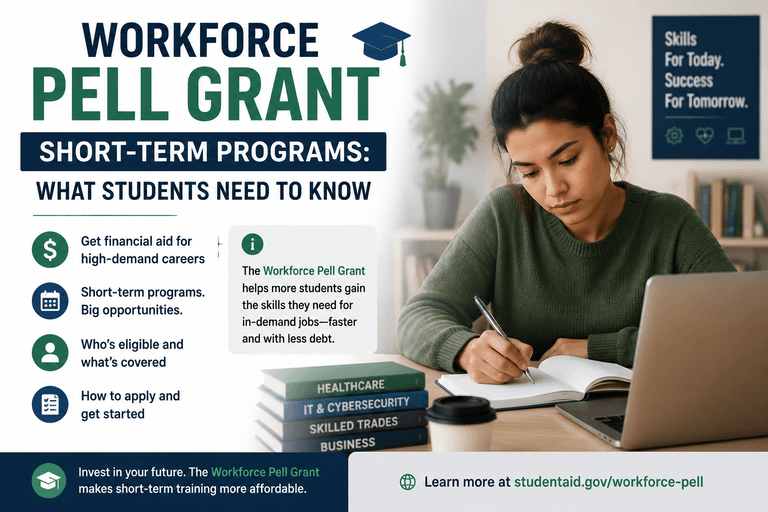

The job market in 2026 looks very different from even a few years ago. Employers are moving away from degree-only hiring filters and toward skills-based evaluation, making short, focused credentials more valuable than ever. Whether you are a mid-career professional trying to pivot, a recent graduate filling skill gaps, or a Canadian or American worker navigating a shifting economy, the best online microcredentials in 2026 may offer a faster, more affordable path to career advancement than a traditional degree. Browse our Education articles for more context on how the credential landscape is evolving.
KEY TAKEAWAYS
- Online microcredentials are short, skills-focused programs that typically take weeks to under a year and are designed to validate specific competencies employers can quickly recognize.
- In 2026, employers increasingly prioritize skills-based hiring, making targeted credentials more valuable for career pivots, upskilling, and filling practical knowledge gaps.
- Not all credentials carry equal value; university-backed and industry-aligned microcredentials generally have stronger employer recognition than generic course certificates.
- Technology, AI, cybersecurity, sustainability, data science, and workforce-transition programs offer some of the strongest career ROI opportunities for microcredential learners.
- Stackable programs can create long-term educational pathways, allowing learners to apply completed coursework toward future certificates or degree programs.
- Microcredentials usually cost far less than traditional degrees, making them attractive for working adults seeking faster, lower-risk career advancement.
- Employer recognition still varies across industries; technology and healthcare-adjacent fields are often more receptive than highly regulated sectors like law or licensed professions.
- Choosing a credential aligned with real job-market demand and specific employer needs matters more than collecting multiple general-purpose badges.
What Are Online Microcredentials?
Online microcredentials are short-form, competency-based certifications earned through accredited institutions or verified platforms, typically requiring fewer than 12 months to complete. They are designed to validate specific skills that employers can assess quickly and clearly.
Microcredentials sit between a single course certificate and a full degree. They usually involve a curated sequence of courses, a capstone project, or a competency assessment, and they often come with a digital badge that can be shared on LinkedIn or a resume. Unlike a bootcamp certificate from a private company, microcredentials issued by accredited universities carry institutional backing that many employers recognize as meaningful.
Harvard Extension School’s microcertificate programs, for example, require completing 2 to 5 graduate-level courses in areas such as AI-powered business, project management, and marketing innovation. Completers earn a credential from a recognized research university without committing to a full master’s degree.
Oregon State University’s Ecampus microcredentials set a minimum of 3 courses and 8 credit hours, with most programs complete in 9 to 12 months. Fields include GIS and mapping, semiconductor engineering, AI in agriculture, and anatomy, covering both introductory and advanced skill levels.
Are Microcredentials Worth It Compared to a Degree?
The microcredential vs. degree question in 2026 largely depends on your career stage and goal. Microcredentials offer speed and lower cost, while degrees still carry weight for certain roles, promotions, and licensing requirements.
A microcredential typically costs a few hundred to a few thousand dollars and takes weeks to months. A traditional degree costs tens of thousands of dollars and takes years. For workers who already hold a degree and need to demonstrate a new technical skill, a microcredential is often the more practical tool. For someone entering a licensed profession such as nursing, law, or engineering, a degree remains a prerequisite.
According to a peer-reviewed systematic review published via PubMed/NIH, microcredentials present significant opportunities for learners, employers, higher education institutions, and governments, but also face challenges around quality assurance, employer recognition, and the absence of standardized definitions. The review, based on a PRISMA-compliant analysis of literature from Scopus, ERIC, Web of Science, and EBSCO databases, found that recognition by employers remains one of the most cited barriers to microcredential uptake.
This points to an important nuance: not all microcredentials carry equal weight. Credentials issued by accredited universities or directly co-designed with industry partners tend to fare better with hiring managers than generic platform certificates. Cross-reference the most in-demand skills for 2026 when choosing which microcredential to pursue first so your investment aligns with real labor market demand.
Which Fields Offer the Strongest Microcredentials in 2026?
Technology, sustainability, data science, and project management are among the fields where employer-recognized microcredentials are most available and most sought in 2026. Healthcare and advanced manufacturing are also growing rapidly.
Technology and AI
AI-related skills remain among the fastest-growing hiring priorities. University-backed microcredentials in machine learning, data analysis, and AI ethics are gaining traction with employers. Pair a microcredential with one of the best AI courses online to build a competitive skill stack that signals both foundational knowledge and practical application.
The SUNY microcredentials hub offers a searchable directory of programs spanning AI and Data Science, Cybersecurity, Advanced Manufacturing, Semiconductor technology, Sustainability, and Leadership. Because SUNY programs are designed with workforce alignment as a core principle, many are co-developed with regional employers and carry digital badge awards that can be verified and displayed on professional profiles.
Sustainability and Green Economy
In Canada, the federal government has made microcredentials a funding priority for workers transitioning toward green economy roles. According to the Sustainable Jobs Training Fund backgrounder from the Government of Canada, funded micro-credential programs include green literacy credentials and AI pathway upskilling for mid-career workers, with projects running across Ontario, British Columbia, Alberta, and Atlantic Canada. This government backing may improve both program quality and employer recognition in those regions.
Cybersecurity and Data
According to the National Institute of Standards and Technology (NIST), the cybersecurity workforce gap in the United States remains significant, with hundreds of thousands of unfilled roles. Microcredentials in network security, threat analysis, and cloud security have become a recognized entry point for workers transitioning into the field, particularly when backed by institutions with industry partnerships.
Comparing Top University-Backed Online Microcredentials in 2026
The table below compares verified university-backed microcredential programs available to U.S. and Canadian learners in 2026, based on publicly available program data from institutional websites.
| Institution | Program Focus | Format | Completion Time | Stackable Toward Degree? |
|---|---|---|---|---|
| Harvard Extension School | AI-Powered Business, Project Management, Marketing Innovation | 2 to 5 graduate-level courses, online | Varies by program | Yes, credits may apply toward Harvard Extension degrees |
| Oregon State University (Ecampus) | GIS/Mapping, Semiconductor Engineering, AI in Agriculture, Anatomy | Minimum 3 courses, 8 credits, fully online | 9 to 12 months | Yes, toward OSU degree programs |
| SUNY System | AI and Data Science, Cybersecurity, Advanced Manufacturing, Sustainability, Leadership | Competency-based, digital badge awarded | Varies by campus and program | Yes, stackable credential design |
| Canadian Sustainable Jobs (Government-Funded) | Green Literacy, AI Pathway Upskilling | Delivered through partnered institutions across provinces | Short-duration (weeks to months) | Varies by delivery institution |
| SUNY (Semiconductor Focus) | Semiconductor Technology and Manufacturing | Workforce-aligned, industry co-designed | Varies by campus | Yes, toward applicable degree programs |
Are Stackable Credentials the Right Strategy for Long-Term Growth?
Stackable credentials allow learners to accumulate multiple microcredentials over time, each building on the last, and sometimes apply completed coursework toward a full degree. This approach suits working adults who cannot step away from employment for full-time study.
The stacking model is increasingly supported by institutional policy. Oregon State, Harvard Extension, and the SUNY system all have formal pathways that allow microcredential completers to apply their work toward a related degree. This means the cost of a microcredential is not necessarily a sunk cost if you later decide to pursue further credentials.
According to the Government of Canada’s workforce development discussion paper, microcredentials are identified as a priority short-duration training option for upskilling and reskilling working adults, with explicit attention to labour productivity, digital economy transitions, and the need for flexible training that fits around existing employment. The paper highlights microcredentials as a structural response to the pace of change in the labor market.
Browse all online learning guides to map a full upskilling roadmap for 2026 that incorporates both microcredentials and longer-form coursework in a coherent sequence.

Do Employers Actually Recognize Online Microcredentials?
Employer recognition varies significantly by industry, credential issuer, and the specificity of skills demonstrated. University-backed and government-affiliated microcredentials generally receive stronger recognition than platform-only certificates.
Recognition is improving but uneven. Large technology companies, healthcare systems, and government agencies have been more willing to accept microcredentials as evidence of skill than traditional industries such as finance or law, where degree signals still dominate. Skills-based hiring initiatives from the U.S. federal government and from major employers in the private sector have helped normalize credential-first evaluation in certain fields.
The key for job seekers is specificity: a microcredential that maps directly onto a job description skill requirement is more persuasive than a general credential. When possible, look for programs developed in partnership with industry or explicitly endorsed by professional associations in your field.
Alternative Perspectives
Not all educators and workforce researchers agree that microcredentials represent unambiguous progress. Some argue that the proliferation of short credentials risks credential inflation, where workers spend money accumulating badges that employers ultimately discount. Critics also note that quality assurance standards across microcredential providers remain inconsistent, and learners without strong institutional guidance may choose programs that carry little real labor market value. On the other side, advocates point to accessibility: for workers who cannot afford the time or cost of a degree, a well-chosen microcredential may be the only practical option for advancing within a changing field. The evidence to date suggests outcomes depend heavily on choosing programs with clear employer alignment and institutional backing.
Disclaimer: Educational outcomes vary based on individual effort and circumstances. Course availability, pricing, and curriculum are subject to change. Verify current details with the provider.
Frequently Asked Questions
Costs vary widely depending on the institution and program length. University-backed programs such as those at Harvard Extension or Oregon State may run from a few hundred to a few thousand dollars per program, while government-funded options in Canada may be subsidized or free for eligible workers. Always verify current pricing directly with the provider, as costs change frequently.
The terms are often used interchangeably, but there is a meaningful distinction. A professional certificate is typically issued after completing a single course or exam. A microcredential usually involves a curated sequence of courses, a competency assessment, or a capstone project, and is awarded by an accredited institution. Microcredentials generally carry more academic weight and may be stackable toward a degree.
Some can. Programs at Oregon State University, Harvard Extension School, and across the SUNY system are designed with stackability in mind, meaning completed coursework may apply toward a related degree program. However, policies vary by institution and program. Always confirm stackability with the specific institution before enrolling if this matters to your educational goals.
Technology, cybersecurity, data science, sustainability, and healthcare support roles have shown the strongest receptivity to microcredentials, particularly those issued by accredited universities or co-designed with industry partners. Traditional fields such as law, finance, and licensed healthcare tend to still prioritize degree credentials, though this is shifting in some specializations.