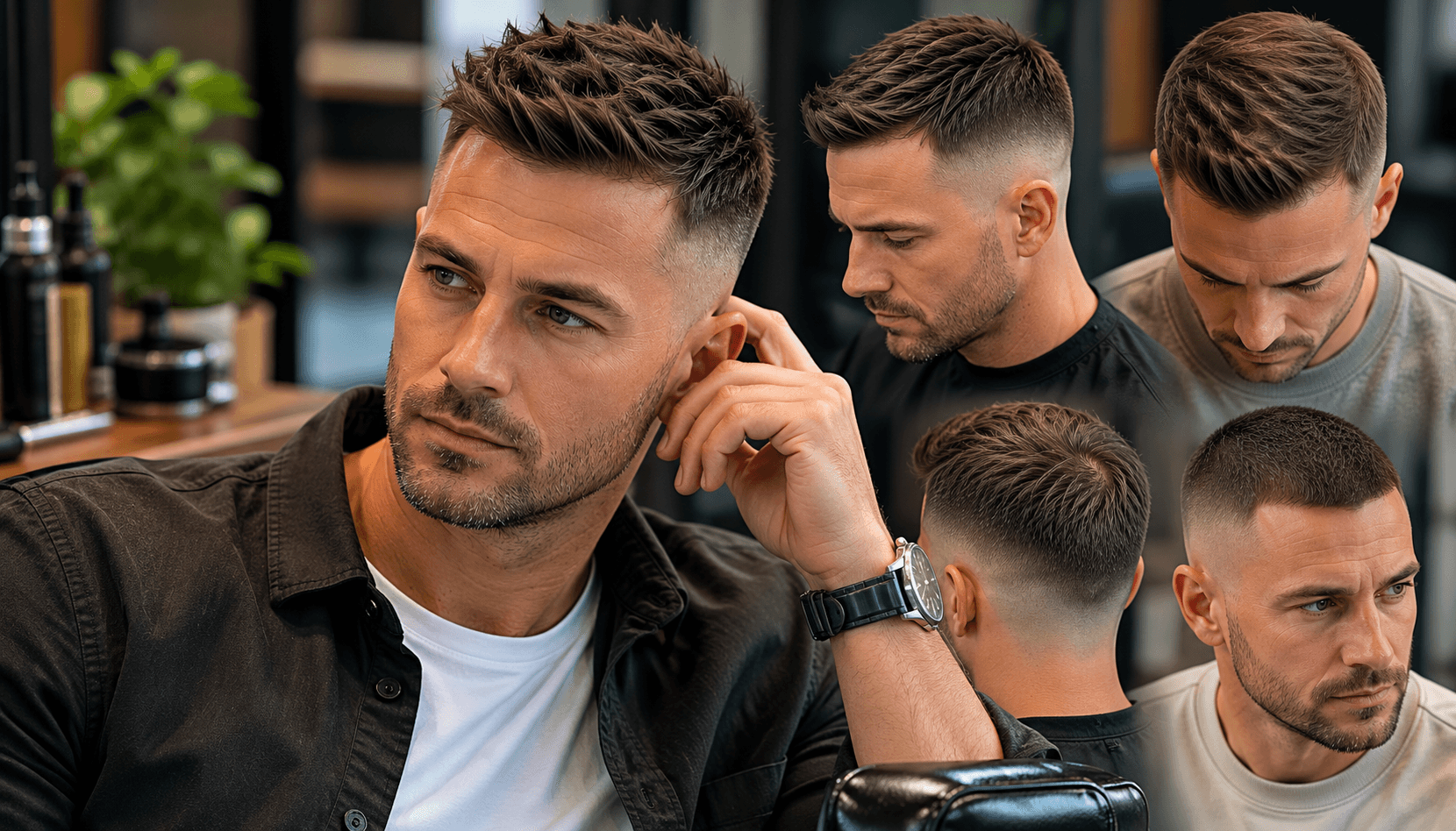
The best haircuts for men who want low-maintenance results are the buzz cut, crew cut, tapered short back and sides, and textured crop, all of which require little to no product and hold their shape for three to five weeks between visits. These short, simple cuts work across most hair types and face shapes, making them the most practical choices for men who want to look sharp without a daily styling routine.
Key Takeaways
- The buzz cut is the single lowest-maintenance option available, requiring zero product and only a clipper at home or a $15–$25 barbershop visit every three to four weeks.
- A textured crop with a skin or low fade ranks among the most requested short haircuts for men in North American barbershops, partly because it suits oval, square, and round face shapes with minimal adjustment.
- Most low-maintenance short haircuts for men need styling in under 60 seconds: a small amount of matte clay or a light paste is typically all that is required.
- Hair that is fine or thinning tends to look fuller and thicker with a short, blunt cut rather than longer styles that emphasize flatness.
- Stretching too long between haircuts (beyond six weeks for most short styles) is the most common reason these cuts stop looking sharp, regardless of how well-chosen the style is.
Why Low-Maintenance Short Haircuts for Men Are Worth Getting Right
A poorly chosen cut can add five to ten minutes of unwanted morning styling time. Getting the right short, simple haircut for your hair type eliminates that problem almost entirely.
Most men are not looking for a style that requires a shelf full of products and a mirror session each morning. The appeal of low-maintenance short haircuts is simple: they look intentional even on the days you do nothing to them. When the cut itself has good structure, a quick towel-dry or a single swipe of product is genuinely enough.
The challenge is that “low-maintenance” gets thrown around loosely in barbershop conversation. A style might be low effort to maintain at home but require precise, frequent cuts to stay sharp. Others look fine growing out for a full six weeks without losing their shape. Understanding that distinction saves both time and money over the course of a year.
For broader guidance on keeping any cut looking its best between visits, browse our full library of hair care tips and guides, or explore more of our Beauty articles covering grooming from scalp health to product recommendations.
Three editorial conclusions stand out from surveying what actually works for most men. First, the simpler the silhouette, the longer it stays presentable growing out. Second, skin fades look striking fresh but require touch-ups every two to three weeks to stay clean, making them higher-maintenance than they appear at first glance. Third, men with coarser or thicker hair consistently get more mileage from their cut than men with fine hair, since fine hair loses shape more visibly as it grows.
The Best Low-Maintenance Short Haircuts for Men, Ranked by Effort
From zero-product buzz cuts to slightly more styled textured crops, these are the short simple mens haircuts that consistently deliver results with minimal daily effort across a range of hair types.
Buzz Cut
The buzz cut is as close to a maintenance-free style as men’s hair gets. Cut at a uniform length with clippers, typically between a number 1 (1/8 inch) and a number 4 (1/2 inch), it requires no product, no combing, and no real styling decision each morning. It works on almost every face shape, though men with oval or square faces tend to get the most balanced result. At most barbershops, a basic buzz runs $15–$30, and many men maintain it at home with a $25–$60 clipper set.
The honest limitation here: the buzz cut is unforgiving of head shape irregularities or prominent scars, and it does little to add perceived volume for men with very round faces. If those are concerns, the crew cut is a better fit.
Crew Cut
The crew cut keeps more length on top, typically 1 to 2 inches, while fading or tapering the sides and back short. It takes about 30 seconds of styling with a small amount of pomade or matte clay to look polished. The crew cut is one of the most versatile short haircuts for men because it scales from casual to business-ready with the same cut, just a different product choice. A light matte product reads casual; a medium-shine pomade looks more dressed up.
It grows out cleanly for four to five weeks before the taper starts to look overgrown, giving it a longer functional window than a skin fade style.
Textured Crop
The textured crop has been one of the most consistently requested men’s haircut styles in North American barbershops for several years running. It features a short, blunt fringe worn slightly forward over the forehead, with the sides cut shorter to create contrast. The texture on top is usually achieved with scissors-over-comb or point-cutting, which gives it a natural, broken-up finish that still looks styled even without product.
For men with fine hair, the blunt top of a textured crop is particularly useful because it creates the visual impression of density that longer styles undermine. A small amount of sea salt spray or matte paste is all most men need to define the texture on top.
Tapered Short Back and Sides
This is the simple hair style men return to again and again because it never really goes out of fashion. The sides and back are tapered short with scissors or clippers, while the top is kept at a manageable 2 to 3 inches. It is longer than a crew cut on top, which allows for a side part or a pushed-back finish on days when more effort sounds appealing. On quick mornings, running fingers through it while damp is enough.
A classic taper is also more forgiving of irregular grow-out than a fade, which makes it genuinely lower maintenance over a six-week period compared to styles with hard skin-fade lines.
Undercut with Minimal Styling
The undercut keeps the sides and back cut very short or shaved close while leaving noticeably more length on top. It creates strong contrast and looks distinctive without requiring the top section to be styled in an elaborate way. A disconnected undercut, where the transition between top and sides is abrupt rather than blended, looks sharp when the top is simply combed back or pushed to the side with a small amount of product.
Worth noting: the undercut does require more frequent side and back maintenance than a taper, roughly every three weeks, to preserve the contrast that makes it work. If visits every three weeks are not realistic, a taper or crew cut will serve better in practice.
Choosing Your Cut Based on Hair Type and Face Shape
Hair texture and face shape each narrow the field of genuinely flattering low-maintenance options. Matching the cut to both factors is what separates a haircut that looks good on arrival from one that looks good every day.
Fine or Thinning Hair
Men with fine or thinning hair get the most reliable results from short, blunt cuts. The textured crop and buzz cut both work well here because they do not rely on length or volume to look good. Longer styles that depend on body or wave tend to flatten against the scalp as fine hair dries, drawing attention to the thinness rather than disguising it. Keeping the sides short also creates visual contrast that makes the top appear denser than it is.
According to the American Academy of Dermatology, gradual hair thinning is normal for men starting in their 30s and accelerates with age, which is a practical reason to choose cuts that work with reduced density rather than fighting it.
Thick or Coarse Hair
Thick or coarse hair is generally more forgiving of most short haircut styles because it holds shape well and grows out more evenly. The main risk is bulk: without texturizing or thinning during the cut, thick hair can look heavy and push outward rather than lying flat. A skilled barber will remove some interior weight with thinning shears or point-cutting, which keeps the silhouette clean without sacrificing coverage.
Matching Cut to Face Shape
Oval faces are the most accommodating, working well with nearly every short style from a buzz to a textured crop. Square faces benefit from a little extra length on top, such as a crew cut or tapered top, which softens the jaw line. Round faces do best with styles that add height, like a crew cut or short quiff, rather than cuts that are the same length all over, which can visually widen the face further. Oblong or rectangular faces are better served by keeping the sides from being cut too short, since removing width from an already narrow face can over-emphasize its length.
Quick Comparison: Best Haircuts for Men at a Glance
| Haircut Style | Daily Styling Time | How Long It Stays Sharp | Best Hair Type | Best Face Shape(s) | Avg. Barbershop Cost (USD) |
|---|---|---|---|---|---|
| Buzz Cut | 0 minutes | 3 to 4 weeks | All types | Oval, square | $15–$30 |
| Crew Cut | Under 1 minute | 4 to 5 weeks | All types | Oval, square, oblong | $25–$45 |
| Textured Crop | 1 to 2 minutes | 4 to 5 weeks | Fine, straight, wavy | Oval, round, square | $30–$55 |
| Tapered Short Back and Sides | Under 1 minute | 5 to 6 weeks | All types | Most shapes | $25–$45 |
| Undercut | 1 to 2 minutes | 2 to 3 weeks (sides) | Thick, straight, wavy | Oval, square | $30–$55 |
| Skin Fade | 1 to 2 minutes | 2 to 3 weeks | All types | Oval, square | $30–$60 |
How to Choose the Best Haircut for Your Face Shape
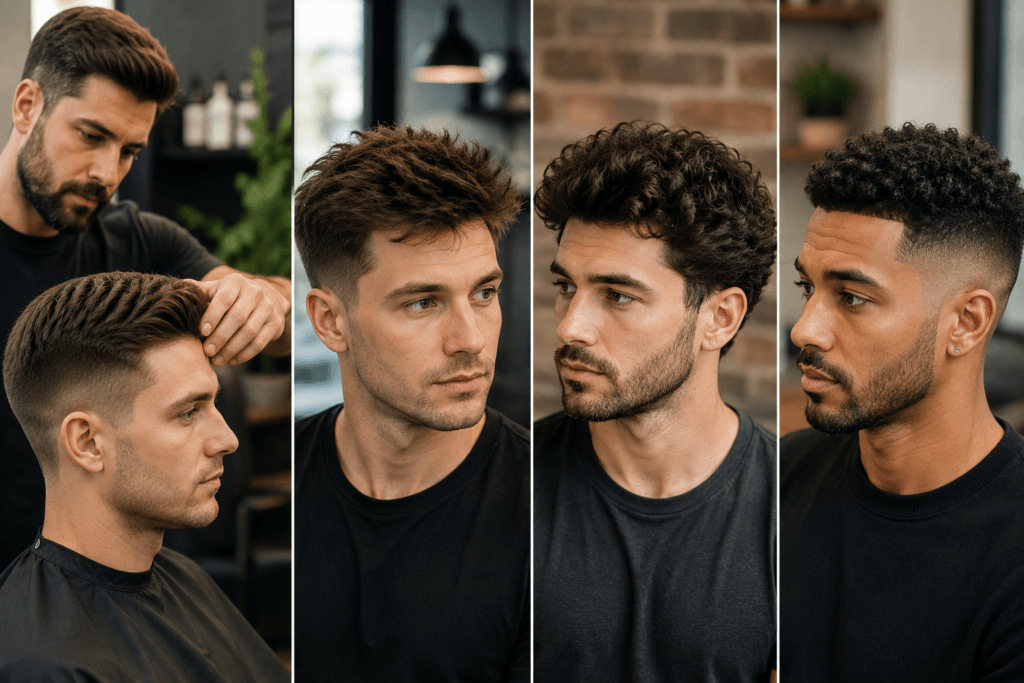
Face shape is one of the most practical filters a man can use when narrowing down haircut options, yet most people skip this step entirely and rely on whatever the barber suggests in the moment. Getting it right means your cut works with your natural proportions rather than against them, which is exactly what makes a style look effortless even when you have done almost nothing to it.
Oval faces are widely considered the most versatile because the proportions are balanced — slightly longer than wide, with a gently rounded jawline. If this describes you, nearly every cut on this list suits you, so the decision comes down to lifestyle and hair texture rather than shape. The buzz cut, the textured crop, and the modern quiff all sit comfortably on an oval face without requiring any visual correction.
Square faces feature a strong jawline, a wide forehead, and roughly equal width at the cheek and jaw. The goal is usually to add some height and soften the angular corners rather than mirror them. A short back and sides with length left on top achieves this cleanly. Skin fades work particularly well here because the gradual taper draws the eye upward, elongating the face just enough. Avoid very blunt, boxy cuts that echo the jaw’s geometry, since they tend to flatten the overall look.
Round faces have similar width and length measurements, with soft curves rather than defined angles. Adding height at the crown and keeping the sides tight creates the impression of length. A high fade combined with a textured top, or an undercut with volume through the crown, both accomplish this without much daily effort. Flat, wide styles that sit low on the head tend to exaggerate roundness rather than balance it.
Oblong or rectangular faces are noticeably longer than they are wide. The priority here is adding width at the sides rather than height on top. A disconnected undercut with fuller sides, a mid fade rather than a high one, or a messy textured cut kept fuller at the temples all do the job well. Avoid tall, elongated styles that push the silhouette even further upward.
Heart-shaped faces are wider at the forehead and taper down toward a narrower chin. Side-parted cuts, textured slick-backs kept moderate in height, and mid-length styles with volume through the mid-section all balance the proportions. High fades can be tricky here because they remove width at a point in the silhouette where a bit more fullness would actually help.
Hair Texture and Thickness: Matching the Cut to What You Actually Have
Face shape tells you what will look proportional. Hair texture tells you what will actually behave the way you need it to. These two filters together are what make a low-maintenance cut genuinely low maintenance rather than a constant battle with a style that was never right for your hair in the first place.
Fine hair benefits enormously from cuts that remove bulk from the ends and add internal texture. Thinning scissors and point-cutting techniques create movement that makes fine hair appear fuller and more substantial. The textured crop and the buzz cut are both excellent choices because they work with fine hair’s natural tendency to lie flat rather than demanding it do something it cannot. Very long styles on fine hair often look limp and shapeless by midday without significant product, which defeats the wash-and-go premise entirely.
Thick hair is the most forgiving texture for wash-and-go styling, but it comes with its own challenge: if left unthinned and unshaped, it can become heavy, poofy, or difficult to keep flat between cuts. Cuts with internal thinning and some tapering at the ends are essential. The undercut handles thick hair especially well because it removes a large volume of weight from the sides while leaving the top manageable. Regular barber visits are more important with thick hair not because the shape deteriorates faster but because the weight builds up faster.
Wavy hair has a natural texture that many cuts simply cannot fake, which is genuinely an advantage. A medium-length cut that lets the waves fall naturally — something like a longer textured crop or a loose Ivy League — requires almost no product because the wave pattern creates its own visual interest. The main trap with wavy hair is cutting it too short, at which point the wave compresses into a slight curl or a fuzzy halo rather than a clean wave. Keeping a little length, typically at least an inch and a half on top, allows the wave to express itself properly.
Curly hair demands the most care in the selection process because curls shrink significantly when dry. A barber experienced with curly hair will always cut it dry or will account for shrinkage when cutting wet. The burst fade and the curly fringe both celebrate the curl pattern rather than fighting it, which is the entire point of a truly low-maintenance approach. Trying to smooth or flatten curly hair into a style designed for straight hair requires product, heat, and daily effort — none of which belong in a wash-and-go routine.
Coarse or wiry hair often benefits from a slightly longer cut because the length adds weight that tames the texture. Very short cuts on coarse hair can create a stiff, bristle-like appearance that requires product to soften. A medium-length cut with soft tapering at the neckline and temples tends to give the best balance of shape and manageability without a product routine.
Best Haircuts for Men by Age: Your 30s, 40s, and 50s
Most haircut guides treat age as irrelevant, which is a significant oversight. Hair changes measurably across decades — in texture, density, growth rate, and distribution — and the cuts that worked at 22 may not serve you as well at 38 or 52. Understanding what is actually happening to your hair as you age, and which cuts account for those changes, is one of the most practical and least discussed aspects of low-maintenance grooming.
In your 30s, hair changes are often subtle but beginning. For many men, the first signs of thinning appear at the temples or along the crown, and hair may feel slightly less dense or resilient than it did a decade earlier. Lifestyle demands also shift — longer working hours, less time in front of a mirror, and a growing preference for looking polished without significant daily effort. The best low-maintenance options in this decade are cuts that still allow some versatility when you want it but hold a clean shape on days you do nothing. The textured crop works particularly well throughout the 30s because it accommodates early temple recession without drawing attention to it — the fringe sits forward and the texture breaks up the hairline. The tapered short back and sides is another strong choice because it stays neat between cuts and never reads as trying too hard. If grey is beginning to appear, it is worth noting that slightly longer cuts tend to distribute early grey more evenly than very short cuts, which can make a handful of grey hairs appear more prominent against the scalp.
In your 40s, the changes become more pronounced for most men. Thinning at the crown and diffuse recession along the hairline are common, and the hair that remains may be finer in diameter than it once was. The instinct for many men at this stage is to grow the remaining hair longer to compensate, but this often has the opposite of the intended effect — longer, thinner hair tends to emphasize sparseness rather than mask it. Shorter cuts worn with confidence almost universally look better than compensatory lengths. The buzz cut becomes one of the most flattering options in the 40s precisely because it neutralizes thinning as a visual concern entirely. A well-executed skin fade also works well, as the gradient draws attention to the overall shape of the head and the clean barberwork rather than to any specific thinning area. For men whose hair is still reasonably dense in their 40s, the classic Ivy League and a refined version of the short back and sides remain excellent choices, and the emerging grey that often arrives in this decade adds character rather than requiring any management.
In your 50s, the priorities tend to consolidate around two things: cuts that are genuinely effortless to maintain and cuts that look intentional and considered rather than neglected. Hair is often significantly finer, growth may have slowed, and a larger proportion of grey or white hair changes the way cuts interact with light and texture. The good news is that grey hair has its own visual authority, and cuts that would have appeared stark or severe on dark hair often look distinguished on grey. The short back and sides is arguably the single best cut for men in their 50s because it is universally flattering, easy to maintain, and carries no age-specific associations in either direction — it simply reads as a clean, well-kept man. The buzz cut remains a strong option and, on grey hair, can look exceptionally sharp. What to avoid in the 50s is mostly the same as what to avoid at any age: cuts that require daily product work, cuts with length that depends on density you no longer have, and cuts chosen to look younger rather than chosen to look good. According to the American Academy of Dermatology, androgenetic alopecia affects a significant percentage of men by their 50s, and working with a barber who understands how to cut thinning hair is one of the most worthwhile grooming investments a man can make at this stage.
“In hereditary hair loss, the hair follicles gradually shrink over time. As this process continues, hair becomes finer and thinner, and some follicles eventually stop producing visible hair. “
— American Academy of Dermatology
“Seborrheic dermatitis commonly affects the scalp and may cause inflammation, scaling, and persistent dandruff. While the condition can be irritating, it does not typically cause permanent hair loss. “
— Mayo Clinic
Finding the best haircuts for men in 2026 comes down to a straightforward intersection of three things: what works with your face shape, what works with your hair’s actual texture and density, and what matches the stage of life your hair is in right now. The cuts covered in this guide — from the zero-effort buzz to the textured crop to the quietly timeless short back and sides — share a common quality: they look better when they are not forced. The best low-maintenance haircut is the one you stop thinking about after the barber’s chair. It holds its shape, suits your face, and fits into a morning routine that runs on rinse and go rather than product and effort. Book a cut that matches those criteria, communicate clearly with your barber about what you want and what you do not want to do each morning, and revisit the length and shape every six weeks or so to keep it working at its best.
Frequently Asked Questions
What is the single best low-maintenance haircut for men?
The tapered short back and sides is the most consistently low-maintenance option across face shapes, hair types, and age groups. It requires under a minute to style — often nothing at all — holds a clean shape for five to six weeks between cuts, and works in every context from casual to professional. The buzz cut is the only cut that requires even less daily effort, though it demands more frequent barber visits to stay sharp.
How often should men get a haircut to keep a low-maintenance style looking good?
It depends on the cut. Skin fades and undercuts begin to lose their definition within two to three weeks and look best when touched up on that schedule. Textured crops and tapered cuts hold their shape for four to six weeks. Longer styles like the Ivy League can go six to eight weeks before the shape becomes noticeably untidy. Going too long between cuts is the most common reason a supposedly easy style starts requiring product and effort to manage.
Do the best haircuts for men with thinning hair differ from those for men with full hair?
Yes, meaningfully so. Men with thinning hair generally do best with shorter cuts that reduce the visual contrast between thinner and denser areas. The buzz cut, a close-cropped textured cut, and a low-to-mid skin fade all tend to produce better results than longer styles that draw attention to sparse patches or lie flat against the scalp. A barber experienced with thinning hair will cut dry when possible and avoid creating hard lines across areas of diffuse thinning.
Can men with curly hair do a true wash-and-go haircut?
Curly hair is actually well suited to wash-and-go styling when the cut works with the curl pattern rather than against it. The key is choosing a length that lets the curl develop fully — typically at least an inch and a half to two inches on top — and working with a barber who cuts curly hair dry or accounts for shrinkage. A lightweight curl-enhancing cream applied to damp hair and left to air dry is about the minimum product investment needed, and for most curl types that is genuinely the entire routine.