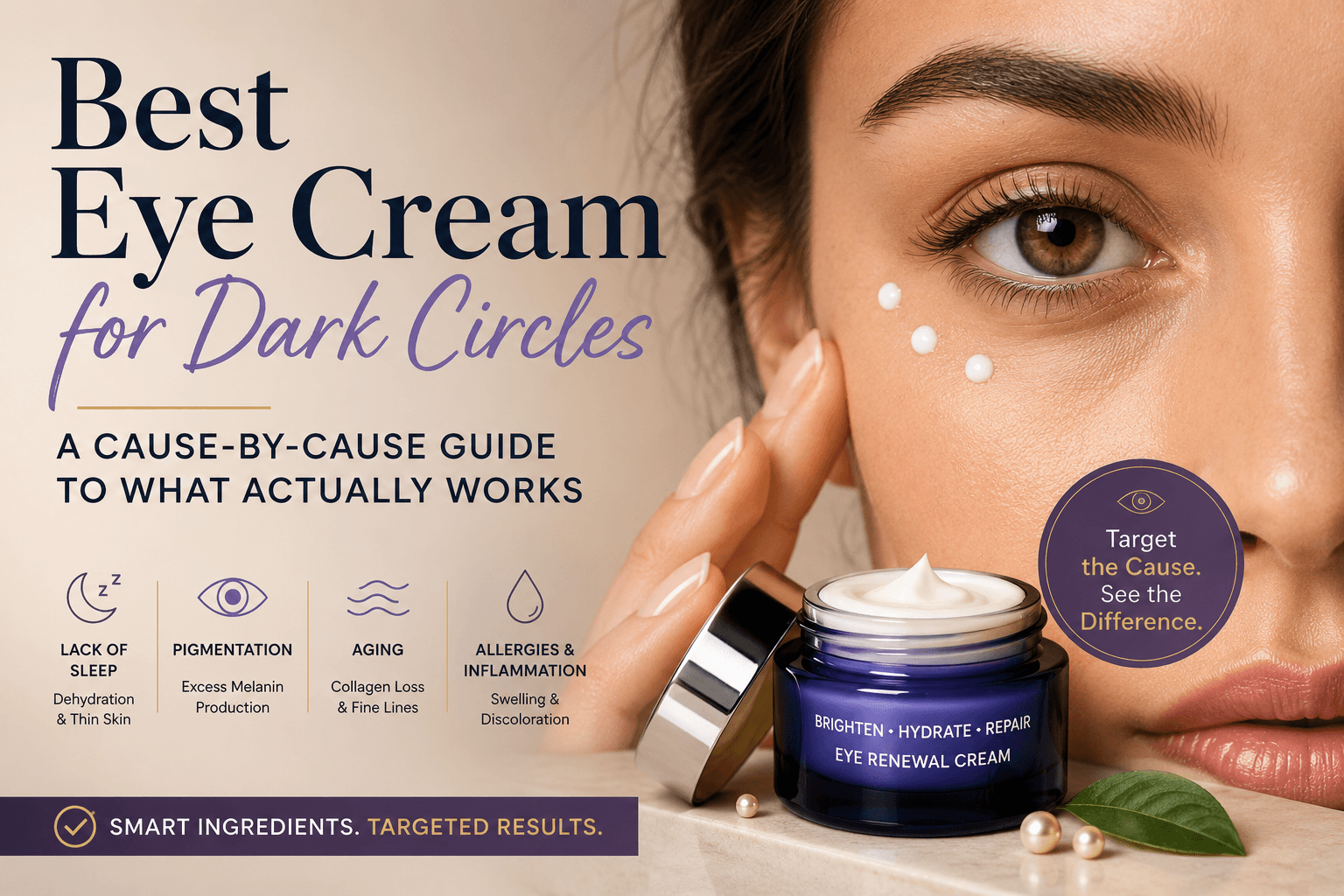
The best eye cream for dark circles depends on the underlying cause: caffeine and vitamin K may help with bluish-purple vascular circles, while niacinamide, tranexamic acid, and stable vitamin C derivatives are better suited to brown pigmented circles. Hollow under-eyes respond best to peptide-rich formulas that support collagen rather than brighteners, since the shadowing comes from volume loss rather than pigment or blood vessels.
Key Takeaways
- Dark circles fall into four distinct categories (blue, brown, purple, and hollow), and treating the wrong type with the wrong ingredients wastes both money and time.
- Niacinamide (INCI: niacinamide) at 5% or above is one of the most evidence-backed brightening ingredients, with studies suggesting measurable reduction in periorbital hyperpigmentation over 8 to 12 weeks of consistent use.
- Caffeine (INCI: caffeine) temporarily constricts blood vessels and reduces puffiness, making it useful for vascular blue or purple circles, but it does not address melanin-based brown pigmentation.
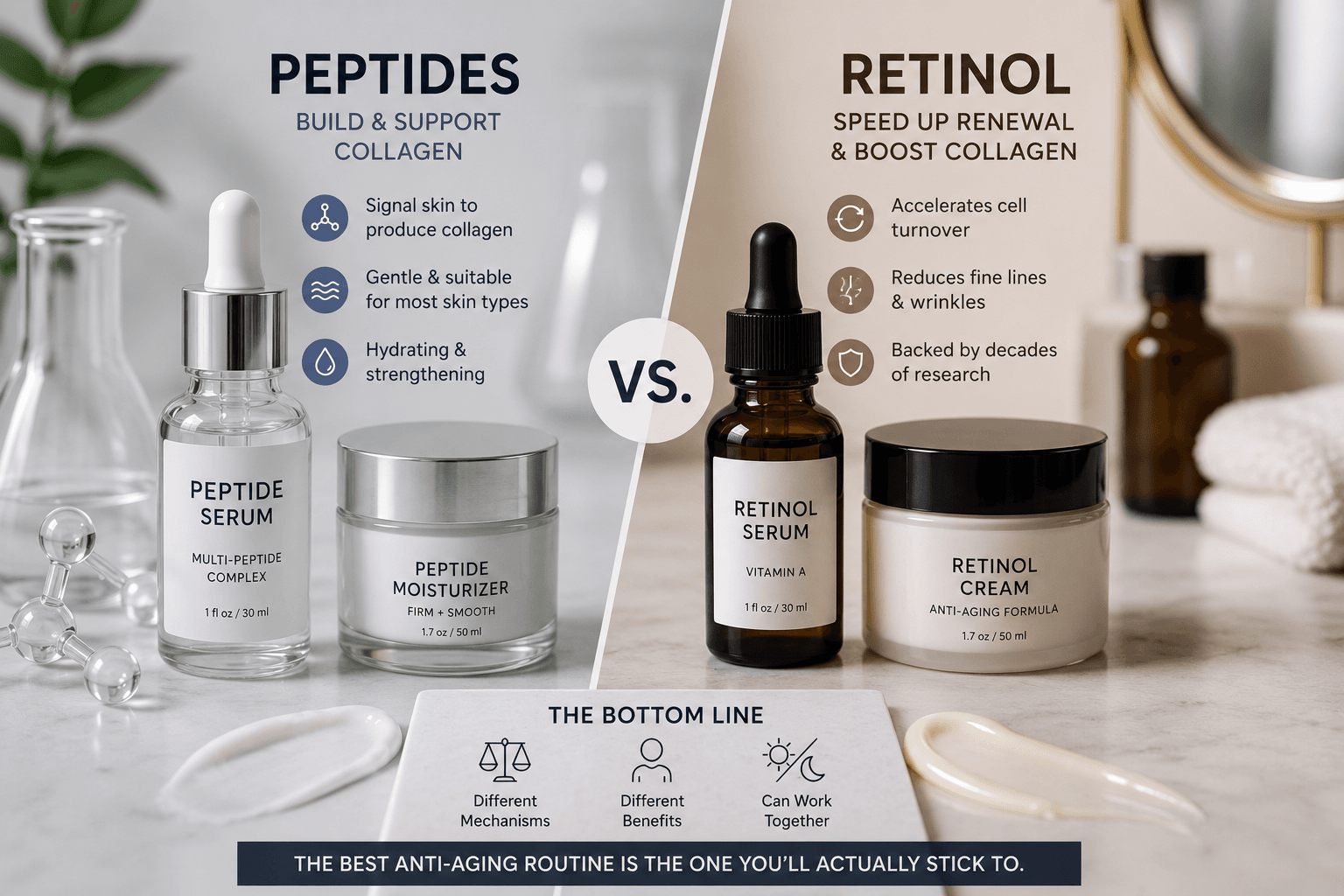
- Retinol (INCI: retinol) and peptides such as Matrixyl (palmitoyl tripeptide-1) may help with structural, hollow under-eyes by supporting collagen turnover, though results typically take 12 or more weeks.
- Fragrance-free formulas are strongly preferred for the eye area, where skin is roughly 40% thinner than on the rest of the face and significantly more prone to irritation.
Why Dark Circles Are Not All the Same
Dark circles look similar at a glance, but the tissue changes driving them vary widely, and matching your product to your specific root cause is the single most important factor in seeing results.
Part of the frustration people feel with eye creams is that they reach for whatever is marketed as “brightening” without first identifying what is actually happening under their eyes. A caffeine serum may visibly depuff a vascular circle in the morning, but it will do little to nothing for someone whose darkness is caused by excess melanin deposits or a structural hollow. This is not a minor distinction. It is the reason someone can use a well-reviewed, well-formulated product for six months and feel like it simply does not work. Dermatologists generally categorize periorbital dark circles into three to four types. Vascular circles, the blue and purple varieties, appear because blood pools or shows through thin skin. Pigmented circles (brown) result from melanin overproduction in the skin itself, often worsened by sun exposure, inflammation, or post-inflammatory hyperpigmentation. Structural circles are really shadows created by volume loss in the tear trough, meaning the under-eye area is hollowed out enough that light creates a dark-looking indentation. Some people experience a combination of two or more types simultaneously, which is why a multi-ingredient approach sometimes makes sense. For more targeted skincare tips and product guides, browse our full skincare section. And if you want to explore broader Beauty articles, WideJournal covers everything from ingredients to routines across all skin types.
How to Figure Out Which Type You Have
A simple home test most dermatologists recommend: press a finger gently against your under-eye area and hold for a few seconds. If the darkness lightens noticeably when you release, the cause is likely vascular. If it stays exactly the same color, you are looking at pigmentation. If the darkness is most visible in certain lighting or at certain angles rather than flat against the skin, a hollow or structural component is likely involved.
The Best Ingredients for Blue and Purple (Vascular) Dark Circles
Vascular dark circles respond best to ingredients that address blood vessel visibility and mild swelling, not ingredients that target pigment.
Blue or purple under-eyes are among the most common types, particularly in people with lighter skin tones or naturally thin under-eye skin. The thinness of the skin here means that the capillary network beneath it becomes more visible, especially in the morning when slight fluid retention makes tissue look more congested.
Caffeine
Caffeine (INCI: caffeine) is the most widely used ingredient for this concern. It temporarily constricts blood vessels and may reduce visible redness and puffiness in the short term. A number of well-formulated eye creams lean on it as a primary active: The Inkey List’s Caffeine Eye Cream ($9.99) is a frequently cited budget option that contains roughly 2% caffeine. Peter Thomas Roth’s Instant FirmX Eye ($55) also uses caffeine alongside peptides. The honest caveat: caffeine’s effects are temporary. It does not permanently alter the structure of the capillaries. Applied in the morning it may give a fresher appearance for several hours, but it is not a long-term fix unless combined with ingredients that address skin thickness.
Vitamin K and Retinol
Vitamin K (INCI: phytonadione) has historically been promoted for vascular dark circles based on the theory that it supports clotting and may help the body reabsorb small capillary leakage. The evidence is limited, and most dermatologists treat it as a supportive ingredient rather than a primary active ingredient. Retinol (INCI: retinol), on the other hand, has stronger support for increasing collagen production in the thin under-eye skin, which over time may make blood vessels less visible simply because the skin above them is thicker and more opaque.
The Best Ingredients for Brown (Pigmented) Dark Circles
Brown pigmented circles require ingredients that interrupt melanin production at the enzymatic level, not vascular solutions like caffeine.
Brown dark circles are particularly common in South Asian, Middle Eastern, East Asian, and Latinx skin tones, though they occur across all Fitzpatrick types. They stem from excess melanin in the epidermis or dermis of the under-eye area, and they are, in many ways, a specialized version of the same hyperpigmentation challenge that affects other areas of the face.
Niacinamide
Niacinamide (INCI: niacinamide) works by inhibiting the transfer of melanin from melanocytes to surrounding skin cells rather than blocking its production outright. This makes it one of the gentler and more broadly effective brightening activities available without a prescription. Formulas like CeraVe Eye Repair Cream ($14.99) include it alongside ceramides, keeping the formula calming and well-tolerated. For a higher-concentration approach, Paula’s Choice Resist Anti-Aging Eye Cream ($35) uses niacinamide as a featured ingredient.
Vitamin C Derivatives
Ascorbic acid in its pure form (INCI: ascorbic acid) is unstable and can oxidize quickly in the small packaging typical of eye creams, which is why most formulas use more stable derivatives: sodium ascorbyl phosphate, ascorbyl glucoside, or 3-O-ethyl ascorbic acid. These may work more slowly than pure vitamin C but are far less likely to irritate sensitive under-eye skin. SkinCeuticals A.G.E. Eye Complex ($107) uses a combination of these alongside proxylane to address both pigmentation and structural concerns.
Tranexamic Acid and Arbutin
Tranexamic acid (INCI: tranexamic acid) is a newer brightening ingredient with growing clinical support, particularly for melasma and post-inflammatory hyperpigmentation. Some research suggests it may perform comparably to kojic acid with a lower irritation profile. Arbutin (INCI: arbutin or alpha-arbutin) is another tyrosinase-inhibiting ingredient worth looking for in formulas targeting pigmented circles. It is used in Good Molecules Discoloration Correcting Eye Serum ($12) alongside other depigmenting agents at a price that makes it accessible.
The Best Ingredients for Hollow (Structural) Under-Eyes
Hollow under-eyes are a structural issue driven by volume loss, meaning brightening ingredients alone are unlikely to produce meaningful improvement.
As the face ages, fat pads beneath the eye shift and diminish, and the connective tissue that once held everything flush loses elasticity. The result is a tear trough shadow that no amount of brightening will eliminate because the darkness is not coming from pigment or blood vessels. It is a shadow cast by a physical indentation. The dermatological gold standard for severe hollowing is hyaluronic acid filler placed by a trained professional. However, topical products can play a supportive role.
Peptides
Peptides signal the skin to produce more structural proteins including collagen and elastin. Matrixyl 3000 (a combination of palmitoyl tripeptide-1 and palmitoyl tetrapeptide-7) is one of the better-studied options in this category. RoC Retinol Correxion Line Smoothing Eye Cream ($24.97) combines retinol with peptides to address both collagen production and skin surface texture. Estee Lauder Advanced Night Repair Eye Serum ($68) uses a peptide-heavy approach alongside hyaluronic acid to plump the under-eye area temporarily.
Hyaluronic Acid
Topical hyaluronic acid (INCI: sodium hyaluronate in its smaller molecular weight form) does not replicate the volumizing effect of filler, but it may temporarily plump the skin surface enough to soften the appearance of shallow hollows. It is most effective at lower molecular weights that allow some degree of penetration rather than simply sitting on top of the skin.
Eye Cream Comparison: Key Products at a Glance
Price (USD)*
| Product | Best For | Key Actives (INCI) | Price (USD) | Fragrance-Free? |
|---|---|---|---|---|
| The Inkey List Caffeine Eye Cream | Blue/purple vascular circles | Caffeine (~2%) | $9.99 | Yes |
| Good Molecules Discoloration Correcting Eye Serum | Brown pigmented circles | Tranexamic acid, arbutin, niacinamide | $12.00 | Yes |
| CeraVe Eye Repair Cream | Pigmented circles, sensitive skin | Niacinamide, ceramides (NP, AP, EOP) | $14.99 | Yes |
| RoC Retinol Correxion Line Smoothing Eye Cream | Hollow/structural, fine lines | Retinol, mineral peptides | $24.97 | Yes |
| Paula’s Choice Resist Anti-Aging Eye Cream | Pigmented circles, combination | Niacinamide, peptides, retinol | $35.00 | Yes |
| Peter Thomas Roth Instant FirmX Eye | Blue/purple, morning puffiness | Caffeine, peptides, hydrolyzed proteins | $55.00 | No |
| Estee Lauder Advanced Night Repair Eye | Hollow/structural, multiple concerns | Peptides, sodium hyaluronate, ChronoluxCB technology | $68.00 | Yes |
| SkinCeuticals A.G.E. Eye Complex | Pigmented, structural, combination | Proxylane, blueberry extract, optical diffusers, ascorbyl glucoside | $107.00 | Yes |
Prices are approximate as of 2026 and subject to change.
How to Apply Eye Cream Correctly (And Mistakes That Make Dark Circles Worse)
Even the most well-formulated eye cream will underperform if it is applied incorrectly. The skin beneath and around the eyes is among the thinnest on the entire body, measuring roughly 0.5mm compared to 2mm elsewhere on the face, which makes it uniquely reactive to friction, pressure, and product overload. Getting your application technique right is not a minor detail; it directly determines how much of an active ingredient reaches the target tissue and how much irritation you inadvertently introduce.
The most important rule is to use your ring finger. It naturally applies the least pressure of any digit, reducing the risk of tugging delicate skin that has limited elasticity and a sparse supporting fat matrix beneath it.Dab, never rub, a rice-grain-sized amount along the orbital bone, which is the bony ridge encircling the eye socket. Most people apply products too close to the lash line, where it migrates into the eye and causes stinging without delivering meaningful benefit to the dark circle zone sitting just below the orbital rim.
Timing also matters more than most guides acknowledge. Water-based eye treatments serums and lighter gels absorb faster and should go on before your moisturizer, while richer cream formulas can be layered after. Retinol-containing eye creams are best reserved strictly for evenings, both because retinol degrades in sunlight and because the cellular turnover it stimulates happens predominantly during sleep. Applying a retinol product in the morning, then heading outdoors without adequate SPF coverage around the eyes, can accelerate the very pigmentation and barrier thinning you are trying to reverse.
Three application mistakes consistently sabotage results. First, using too much product excess cream that sits on the skin’s surface rather than absorbing can migrate into the eye and provoke milia, those small white keratin cysts that develop when product clogs the follicle openings common to that area. Second, inconsistency: ingredients like niacinamide, vitamin C derivatives, and peptides require sustained daily use across six to twelve weeks before visible results appear, and sporadic application resets the process. Third, applying eye cream after an activity that has not fully dried layering retinol or an acid exfoliant while still tacky causes unintended ingredient interaction and elevates irritation risk significantly.
One frequently overlooked step is refrigerating your eye cream. While this does not change the biochemistry of the active ingredients, the cool temperature causes temporary vasoconstriction beneath the eyes, visibly reducing puffiness and the bluish tone that dilated superficial vessels project through thin skin. It is a particularly useful habit for mornings when sleep deprivation has worsened the appearance of under-eye circles overnight.
Lifestyle Factors That Amplify Dark Circles And What Actually Helps
No eye cream, regardless of its price or ingredient list, can fully compensate for lifestyle variables that are actively worsening periorbital discoloration. Understanding these factors helps you set realistic expectations for topical products and address the root cause in parallel rather than relying entirely on skincare to solve a systemic problem.
Sleep deprivation is the most universally cited cause, and the mechanism is well-established. When you are sleep-deprived, cortisol elevates, causing blood vessels throughout the body including the fine capillaries beneath the eyes to dilate. Because the overlying skin is so thin, that increased blood volume becomes visible as a bluish or purplish cast. Chronic poor sleep also impairs the lymphatic drainage that normally clears fluid and cellular waste from periorbital tissue overnight, compounding puffiness and shadow. Most adults require between seven and nine hours for this drainage process to complete adequately, and no amount of caffeine eye cream substitutes for that physiological window.
Dietary sodium intake has a direct and often underestimated impact on under-eye appearance. High sodium consumption causes the body to retain water in interstitial tissue the loose connective tissue around the eyes is particularly susceptible because it offers little structural resistance to fluid accumulation. Reducing processed food intake, particularly in the evening hours, produces noticeable improvement in morning puffiness and the shadows created by fluid-filled pouches for many people within days rather than weeks.
Seasonal allergies represent another commonly missed driver. Allergic rhinitis triggers histamine release, which dilates blood vessels and causes the characteristic dark circles sometimes described as allergic shiners. The repeated rubbing that accompanies eye itching also breaks down collagen and causes post-inflammatory hyperpigmentation over time. Managing the underlying allergy whether through antihistamines, nasal corticosteroids, or allergen avoidance often improves under-eye appearance more meaningfully than any topical product.
Sun protection deserves specific mention because it is the lifestyle intervention most supported by dermatological evidence for preventing pigmented dark circles. UV exposure stimulates melanocytes throughout the periorbital area, deepening brown hyperpigmentation and breaking down collagen that would otherwise provide structural support beneath the eyes. Wearing broad-spectrum SPF 30 or higher daily, including a physical sunscreen or tinted mineral formula that sits closer to the eye without stinging, prevents ongoing melanin stimulation that actively works against the brightening ingredients in your eye cream.
Alcohol consumption accelerates dehydration and causes vasodilation, both of which worsen the appearance of all dark circle types simultaneously. Even moderate alcohol intake the evening before consistently produces more pronounced under-eye discoloration the following morning, particularly the vascular blue-purple variety. Adequate hydration throughout the day supports the lymphatic clearance and maintains the slight natural plumpness of periorbital skin that minimizes shadow from any residual hollowness.
Best Eye Creams for Dark Circles on Melanin-Rich Skin: Why Standard Picks Often Fall Short
If you have a deeper skin tone, Fitzpatrick types IV through VI and have worked through a long list of highly rated eye creams without seeing meaningful improvement in your dark circles, the problem is almost certainly not your diligence. It is that the majority of mainstream recommendations were not formulated with your skin’s biology as the primary consideration.
Periorbital dark circles in melanin-rich skin are driven predominantly by excess melanin deposits in the epidermis and dermis rather than by the vascular congestion that sits at the center of most bestseller formulas. The genetics of darker skin types include a higher baseline melanocyte activity, meaning that any form of inflammation including the low-grade chronic kind caused by repeated eye rubbing, sun exposure, or even contact dermatitis from a fragrant eye cream translates into post-inflammatory hyperpigmentation more readily and more intensely than in lighter skin tones. Caffeine, the star ingredient in the majority of widely recommended eye creams, is a vasoconstrictor that addresses superficial blood vessel visibility. It does essentially nothing to reduce melanin deposits, which means an entire category of products dominating best-of lists provides no meaningful benefit for this root cause.
The ingredient class that matters for melanin-driven periorbital hyperpigmentation is tyrosinase inhibitors compounds that interrupt the enzymatic pathway through which melanocytes produce melanin. Several are well-established, each with a distinct profile worth understanding before you select a formula.
Tranexamic acid has become one of the most clinically supported options for hyperpigmentation in deeper skin tones, partly because it does not carry the irritation risk of hydroquinone and works through a different mechanism it blocks the interaction between keratinocytes and melanocytes that triggers melanin overproduction. It is particularly well-suited to the periorbital area because it delivers brightening activity without the sensitivity or rebound hyperpigmentation risk that makes stronger activities problematic near the eyes. Look for concentrations between 2% and 5% in an eye-specific formula.
Niacinamide (vitamin B3) inhibits the transfer of melanin from melanocytes to surrounding skin cells rather than suppressing melanin production itself. It is exceptionally well-tolerated, anti-inflammatory, and compatible with almost every other active, making it a reliable foundational ingredient in any eye cream targeting pigmented dark circles. At 4% to 5% concentration it demonstrates measurable brightening effects with consistent use over eight to twelve weeks.
Alpha-arbutin is a stabilized derivative of hydroquinone that inhibits tyrosinase activity without the regulatory concerns or long-term side effects associated with prescription-strength hydroquinone. It works most effectively when combined with vitamin C or niacinamide in a formula, and it is generally safe for use around the eyes at low concentrations. Avoid formulas relying on beta-arbutin, which is a less potent and less studied alternative.
Stable vitamin C derivatives specifically ascorbyl glucoside and 3-O-ethyl ascorbic acid rather than the oxidation-prone L-ascorbic acid provide tyrosinase inhibition alongside antioxidant protection from UV-induced melanin stimulation. L-ascorbic acid at the low pH needed for stability is frequently too irritating for periorbital use, and it oxidizes quickly in most eye cream formulations, rendering it ineffective. The stabilized ester forms deliver brightness without the instability or stinging that makes standard vitamin C eye products unreliable.
Beyond individual ingredients, formulas targeting melanin-driven dark circles in deeper skin tones should be fragrance-free and free of common sensitizers essential oils, certain preservatives, and high-concentration alcohols because contact irritation directly stimulates melanocyte activity in skin with higher baseline pigmentation capacity. A formula that calms while it brightens is consistently more effective than one that brightens while quietly triggering the inflammatory cycle that deepens pigmentation over time. Products combining tranexamic acid with niacinamide in a ceramide-based or hyaluronic acid carrier represent the most evidence-aligned architecture for this concern, and this combination is worth prioritizing over any formula built around caffeine and peptides alone when melanin deposition is your primary driver.
“Post-inflammatory hyperpigmentation is one of the most common and distressing conditions seen in patients with skin of color, and it occurs more frequently and with greater intensity in darker skin types due to higher melanocyte activity and larger, more numerous melanosomes. Treatment must target melanogenesis directly rather than vascular components to achieve meaningful improvement.”
— American Academy of Dermatology Association, guidance on hyperpigmentation treatment in skin of color
“Niacinamide has been shown to inhibit the transfer of melanosomes from melanocytes to keratinocytes, resulting in reduced skin pigmentation with good tolerability across all Fitzpatrick skin types, making it a preferred option in formulations designed for sensitive or reactive areas including the periorbital zone.”
— According to the National Institutes of Health, published literature on niacinamide and pigmentation mechanisms via PubMed
Choosing the best eye cream for dark circles means accepting that there is no single formula that addresses every cause equally well but that gap narrows considerably when you match the ingredient logic to the specific biology driving your concern. Whether your dark circles stem from dilated vessels, excess melanin deposits, volume loss, or a combination of all three, the most effective approach pairs a correctly targeted topical with the lifestyle adjustments that prevent active worsening: consistent sun protection, adequate sleep, low dietary sodium, and managing underlying allergies if relevant. The products outlined in this guide represent the most evidence-aligned options currently available across each category, and while this framework works for the majority of readers, anyone experiencing persistent or worsening periorbital hyperpigmentation particularly those with deeper skin tones considering higher-potency brightening actives should consult a board-certified dermatologist before beginning treatment to confirm the diagnosis and rule out any underlying contributing conditions.
Frequently Asked Questions
How long does it take for eye cream to reduce dark circles?
Most active ingredients targeting dark circles niacinamide, tranexamic acid, peptides, and vitamin C derivatives require consistent daily application for a minimum of six to eight weeks before visible improvement appears, with the most meaningful results typically emerging between week eight and week twelve. Vascular ingredients like caffeine produce temporary cosmetic reduction in puffiness within minutes of application, but this is not the same as lasting structural improvement. Setting a realistic twelve-week evaluation window before switching products prevents the common mistake of abandoning a formula before it has had sufficient time to work.
Can retinol eye creams make dark circles worse before they get better?
Yes, particularly during the first two to four weeks of use. Retinol accelerates cell turnover, which can temporarily disrupt the skin barrier and cause mild dryness, flaking, and redness all of which make the under-eye area look worse in the short term. This initial adjustment phase is normal and usually resolves as the skin acclimates. Starting with a low-concentration formula (0.025% to 0.05% retinol) used two to three nights per week and gradually increasing frequency is the standard approach for minimizing this effect. Anyone with very sensitive skin or active eczema near the eyes should approach retinol products with particular caution.
Do eye creams for dark circles work differently for men than for women?
The underlying causes of dark circles vascular congestion, melanin deposits, volume loss, and structural shadowing are the same regardless of sex, and the ingredient logic for addressing each cause applies equally. Male facial skin does tend to be somewhat thicker and oilier on average, which means lighter gel-cream formulas often absorb more comfortably than heavier occlusive creams. The most meaningful difference in outcomes is typically not biological sex but rather lifestyle factors: higher rates of chronic sleep disruption and alcohol consumption, which are statistically more prevalent in men, tend to sustain the vascular dark circle cycle irrespective of what is being applied topically.
Is eye cream necessary if you already use a good face moisturizer?
A standard face moisturizer is not a true substitute for a dedicated eye cream for two main reasons. First, many effective facial activities, high-concentration retinol, AHAs, and strong vitamin C formulas are too irritating for periorbital skin and cannot be safely applied near the eyes, meaning that area goes under-treated. Second, the structural concerns specific to under-eye dark circles (melanin deposits, capillary visibility, volume loss) require targeted ingredient concentrations that general moisturizers are not formulated to deliver. If your only goal is basic hydration and your dark circles are mild, a gentle moisturizer applied carefully can serve as a functional substitute but for anyone with a pronounced concern across any of the four causes discussed in this guide, a specifically formulated product will outperform a general moisturizer consistently.