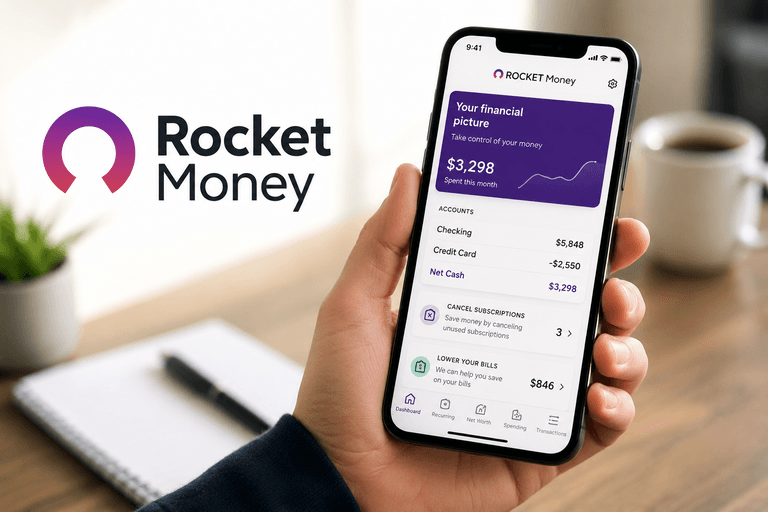
Rocket Money is a personal finance app that tracks subscriptions, negotiates bills, and helps you build a budget by connecting to your bank accounts. It is legitimate and generally safe to use, backed by Rocket Companies (the same parent company as Rocket Mortgage), with bank-level 256-bit encryption and read-only account access. The free version covers basic budgeting, while the premium plan runs $6 to $12 per month depending on what you choose to pay.
Key Takeaways
- Rocket Money’s premium subscription uses a pay-what-you-want model between $6 and $12 per month, billed annually or monthly.
- The bill negotiation service charges a success fee of 35% to 60% of your projected first-year savings, paid upfront regardless of whether the negotiated rate holds beyond the promotional period.
- Rocket Money connects to accounts via read-only access through Plaid, meaning it cannot move or withdraw your money.
- The app is owned by Rocket Companies, which also operates Rocket Mortgage and Rocket Loans, creating a built-in cross-sell environment within the platform.
- Free users get subscription tracking and basic budgeting; premium unlocks bill negotiation, custom budget categories, credit score monitoring, and priority support.
What Is Rocket Money?
Rocket Money is a budgeting and subscription management app designed to help users track spending, cancel unwanted subscriptions, and lower recurring bills through automated negotiation.
Rocket Money launched in 2015 under the name Truebill before being acquired by Rocket Companies in 2021 and rebranded in 2022. It sits within a broader ecosystem of financial products from Rocket Companies, which also includes Rocket Mortgage, Rocket Loans, and Rocket Solar. That corporate context matters more than most reviews acknowledge, and we’ll return to it in detail later.
At its core, the app connects to your checking, savings, and credit card accounts through Plaid, a third-party data aggregator used by thousands of financial apps including Venmo and Robinhood. Once connected, Rocket Money scans your transaction history to surface recurring charges, flag potential duplicates, and build a picture of where your money is going each month. You can explore more money management strategies across our Finance articles and our dedicated budgeting articles section.
The app is available on iOS and Android and includes a web dashboard. It is not an investment platform and does not offer savings accounts or financial products directly (though it will suggest them, as discussed below).
How Does Rocket Money Work?
After you connect your bank and credit accounts, Rocket Money automatically categorizes transactions, identifies subscriptions, and gives you tools to cancel services or negotiate lower rates on bills like cable, internet, and phone.
Account Linking and Transaction Tracking
When you first set up Rocket Money, you link your financial accounts through Plaid. The connection is read-only, which means the app can view your transaction data but cannot initiate transfers or withdraw funds. This is a meaningful security distinction that places Rocket Money in the same technical category as other read-only aggregators rather than full-access financial platforms.
Once linked, the app pulls in transaction history and begins sorting charges into categories: food and drink, transportation, entertainment, subscriptions, and so on. You can manually recategorize transactions and set monthly spending targets for each category. The budgeting interface is similar to what Mint offered before its shutdown in 2024, and Rocket Money actively positioned itself to absorb displaced Mint users during that transition.
Note for Canadian users: While Plaid supports major Canadian institutions, Rocket Money’s core features, such as automated bill negotiation, are heavily optimized for US service providers.
Subscription Tracking and Cancellation
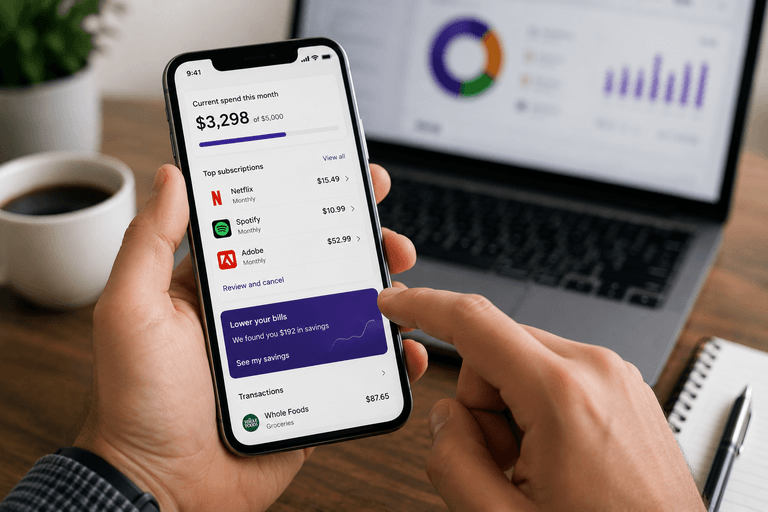
Subscription detection is one of Rocket Money’s most-marketed features. The app flags recurring charges, including annual fees that many users forget about, and presents them in a consolidated view. From that view, you can request cancellation for services you no longer use. Rocket Money handles the cancellation process on your behalf, contacting the provider directly.
This is genuinely useful for people who have accumulated streaming services, gym memberships, free trials that converted to paid plans, and similar recurring charges. That said, Rocket Money does not guarantee successful cancellation for every service, and some cancellations require direct action from the user regardless of what the app initiates.
Bill Negotiation
The bill negotiation feature is Rocket Money’s most frequently cited selling point and also its most financially significant feature to evaluate carefully. You submit a bill (internet, cable, phone, insurance) and Rocket Money’s team of human negotiators contact the provider on your behalf to request a lower rate or promotional credit.
If the negotiation succeeds, Rocket Money charges a success fee of 35% to 60% of the projected first-year savings. You choose the percentage when you sign up for the service, with higher percentages reportedly improving the priority your negotiation receives. This fee structure has important implications that most reviews underexplain, covered in full in the section below.
Rocket Money Features: Free vs. Premium
The free version of Rocket Money covers basic subscription tracking and budgeting, while the premium tier unlocks bill negotiation, credit monitoring, net worth tracking, and custom spending categories.
Rocket Money operates on a freemium model. The free plan is functional enough for basic use, but several of its most-promoted features require a paid subscription. Here is how the two tiers compare across the features most relevant to everyday budgeters.
| Feature | Free Plan | Premium Plan ($6–$12/mo billed annually; $8–$12/mo monthly) |
|---|---|---|
| Subscription tracking | Yes | Yes |
| Subscription cancellation assistance | Limited | Full access |
| Bill negotiation | No | Yes (+ 35–60% success fee) |
| Custom budget categories | No (preset only) | Yes |
| Credit score monitoring | No | Yes |
| Net worth tracking | No | Yes |
| Smart savings account (automated) | No | Yes |
| Priority customer support | No | Yes |
| Transaction search and export | Limited (90 days) | Full history |
The pay-what-you-want pricing model for premium is intentionally flexible, but it is worth noting that the lower end of the range ($6/month) may reduce negotiation priority compared to users who select the higher tier. Rocket Money does not publish a precise policy on this, but user reports and the app’s own onboarding flow suggest that the percentage you select for the bill negotiation success fee correlates with service speed and attention.
For readers building a broader personal finance toolkit, pairing a budgeting app like Rocket Money with dedicated spending-reduction tools can accelerate results. Reducing discretionary spending on groceries, for instance, tends to have one of the fastest payoff timelines, and combining a budget tracker with one of the best meal planning apps is one practical way to close the gap between your budget targets and your actual grocery spending.
Rocket Money Premium: What You Get, What It Costs, and Who Should Pay for It
Rocket Money’s free tier is genuinely functional for basic use. It tracks subscriptions, categorizes transactions, allows manual budget creation, and displays a net worth snapshot. For a user who simply wants a single view of their recurring charges and monthly cash flow, the free version may be sufficient without ever entering a credit card number.
Premium is where the pricing structure becomes unusual. Rather than a fixed monthly price, Rocket Money charges between $6 and $12 per month on an annual basis, or between $8 and $12 per month on a monthly basis and the subscriber chooses their own price within that range during signup. In practice, the app defaults to the higher end of the range and relies on the visual design of the pricing screen to make the lower price feel like a deliberate downgrade rather than a legitimate choice. Choosing $6 per month is permitted, but the interface is not designed to make that feel comfortable.
Premium unlocks several features that are absent from the free tier: unlimited budgeting categories, premium chat support, the bill negotiation service, credit score monitoring with weekly updates, savings account access through a partner bank, and the auto-cancellation feature that lets you cancel subscriptions directly through the app. Whether those additions justify the cost depends almost entirely on how you intend to use the bill negotiation service, since that feature is the one most likely to return measurable dollar savings.
For a user who has three to five large recurring bills internet, wireless, satellite TV, home security and who has never negotiated those bills before, one successful negotiation can easily return more than a year’s worth of premium subscription fees. A single $20-per-month reduction on a cable bill recovers $240 annually against a maximum premium cost of $144 per year. In that specific scenario, premium is worth paying for the negotiation feature alone.
For users who already negotiate their own bills, have no large discretionary subscriptions to cancel, or primarily want basic budgeting features, the free tier is likely sufficient. The credit monitoring feature is useful but largely duplicated by free options including Credit Karma and the free credit score access many major credit cards already provide. The savings account, offered through a partner institution rather than Rocket Money itself, carries interest rates that are competitive at times but not consistently market-leading.
Is Rocket Money Safe and Legit? Infrastructure & Data Privacy
Rocket Money holds an A+ rating with the Better Business Bureau (BBB) and carries over 100,000 reviews across the App Store and Google Play, the majority of which are positive. Those numbers suggest a functioning, broadly trusted product. However, “legitimate” and “safe” answer two completely different questions in fintech, and conflating them leads consumers to skip the fine print that matters most.
Security Infrastructure and Legitimacy
On the legitimacy side, Rocket Money is a registered financial technology company operated by Rocket Companies, Inc., a publicly traded corporate giant listed on the New York Stock Exchange (NYSE: RKT). Because it is backed by a major public institution that files regular financial disclosures with the U.S. Securities and Exchange Commission (SEC), the platform operates with a baseline of institutional accountability that distinguishes it from lesser-known budgeting apps.
To secure your data, Rocket Money employs bank-level infrastructure:
- Data Encryption: Uses 256-bit AES encryption for stored data and TLS protocols for all data in transit.
- No Direct Transfers: Your funds stay in your existing bank accounts at all times. Rocket Money is an analytics tool, not a bank, meaning it has no capability to move, withdraw, or touch your money.
- Read-Only Authentication: Account credentials are never stored directly by Rocket Money. Instead, authentication is handled by Plaid, a third-party data aggregator used by thousands of financial platforms like Venmo and Robinhood. Plaid passes only read-only transaction history back to the app.
The Compliance and Data Privacy Catch
While the platform is highly secure from a traditional cybersecurity standpoint, “legitimate” does not mean “free of privacy trade-offs.” Rocket Money requires deep access to your behavioral data including detailed transaction histories, spending habits, income patterns, and subscription details to perform its core functions.
Furthermore, the integration with third-party tools carries documented historical baggage:
- Plaid Scrutiny: In 2022, the Federal Trade Commission (FTC) finalized a major enforcement action against Plaid, alleging that the aggregator collected more financial data than consumers expected and utilized deceptive user interfaces.
- Email Scanning Exposure: Users who choose to connect their primary email inboxes for automated subscription scanning grant the app read-access to an environment that often contains sensitive personal and professional correspondence well beyond simple digital receipts.
- Corporate Ecosystem Sharing: Rocket Money’s privacy policy explicitly permits sharing aggregated and, in some cases, individual financial profiles with its corporate affiliates. Because its parent company also operates Rocket Mortgage and Rocket Loans, your financial health indicators directly inform the targeted loan and refinancing offers you encounter within the app’s dashboard.
Practical Steps to Minimize Exposure
If you want to use Rocket Money’s automation but are concerned with data minimization, you can reduce your digital footprint using two hidden settings:
- Use an Email Alias: Create a dedicated email alias strictly for your retail and streaming subscriptions. Connect this secondary alias to Rocket Money rather than your primary personal or work inbox.
- Opt Out of Marketing Sharing: Navigate deep into the app’s account security settings post-onboarding to manually opt out of external data-sharing for marketing purposes. This cuts off the automated pipeline that sends your financial profile to affiliated Rocket lenders.
Consumer privacy concerns around financial apps are not limited to what data is collected, but also how that data is shared, used, and connected to commercial decisions. Regulators such as the CFPB and FTC have emphasized transparency, consumer control, and clear disclosures in financial data-sharing practices.
Final Assessment: Who Should Use Rocket Money in 2026
Rocket Money is a capable budgeting and subscription management tool that earns its positive reputation in the specific use cases it was designed for. Users who have lost track of recurring charges, who have never negotiated a large monthly bill, and who want a single consolidated view of their financial accounts will likely find the app valuable and for that group, a trial of the premium tier for two to three months is a reasonable experiment, particularly if the bill negotiation service returns even one meaningful reduction. The app is not a scam, not a security failure in any headline sense, and not a product that delivers nothing for its subscription price.
The more honest assessment is that Rocket Money works best as a short-term intervention rather than a permanent fixture of your financial stack. Use it to audit subscriptions you have forgotten, run bill negotiations on your two or three highest recurring services, and then evaluate whether the ongoing premium cost is justified by what the app continues to return. The data-sharing relationship with Rocket Companies’ affiliated lenders is a structural feature of the product rather than a flaw that will be corrected, and users who are uncomfortable with behavioral financial data informing mortgage and loan marketing directed at them should weigh that alongside any savings the app generates. As with any financial tool that touches bank account access and spending behavior, anyone navigating complex credit circumstances, active loan applications, or sensitive financial transitions should review the full privacy policy and, where the stakes are high, consult a financial advisor before linking primary accounts.
Editorial Disclaimer: WideJournal is an independent digital publisher and media portal. The information, reviews, and analyses provided in this article are for informational, educational, and entertainment purposes only and do not constitute professional financial, investment, legal, or tax advice. Personal finance management involves inherent risks, and individual financial situations vary significantly. While we strive to maintain absolute factual precision and temporal accuracy, platform terms, pricing models, success fees, and data policies can change without notice. WideJournal does not guarantee the financial outcomes of using any third-party application, service, or negotiation tool. Always conduct your own due diligence, review a platform’s privacy policy and terms of service thoroughly, and consult with a certified financial planner (CFP) or legal advisor before linking sensitive financial accounts or making critical financial decisions.
Frequently Asked Questions
Does Rocket Money actually cancel subscriptions for you, or do you have to do it yourself?
Rocket Money can cancel certain subscriptions on your behalf, but this feature is limited to premium subscribers and applies only to a subset of services. For many subscriptions, particularly those without a direct cancellation API or those tied to contracts, the app provides cancellation instructions and contact information rather than handling the process directly. Users with subscription services tied to annual contracts or cancellation fees will need to manage those themselves regardless of premium status.
How does Rocket Money’s bill negotiation success fee work if my rate goes back up?
Rocket Money calculates its success fee based on the projected annual savings at the moment the negotiation is completed, not on the savings you actually realize over the following twelve months. If your provider applies a promotional rate that reverts after six months, you still owe the fee calculated on the full-year projection. This is disclosed in the terms of service, but it means your effective fee rate on actual savings can be significantly higher than the stated 30 to 60 percent range when promotional periods are short.
Is the free version of Rocket Money worth using, or do you need premium?
The free version is genuinely useful for subscription tracking and basic transaction categorization, and many users will find it sufficient without upgrading. Premium becomes worth considering primarily if you plan to use the bill negotiation service, since that feature is locked to paid tiers and is the one most likely to generate savings that exceed the subscription cost. If you already negotiate your own bills and have a functioning budget system, the free tier covers most practical needs.
What happens to my data if I cancel Rocket Money?
Canceling your Rocket Money subscription does not automatically delete your account data. To request data deletion, users must submit a separate deletion request through the app’s privacy settings or contact support directly. Even after deletion, Rocket Money’s privacy policy permits retention of certain anonymized or aggregated data and may retain records required for legal or compliance purposes. Users who have granted email access should also revoke that permission separately through their email provider’s connected apps settings, since the app permission may persist independently of the Rocket Money account status.