
The carnivore diet is an all-animal-foods eating pattern that eliminates every plant food, including vegetables, fruits, grains, and legumes, in favor of meat, fish, eggs, and some dairy. Most beginners see meaningful changes in energy and body composition within 30 days, though the first one to two weeks typically involve an adjustment period as the body shifts away from carbohydrates.
Key Takeaways
- The carnivore diet excludes all plant foods and centers on ruminant meat (beef, lamb, bison), organ meats, fish, eggs, and optionally dairy, making it one of the most restrictive elimination diets in common use.
- Research on strict carnivore eating is limited, but studies on related very-low-carbohydrate diets suggest potential benefits for blood sugar regulation, inflammation markers, and body weight in some individuals.
- A transitional “carnivore flu” lasting three to seven days is reported by many new adopters as the body depletes glycogen stores and begins relying on fat for fuel.
- Organ meats, particularly beef liver, are nutritionally dense enough that many practitioners consider 4 to 6 ounces per week adequate to cover several key micronutrients, including vitamin A and B12.
- Anyone with kidney disease, a history of cardiovascular disease, or familial hypercholesterolemia should discuss this diet with a physician before starting, as high saturated fat and protein loads carry specific risks for those populations.
What Is the Carnivore Diet?
The carnivore diet is a zero-carbohydrate eating pattern built entirely around animal-sourced foods, with no fruits, vegetables, grains, or plant-based oils of any kind.
The core idea is simple: eat animals, drink water. Every meal comes from the animal kingdom, which in practice means beef, pork, lamb, poultry, seafood, eggs, and for many people, certain dairy products like butter, cheese, and heavy cream. Proponents describe it as an extension of the ketogenic diet taken to its logical endpoint. Where keto allows low-carb vegetables and plant fats, carnivore removes them entirely. The result is a diet that derives essentially all of its calories from protein and fat, pushing carbohydrate intake as close to zero as possible. The diet gained broader visibility in the mid-2010s through figures like Dr. Shawn Baker, an orthopedic surgeon who documented his own carnivore experience and later co-founded Revero, a digital health platform supporting zero-carb practitioners. Interest accelerated sharply after podcasts and social media communities began sharing personal transformation stories, and by 2025 carnivore-related searches had reached an estimated 1.8 million monthly queries in the US alone. It is worth being direct about what the evidence base looks like. There are no large, long-term randomized controlled trials on the strict carnivore diet. Much of what is known comes from mechanistic research on ketogenic and very-low-carbohydrate diets, self-reported data from carnivore communities, and a handful of observational studies. That does not mean the diet has no merit, but it does mean strong clinical claims in either direction require caution.
Carnivore Diet Food List: What You Can Eat
The carnivore food list is short by design: prioritize ruminant meats, include organ meats weekly, and let personal tolerance guide whether you include dairy and eggs.
The Core Foods
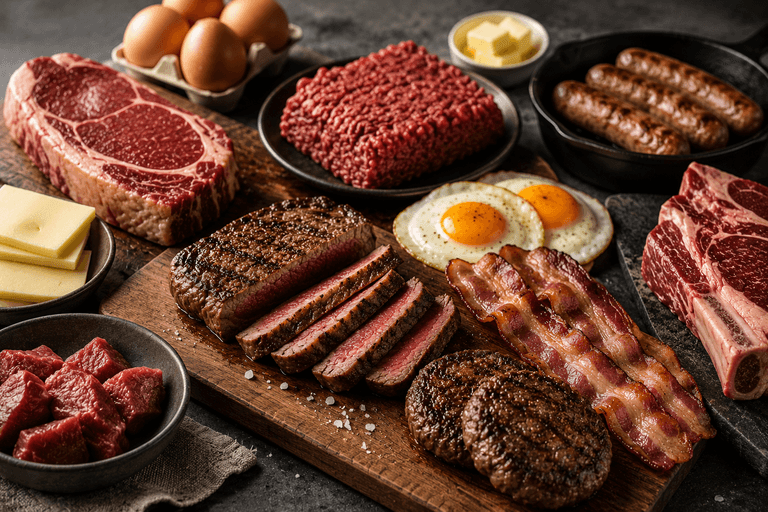
Beef is the most commonly recommended foundation of the carnivore diet. Fattier cuts like ribeye, chuck roast, short ribs, and 80/20 ground beef are preferred because they provide a higher fat-to-protein ratio, which helps meet calorie needs without over-relying on lean protein alone. Consistently eating too much lean protein without enough fat can cause a condition informally called “rabbit starvation,” a state of nausea and fatigue associated with very high protein and very low fat intake. Beyond beef, the following animal foods are widely considered acceptable on a standard carnivore diet: Lamb, bison, and venison are all nutrient-dense red meat options. Pork, including bacon and pork belly, is permitted though some stricter practitioners limit it. Poultry such as chicken and turkey is technically allowed, though many experienced carnivore eaters de-prioritize it in favor of fattier red meats. Seafood, including salmon, sardines, mackerel, shrimp, and oysters, is both allowed and encouraged. Oysters in particular are exceptionally high in zinc. Organ meats hold a special place on most carnivore food lists. Beef liver is one of the most nutrient-dense foods measured by volume, providing high amounts of vitamin A, B12, folate, copper, and iron. Most practitioners recommend starting with small amounts, around 2 ounces a week, and working up gradually because the vitamin A content of liver is high enough that very large daily portions could become excessive over time.
Eggs and Dairy
Eggs are broadly accepted. They provide complete protein, fat-soluble vitamins, and choline, a nutrient many people do not get enough of from other sources. Dairy is where carnivore practitioners diverge. Some follow a strict “meat and water” protocol and exclude all dairy. Others include butter, ghee, hard cheeses, and heavy cream on the basis that they are low in lactose and high in animal fat. Soft cheeses, milk, and yogurt contain more carbohydrates and are more likely to cause digestive issues, so most beginners are advised to start without dairy and add it back selectively.
Beverages
Water is the universal standard. Some practitioners drink black coffee and plain tea; others eliminate them entirely, arguing that plant-derived compounds in coffee and tea are inconsistent with a true zero-plant approach. Bone broth is widely accepted and is particularly useful during the adaptation phase for its sodium, potassium, and collagen content.
What to Eat on the Carnivore Diet: Foods to Avoid
Every plant food is off the table on a standard carnivore diet, including items many people consider healthy, like spinach, blueberries, olive oil, and almonds.
The exclusion list is comprehensive. Vegetables of all kinds are eliminated, including leafy greens, cruciferous vegetables, root vegetables, and alliums. Fruits are excluded. All grains, including rice, oats, and wheat, are out. Legumes, including lentils, chickpeas, and peanuts, are excluded. Nuts and seeds are eliminated. All plant-based oils, including olive oil, coconut oil, and avocado oil, are not part of a strict carnivore protocol. Condiments and sauces almost always contain plant ingredients or added sugars, so most store-bought versions are excluded. Salt is universally permitted and many carnivore practitioners use it liberally, particularly during the early weeks. Some use pepper and other spices, though strict versions exclude these as well. The reasoning behind eliminating plant foods varies by practitioner. Some point to antinutrients, compounds like oxalates, lectins, and phytates that are naturally present in plants and that may interfere with mineral absorption in sensitive individuals. Others cite the elimination of all dietary carbohydrates as the central goal. Neither claim is settled science, and many nutrition researchers argue that antinutrients in typical food amounts are not problematic for most healthy adults.
How to Start the Carnivore Diet: A Practical First Week
The most effective way to start is to simplify: pick two or three go-to meals using beef, eggs, and salmon, cook in bulk at the start of the week, and commit to at least 30 days before evaluating results.
Starting the carnivore diet does not require buying specialty products or following a complicated protocol. The practical barrier is mostly mental. Most people eat carbohydrates at nearly every meal, so removing them entirely requires deliberate planning for the first one to two weeks until new habits form.
Building a Simple Carnivore Meal Plan
A beginner carnivore meal plan works best when it is repetitive. Variety is fine over time, but in week one, decision fatigue is the enemy. A straightforward structure looks like this: two to three meals per day, each built around a large portion of protein and fat. Breakfast might be three eggs cooked in butter with two strips of bacon. Lunch could be a ground beef patty or a can of sardines. Dinner is typically the largest meal, often a ribeye steak or salmon fillet. For batch cooking strategies that keep costs manageable, approaches similar to those covered in our guide on high-protein meal prep on a budget translate well to carnivores, since the core principle is the same: cook large quantities of protein at once to reduce daily friction.
Grocery Shopping for Beginners
Budget matters. Ribeye steaks every day is not realistic for most households. Ground beef, chicken thighs, eggs, canned sardines, and pork shoulder are the most cost-effective carnivore staples in the US market. Buying in bulk from warehouse stores like Costco or Sam’s Club, or sourcing from a local butcher who sells by the quarter or half animal, can reduce the per-pound cost of beef significantly. A basic first-week shopping list covers: 5 to 7 pounds of 80/20 ground beef, a dozen eggs, 2 pounds of bacon, a pack of salmon fillets or several cans of sardines, a block of butter, and salt. That covers the nutritional bases without specialty items.
Carnivore Diet Meal Plan: Sample 30-Day Framework
The table below outlines a simplified 30-day structure organized by phase, reflecting how most practitioners describe their experience progressing through the diet.
| Phase | Days | Primary Focus | Typical Foods | Key Considerations |
|---|---|---|---|---|
| Elimination Entry | Days 1–3 | Remove all plant foods; establish baseline meals | Ground beef, eggs, bacon, butter, water | Increase salt intake; expect hunger spikes as meal timing adjusts |
| Adaptation (Carnivore Flu) | Days 4–10 | Manage transition symptoms; prioritize electrolytes | Fatty beef cuts, bone broth, salmon, eggs | Fatigue and headaches are common; increase sodium and water intake |
| Stabilization | Days 11–21 | Establish hunger signals; reduce meal frequency if natural | Ribeye, pork belly, ground beef, sardines, hard cheese (optional) | Many people naturally shift to two meals per day; this is normal |
| Optimization | Days 22–30 | Introduce organ meats; assess energy and digestion | Beef liver (2–4 oz weekly), bison, oysters, eggs | Evaluate results against baseline; decide whether to continue or modify |
| Evaluation Point | Day 30+ | Review carnivore diet results; adjust or continue | Flexible within animal foods based on preferences | Consider bloodwork to monitor lipids, kidney markers, and iron levels |
What Can You Eat on the Carnivore Diet? A Practical Food List
One of the first questions beginners ask is exactly which foods belong on the plate and which ones cross the line. The carnivore diet for beginners is built on a straightforward rule: if it came from an animal, it generally qualifies. If it grows from the ground, it does not. That simplicity is part of the appeal, but there are still meaningful distinctions between foods that accelerate results and foods that technically pass the test while slowing progress.
Beef is the cornerstone of most carnivore plates, and for good reason. It delivers a complete amino acid profile, abundant creatine and carnosine, and highly bioavailable iron and zinc. Fatty cuts like ribeye, chuck roast, and 80/20 ground beef are preferable to lean cuts for beginners because fat replaces carbohydrates as the primary fuel source. Eating a six-ounce sirloin with almost no fat while carbohydrates are also absent is a reliable path to low energy and early dropout. Lamb, pork belly, and duck thighs offer similar fat density and are excellent for variety without leaving the spirit of the diet.
Organ meats occupy a separate tier. Beef liver is often called the most nutrient-dense food on earth, and that reputation is grounded in its concentrations of vitamin A, B12, folate, copper, and CoQ10. Two to four ounces once or twice per week covers micronutrient bases that muscle meat alone cannot. Heart is rich in CoQ10 and tastes far closer to steak than most beginners expect. Kidneys provide selenium, and bone marrow delivers fat-soluble vitamins alongside a buttery texture that makes it one of the more enjoyable organ introductions. Most practitioners recommend holding off on organ meats for the first two to three weeks while the digestive system adjusts to the new eating pattern, then introducing them gradually.
Eggs, butter, and hard aged cheeses occupy a gray zone that most carnivore approaches accept, particularly for beginners. Eggs offer choline, which is critical for liver function and cognition, and the fat-to-protein ratio makes them useful for hitting calorie targets. Butter and ghee provide butyrate, a short-chain fatty acid that supports the gut lining. Strict carnivore purists exclude all dairy on the grounds that it contains lactose and can trigger inflammation in sensitive individuals, but the more common beginner approach is to include full-fat dairy and eliminate it only if digestion or skin symptoms point to a problem.
Fish and shellfish round out the protein rotation with meaningful additions. Salmon and sardines contribute omega-3 fatty acids that balance the omega-6 load from grain-fed beef. Oysters are one of the few foods that rival liver for zinc and also supply a useful dose of vitamin D. Shrimp and scallops are lower in fat but work well when cooked in butter. Water, sparkling water, and black coffee are the only beverages most practitioners include. Salt is not only allowed but actively encouraged, especially during the adaptation period when sodium excretion accelerates.
Carnivore Diet Benefits Backed by Evidence and Where the Research Still Has Gaps
The claims made about the carnivore diet range from reasonable to extravagant, and beginners deserve an honest accounting of both. The honest version is that the diet has a small but growing body of peer-reviewed support for some outcomes, a much larger body of anecdotal and survey-based evidence, and genuine scientific uncertainty in areas that matter.
Weight loss is the most consistently reported benefit, and the mechanism is straightforward. Eliminating carbohydrates removes the primary driver of insulin secretion, which shifts the body from fat storage to fat oxidation. Protein is highly satiating, meaning most people naturally eat fewer total calories without tracking or restricting. A 2021 survey study of roughly 2,000 carnivore diet followers published by researchers affiliated with Harvard found that the majority reported weight loss, improved energy, and better mental clarity, with high rates of satisfaction and low rates of adverse events. That study cannot establish causation, but the consistency of the self-reported outcomes is notable.
Inflammation reduction is a commonly reported benefit and a biologically plausible one. Eliminating seed oils and processed carbohydrates removes two of the more reliably pro-inflammatory inputs in the modern diet. People with autoimmune conditions, particularly inflammatory bowel diseases, psoriasis, and rheumatoid arthritis, report symptom improvement at rates that have drawn interest from clinicians, though randomized controlled trials in these populations are largely absent. The working hypothesis is that certain plant compounds lectins, oxalates, phytates trigger immune responses in predisposed individuals, and their removal quiets that response. This hypothesis is plausible but not settled.
Mental clarity and mood stability are among the most frequently cited benefits in carnivore communities. The likely explanation connects to ketosis, stable blood glucose, and the removal of dietary inputs that cause reactive hypoglycemia. Ketones are a highly efficient fuel for the brain, and many people report sharper focus and reduced anxiety within two to four weeks of strict adherence. Whether this effect persists long-term or represents an adaptation-phase phenomenon is not yet established by long-term studies.
The honest gaps are significant. Long-term cardiovascular data on carnivore diets specifically does not exist. The impact on LDL cholesterol is heterogeneous; some followers see it fall, others see significant increases, and a subset experience the so-called hyperresponder pattern in which LDL rises dramatically alongside HDL. Whether elevated LDL in the context of low triglycerides and high HDL carries the same cardiovascular risk as elevated LDL in a conventional metabolic context is an active area of research without a firm answer. Gut microbiome diversity typically decreases on carnivore diets by conventional measures, though whether reduced diversity is problematic when the dietary inputs driving it are fundamentally different remains debated. Kidney function concerns in people with pre-existing impairment are legitimate and worth monitoring with periodic bloodwork. Beginners who are pregnant, managing kidney disease, or dealing with liver conditions should discuss the approach with a physician before starting.
What to Expect in Your First 2–4 Weeks on Carnivore (And How to Get Through It)
The single biggest reason beginners abandon the carnivore diet is not that it stopped working. It is that the adaptation phase felt like failure when it was actually progress. Understanding what is happening inside your body during each of the first four weeks transforms confusing, uncomfortable symptoms into legible signals, and legible signals are manageable. Here is the week-by-week reality.
Week One: The Metabolic Handoff
The first week is the hardest, and it helps to know that going in. When carbohydrate intake drops to near zero, glycogen stores in the liver and muscles deplete within 24 to 72 hours. The body has been running primarily on glucose, and it does not immediately shift into efficient fat and ketone burning. That gap between glucose running out and the fat-burning machinery spinning up is where most of the early symptoms live.
Fatigue during week one is not a sign that your body needs carbohydrates. It is a sign that the metabolic transition is underway. The same applies to headaches, mild brain fog, irritability, and muscle cramps. The physiological driver behind the headaches and cramping is almost always electrolyte loss rather than some fundamental problem with the diet. When insulin drops sharply, the kidneys shift into a mode where they excrete sodium more aggressively. Sodium loss drags magnesium and potassium out with it. This is why the carnivore community refers to this cluster of symptoms collectively as the “keto flu,” even though it occurs on carnivores just as it does on any very low-carbohydrate approach.
The daily decisions that determine whether you get through week one come down to three things: salt aggressively, eat enough fat, and sleep more than you think you need to. Salting every meal generously and drinking salted water or a sodium-forward electrolyte supplement without added sugar handles a majority of the headache and cramping complaints. Eating enough fat is the other critical variable your brain needs fuel, and if fat intake is too low while carbohydrates are also absent, the caloric deficit compounds the fatigue. Aim for meals that feel rich and satisfying, not lean and restrained. Sleep is metabolically active in ways beginners underestimate. The transition stresses the body’s systems in a measurable way, and recovery time accelerates the process. If you can sleep an extra hour during week one, do it.
Warning signs in week one that go beyond normal adaptation include heart palpitations that persist beyond adding electrolytes, severe gastrointestinal distress lasting more than two days, or dizziness that does not resolve with increased sodium and fluid intake. These warrant a conversation with a physician rather than a doubling down on electrolytes.
Week Two: Adaptation Gains Traction
Most beginners who reach day eight notice that something has shifted. The fatigue lightens noticeably for the majority of people somewhere between days seven and ten, and the brain fog that characterized the first week begins to lift. This is the upregulation of fat-oxidation enzymes, a real, measurable biochemical process. The liver has begun ramping up ketone production, and muscle cells are increasing their mitochondrial capacity to use fatty acids directly. The body is learning a skill it has not practiced since early childhood in most cases.
Digestion is the variable that most commonly disrupts week two. Some beginners experience constipation as stool volume decreases dramatically, a natural consequence of eliminating fiber and carbohydrates, which add bulk. Lower stool volume is not the same as constipation in the clinical sense, and many people simply need to recalibrate their expectations. Others experience loose stools or diarrhea, particularly if fat intake is high and the gallbladder has not yet adjusted to producing adequate bile for the increased fat load. Adding digestive enzymes that include lipase, or temporarily reducing fat intake and rebuilding it gradually, resolves most cases. Ox bile supplements are used by some practitioners specifically to support fat digestion during this window.
Meal frequency is a real decision point in week two. Three meals a day is a reasonable default for beginners, but many people find that hunger signals become less predictable during adaptation, sometimes ravenous, sometimes absent. Following actual hunger rather than the clock tends to produce better outcomes than forcing meals at rigid intervals. The goal is adequate caloric intake, not adherence to a schedule. Skipping meals because appetite has temporarily diminished is fine. Forcing meals when full is also unnecessary.
Week Three: The Turning Point Most Beginners Don’t Reach
Week three is where the anecdotal and survey evidence suggests people begin reporting the benefits that drew them to the diet in the first place. Energy stabilizes rather than cycling through peaks and valleys. Mental clarity becomes more consistent. Sleep quality frequently improves, which researchers studying ketogenic states attribute in part to increased adenosine sensitivity and changes in glutamate-GABA balance in the brain. Physical performance in the gym or during cardio remains reduced for many people through week three, which is normal. Full athletic adaptation to fat oxidation takes longer than cognitive and energy adaptation, often six to twelve weeks.
Cravings for sugar and carbohydrates, which can be intense during week one, typically diminish substantially by week three. The mechanism is partly metabolic ketones suppress the appetite hormone ghrelin and partly a rewiring of reward pathways that previously associated carbohydrate consumption with dopamine release. Many beginners are surprised to find that the foods they expected to miss no longer hold much pull. Others still experience psychological cravings around social situations and habitual eating contexts even when the physiological drive has faded. Recognizing the difference between a biochemical signal and a conditioned habit makes the psychological cravings easier to manage.
This is also the week to pay attention to hydration in a more nuanced way. By week three, many beginners have solved the acute electrolyte problem but have undershot their total fluid intake in ways that show up as persistent mild headaches or afternoon fatigue. A practical check is urine color pale yellow indicates adequate hydration, dark yellow or amber suggests more fluid is needed.
Week Four: Calibration and Honest Assessment
By week four, the adaptation phase is largely complete for most people, though individual variation is real. Some people report not feeling fully adapted until six to eight weeks, particularly if they were heavy carbohydrate consumers beforehand or if they have been inconsistent during the transition. Week four is the appropriate moment to make an honest assessment of where you are relative to your baseline.
This is when the decisions from the 30-day table in Part 1 become concrete. Energy during workouts, sleep quality, digestion regularity, cognitive function, and body composition changes are all assessable by day 28 to 30. Bloodwork at this point, specifically a lipid panel, a basic metabolic panel to check kidney markers, and a complete blood count provides objective data to pair with subjective experience. According to Mayo Clinic, interpreting cholesterol in the context of a very low-carbohydrate diet benefits from looking at the full picture triglycerides, HDL, and LDL together rather than LDL in isolation, because the ratio and particle context matter in ways a single number does not capture.
The mental model that gets beginners to week four is simple but worth stating plainly: the symptoms of week one are not evidence that the diet is wrong for you. They are evidence that a significant metabolic transition is happening on schedule. The question to ask is not “why do I feel bad right now” but “am I making the daily decisions electrolytes, fat intake, sleep, fluid that determine whether this transition succeeds?” Most people who quit in week one do so because they interpret adaptation symptoms as failure rather than process. Most people who reach week four are glad they did.
Conclusion
The carnivore diet for beginners is not a particularly complicated protocol once the foundational logic is clear: eliminate plant foods, eat animal foods to satiety, manage the adaptation phase deliberately, and give the approach a genuine 30-day evaluation before drawing conclusions. The first two to four weeks will test your patience in ways that have nothing to do with willpower and everything to do with biology. The electrolyte shifts, the metabolic recalibration, and the recalibration of hunger signals are predictable and manageable when you understand what is driving them. Beyond that window, the diet becomes considerably more straightforward, and the outcomes most beginners are chasing stable energy, better body composition, reduced inflammation, and improved mental clarity tend to emerge in that order, on roughly that timeline. Whether the carnivore approach becomes a long-term lifestyle or a diagnostic reset that clarifies your relationship with specific foods, the 30-day framework gives you real information to work with rather than guesswork, and anyone with existing kidney, liver, or cardiovascular conditions should speak with a registered dietitian before beginning to ensure the approach is appropriate for their specific health picture.
Frequently Asked Questions
How much should I eat on the carnivore diet as a beginner?
Eat to satiety rather than tracking calories, especially during the first 30 days. Most beginners consume between 1.5 and 2.5 pounds of meat per day, but individual variation is wide based on body size, activity level, and how much fat versus lean protein makes up the meals. The more important variable than quantity is fat intake, undereating fat while carbohydrates are absent leads to low energy and early abandonment of the diet. Fatty cuts of beef, butter, and eggs help beginners hit adequate caloric density without needing to weigh and measure every meal.
Is the carnivore diet safe for beginners with no previous low-carb experience?
Most healthy adults can begin the carnivore diet without prior low-carb experience, but the adaptation phase will typically be more pronounced than it is for someone who has done keto before. The metabolic transition from glucose to fat and ketone burning takes the same time regardless of prior experience, but someone whose diet was previously high in refined carbohydrates may experience stronger electrolyte losses and more pronounced fatigue during week one. Starting with generous salt intake, adequate fat, and the expectation of a two-week adjustment period prepares most beginners for a manageable transition. People with diabetes who use insulin or blood-sugar-lowering medications should not start without medical supervision, as carbohydrate elimination changes insulin requirements rapidly.
Will I get enough nutrients on the carnivore diet without vegetables or supplements?
Muscle meat and organ meats together cover most essential micronutrients more completely than most people expect. Beef liver alone provides vitamin A, B12, riboflavin, folate, copper, and iron at levels that exceed the daily requirements in a small serving. Fatty fish and oysters contribute vitamin D, omega-3s, and zinc. The nutrients most commonly cited as concerns vitamin C and fiber have nuanced answers. Vitamin C requirements appear to be lower in the absence of glucose because the two compounds compete for cellular uptake, and fresh meat contains small amounts of vitamin C that may be sufficient when carbohydrate intake is near zero. Fiber is not an essential nutrient and its absence is not a deficiency in the clinical sense, though the microbiome implications of its removal are still being studied. Introducing a variety of organ meats by week three reduces the likelihood of any meaningful micronutrient gap.
Can I drink coffee on the carnivore diet?
Black coffee is accepted by most carnivore practitioners and does not appear to disrupt the metabolic state the diet is intended to produce. It contains no carbohydrates or plant proteins in meaningful amounts, and its caffeine and antioxidant content is generally considered benign within the context of the diet. Strict carnivore purists exclude it on the grounds that it is a plant product, and some sensitive individuals find that coffee aggravates cortisol response or disrupts sleep in ways that interfere with adaptation. The practical approach for beginners is to keep coffee black, observe whether it affects sleep or digestive comfort, and eliminate it only if a clear pattern emerges. Adding cream or butter to coffee is a common modification that adds fat calories and keeps the drink within carnivore parameters for most practitioners.