Key Takeaways
- Capital One Shopping is free to download and use, and requires no Capital One financial account of any kind.
- The extension’s rewards credits can be redeemed for gift cards, but their cash-equivalent value is typically modest – often worth a fraction of a cent per credit.
- Capital One Shopping automatically applies coupon codes at checkout and displays price comparison data from competing retailers, including historical price tracking on Amazon.
- A 2025 class action lawsuit (Case No. 1:25-cv-00023-AJT-WBP, E.D. Va.) settled for approximately $4 million after creators alleged the extension diverted affiliate commissions by overwriting tracking cookies at checkout.
- Capital One Shopping and Honey operate nearly identical business models, both earning revenue through affiliate partnerships with the retailers whose coupons they surface.
What Is Capital One Shopping?
Capital One Shopping is a free shopping tool, available as a browser extension and mobile app, that helps online shoppers find coupon codes, track prices, and earn rewards without needing any Capital One financial product.
Capital One Shopping launched in 2019 after Capital One acquired Wikibuy, a coupon and price-comparison startup that had been operating since 2016. The rebrand brought the tool under the Capital One umbrella, giving it the credibility of a major financial institution’s name while keeping the core product entirely free for consumers.
Despite the Capital One branding, this is not a credit card feature, a bank perk, or a loyalty program tied to any account. Any shopper with a compatible browser can install it. The extension is available for Chrome, Firefox, Edge, and Safari, and a standalone mobile app is available for iOS and Android for browsing deals outside of a desktop session.
Capital One Shopping sits within the broader category of Finance tools designed to reduce everyday spending without requiring significant behavioral change. Much like apps that help you find the cheapest gas near you, it operates in the background, surfacing savings at the moment you are already prepared to spend.
The tool earns revenue not from users but from retail partners. When a shopper clicks through and completes a purchase, Capital One Shopping earns an affiliate commission from the retailer. A portion of that commission is passed back to the user as Credits, the extension’s proprietary rewards currency. This affiliate model is the foundation of how the product sustains itself, and it carries implications worth understanding before installing.
How Does Capital One Shopping Work?
Once installed, the extension monitors your checkout process in real time, automatically testing available coupon codes and alerting you when a better price exists at a competing retailer, all without requiring any manual input.
The Coupon Code Feature
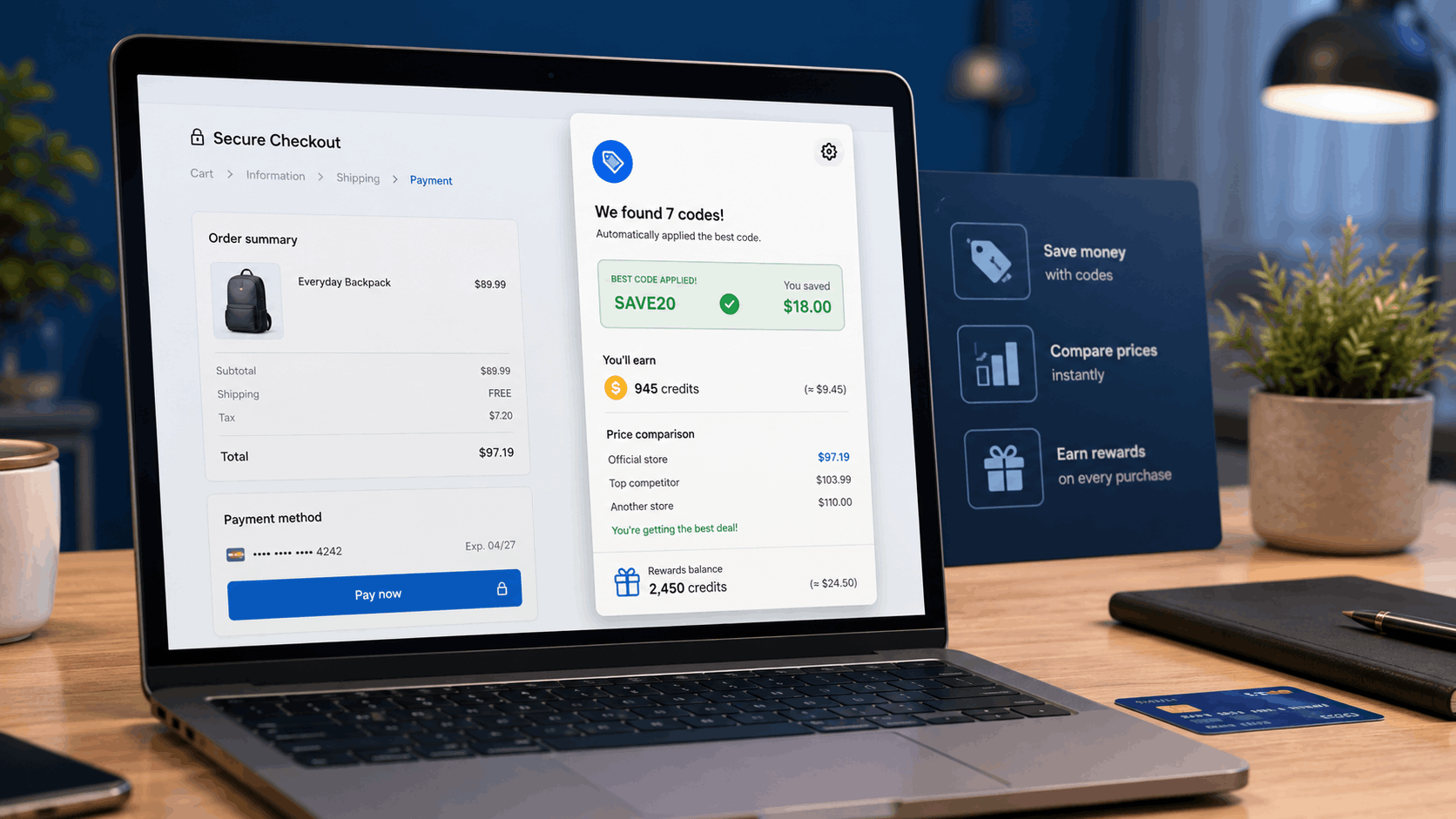
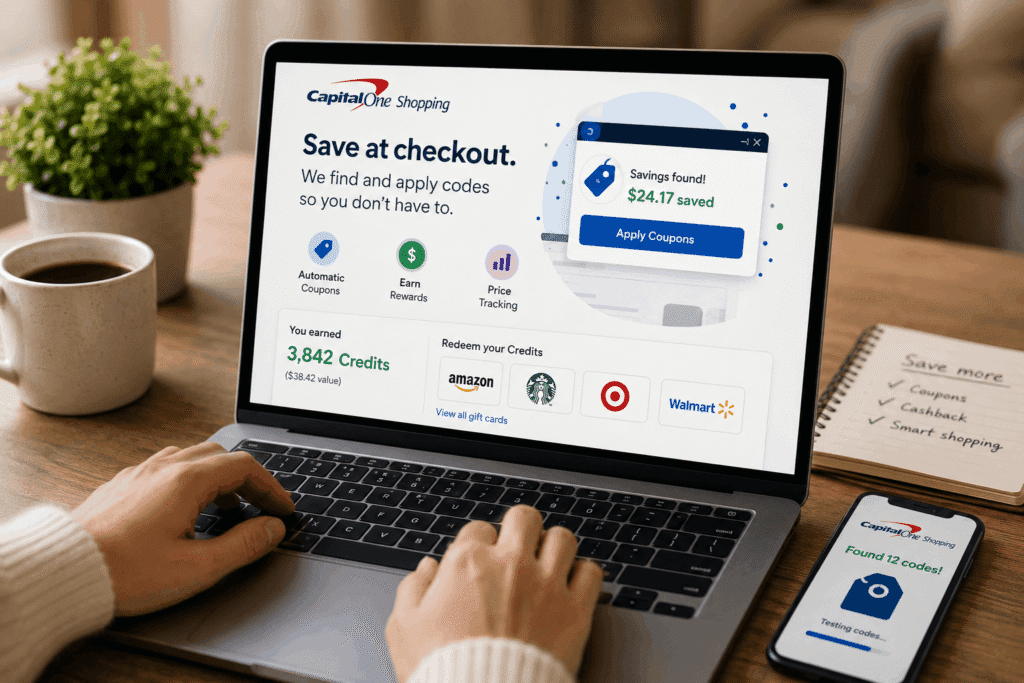
The most immediately useful feature is automatic coupon testing. When you reach a checkout page at a supported retailer, Capital One Shopping scans its database of available promo codes and applies them one by one in the background until it finds the best discount. If a valid code is found, it applies automatically. If none work, it tells you so, which at minimum saves you the time of manually searching for codes that may not exist.
This process is similar to what competing tools like Honey (now owned by PayPal) offer, and the practical result for consumers is largely the same: a small but real chance of a discount appearing at checkout with zero effort required.
Price Comparison and Price History
Beyond coupons, Capital One Shopping displays a price comparison panel when you view a product page on major retail sites. This panel shows whether the same or a comparable item is available for less at another retailer. On Amazon specifically, the extension also surfaces historical price data, allowing you to see whether the current price is genuinely a deal or whether it follows a pattern of artificial inflation before a sale event.
This price history feature has practical value for deal-seeking shoppers who want to avoid buying at an inflated price during a promotional period. Amazon’s pricing algorithm adjusts prices frequently, and a product marked “30% off” may simply be returning to its standard price after a temporary markup.
Capital One Shopping Rewards Credits
When you shop through Capital One Shopping’s affiliated retailers, you accumulate Credits. These Credits are earned at varying rates depending on the retailer and the specific promotion active at the time of purchase. Credits can be redeemed for gift cards from a selection of popular brands.
The value of Credits is where consumers should temper their expectations. Credits are not a 1:1 cash-back equivalent. The conversion rate means that a meaningful gift card redemption typically requires a substantial volume of purchases over time. Capital One does not publish a standardized per-credit dollar value, and independent reviewers have calculated the effective return to be quite low compared to dedicated cash-back credit cards, which routinely offer 1.5% to 5% back on purchases.
Credits should be viewed as a minor bonus on purchases you were already going to make, not as a primary savings strategy. Shoppers looking to maximize return on spending may find that a rewards credit card, used responsibly, delivers more consistent value per dollar spent.
Is Capital One Shopping Legit and Safe?
Capital One Shopping is a legitimate product operated by Capital One Financial Corporation, one of the largest banks in the United States (NYSE: COF), with full regulatory oversight. It is available through the Chrome Web Store, the Firefox Add-ons library, and the Safari Extensions Gallery, and has been downloaded by tens of millions of users.
Is It a Scam?
Capital One Shopping is not a scam. The coupon codes it applies are real, the price comparisons are real, and the Credits it awards can be genuinely redeemed. There is no fee to download, no subscription required, and no hidden charges in the terms. The confusion around legitimacy often stems from the fact that the tool requires no Capital One account, which leads some users to assume a fraudulent or loose affiliation with the brand. The product is legitimate in both name and operation.
What Data Does the Extension Collect?
Because Capital One Shopping operates as a browser extension with access to your shopping sessions, it does collect data. The extension requests fairly broad permissions on installation — on Chrome, for example, it asks for access to data on all websites you visit, which is what allows it to detect when you are on a product page or at checkout.
According to Capital One’s privacy documentation, the extension may collect browsing data related to shopping activity, including merchants you visit, items you view, and purchases you complete. This data is used to improve coupon matching, personalize offers, and inform Capital One’s broader business analytics.
The extension does not have access to your bank account, payment card numbers, or login credentials for financial institutions. For consumers who are already Capital One cardholders, the privacy calculus is somewhat simpler since Capital One already holds substantial financial data about them. For non-cardholders, the extension represents a meaningful data-sharing relationship with a major financial institution in exchange for coupon codes and rewards. Whether that tradeoff is worthwhile is a personal decision, but it is worth understanding clearly before installing. The data collection is not meaningfully different from what competing tools like Honey collect, and it is disclosed in Capital One’s privacy policy.
Capital One Shopping vs. Honey and Other Alternatives
Capital One Shopping and Honey share nearly identical core mechanics, but differ in ownership, rewards structure, and recent legal history in ways that may influence which tool a consumer chooses to install.
Honey was acquired by PayPal in 2020 for $4 billion and remains the most widely recognized competing tool. Both extensions automatically test coupon codes at checkout, both offer a rewards program, and both earn revenue through affiliate commissions paid by retail partners. For the average shopper, the day-to-day experience with either tool is comparable.
The differences lie in the specifics. Honey’s rewards program (called Honey Gold) converts to PayPal cash or gift cards, which some users find more flexible than Capital One Shopping’s gift card redemptions. Capital One Shopping’s price history feature for Amazon is generally considered more robust than what Honey surfaces. Rakuten, another major alternative, focuses on cash-back percentages rather than coupons, paying users a stated percentage back on purchases at partner retailers, which makes its value proposition easier to calculate and compare.
Savvy shoppers who treat their spending like a budget exercise will recognize that none of these tools is a substitute for a deliberate spending plan. They are friction-reduction tools that make saving slightly easier, not comprehensive budgeting systems.
Capital One Shopping vs. Key Alternatives
| Feature | Capital One Shopping | Honey (PayPal) | Rakuten |
|---|---|---|---|
| Automatic coupon testing | Yes | Yes | No (manual activation) |
| Price comparison | Yes, multi-retailer | Limited | No |
| Amazon price history | Yes | Yes (via Droplist) | No |
| Rewards program | Credits (gift cards) | Honey Gold (PayPal/gift cards) | Cash back (PayPal or check) |
| Rewards clarity | Low (opaque credit value) | Low (opaque Gold value) | High (stated % back) |
| Capital One account required | No | No | No |
| Subject to affiliate cookie lawsuit | Yes (2025 settlement) | Yes (2024 allegations) | Not publicly litigated |
| Cost to consumer | Free | Free | Free |
How to Get the Most Out of Capital One Shopping
Using Capital One Shopping effectively means understanding which of its features deliver the most reliable value and which are better treated as a bonus rather than a primary savings strategy.
The coupon-application feature at checkout is the most consistently useful function. When you reach a checkout page that has a promo code field, the extension will attempt available codes automatically and apply the best one it finds. This requires no action on your part beyond having the extension installed and active. Retailers including Amazon, Walmart, Target, Best Buy, and hundreds of smaller merchants are supported. The success rate varies widely by retailer, but for purchases above roughly fifty dollars, it is worth letting the tool run through its attempts.
Price comparison alerts are valuable for considered purchases rather than impulse buys. When you are viewing a product on one retailer’s site, the extension will surface lower prices at competing retailers. This works best for electronics, appliances, home goods, and branded apparel where the same SKU is sold in multiple places. For highly variable categories like groceries or fast fashion, where sizing and quality differ by retailer, the comparisons are less meaningful.
The rewards system requires the most patience. Credits accumulate slowly through Capital One Shopping’s network of participating merchants, and the redemption process involves converting credits to gift cards at a rate that Capital One determines. If you are shopping primarily at major retailers where you already have loyalty accounts earning points, the marginal value of Capital One Shopping rewards may be modest. Where it tends to shine is at mid-tier online retailers you might not otherwise have a rewards relationship with.
A practical workflow for high-value purchases: check the Capital One Shopping price comparison panel before committing to a retailer, proceed to checkout at the best-priced option, let the extension attempt coupon codes, and treat any rewards credits earned as a secondary benefit rather than a reason to choose a particular merchant. This approach extracts the tool’s genuine utility without over-indexing on the rewards side of the equation.
How Capital One Shopping’s Cookie Attribution Model Works – And What the Lawsuit Revealed
To understand why Capital One Shopping has attracted legal controversy, it helps to know how affiliate marketing works at a structural level. When a blogger, YouTuber, or publisher links to a product using an affiliate link, that link plants a tracking cookie in the reader’s browser. If the reader eventually purchases that product, the retailer’s system reads the cookie and pays the affiliate a commission, typically ranging from one to ten percent of the sale price. The entire model depends on that cookie remaining intact through checkout.
Capital One Shopping’s browser extension operates using a mechanism called last-click attribution. At the moment a user initiates checkout, the extension can insert or overwrite affiliate tracking cookies with its own affiliate identifiers. Because most retailer commission systems pay the affiliate whose cookie was read last at checkout, Capital One Shopping’s identifier receives the commission instead of the original affiliate who drove the purchase. The user experience is unchanged, the retailer pays the same commission rate, but the payment is redirected from the original publisher to Capital One.
This practice is not unique to Capital One Shopping. Honey, the PayPal-owned extension, faced nearly identical allegations and was the subject of prominent public criticism in late 2024, including a widely circulated video by creator MegaLag that documented the cookie-stuffing mechanism in detail. The backlash was substantial enough that PayPal faced significant advertiser and creator scrutiny in early 2025.
Capital One Shopping faced more formal legal exposure. In 2025, Capital One reached a settlement related to litigation over its affiliate attribution practices. The case centered on claims that the extension allegedly systematically redirected commissions that would otherwise have gone to content creators, deal sites, and publishers who had driven consumer intent toward specific products. The settlement terms were not fully disclosed publicly, but the litigation confirmed that the structural concern critics had raised about last-click overriding was not merely theoretical.
For everyday consumers, this mechanism does not change how much you pay or whether your coupon codes work. For anyone who runs a website, newsletter, or social channel that relies on affiliate income, it is a material consideration. If your readers have Capital One Shopping or Honey installed, purchases originating from your affiliate links may not credit to you at checkout. Several affiliate program managers have documented this as a meaningful source of commission leakage, and some creator communities now explicitly flag both extensions in their disclosure language.
Capital One’s position is that the extension provides genuine value to consumers and that its affiliate participation is a standard commercial arrangement with retailers. Critics argue the distinction matters ethically because the consumer intent was generated by the original affiliate, not by the extension, and that overwriting the cookie appropriates value created by someone else’s work. Both framings are present in the ongoing industry debate.
The FTC’s guidance on endorsements and affiliate disclosure frameworks has long emphasized that accurate attribution is foundational to how affiliate incentive structures function. When browser tools systematically redirect last-click credit, they alter the economics of content creation in ways that are largely invisible to the consumer making the purchase.
Legal commentators within the ABA’s Section of Business Law have noted that inserting affiliate tracking parameters at checkout to capture commissions raises questions about whether such conduct could constitute unfair competition or tortious interference with existing contractual relationships between publishers and merchants — though no definitive regulatory ruling on last-click overriding as a category has been issued to date.
The Bottom Line on Capital One Shopping
Capital One Shopping delivers real, measurable value in its core coupon-matching and price-comparison functions. For most casual online shoppers, those features alone justify the minimal friction of installation. The rewards program is a legitimate if slow-building benefit, and the absence of a Capital One account requirement makes it broadly accessible.
The privacy tradeoffs are real but comparable to other data-for-savings arrangements that consumers routinely accept. The extension poses no direct financial risk to users — it does not access bank accounts, payment credentials, or financial login information.
Where the picture becomes more complicated is in its affiliate attribution model, which the 2025 litigation confirmed can redirect commissions away from the publishers and creators who generated shopping intent in the first place. Consumers can use the extension with clear eyes as long as they understand that its business model operates partly at the expense of the affiliate ecosystem.
Who should install it: Casual shoppers who want automatic coupon testing and price comparison with no ongoing effort. The tool earns its place on those two features alone.
Who should think twice: Content creators, bloggers, and publishers whose audiences may have the extension installed — purchases from your affiliate links may not credit to you at checkout.
This article is for informational purposes only and does not constitute financial advice. Consult a qualified financial advisor before making decisions based on any rewards or cashback tool. Individual results may vary. Past performance of any rewards program does not guarantee future returns.
Frequently Asked Questions
Does Capital One Shopping require a Capital One credit card or bank account?
No. Capital One Shopping is free to use for anyone regardless of whether they hold a Capital One financial product. The browser extension is available for:
– Google Chrome
– Mozilla Firefox
– Microsoft Edge
– Apple Safari
A standalone mobile app is available for iOS and Android. You can install the extension, apply coupon codes, and earn rewards credits without any Capital One account. If you do have a Capital One card, certain integrations may offer additional features, but they are not required to access the core functionality.
How does Capital One Shopping make money if it is free?
Capital One Shopping earns affiliate commissions from retailers when purchases are completed through its tracked links. When the extension applies a coupon code or a user clicks through to a merchant via the Capital One Shopping interface, Capital One’s affiliate identifier is placed in the session. If a sale is completed, the retailer pays Capital One a commission. This is the same model used by Honey, Rakuten, and most other shopping reward tools.
Is Capital One Shopping the same as the Capital One credit card rewards program?
No, they are separate programs. Capital One Shopping has its own rewards currency called Credits, which can be redeemed for gift cards through the Capital One Shopping platform. Capital One credit card rewards — such as miles or cash back on Venture or Quicksilver cards — are entirely different and are earned through card spending rather than through the browser extension. The two programs do not automatically combine or transfer between each other.
Should I use Capital One Shopping and Honey at the same time?
Running both extensions simultaneously is technically possible but not recommended. Because both tools attempt to apply coupons and insert affiliate cookies at checkout, they can conflict with each other and may produce inconsistent results. It is generally more effective to choose one, use it consistently, and understand its rewards structure clearly rather than splitting activity across multiple overlapping tools where reward credit tracking becomes unreliable.