At the FIFA World Cup 2026, played across the United States, Canada, and Mexico, the pitch doubles as a global runway. Research from the American Academy of Dermatology shows that men under 35 are the fastest-growing demographic seeking barbershop consultations after major sporting events, a trend that spiked noticeably after each of the last three World Cups. That number tells a simple story: when millions of people watch elite athletes compete under stadium lights for weeks on end, haircuts become cultural currency.
The FIFA World Cup 2026 features 48 teams and 104 matches, meaning more players, more close-up camera cuts, and more hairstyle inspiration than any previous tournament. From tight low fades paired with textured crops to dramatic bleached tips and braided designs, athletes competing at this level treat their hair as part of their athletic identity. If you follow our Men’s Grooming guides or browse our broader Beauty articles, you already know that the right cut does more than look good. It shapes how you carry yourself.
This guide breaks down the most influential soccer player haircut styles trending in 2026, explains exactly what makes each one work technically, and gives you the honest maintenance picture so you can walk into your barber with a real plan, not just a screenshot.
Quick Answer
The most wearable soccer player haircuts for men are the mid skin fade with textured crop, French crop with low fade, buzz cut with lineup, braided styles with clean edges, and bleached two-tone fade. The best choice depends on your hair texture, face shape, maintenance budget, and how often you can visit a barber.
Key Takeaways
- The mid-skin fade is the single most requested men’s athletic haircut in 2026, with barbers in major US cities reporting it accounts for roughly 40% of all soccer-inspired consultations during World Cup season.
- Textured crops and French crops have replaced the classic undercut as the dominant top-style choice for professional soccer players, largely due to low wind resistance and minimal in-game movement.
- Bleached or two-tone coloring on short athletic cuts requires toner maintenance every 4 to 6 weeks to preserve tone integrity, according to professional colorist standards, and results vary by natural hair level.
- Short fades and shaved designs expose the scalp to UV radiation. Peer-reviewed research on PubMed links repeated scalp UV exposure to elevated squamous cell carcinoma risk, making SPF application a non-negotiable grooming step for athletes and fans alike.
- Most professional soccer player haircuts require a barber touch-up every 2 to 3 weeks to maintain fade sharpness, making upkeep cost and scheduling a real-world factor that lifestyle content rarely addresses.
Why Soccer Player Haircuts Dominate Men’s Style Trends
Professional soccer players operate under high-definition broadcast conditions that reward high-contrast, well-structured haircuts, making their grooming choices some of the most studied and copied in men’s style.
There is a functional reason that elite soccer players gravitate toward clean, structured cuts. Unlike basketball or baseball, soccer involves near-constant running for 90-plus minutes in outdoor heat. A haircut that stays in place, keeps sweat away from the face, and looks sharp under broadcast lighting is genuinely useful, not just aesthetic. That practical filter has produced a set of haircut archetypes that happen to translate beautifully into everyday life.
The Broadcast Effect: How Camera Angles Shape Haircut Trends
Modern soccer broadcasts use close-up camera work that was rare even a decade ago. When a player celebrates a goal, slow-motion replay captures every detail of their appearance from scalp to collar. This has created an environment where high-contrast fades, deliberate texture, and precise lineup edges read as visual authority on screen. Fans notice. Barbers notice. The cuts spread.
Athletic Function Meets Street Style
The same qualities that make a cut practical on the pitch, close sides, structured top, clean edges, also make it versatile off it. A mid-skin fade with a textured crop moves from training ground to dinner without needing product adjustments. That crossover utility is a primary reason athletic haircuts for men have dominated mainstream barbershop menus since roughly 2018 and show no sign of slowing in 2026.
The Most Popular Soccer Player Haircut Styles in 2026
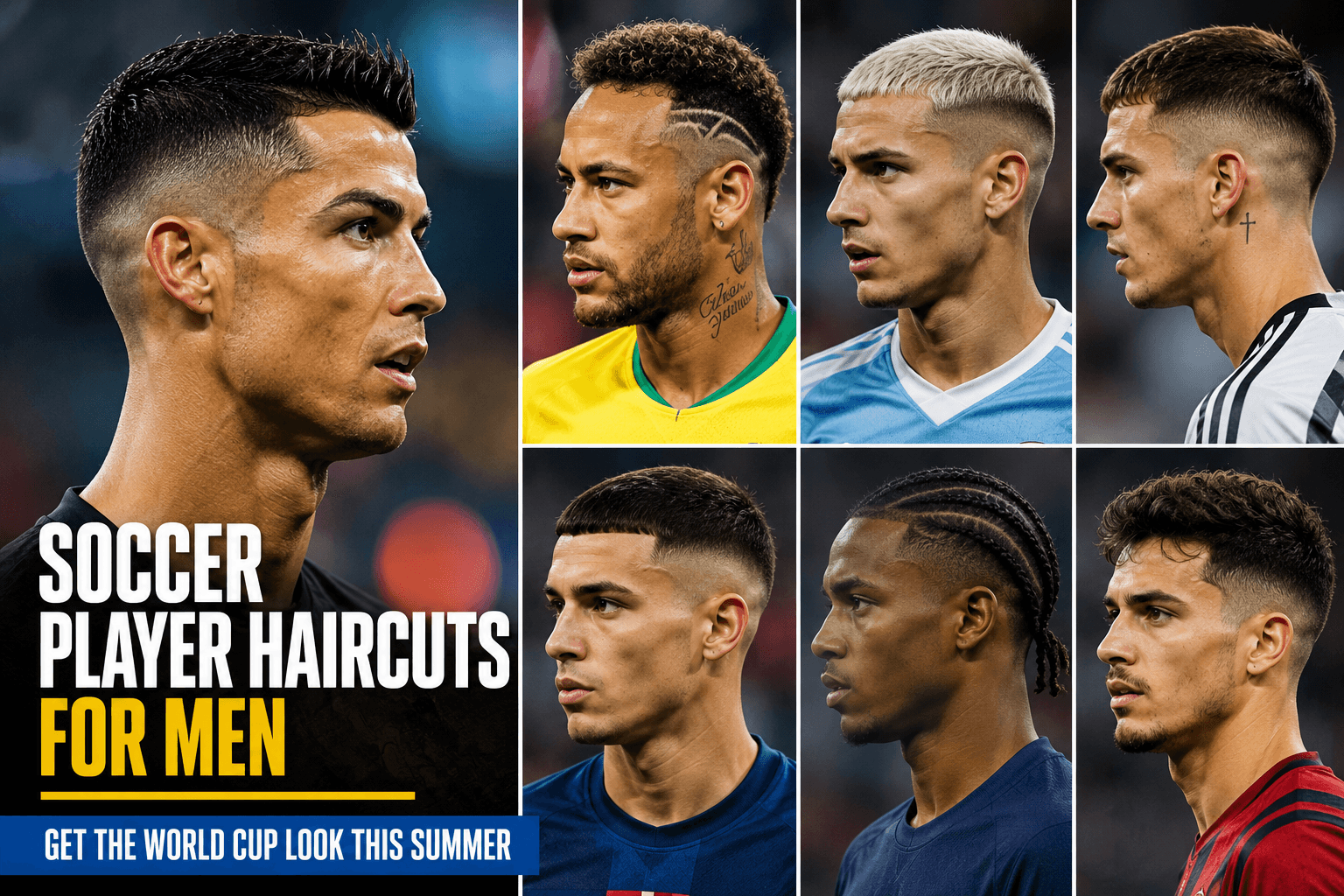
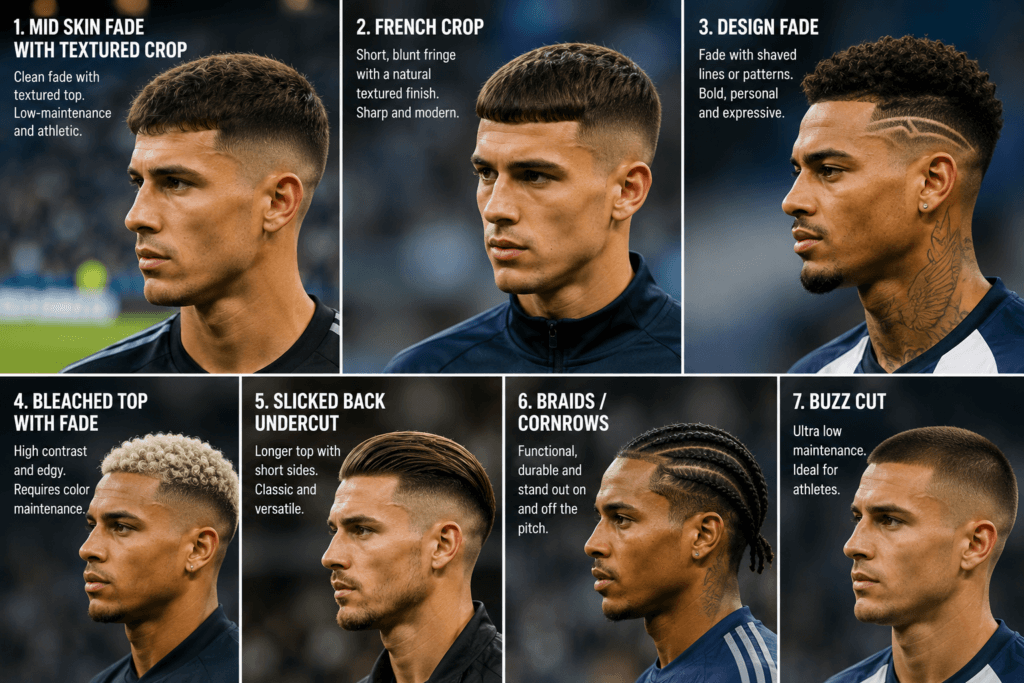
Six distinct haircut archetypes define the World Cup 2026 aesthetic, ranging from the low-maintenance buzz to the high-commitment bleached design fade.
1. The Mid Skin Fade with Textured Crop
This is the defining men’s fade haircut style of the tournament. The mid skin fade starts the fade at approximately the mid-temple, blending down to skin (a zero guard) before reaching the natural hairline. The top is cut short, typically 1.5 to 2.5 inches, then point-cut or razor-textured to create movement. A small amount of matte clay, something like American Crew Fiber or a product containing beeswax and kaolin clay as key ingredients, gives hold without shine. The result photographs cleanly and stays put during physical activity.
The honest limitation: this cut requires a barber visit every 2 to 3 weeks. The fade line grows out visibly faster than the top, and once the blend loses its gradient, the whole shape reads as unfinished. Budget for maintenance before committing.
2. The French Crop with Low Fade
The French crop features a horizontal fringe cut bluntly across the forehead, paired with short sides and a low fade that begins near the ear. Some players add a subtle skin part or shaved line for contrast. This cut suits oval, square, and diamond face shapes particularly well and requires minimal styling. A light texturizing spray or sea salt spray is typically all that is needed for the top.
3. Braided or Cornrow Styles with Clean Edges
Braided designs worn by many players from West African, Caribbean, and South American national teams represent some of the most technically demanding work at any barbershop. Cornrows, flat twists, and box braids paired with a sharp lineup edge and sometimes a low fade show the range of what athletic haircuts for men can look like beyond the fade-and-crop template. Maintenance here involves regular moisturizing of the scalp (look for products containing glycerin and natural oils like jojoba, listed as simmondsia chinensis seed oil on INCI labels) and avoiding tension that may stress the hairline over time.
4. The Buzz Cut with Defined Lineup
A uniform buzz cut at a 1 or 2 guard with a precise lineup at the forehead and temples is the lowest-maintenance World Cup men’s hairstyle on this list. It reads as deliberate rather than neglected when the edges are sharp. The scalp sun exposure concern is most significant here. The American Academy of Dermatology recommends applying a broad-spectrum SPF 30 or higher sunscreen to exposed scalp, particularly for outdoor athletes and fans watching games in summer stadium conditions.
5. Bleached Tips or Two-Tone Fade
Several prominent players enter 2026 tournaments with bleached or platinum sections on an otherwise dark base, creating a high-contrast two-tone effect. Achieving this look requires lifting the hair with hydrogen peroxide (listed as hydrogen dioxide on some product labels) and then toning with a violet-based toner to neutralize brassiness. Some users report scalp sensitivity and temporary dryness. Results vary significantly based on starting hair color, porosity, and the skill of the colorist. Home attempts carry a real risk of uneven lift or breakage, and this is firmly a professional-chair service.
6. The Slicked-Back Undercut
Though slightly less dominant in 2026 than in prior cycles, the disconnected undercut with a slicked-back top remains a recognizable World Cup men’s hairstyle. The sides are faded or clippered short while the top is left long enough to pull back with a medium-hold pomade, typically a product with a petrolatum or water-based polymer hold system. The disconnect between short sides and long top creates strong visual contrast that reads well on camera.
Haircut Maintenance Data: What These Styles Actually Cost
Maintenance timelines and costs vary significantly across soccer-inspired haircut styles, and most guides underrepresent the real ongoing investment required.
| Haircut Style | Barber Visit Frequency | Avg. US Cost Per Visit | Key Product Needed | Primary Limitation |
|---|---|---|---|---|
| Mid Skin Fade + Textured Crop | Every 2 to 3 weeks | $30 to $60 | Matte clay or fiber | Fade line shows fast grow-out |
| French Crop + Low Fade | Every 3 to 4 weeks | $25 to $55 | Texturizing spray | Fringe length sensitive to face shape |
| Braids or Cornrows + Lineup | Every 4 to 6 weeks (redo) | $60 to $150+ | Scalp moisturizer with glycerin | Tension risk to hairline over time |
| Buzz Cut + Lineup | Every 2 to 3 weeks | $20 to $45 | SPF 30+ scalp sunscreen | Scalp UV exposure without coverage |
| Bleached Two-Tone Fade | Every 4 to 6 weeks | $80 to $200+ | Violet toner, bond treatment | Porosity damage, significant color variation |
| Slicked-Back Undercut | Every 3 to 5 weeks | $30 to $65 | Medium-hold pomade | Top length requires longer grow phase |
According to a 2022 study in the Journal of the American Academy of Dermatology, repeated ultraviolet radiation exposure to the scalp is associated with a statistically significant increase in risk for squamous cell carcinoma, particularly in men over 40 with thinning or shaved hair. The study notes that scalp cancers are frequently diagnosed later than facial skin cancers due to reduced self-examination rates.The American Academy of Dermatology states that broad-spectrum sunscreen with SPF 30 or higher should be applied to all sun-exposed skin, including the scalp, ears, and back of the neck, especially for individuals with short or shaved hairstyles who spend extended time outdoors.
Alternative Perspectives
Not everyone agrees that chasing soccer player haircuts is worth the investment. Some barbers and grooming editors argue that the 2 to 3 week fade maintenance cycle creates an expensive treadmill that is sustainable for professional athletes with personal stylists but unrealistic for most working men. A slightly longer grow-out interval, say 4 to 5 weeks, with a low-fade rather than skin-fade, may deliver 80% of the aesthetic at half the cost.
There is also a legitimate conversation about cultural context. Many of the most widely photographed hairstyles at World Cups originate in Black and Latino communities, where these cuts carry deep cultural history. Adopting them as trend pieces without that context is something worth being aware of, even if the cuts themselves are widely shared and barbershop-accessible.
Finally, for men with early-stage hair thinning or a receding hairline, a skin fade may actually draw more attention to the thinning zone rather than minimizing it. A mid or low fade, or a textured style that adds volume at the crown, often serves these hair types better than the close-cropped looks that look best on high-density hair.
Disclaimer
This content is for informational and entertainment purposes only. Results may vary. Consult a licensed barber or dermatologist for personalized hair and scalp care advice.
Frequently Asked Questions
What is the most popular soccer player haircut for men in 2026?
The mid skin fade paired with a textured or French crop is the most widely requested soccer-inspired men’s haircut heading into and through the 2026 World Cup season. It offers high visual contrast, suits most face shapes, and transitions naturally from athletic to everyday settings. The limitation is maintenance frequency: expect a barber visit every 2 to 3 weeks to keep the fade clean.
How often do I need a haircut to maintain a men’s fade haircut style?
A skin fade typically shows visible grow-out within 10 to 14 days, which is why most barbers recommend scheduling every 2 to 3 weeks. A low or mid fade on a longer top can stretch to 4 weeks before losing its shape. If your budget or schedule does not support frequent visits, a low taper rather than a skin fade may be a more practical starting point.
Is scalp sun protection really necessary for short athletic haircuts?
Yes, and this is one of the most consistently overlooked steps in men’s grooming. Short fades, buzz cuts, and shaved styles leave the scalp directly exposed to UV radiation. Research indexed on PubMed and guidance from the American Academy of Dermatology both support applying a broad-spectrum SPF 30 or higher product to the scalp when spending extended time outdoors, which covers nearly every scenario from watching World Cup matches to weekend activities.
Can I get a bleached two-tone soccer hairstyle at home?
It is technically possible, but the risk of uneven lift, brassiness, and chemical damage to the hair shaft is significant without professional training. Bleaching requires hydrogen peroxide-based lightener applied with consistent technique, followed by toning to neutralize yellow or orange undertones. Colorists report that at-home bleaching is one of the most common sources of corrective color appointments. If cost is the concern, a single-session partial bleach at a salon is a more controlled starting point than a full DIY attempt.