A hotel hopping itinerary along Route 66 typically spans 10 to 14 nights, moving west from Chicago to Santa Monica with stops in Springfield, St. Louis, Oklahoma City, Amarillo, Albuquerque, and Flagstaff. Booking in advance is essential for 2026, as centennial celebrations are drawing record visitor numbers to properties that normally stay half-empty in summer.
Key Takeaways
- A full Chicago-to-Santa Monica hotel hop covers roughly 2,400 miles across 8 states. While a rushed trip can be done in 10 to 12 nights, the definitive 2026 Centennial itinerary requires 19 nights to fully experience the festival calendar without spending 8 hours a day trapped in a car.
- Historic motor courts and boutique properties along the Mother Road can book out 3 to 6 months ahead during the centennial year, so reservations made by early spring are strongly recommended.
- Budget travelers can find solid roadside motels for $80 to $120 per night in smaller towns like Tucumcari and Williams, while mid-range boutique options in Albuquerque and Flagstaff run $150 to $250.
- The 2026 centennial events are spread across all 8 Route 66 states from April through November, making your hotel hop schedule directly tied to where and when you want to celebrate.
- Flexibility of one or two unbooked nights mid-trip protects you from mechanical delays, weather detours, or spontaneous stops without forfeiting nonrefundable deposits.
What Is Hotel Hopping on Route 66 and Why 2026 Changes Everything
Hotel hopping on Route 66 means booking a different property each night as you drive the historic highway, using your accommodations as part of the experience rather than just a place to sleep. In 2026, the road’s 100th anniversary adds a layer of urgency and festivity that no previous road trip generation has faced.
Route 66 was commissioned on November 11, 1926, which means 2026 marks exactly 100 years since the road officially connected Chicago to Los Angeles. That centennial is not a quiet milestone. State tourism offices, local chambers of commerce, and Route 66 preservation groups have been coordinating events for years, and 2026 is shaping up to be the busiest travel year the highway has seen since its 1950s heyday. Hotel hopping, as a travel style, works particularly well here because the towns along Route 66 are genuinely different from each other. A night in Galena, Kansas feels nothing like a night in Winslow, Arizona. The properties reflect that: you get neon-lit motor courts, converted railroad depots, pueblo-style inns, and mid-century motels that have been lovingly restored rather than razed. Staying in one central hub and driving back and forth would erase the whole point. For anyone considering the drive this year, looking at best hotel stays for road trippers is a useful starting point before narrowing down to specific Route 66 stops. The general principles of choosing road-friendly properties, parking access, check-in flexibility, and proximity to the highway rather than buried in a suburban sprawl apply just as much here. The practical reality of 2026 is that availability is tighter than usual. Properties that normally welcome walk-ins are reporting advance bookings well above their historical averages. If your plan is to show up and choose, you may end up in a chain hotel 20 miles off the old alignment, which defeats most of the purpose.
How to Structure a Hotel Hopping Road Trip Across All 8 States
A workable Route 66 hotel hop groups the 8 states into logical overnight clusters based on driving distance, town character, and what each stop actually has to offer. Trying to rush through all 8 states in under a week means spending most of your time in a car rather than on the road.
The classic west-to-east direction runs Chicago to Santa Monica. Most hotel hoppers prefer east-to-west because you build toward the Pacific Ocean as a finale, the light is better for photography in the afternoons when heading west, and prevailing winds in summer mean slightly more comfortable driving temperatures across the Southwest.
When planning your timeline, you face a crucial choice between two pacing strategies:
- The 12-Night Express Route (The Bare Minimum): This is the absolute “sweet spot” if you are strictly limited by a two-week vacation. It allows you to hit the major icons, but it forces a relentless pace of 200+ miles per driving day. You will spend your afternoons racing the clock rather than talking to locals or exploring roadside ruins.
- The 19-Night Centennial Odyssey (The Expert Choice): For the 100th anniversary in 2026, we strongly recommend a 19-night itinerary. This expanded timeline lowers your daily average to a comfortable 120–150 miles. More importantly, it gives you the breathing room to slow down for local festivals, absorb mechanical or traffic delays, and actually stay in historic preservation properties instead of bypass-highway chain motels.
Below, we have mapped out the ultimate 19-night framework designed specifically to align with the 2026 Centennial event calendar.
Illinois and Missouri: Nights 1 to 3
Chicago’s starting point at Grant Avenue and Jackson Boulevard is a photo stop, not an overnight decision. Most hotel hoppers begin their first night in Springfield, Illinois, about 200 miles in, which puts you near the heart of Lincoln country and a reasonable first-day drive. Night two commonly falls in St. Louis, where the Gateway Arch anchors the skyline and properties near the Soulard neighborhood offer character without being gimmicky. Night three pushes into Missouri’s Ozark towns, with Rolla or Lebanon offering small-scale motor courts that feel genuinely vintage without the markup of more famous stops.
Oklahoma: Nights 4 and 5
Oklahoma is underrated on the Route 66 circuit. Tulsa’s Art Deco architecture makes it one of the highway’s most visually rewarding cities, and the Blue Dome District has enough independently owned restaurants and bars to hold you for two nights without effort. Oklahoma City is an alternative anchor for travelers who want a larger city feel before crossing into the plains.
Texas to New Mexico: Nights 6 and 7
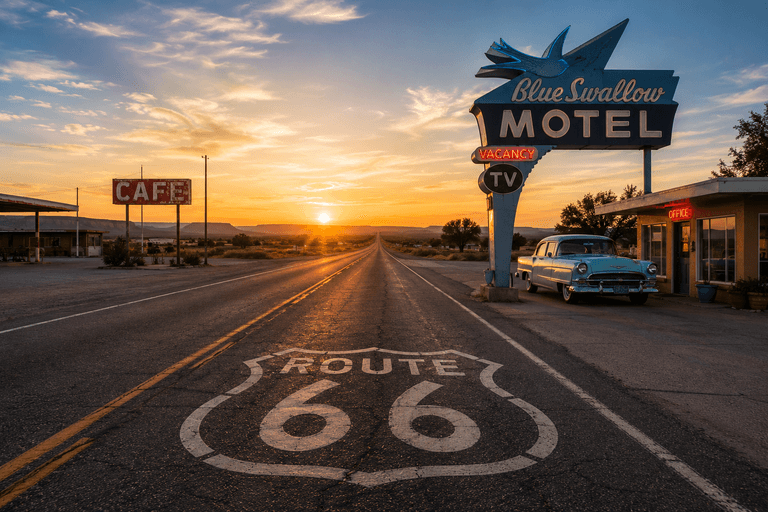
The Texas panhandle section is short at 178 miles but significant. Amarillo is the obvious overnight, and the Big Texan Steak Ranch motel is exactly as over-the-top as it sounds, which makes it worth one night purely for the story. Tucumcari, New Mexico follows, and it may be the single best town on the entire route for neon-lit motor court photography. The Blue Swallow Motel is the most-photographed property on Route 66 and books out fast in the centennial year.
Arizona and California: Nights 8 to 12
Flagstaff serves as the Arizona base, with Williams (the last town on Route 66 to be bypassed by Interstate 40, in 1984) worth a night for its preserved main street. The Wigwam Motel in Holbrook is a novelty stay that children and adults both remember. Crossing into California through the Mojave Desert leads to Barstow, then the long final stretch to Santa Monica Pier.
Best Hotels Along Route 66 by Category and Price
The best hotels along Route 66 range from lovingly restored motor courts under $100 a night to upscale boutique properties in Albuquerque and Flagstaff that charge $200 and up. Knowing which towns justify a splurge versus a budget stay shapes the whole budget of the trip.
Not every stop deserves the same spend. Some towns have one great property and nothing else worth noting. Others have enough competition to drive prices down. The table below gives an honest snapshot of what to expect at each major stop.
| City / Stop | State | Property Type | Avg Nightly Rate (2026) | Best-Known Option |
|---|---|---|---|---|
| Springfield | Illinois | Historic downtown hotel | $110 to $150 | The Inn at 835 |
| St. Louis | Missouri | Boutique / mid-range | $130 to $200 | Moonrise Hotel |
| Tulsa | Oklahoma | Art Deco boutique | $120 to $180 | Hotel Indigo Tulsa |
| Amarillo | Texas | Novelty / roadside | $80 to $130 | Big Texan Steak Ranch Motel |
| Tucumcari | New Mexico | Restored motor court | $75 to $110 | Blue Swallow Motel |
| Albuquerque | New Mexico | Boutique / historic | $150 to $250 | Hotel Parq Central |
| Flagstaff | Arizona | Historic downtown | $140 to $220 | Hotel Monte Vista |
| Williams | Arizona | Small-town motel | $80 to $120 | The Lodge on Route 66 |
| Santa Monica | California | Beachside / upscale | $220 to $380 | Shore Hotel |
A common mistake is treating Santa Monica as an afterthought and underspending on the final night. The last evening of a long road trip deserves something memorable, and an oceanfront property with a balcony costs more but functions as a genuine trip reward rather than just another sleep stop.
Planning Your Hotel Hop Route: Logistics, Timing, and Common Mistakes
The most common planning mistake on a Route 66 hotel hop is booking every single night in advance with nonrefundable rates. Leaving two or three nights flexible, particularly in the middle of the trip, gives you room to absorb the delays that almost always happen.
The original Route 66 alignment is not always the fastest road, and that is entirely the point. If you are using GPS to find the most efficient path between cities, you are probably missing the actual highway. Multiple free apps and dedicated Route 66 navigation tools keep you on the historic alignment rather than defaulting to the interstate. The National Park Service Route 66 corridor preservation program maintains resources on alignment maps and historically significant sites worth tracking down between hotels. Timing the trip matters more in 2026 than in a typical year. Late April through early June catches the centennial kickoff events while avoiding peak summer heat in Arizona and New Mexico. September through early October brings cooler temperatures across the Southwest but overlap with fall festival season in the Midwest, which tightens hotel availability in smaller towns. For travelers who want to pace the drive thoughtfully rather than race the odometer, the approach described in guides on how to plan a slow road trip across the US translates directly to Route 66. Treating the highway as a destination rather than a transit corridor changes how you book, how long you stay, and what you actually remember afterward. Budget planning should account for more than just hotel rates. Gas across 2,400 miles adds up quickly, particularly if you are driving a larger vehicle. Food costs vary enormously between, say, a diner in Commerce, Oklahoma and a restaurant in Santa Monica. A realistic all-in daily budget for two travelers runs $250 to $400, covering accommodation, fuel, meals, and a modest allowance for admission fees and souvenirs.
How to Choose Hotels on Route 66 Without Getting Burned by the Nostalgia Tax
Route 66 hospitality runs the full spectrum from genuinely restored mid-century gems to properties that charge vintage prices for peeling wallpaper and spotty Wi-Fi. Knowing how to tell them apart before you book saves both money and disappointment, which matters considerably more in 2026 when availability is tighter and rates are higher than the highway has seen in years.
The first filter is recency of reviews, not volume. A motel with four hundred reviews averaging four stars sounds reliable until you notice the most recent fifty reviews average three. Properties along Route 66 change hands and change standards faster than most travel corridors, so sorting by most recent rather than most reviewed gives you the accurate picture. Look specifically for comments about bed quality, air conditioning reliability, and bathroom cleanliness the three categories where aging roadside properties most commonly fall short.
Independent motels along the Mother Road tend to outperform chain properties on character but underperform on consistency. A room at the Blue Swallow Motel in Tucumcari might be the highlight of the entire trip, while a room three doors down in the same building might have a window unit that sounds like a diesel engine. Calling ahead and requesting a specific room type asking which units were most recently updated, or which face away from the road costs nothing and frequently produces a meaningfully better stay.
Chain hotels clustered near Route 66 towns offer reliability but require a different kind of vetting. Many are positioned a mile or two off the historic alignment, which sounds trivial until you realize that driving out and back twice a day adds forty minutes of context-free highway to a trip that is supposed to be about the road itself. Before booking any chain property, open a satellite map and measure the actual walking or driving distance to the stretch of original alignment you want to explore. In towns like Amarillo or Flagstaff, there are chain options genuinely on or adjacent to the old road. In others, the chain presence is entirely suburban, and you lose the evening atmosphere that makes Route 66 towns worth lingering in.
Booking windows in 2026 are running longer than typical for this route. Properties in Gallup, Williams, and Seligman all small towns with limited room inventory sitting squarely on centennial celebration circuits are showing compression as early as six months out for the peak spring and fall windows. Waiting for last-minute deals on this particular road trip in this particular year is a strategy that works until it doesn’t, and the towns with the most character are exactly the ones with the least room to absorb overflow demand.
Pacing the Drive: Why Most Route 66 Itineraries Are Too Short
The number most commonly cited for driving Route 66 is ten to fourteen days. That figure assumes a pace that leaves travelers feeling like they consumed the highway rather than experienced it. The math is straightforward: 2,400 miles over ten days requires averaging 240 miles of driving per day. On an interstate, that is a comfortable four hours. On Route 66, where the historic alignment through small towns drops to 25 miles per hour, where you will stop for a photograph of a neon sign, where a diner conversation with a local adds forty minutes you would not trade for anything, that same 240 miles can occupy seven or eight hours of actual time. Something has to give, and it is usually the stop.
While a 12-night trip is a common compromise for tight schedules, our detailed 19-night Centennial itinerary is designed for travelers who want genuine engagement with the route. This pacing allows you to sit with a place rather than pass through it.
The Route 66 Centennial Hotel Hopping Itinerary: Book by Event, Not by Nostalgia
The 2026 centennial marks one hundred years since the official certification of US Route 66 on November 11, 1926. What that means practically for travelers is that this year carries a structured calendar of events across eight states, and the smartest hotel hopping strategy on the Mother Road right now is not organized around which motels have the best neon signs, it is organized around where the celebrations are happening and when. Here is a night-by-night framework built around that calendar, weighted toward the event windows where advance booking is most critical.
Chicago to Springfield, Illinois — Nights 1 and 2
Target window: late April or early May, ahead of the main centennial season traffic. Chicago’s Museum of Science and Industry has confirmed programming tied to the centennial through its transportation history exhibitions. Night 1 lands in Chicago proper; Night 2 in Springfield, where the Illinois Route 66 Scenic Byway corridor hosts its own spring kickoff programming. The Abraham Lincoln Presidential Library is the anchor attraction for non-driving hours in Springfield. Book Springfield accommodation at least three months out the town’s small hotel footprint fills quickly when any statewide event overlaps.
Springfield to St. Louis Gateway — Night 3
A transition night used to position for Missouri. The Route 66 State Park in Eureka, just outside St. Louis, operates interpretive programming that intensifies in its centennial year. Properties in the Eureka and Pacific corridor give you morning access to the park before continuing west. One night is sufficient here; chain hotels along this stretch are plentiful and available without long lead times.
Rolla to Joplin, Missouri — Nights 4 and 5
Rolla earns a full night because the Ozark landscape and intact alignment through Cuba and Rolla reward slower driving. The Route 66 Mural City designation in Cuba makes the short stretch between Rolla and Cuba one of the most photographed single segments on the entire highway. Night 5 in Joplin positions you for morning entry into Oklahoma, where the density of centennial programming increases substantially. Joplin itself has serviceable mid-range hotel options with no acute booking pressure, but confirmed rates of early centennial tourism is pushing baseline prices upward even in lower-demand segments.
Commerce to Tulsa, Oklahoma — Nights 6 and 7
Oklahoma is where the centennial itinerary tightens considerably. The Oklahoma Route 66 Association has confirmed major centennial programming centered in Tulsa during late June and early September, with the September window aligning with cooler temperatures and a more complete event roster. Night 6 in the Commerce or Miami area gives you the Twin Bridges, the Ribbon Road, and the Sidewalk Highway three irreplaceable pieces of original infrastructure before arriving in Tulsa for Night 7. In Tulsa, the Philtower and Mayo Hotel both carry genuine historic weight and are the two properties most worth the splurge if budget allows an anchor upgrade. Book Tulsa for the September centennial window no later than six months in advance; inventory in the historic downtown corridor is genuinely limited.
Arcadia to Oklahoma City — Night 8
The Round Barn in Arcadia is a mandatory stop, and the proximity to Oklahoma City makes this a natural single-night transition. Oklahoma City offers the National Cowboy and Western Heritage Museum as a non-driving anchor. Properties downtown or along the Bricktown corridor provide walkable evening options. Booking pressure here is moderate; three months out is sufficient for most dates.
Elk City to Amarillo, Texas — Night 9
The Western Oklahoma landscape shifts noticeably here, and the drive through Sayre and Shamrock rewards an unhurried pace. Night 9 lands in Amarillo, home of Cadillac Ranch and the Big Texan Steak Ranch, which remains the single most photographed dining establishment on the highway and a genuine Route 66 institution regardless of your feelings about its scale. The National Park Service Route 66 Corridor Preservation Program has documented the Texas Panhandle’s historic alignment in detail, making it easier to confirm which sections of original road remain drivable through this segment. Amarillo hotel options are plentiful; no acute booking pressure applies here outside of major local events.
Tucumcari, New Mexico — Night 10
This is one of two anchor nights where neon and event timing align most completely. Tucumcari’s motel row is the most intact neon corridor remaining on Route 66, and the Blue Swallow Motel and Motel Safari both participate in centennial programming throughout the year. The Blue Swallow in particular is the most-requested individual property on the entire highway; availability in 2026 is limited and book-outs for peak dates (May through October) are common. If the Blue Swallow is full, the Motel Safari is the strongest backup. Book this night the moment your travel dates are confirmed this is the single highest-priority accommodation on the entire trip from a reservation standpoint.
Albuquerque — Nights 11 and 12
Albuquerque’s Central Avenue is the longest surviving urban stretch of Route 66 in any American city, and the city has built centennial programming around that distinction. The Albuquerque International Balloon Fiesta falls in early October and, in 2026, overlaps deliberately with centennial celebrations, making the first week of October the single highest-demand accommodation window in any city on the route. If your itinerary lands here in that window, book six to nine months ahead. If you are traveling outside the balloon fiesta window, Albuquerque offers strong mid-range options along Central Avenue with genuine Route 66 character. Two nights here is worthwhile; use the second day for Old Town and the Petroglyph National Monument rather than driving.
Gallup — Night 13
Gallup sits at the intersection of Route 66 history and Native American cultural heritage that is unlike any other stop on the route. The Inter-Tribal Indian Ceremonial, held annually in August, has centennial-year programming additions in 2026. El Rancho Hotel is the landmark property and has hosted Hollywood productions and presidents; request rooms in the historic wing rather than the motor lodge addition. Book this one early for any August date; Gallup’s room inventory is small and the ceremonial weekend sells out entirely.
Holbrook and Winslow, Arizona — Night 14
Two towns, one night, both with specific centennial resonance. Holbrook’s Wigwam Motel is the kind of property Route 66 is famous for concrete teepee units that have been in continuous operation since the 1950s. Winslow earned its modern cultural touchstone from a 1972 Eagles song, and Standin’ on the Corner Park draws a specific kind of traveler who finds the reference either charming or obligatory. Either town works for Night 14; Holbrook’s Wigwam requires advance booking given its small unit count and high recognition factor.
Williams and Flagstaff, Arizona — Nights 15 and 16
Williams serves as the most logical base for Grand Canyon day trips and is the departure point for the Grand Canyon Railway, which runs daily service to the South Rim. The centennial year has elevated Williams’s profile considerably, and the town’s compact historic district along Bill Williams Avenue fills quickly for weekends. Night 16 in Flagstaff shifts the pace; Flagstaff is a genuine mid-size city with breweries, independent restaurants, and proximity to Walnut Canyon and Wupatki National Monuments for travelers who want a non-driving activity day.
Seligman and Kingman, Arizona — Night 17
The stretch from Flagstaff to Seligman on the old alignment is among the most cinematic on the entire highway. Seligman’s Snow Cap Drive-In and the surrounding town have become centennial pilgrimage points; the town is small and parking on summer weekends is genuinely difficult. Kingman makes a stronger overnight base with better hotel options and the Route 66 Museum anchoring a few hours of indoor time. One night covers both towns comfortably if you time the Seligman stop for late morning and continue to Kingman for the night.
Needles to Barstow, California — Night 18
The Mojave crossing is the segment most travelers underestimate. Summer temperatures regularly exceed 110 degrees Fahrenheit between Needles and Barstow, and driving the original alignment through this stretch in June through August requires genuine preparation: water, a checked cooling system, and no assumptions about fuel availability. Barstow serves as the last functional overnight stop before the Los Angeles basin. The Route 66 Mother Road Museum in Barstow is worth two hours before pushing west on the final leg.
Pasadena to Santa Monica — Night 19 and the finish
The final approach along Colorado Boulevard through Pasadena and into Santa Monica is emotionally different from every other mile on the trip. The western terminus at the Santa Monica Pier is where the centennial celebration on the California end concentrates, with programming through November 2026 marking the anniversary date. Stay at least one night in Santa Monica proper rather than routing to a cheaper inland hotel. The walk from your room to the pier for the endpoint photograph is the ending the trip deserves. Book Santa Monica accommodation for any November date no later than summer 2026; centennial-specific events will draw travelers who have no interest in driving the highway and simply want to be at the western endpoint for the hundredth anniversary.
The through-line in this itinerary is that 2026 is not a year to be flexible about timing and assume rooms will be available. The centennial calendar creates localized demand spikes that are not reflected in any Route 66 guide written before this year, and the travelers who book early around specific event dates will have a meaningfully different trip than those who plan the same route with the same stops but arrive to find their preferred properties fully booked and event parking three miles from the action.
Route 66 at one hundred years is simultaneously more popular than it has been in decades and more at risk of the overcrowding that erodes exactly what makes it worth driving. Booking deliberately, spacing your anchor nights thoughtfully, and treating the centennial calendar as a planning tool rather than a tourist backdrop is how you have the trip this highway is capable of delivering one that stays with you the way a good road trip should, not as a checklist of sites visited but as a sequence of places where you actually stopped, talked to someone, ate something you were not expecting, and remembered that moving through a landscape slowly is still one of the more worthwhile things a person can do.
Frequently Asked Questions
How far in advance should I book hotels for a Route 66 centennial trip in 2026?
For peak travel windows between May and October, booking three to six months ahead is the minimum for most stops. Properties in Tucumcari, Gallup during the Inter-Tribal Ceremonial in August, and Santa Monica for November centennial events should be booked as soon as your dates are confirmed; some of these are already showing limited availability. Transition-night stops in larger cities like Amarillo or Oklahoma City carry less urgency and can often be confirmed two to three months out without difficulty.
What is the best direction to drive Route 66 for a hotel hopping itinerary?
East to west, Chicago to Santa Monica, is the traditional direction and makes logistical sense for most travelers. It puts the most intense heat of the Mojave crossing at the end of the trip when you are already near the California coast rather than at the beginning, and the emotional weight of finishing at the Santa Monica Pier gives the itinerary a natural endpoint. Driving west to east works well if you are based in California and want to minimize positioning travel, but you lose the traditional narrative arc that makes the highway feel like it is moving toward something.
Which Route 66 states have the most centennial events in 2026?
Oklahoma and Arizona carry the heaviest centennial programming based on confirmed plans from their respective Route 66 associations. New Mexico’s Albuquerque adds the Balloon Fiesta overlap in October, which creates the single most compressed accommodation window in any city on the route. Illinois anchors the eastern celebration calendar and California concentrates programming at the Santa Monica terminus in November around the November 11 anniversary date. Texas and Missouri have centennial acknowledgments but fewer dedicated multi-day events compared to the western states.
Is it possible to do Route 66 on a budget during centennial year without sacrificing the experience?
Budget travel on Route 66 in 2026 is doable but requires more flexibility than in prior years. Centennial demand has pushed rates upward at marquee properties, but the highway still has stretches particularly through rural Illinois, the Missouri Ozarks, and the Texas Panhandle where independent motels charge $70 to $90 per night and deliver solid value. Traveling in shoulder season, specifically late March through early May or the second half of October, captures most of the event calendar at lower price points. AP News has covered the centennial economic impact on small Route 66 communities, and the pattern that emerges is that the towns with the most to offer visitors are also the ones with the least accommodation inventory to absorb demand which is the core planning challenge the budget traveler has to solve with flexibility and early booking rather than last-minute deals.