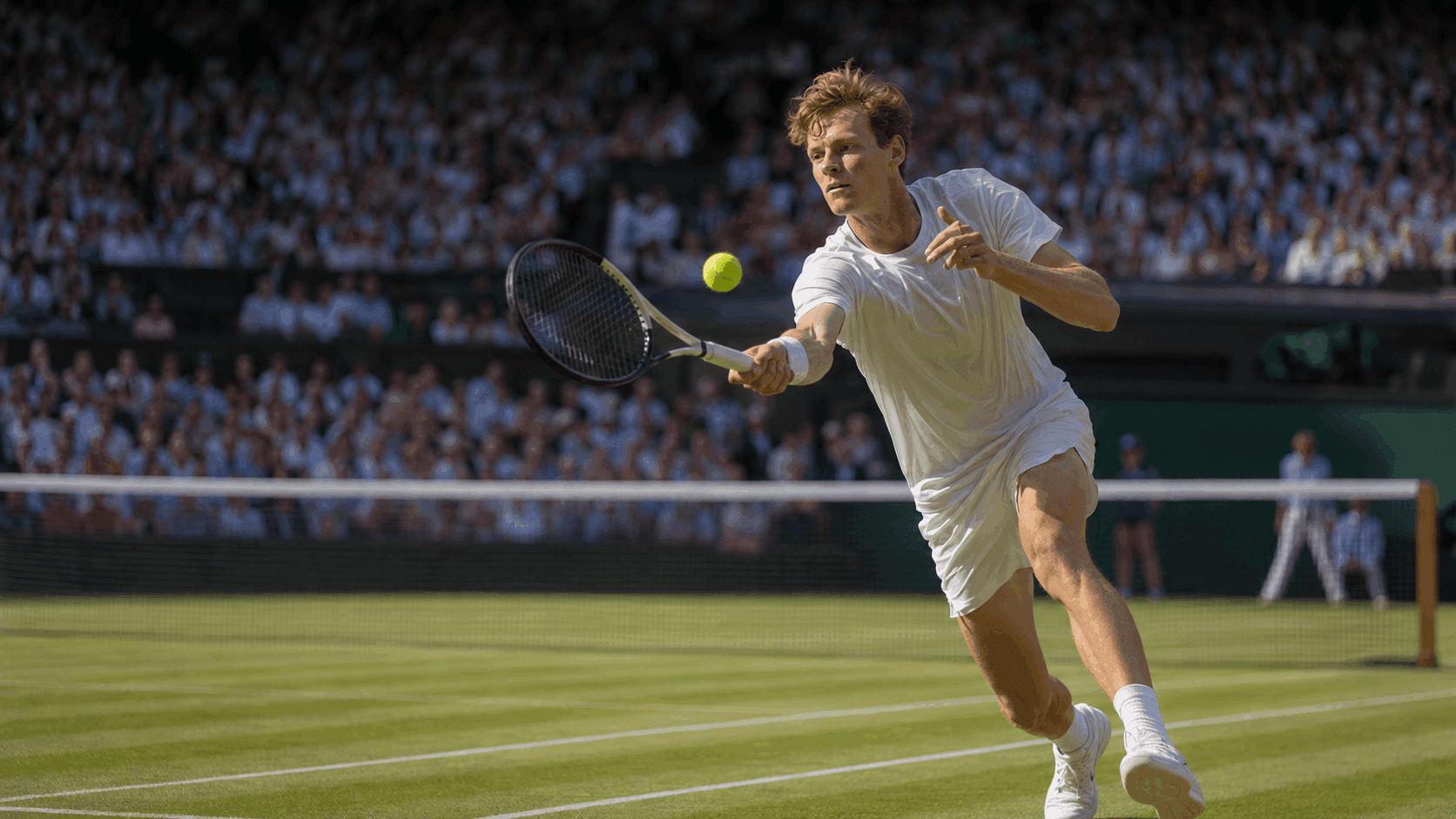
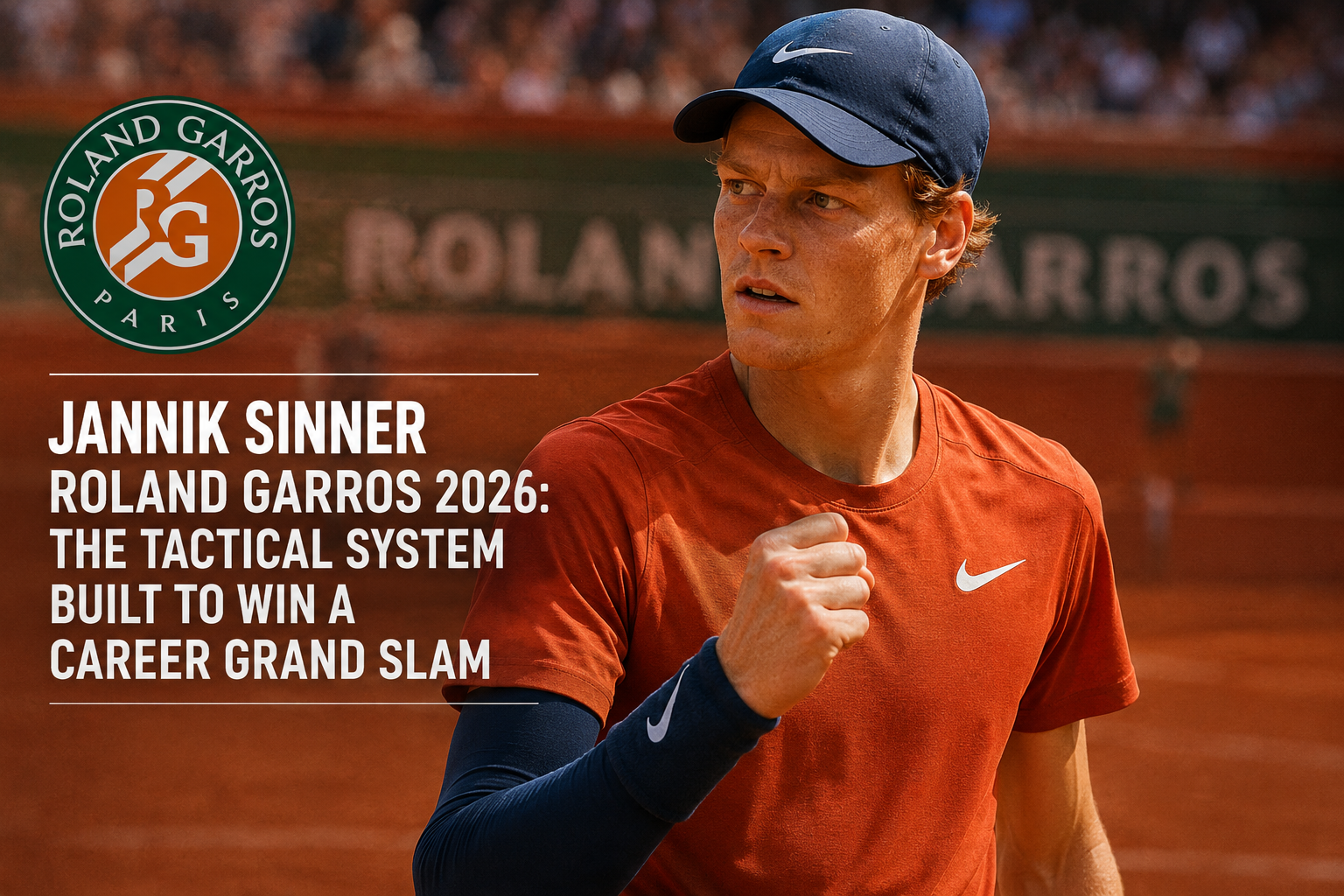
Jannik Sinner opened his 2026 Roland Garros campaign with a 6-1, 6-3, 6-4 dismantling of French wildcard Clement Tabur on Tuesday night, and the numbers from that match tell you almost everything about why the No. 1 seed is the most feared player on the draw sheet this fortnight. Forty winners. Zero break points faced. Two hours and eight minutes. That was more than a routine first-round win; it was a performance that reflected how stable Sinner’s clay-court system has become in 2026. WideJournal Tennis breaks down exactly what Sinner is doing on clay in 2026 and why Sinner enters Roland Garros as the most tactically complete player in the men’s draw.
Key Takeaways
- Jannik Sinner enters Roland Garros with an undefeated 18-0 clay-court record in 2026 and a 30-match winning streak, making him the strongest statistical favourite in the men’s draw.
- Sinner’s tactical system is built around elite two-way pressure: dominant serving combined with aggressive baseline control and diagonal shot acceleration that consistently forces opponents into defensive positions.
- The technical overhaul of Sinner’s serve under coach Simone Vagnozzi has transformed his clay-court game by generating more free points and shortening physically demanding rallies.
- The absence of defending champion Carlos Alcaraz removes Sinner’s most dangerous stylistic rival from the tournament, giving the world No. 1 a clearer route toward a potential Career Grand Slam.
- Despite Sinner’s dominance, the article highlights remaining tactical concerns, including heavy topspin opponents, slower evening conditions, and the physical demands of best-of-five matches deep into the second week in Paris.
Where Sinner Stands Entering Week One
Jannik Sinner arrives at Roland Garros 2026 with an 18-0 clay record this season, a 36-2 overall mark, and a 30-match winning streak that puts him in the same category as Federer, Nadal, and Djokovic for sustained excellence this century.
The broader context matters here. Sinner has won the Australian Open twice (2024 and 2025), the US Open in 2024, and Wimbledon in 2025. Roland Garros is the only major left on his list, and if he lifts the Coupe des Mousquetaires, he becomes just the seventh man in the Open Era to complete the Career Grand Slam. He would also be the first Italian man to win Roland Garros since Adriano Panatta in 1976, a fifty-year gap that gives the Italian tennis community a specific kind of investment in every match he plays here.
Defending champion Carlos Alcaraz is absent from the draw entirely due to a wrist injury, confirmed by the Roland Garros official site. That removes the one player who has consistently matched Sinner at majors in recent years, including the man who took three championship points off him in last year’s final. The draw does not hand Sinner the title; it simply removes the most obvious obstacle. Alexander Zverev, the second seed, shares a half with Novak Djokovic, meaning Sinner has a structurally cleaner route to the final.
The Clay Swing That Rewrote the Record Books
Sinner swept all three clay-court ATP Masters 1000 titles in 2026, joining Rafael Nadal as the only players in history to accomplish that feat in a single season, dropping just three sets across Monte-Carlo, Madrid, and Rome.
In that five-week stretch, Sinner did not just win three tournaments; he produced the kind of sustained dominance that pushes a player into a different statistical bracket. Only Nadal, in 2010, had previously swept all three clay Masters 1000 events in one season. The fact that Sinner dropped only three sets across all three tournaments underlines how rarely his opponents found any traction, and Casper Ruud, who faced him in the Rome final, articulated the problem as clearly as any analyst could. As reported by myKhel, Ruud described the tactical suffocation: “Whether you’re playing a forehand cross-court rally, or a backhand cross-court rally, you know the ball will come at a high pace and typically good placement as well.”
The Tactical System: How Sinner Controls Clay Court Matches
Sinner’s clay court system in 2026 combines a rebuilt, more aggressive serve with relentless diagonal baseline pressure, winning 94.3% of service games and 31.9% of return games simultaneously, a statistical profile rarely sustained over a full clay season.
The foundation of Sinner’s game on clay is not a single weapon. It is the combination of two weapons operating at the same time. The ATP Tour’s Infosys Beyond the Numbers analysis describes it as an “unrelenting two-pronged attack,” with Sinner winning 94.3% of his service games and 31.9% of his return games so far in 2026. Those two numbers together, in the same season, are what make the system genuinely difficult to solve. Most elite baseliners dominate one side of the ledger. Sinner is controlling both ends of every service game regardless of who is serving.
In 2025, Sinner led the ATP Tour in first-serve points won at 79.5%, second-serve points won at 59.1%, and service games won at 92%. In 2026 he has pushed the service games won figure to 94%, and his aces per match have nearly doubled, from 6.3 in 2025 to 11.1 this season. When a player is already the best returner in the world, adding genuine free-point threat on serve changes the entire tactical calculus an opponent faces.
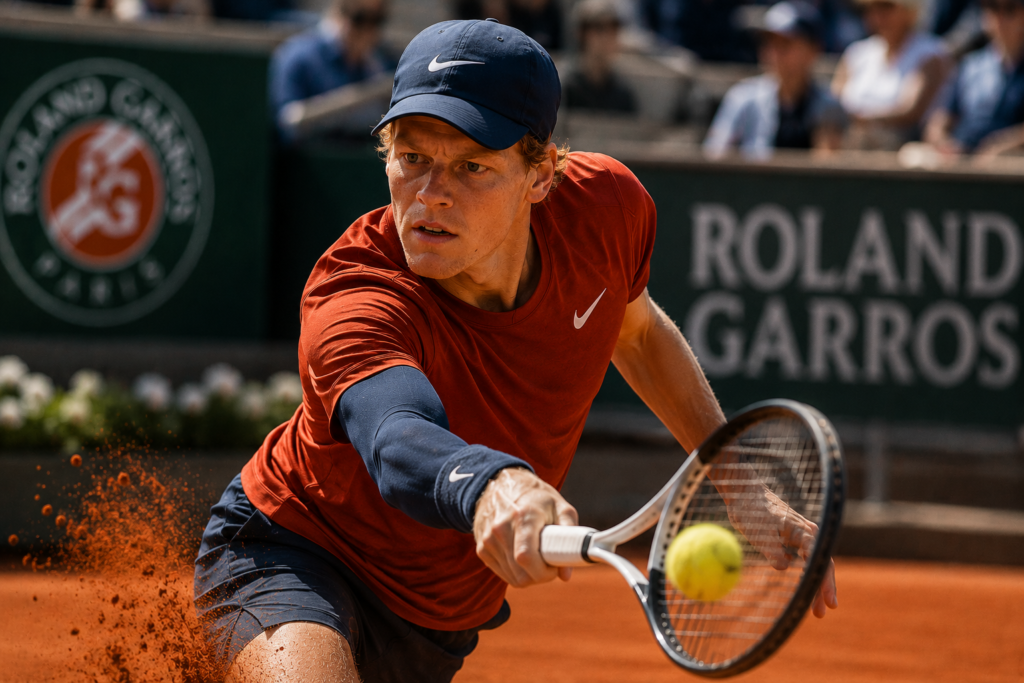
From the baseline, the system is built around diagonal acceleration. His forehand and two-handed backhand both generate enough pace and spin to push opponents wide and keep them pinned behind the baseline, but the real damage comes when he shifts direction. Once he has pulled an opponent off the court, he can redirect with either wing, and on clay, where slides give him additional time to reset, those exchanges rarely end poorly for him. The R1 win over Tabur offered a clean illustration: a swatted forehand squash shot from deep in the court followed by a sliding backhand winner in the third set. Neither shot was a panic response; both were calculated choices under pressure, which is exactly what the clay surface rewards over five sets.
What the Numbers Say About His Roland Garros History
Sinner holds a 22-6 all-time record at Roland Garros and an 82-24 career clay court mark (77.4% win rate), ranking third among active players in clay court win percentage entering 2026.
Since his Roland Garros debut in 2020, the trajectory has been consistent and upward. A 22-6 record at a single major, accumulated across six appearances starting from his first senior season on the main tour, reflects a player who has never been out of place on the surface, even before he became the dominant force he is today. His career clay court record of 82-24, a 77.4% win rate that ranks third among active players, sits comfortably in the elite bracket but also reminds you that he has lost on this surface, and those losses inform how he approaches big clay matches tactically.
Sinner himself flagged the specific demands of best-of-five clay matches during his post-match press conference after the Tabur win. As confirmed by the Roland Garros official site, he noted: “Best-of-five matches, they are a bit different. It gives you a little bit more time to understand how to beat a player.” That is a tactically self-aware observation from someone who has absorbed lessons from his previous Roland Garros losses, including last year’s final.
Jannik Sinner: Key Stats and Records Entering Roland Garros 2026
| Category | Figure | Source |
|---|---|---|
| 2026 Season Record (overall) | 36-2 | ATP Tour / Infosys |
| 2026 Clay Court Record | 18-0 | ATP Tour / Infosys |
| Career Clay Court Record | 82-24 (77.4%) | ATP Tour / Infosys |
| Roland Garros All-Time Record | 22-6 | ATP Tour |
| 2026 Service Games Won | 94.3% | ATP Tour / Infosys |
| 2026 Return Games Won | 31.9% | ATP Tour / Infosys |
| Aces Per Match (2026 vs. 2025) | 11.1 (up from 6.3) | ATP Tour / Infosys |
| Current Win Streak | 30 matches | Roland Garros Official |
| R1 vs. Tabur: Winners / Break Points Faced | 40 winners / 0 BPs | Roland Garros Official |
| Grand Slam Titles Won | 4 (AO 2024, 2025; USO 2024; Wimbledon 2025) | ATP Tour |
The Tactical Architecture: How Sinner Dismantles Clay Court Opponents
To understand why Sinner has become such a difficult player to solve on clay, it helps to look beyond the raw results and examine the tactical structure underneath them. Sinner’s game on clay is not built around spin-heavy grinding or net-rushing bravado. It is built around tempo control — the ability to dictate the pace of a rally so relentlessly that opponents are forced into decision-making under duress rather than comfort. His game centers on a blistering forehand, a laser-precise two-handed backhand, and an uncommon ability to accelerate through diagonals, making him devastating from the baseline while remaining comfortable at the net.
The Serve Overhaul: A Structural Upgrade That Changes the Math at Roland Garros
Of all the tactical developments underpinning Sinner’s 2026 clay dominance, the evolution of his serve is the most structurally significant. For much of his early career, Sinner’s serve was functional but not a genuine weapon — serviceable enough to keep him competitive, but not the kind of deliverable that shortened points and reduced physical wear across long best-of-five matches. That changed meaningfully in 2025 and has accelerated further in 2026. Coach Simone Vagnozzi’s long-term project to overhaul Sinner’s serve, moving him to a pinpoint technique, has produced measurable statistical jumps in 2026 confirmed by Infosys ATP analysis.
In 2025, Sinner led the ATP Tour in first-serve points won (79.5%), second-serve points won (59.1%), and service games won (92%). In 2026, that profile has become even more difficult to attack, with Sinner winning 94.3% of his service games on clay. His ace production has also jumped significantly, rising from 6.3 aces per match in 2025 to 11.1 this season, giving him more free points on a surface that traditionally limits serve dominance.
The Road Ahead: Draw Context and the Career Grand Slam Stake
Winning Roland Garros would carry a weight that no other title in Sinner’s remaining career can replicate. Sinner has already won the Australian Open in 2024 and 2025, the US Open in 2024, and Wimbledon in 2025, making Roland Garros the only major title missing from his collection. If he wins in Paris, he will become just the seventh man in the Open Era to complete the Career Grand Slam, placing him in a category occupied by Rod Laver, Andre Agassi, Rafael Nadal, Roger Federer, Novak Djokovic, and Mats Wilander. He would also become the first Italian man to win Roland Garros since Adriano Panatta in 1976.
The draw has shaped up in a way that removes one significant complication. Defending champion Carlos Alcaraz is absent from the 2026 Roland Garros draw due to a wrist injury, removing the player who denied Sinner three championship points in last year’s final. Sinner and Novak Djokovic are in opposite halves of the draw, meaning a potential meeting between the two would only arrive in the final. Alexander Zverev, the second seed, is in the same half of the draw as Djokovic, which means Sinner’s most difficult projected matches on the bottom half would come before the final. Sinner’s immediate next challenge is Juan Manuel Cerundolo in the second round.
Sustaining that streak across six more best-of-five matches on a surface that punishes any drop in concentration is the central test. His 2026 clay season — three Masters 1000 titles in Monte-Carlo, Madrid, and Rome, dropping only three sets across all three tournaments — suggests that his conditioning and mental reset between matches have been as precise as his groundstrokes.
Alternative Perspectives
Despite the statistical case for Sinner’s dominance, important counterarguments exist. His entire 2026 clay campaign has unfolded without a match against Carlos Alcaraz, who had previously demonstrated the specific ability to disrupt Sinner’s tempo at Roland Garros and was absent this year through injury rather than any tactical solution Sinner found. Analysts have also pointed out that a 30-match winning streak, however impressive, has been constructed against a field that did not include several of the top-10 players at their best, and that Roland Garros best-of-five tennis across two weeks introduces fatigue and variance that a three-set Masters 1000 format does not fully replicate.
What Could Still Trouble Sinner in Paris
Despite Sinner’s dominance, several tactical variables could still complicate his path in Paris. Heavy topspin players capable of pushing him high above shoulder level on clay can occasionally disrupt his preferred strike zone, particularly on slower evening courts. Extended physical matches deep into the second week also remain a different challenge from best-of-three Masters events, especially against opponents comfortable defending several meters behind the baseline.
There is also the unresolved question of how Sinner’s current clay system would hold up against a fully healthy Carlos Alcaraz over five sets at Roland Garros. Alcaraz remains one of the few players capable of consistently breaking Sinner’s rhythm through variation, net pressure, and abrupt changes in tempo.
Conclusion
Sinner arrives in Paris with the strongest clay-court profile on the ATP Tour and a tactical system that currently looks more stable than any of his rivals. The combination of improved serving, relentless baseline pressure, and physical consistency has turned him into the tournament favourite. Whether that translates into a Career Grand Slam will depend on how his game holds up deep into the second week, where Roland Garros has historically punished even the most dominant players.
FAQ
Sinner holds a 22-6 all-time win-loss record at Roland Garros since his tournament debut in 2020, making him one of the most consistently successful players at the event over that stretch. His 2026 first-round victory over Clement Tabur — a 6-1, 6-3, 6-4 win in which he hit 40 winners and faced zero break points — extended that record to 22-6 entering the second round.
The Career Grand Slam refers to winning all four major titles (Australian Open, French Open, Wimbledon, and the US Open) at least once across a player’s career. Sinner has already won the Australian Open in 2024 and 2025, the US Open in 2024, and Wimbledon in 2025. Roland Garros is the only major title still missing from his collection. A victory in Paris would make him just the seventh man in the Open Era to complete the set.
Novak Djokovic remains the most tactically adaptable opponent left in the draw, particularly over five sets where experience and in-match adjustments become critical. Casper Ruud’s heavy topspin patterns and clay-court consistency could also create longer physical exchanges that test Sinner differently from the faster baseline matches he has dominated during his 2026 clay run. Carlos Alcaraz, however, remains the biggest unanswered matchup question despite missing the tournament through injury.
Sinner’s serve has undergone a significant technical overhaul under coach Simone Vagnozzi, shifting to a pinpoint technique that has produced measurable statistical improvements. In 2026, he has won 94.3% of his service games and averaged 11.1 aces per match, up from 6.3 aces per match in 2025. On clay, where the surface typically reduces a server’s advantage, that level of free-point generation is historically unusual. Combined with a 31.9% return games won rate, the serve transforms Sinner’s tactical profile from a strong baseline player into a two-way threat that removes the variance clay courts normally introduce.