
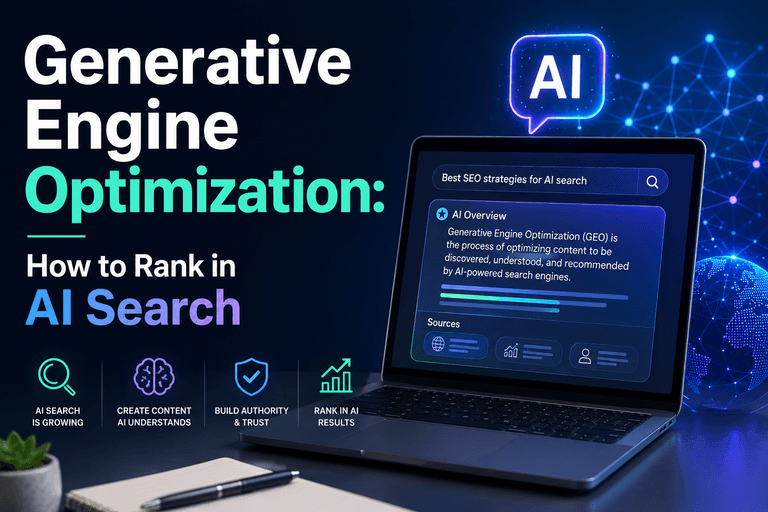
Generative Engine Optimization (GEO) is the practice of structuring content so AI systems like Google AI Overviews, ChatGPT, and Perplexity cite it in their generated responses. Research from Princeton University found that targeted GEO techniques can boost a brand’s visibility in AI-generated answers by 22 to 41 percent. Unlike traditional SEO, GEO is not about ranking in a list of links; it is about becoming the source an AI quotes directly.
Key Takeaways
- Adding statistics to content is the single most effective GEO tactic, improving AI visibility by 41%, according to the Princeton/KDD 2024 GEO-bench study of roughly 10,000 queries.
- About 58% of U.S. adults encountered a Google AI-generated summary in March 2025, yet only 8% clicked a traditional link when one appeared, down from 15% on pages without a summary (Pew Research Center, July 2025).
- AI-driven traffic to U.S. retail sites grew 693% year-over-year during the 2025 holiday season, with AI-referred visitors converting 31% higher than other organic sources (Adobe Analytics).
- Defensive GEO matters as much as offensive GEO: AI hallucinations about pricing, features, and brand positioning are an active legal and revenue risk that most GEO guides ignore entirely.
What Is Generative Engine Optimization?
GEO is the discipline of optimizing content so AI-powered search engines select it as a cited source inside their generated answers, not just as a ranked link below them.
The term was formally coined in a paper titled “GEO: Generative Engine Optimization,” published at ACM SIGKDD 2024 by researchers from Princeton University, IIT Delhi, Georgia Tech, and the Allen Institute for AI. The paper introduced GEO-bench, a framework that tested roughly 10,000 queries across nine datasets to measure which content signals most reliably drove AI citation. The core problem GEO solves is straightforward: when a user asks ChatGPT or Perplexity a question, the AI does not return ten blue links. It synthesizes an answer, often citing two or three sources inline. If your content is not structured for that synthesis, you are invisible regardless of your traditional search ranking.
GEO vs. SEO: What Changes and What Stays the Same
SEO wins you a ranked position in a list; GEO wins you a quoted sentence inside an AI’s answer. The audiences, signals, and success metrics are meaningfully different.
Traditional SEO optimizes for crawlability, backlink authority, and keyword placement so a search engine surfaces your URL. GEO optimizes for quotability: clear definitions, embedded statistics, and authoritative sourcing that an AI can lift verbatim and attribute. Both disciplines reward genuine expertise and factual accuracy, so strong foundational content serves both goals. What shifts is the format. SEO favors comprehensive coverage; GEO favors self-contained, citable paragraphs that answer one question fully in three to five sentences. Understanding this distinction is part of the broader recalibration happening across business growth fundamentals as AI search reduces the click-through value of traditional rankings. As the Pew Research data makes clear, a Google AI summary cuts link clicks nearly in half, from 15% to 8%. Brands that optimize only for ranking position are already losing ground. GEO vs. SEO: Core Differences at a Glance
| Dimension | Traditional SEO | GEO |
|---|---|---|
| Primary goal | Rank in search results list | Get cited inside AI-generated answer |
| Success metric | Ranking position, organic clicks | AI citation frequency, brand mentions |
| Content format | Comprehensive long-form pages | Self-contained, quotable answer blocks |
| Key signal | Backlinks, keyword density | Statistics, sourced claims, clear definitions |
| Click-through dynamic | Users click your link directly | Users read your answer without visiting |
| Authority signals | Domain authority, page authority | Named authors, institutional citations, schema |
How to Appear in Google AI Overviews and Get Cited in ChatGPT
The tactics that earn AI citations share one trait: they make a specific, verifiable claim in plain language that an AI can quote without paraphrasing.
The Princeton GEO-bench research identified statistics as the highest-leverage signal, improving AI visibility by 41% on its own. Every content piece should anchor its core argument to a verifiable number drawn from a credible source, named explicitly in the text. Beyond statistics, three additional practices consistently drive citation: writing a direct definition or answer in the first paragraph (what this article calls an answer-first block), using structured data markup so AI crawlers can parse entity relationships, and building topical authority through a cluster of related pages that reinforce a single subject area. Conversational query matching also matters. AI engines are trained on natural-language questions, so content framed around the exact phrasing users speak (“how does GEO work,” “what is the difference between GEO and SEO”) maps directly to retrieval patterns. Alongside the other marketing strategies we cover, GEO is quickly becoming non-negotiable for brands that depend on search-driven discovery.

Defensive GEO: How to Prevent, Detect, and Correct AI Hallucinations About Your Brand
Most GEO guides focus on getting AI to mention your brand more. This section covers the opposite and equally urgent problem: what to do when AI is already mentioning you incorrectly.
AI systems occasionally generate confident, wrong statements about real brands: outdated pricing, discontinued features, false service claims. These hallucinations are not hypothetical edge cases. A Canadian court ruled against Air Canada after its chatbot provided a customer with incorrect refund policy information, establishing that a company cannot disclaim responsibility for what its AI-facing content says. That legal precedent applies equally when a third-party AI misrepresents your brand to prospective buyers. The defensive GEO playbook has three layers. First, audit: run your brand name through ChatGPT, Perplexity, and Google AI Overviews monthly and document any factually incorrect outputs. Second, publish correction anchors: create or update highly structured pages (pricing pages, product spec pages, FAQ pages) with explicit, dated, schema-marked facts that give AI systems an authoritative source to prefer over stale or synthesized data. Third, escalate through official channels: both Google and OpenAI maintain processes for reporting factual errors in AI-generated content tied to real entities. Submitting corrections through these channels, combined with strong on-site sourcing, gives the model a clear signal to update its retrieval behavior. The financial case for defensive GEO is direct. AI-referred shoppers already convert 31% higher than other organic sources, which means a hallucination that undermines purchase confidence carries a disproportionate revenue cost.
The GEO Marketing Strategy That Works Right Now
A practical GEO strategy does not require rebuilding your content library; it requires retrofitting your highest-value pages with the signals AI engines prioritize.
Start with your ten highest-traffic pages. Add one statistic per section, sourced and named. Rewrite each page’s opening paragraph as a self-contained answer to the question the page targets. Add FAQ schema markup using questions pulled from “People Also Ask” boxes and AI-autocomplete suggestions. Publish an author bio page with credentials and institutional affiliations, since named-author signals correlate with AI citation in several analyses of retrieval-augmented generation behavior. Track results by searching your brand and target queries in ChatGPT, Perplexity, and Google AI Overviews each month. Log which pages get cited. Additionally, extend your footprint beyond your owned site to high-density user-generated content (UGC) platforms like Reddit and Discourse. Modern RAG architectures in 2026 heavily weigh real-world community consensus, making structured brand discussions on these forums a primary sourcing ground for AI engines. This is still an emerging measurement discipline; no single platform offers a unified GEO analytics dashboard yet, so manual auditing remains the most reliable approach. The scale of the opportunity is real: Perplexity AI now processes over 1.2 billion search queries per month and consistently draws over 170 million monthly visits more than triple its early 2024 volume. Brands that establish citation presence now are building a position that compounds as AI search volume grows.
Frequently Asked Questions
Does GEO replace SEO, or do both matter?
Both matter for now, but for different reasons. Traditional SEO still drives traffic on queries where users want to browse multiple sources. GEO captures users who accept an AI’s synthesized answer without clicking through. A complete search strategy addresses both, with GEO becoming increasingly important as AI-summary adoption rises.
How long does it take to see results from GEO?
There is no established consensus timeline because AI retrieval systems update on their own crawl and retraining schedules, which vary by platform. Many practitioners report seeing citation changes within four to eight weeks of publishing optimized content, but this is anecdotal. Monitoring monthly gives a reasonable signal of whether changes are taking effect.
Which types of content get cited most often by AI engines?
Content that contains specific statistics, named authors with stated credentials, clear one-paragraph definitions, and structured data markup tends to earn citations most reliably, based on findings from the Princeton GEO-bench research. Thin, unattributed, or jargon-heavy content is rarely selected as a primary source.
Can small businesses compete with large brands in AI search?
Potentially yes, particularly in highly specific or long-tail queries where clear structure, precise statistics, and direct answers matter more than raw domain authority. However, in high-volume or broad brand categories, LLM retrieval engines still exhibit significant “entity bias” preferring dominant, heavily recognized brands that appear frequently across their pre-training data and live index. Small businesses can win consistently by targeting precise niche topics rather than trying to displace legacy market leaders on broad head terms.