
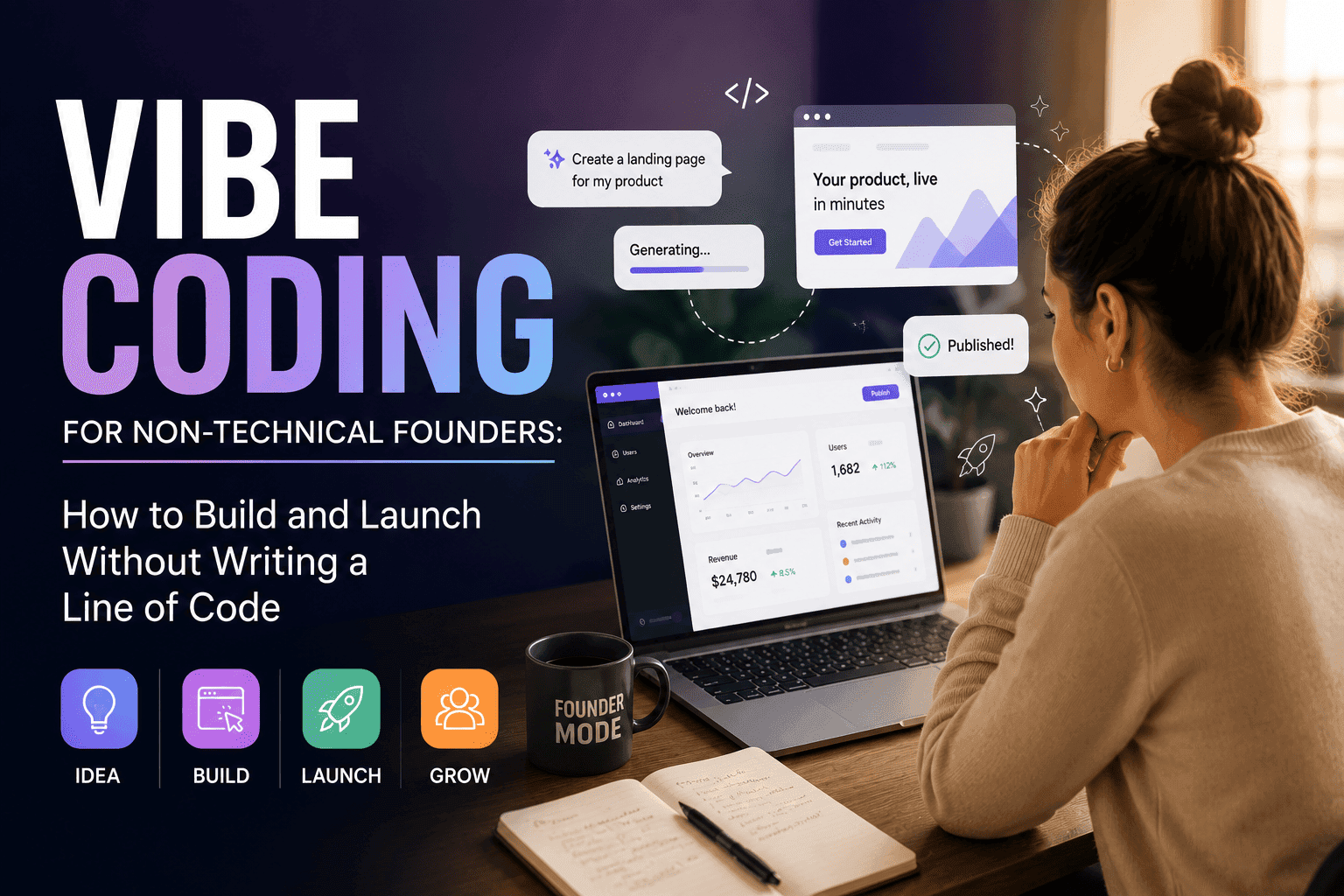
Non-technical founders can now build functional software products by describing what they want in plain English, letting AI tools generate and iterate on the code automatically. This approach, called vibe coding, has moved from experiment to mainstream startup strategy, with 63% of users being non-developers and a quarter of Y Combinator’s Winter 2025 batch running codebases that were 95% AI-generated.
Key Takeaways
- 63% of vibe coding users have no development background, and founders are the single largest user group on platforms like Lovable at 45.7% of all users.
- Non-technical founders using AI tools ship 73% faster than those relying on traditional development, according to SeedScope data from 2026.
- AI-generated code introduces security vulnerabilities in 45% of cases, per Veracode’s 2025 GenAI Code Security Report, making security review a non-negotiable step before launch.
- The global vibe coding market is valued at $6.22 billion and growing at 27.1% annually, signaling this is infrastructure for the next generation of startups, not a passing trend.
What Vibe Coding Actually Is (and Why It Matters for Founders)
Vibe coding means building software by conversing with AI in natural language rather than writing code yourself. The term was coined by AI researcher Andrej Karpathy in a post on X on February 2, 2025, which went on to receive 4.5 million views and triggered a wave of mainstream adoption.
The mechanics are straightforward. You describe the product you want (“a booking page where clients can pick a 30-minute slot and pay upfront”), and the AI generates working code, which you can refine through follow-up prompts. No syntax, no debugging stack traces, no learning curve measured in months. The tools handle the implementation; you handle the vision and product judgment. What makes this relevant for founders specifically is economics. Hiring a developer to build even a basic MVP costs tens of thousands of dollars and months of time. Vibe coding compresses both. It does not eliminate the need for technical thinking, but it removes the barrier to entry that has historically kept non-technical founders dependent on technical co-founders or expensive agencies.
Which Tools Are Actually Worth Using?
The vibe coding tool landscape has matured quickly. The right choice depends on what you are building and how much control you need over the output.
The main categories are browser-based builders (where everything runs in a visual interface), AI code editors (where you work inside a development environment but prompt the AI to write the code), and hybrid platforms designed for founders who want deployable apps without touching infrastructure.
| Tool | Best For | Technical Barrier | Deployment Included | Starting Price |
|---|---|---|---|---|
| Lovable | Full-stack web apps, SaaS MVPs | Very low | Yes | Free tier available |
| Cursor | Founders with some code comfort | Low to medium | No (bring your own) | ~$20/month |
| Bolt.new | Rapid prototyping, landing pages | Very low | Yes | Free tier available |
| Replit Agent | Iterative building, team demos | Low | Yes | Free tier available |
| V0 by Vercel | UI components, front-end design | Low | Partial | Free tier available |
Cursor raised a $900 million Series C at a $9 billion valuation, which tells you something about where serious development investment is concentrating. For a founder building a first product, tools like Lovable or Bolt tend to require less configuration upfront and handle hosting automatically.
How to Start: A Practical Sequence for Non-Technical Founders
Starting with vibe coding is not about picking the most powerful tool first. It is about scoping your first build tightly enough that AI can execute it cleanly.
Begin with a problem statement, not a feature list. Write one sentence describing what your product does and for whom. Then break that into five to seven user flows (the exact steps a user takes to get value). This document becomes your prompt foundation. From there, start with a single flow and build it to completion before adding complexity. AI tools perform best on focused, bounded tasks. Asking for “a full SaaS platform” in one prompt produces bloated, error-prone output. Asking for “a sign-up page that collects an email and sends a confirmation” produces something clean and usable within minutes. You iterate from there. Combining AI-assisted development with sound fundamentals is central to the business strategies and startup insights that separate sustainable ventures from weekend experiments.

The Security Problem Founders Cannot Ignore
Vibe-coded products carry real security risks that many founders underestimate until it becomes expensive. Understanding the exposure before launch is not optional.
Veracode’s 2025 GenAI Code Security Report analyzed more than 80 coding tasks across over 100 large language models and found that AI-generated code introduces vulnerabilities in 45% of cases, including OWASP Top 10 issues like SQL injection and broken authentication. AI-generated code also contains 2.74 times more vulnerabilities than human-written code on average. The practical implication is clear: ship fast, but run a security scan before you expose real user data. Tools like Snyk, Semgrep, or a one-time engagement with a freelance security auditor can catch the most common issues without requiring you to understand the underlying code. Developer trust in AI code accuracy has also dropped from roughly 40% in 2024 to 29% in 2025, which suggests even technical users are learning this lesson.
How to Survive Investor Due Diligence When Your Product Was Vibe Coded
Investors are now explicitly asking whether founding teams understand their own architecture. A vibe-coded codebase is not disqualifying, but an unprepared answer about it can be.
The conversation has shifted. Sophisticated investors treat AI-generated codebases as a distinct due diligence workstream, covering four areas: security posture, IP ownership, architecture comprehension, and transition planning. Founders who walk in without a prepared answer on any of these will lose credibility regardless of traction. On security, have documentation showing you ran automated scanning (name the tool, share the report). On IP, understand that code generated by AI tools is generally owned by you under current terms of service for most major platforms, but review the specific terms for whichever tool you used and have that answer ready. On architecture comprehension, you do not need to read every line, but you must be able to explain what your core modules do, how data flows through the product, and where the main failure points are. Use your AI tool to generate a plain-English architecture summary, review it until you can speak to it confidently, and keep it as a one-page document in your data room. Transition planning is where many founders get caught off guard. Investors want to know what happens when you hire an engineer. Can that person work with this codebase? The honest answer for most vibe-coded products is yes, with caveats, especially if the code is well-documented and modular. Ask your AI tool to annotate the codebase with comments explaining each section. That single step significantly reduces the perceived risk for any technical reviewer.
Conclusion
Vibe coding has made software development genuinely accessible to founders who have business clarity but no engineering background. The speed advantage is real, the tooling is mature, and the market has validated the approach at scale. The ceiling is security hygiene and investor readiness, both of which are solvable with preparation rather than a computer science degree. For more founder-focused guides, explore the entrepreneurship resources on WideJournal.
Frequently Asked Questions
Can a vibe-coded product actually scale to real users?
Many early-stage vibe-coded products handle initial user loads without issue because the underlying infrastructure (databases, hosting, APIs) comes from enterprise-grade providers like Supabase, Vercel, or AWS. Scaling problems tend to emerge at growth stages that most startups never reach in their first year, and by that point, most teams have brought in engineering help to refactor critical components.
Do I own the code my AI tool generates?
In most cases, yes. The terms of service for major vibe coding platforms generally assign ownership of generated code to the user. However, terms vary by platform and can change. Review the specific terms for your tool before fundraising or acquiring customers, and document what version of the terms applied when you built your product.
What kinds of businesses are best suited to vibe coding?
Vibe coding works best for software products with defined, bounded user flows: booking tools, internal dashboards, SaaS portals, marketplaces, directory sites, and lightweight data collection apps. It is less suited for products requiring real-time high-throughput processing, complex hardware integration, or regulated industries where code must meet strict auditability standards from day one.
How much does it cost to build an MVP with vibe coding tools?
Most major platforms offer free tiers sufficient for prototyping. Paid plans for tools like Lovable, Bolt, or Replit typically run between $20 and $50 per month for an individual founder. A functional MVP with a database, authentication, and a payment integration can be built for under $100 in tool costs, though you may want to budget separately for a one-time security review before launch.