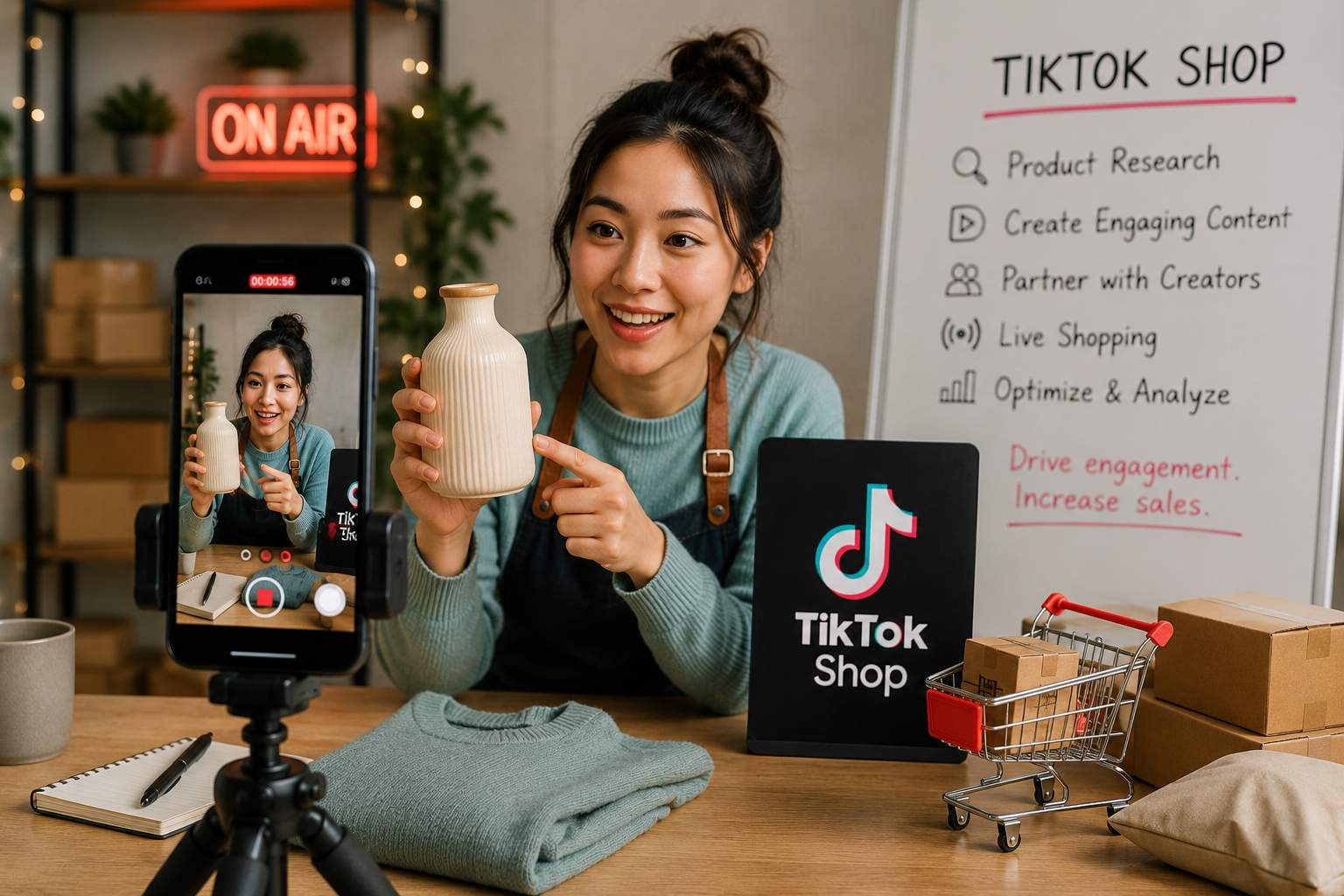
Social commerce has moved from a novelty to a core revenue channel for US e-commerce sellers, and TikTok Shop sits at the center of that shift. If you have been waiting for the right moment to build a presence on the platform, the data suggests 2026 may be the most consequential year yet. This guide breaks down the practical steps, strategic considerations, and honest trade-offs every seller should understand before committing budget and inventory. For broader context on building an online retail business, explore our Business articles covering retail trends, logistics, and platform strategy.
Key Takeaways
- TikTok Shop in 2026 is one of the fastest-growing social commerce channels for US e-commerce sellers, driven by algorithm-based product discovery.
- Unlike Amazon’s search-driven shopping model, TikTok Shop relies heavily on short-form video content, storytelling, and impulse purchasing behavior.
- Successful TikTok Shop sellers typically combine organic content, live shopping sessions, creator partnerships, and paid Shop Ads to scale revenue.
- Products that demonstrate visually or solve obvious problems tend to perform better on TikTok Shop than commodity-style products with little visual differentiation.
- TikTok Live Shopping works best when creators focus on entertainment, demonstrations, and audience interaction rather than aggressive sales tactics.
- Testing organic content before increasing paid advertising budgets is generally a more efficient strategy for new TikTok Shop sellers.
- Sellers using TikTok’s affiliate creator marketplace gain access to scalable influencer promotion, but they also take on additional brand safety and compliance risks.
- Diversifying across multiple sales channels, including Shopify, Amazon, Instagram Shopping, and TikTok Shop, helps reduce platform dependency and regulatory risk.
What Is TikTok Shop and Why Does It Matter for US Sellers?
TikTok Shop is an integrated e-commerce feature that allows brands and individual sellers to list, market, and sell products directly inside the TikTok app through shoppable videos, live streams, and a dedicated product tab. For US sellers, it represents a direct path to younger, high-intent buyers without the need to redirect traffic to an external website.
TikTok’s parent company ByteDance officially expanded TikTok Shop to US sellers in September 2023, and the feature has continued growing through 2025 and into 2026. According to the US Department of Commerce, social commerce broadly (including in-app purchasing on platforms like TikTok) has become a measurable segment of domestic retail e-commerce, with younger consumer cohorts driving disproportionate adoption.
The appeal for sellers is straightforward: product discovery happens organically through the algorithm, which can surface a product video to millions of viewers without any paid promotion. That organic reach potential distinguishes TikTok Shop from more traditional search-driven marketplaces.
TikTok Shop vs. Amazon in 2026: How Do the Two Platforms Compare?
TikTok Shop and Amazon serve overlapping but distinct buyer behaviors. Amazon dominates intent-based search shopping, while TikTok Shop excels at discovery-driven impulse purchasing fueled by short-form video content.
| Factor | TikTok Shop (2026) | Amazon (2026) |
|---|---|---|
| Primary Discovery Method | Algorithm-driven video feed | Keyword search |
| Seller Commission / Referral Fee | Typically 2-8% depending on category | Typically 8-15% depending on category |
| Fulfillment Options | Seller-fulfilled or TikTok Fulfilled Network (TFN) | Seller-fulfilled, FBA, or SFP |
| Content Requirement | High (video is central to discoverability) | Low to moderate (static images acceptable) |
| Average Buyer Age (US) | Skews 18-34 | Broader 25-54 range |
| Affiliate / Creator Program | Built-in creator affiliate marketplace | Amazon Associates (external) |
| Platform Regulatory Risk (US) | Elevated (ongoing federal review history) | Low to moderate |
Most established US sellers treat TikTok Shop as a complementary channel rather than a replacement for Amazon or their own Shopify storefront. Diversification across platforms remains a standard risk-management strategy in 2026.
How to Set Up Your TikTok Shop Account as a US Seller
US-based sellers can register through TikTok’s Seller Center by providing a valid US business license or tax identification number, a linked bank account, and identity verification documents. Individual sellers may qualify under certain thresholds, though business accounts typically unlock more features.
Step 1: Confirm Eligibility and Gather Documents
To register, sellers generally need a US business address, a government-issued ID or business registration document, a US bank account for payouts, and a TikTok account in good standing. Requirements can update frequently, so always verify current documentation requirements directly through TikTok’s official Seller Center portal before beginning the application.
Step 2: Register on the TikTok Seller Center
TikTok’s Seller Center is the backend dashboard where sellers manage listings, orders, promotions, and analytics. After approval (which can take a few business days), sellers gain access to the product catalog builder, the affiliate creator marketplace, and TikTok Shop’s advertising integrations.
Step 3: List Your Products with Compliant Descriptions
Product listings require clear titles, accurate descriptions, high-quality images, and compliant claims. Sellers in health, beauty, food, and supplement categories should be aware that the US Food and Drug Administration governs permissible language around product benefits. Making unsubstantiated health claims in listings can result in product removal or account penalties.
Does Your Niche Work Well on TikTok Shop?
Categories that have historically performed well on TikTok Shop include beauty and skincare, fashion and apparel, home organization, fitness accessories, and food and beverage. Commodity products with low visual differentiation (such as basic office supplies) tend to see weaker organic traction because they are harder to feature compellingly in short-form video. Sellers should honestly evaluate whether their product lends itself to demonstration, transformation, or storytelling before investing heavily in the channel.
TikTok Live Shopping: What Is the Strategy for 2026?

TikTok Live Shopping combines real-time video broadcasting with in-app purchasing, allowing hosts to showcase products, answer viewer questions, and drive immediate conversions without leaving the platform.
How to Run a High-Converting TikTok Live Session
Effective live shopping sessions on TikTok share several consistent characteristics. First, they typically run for at least 30 minutes to build audience momentum, as the algorithm tends to surface live streams with growing concurrent viewership. Second, successful hosts treat the session as entertainment first and sales pitch second, demonstrating real product use rather than reading off spec sheets. Third, limited-time coupons or bundle offers created within the Seller Center help convert viewers who are on the fence.
Scheduling consistency also matters. Sellers who broadcast live on predictable schedules (for example, every Tuesday and Thursday evening) build a returning audience rather than relying entirely on cold algorithmic discovery each session.
According to the Federal Trade Commission, influencers and sellers conducting live commerce must clearly disclose any material connections to the products they promote, including affiliate arrangements or paid partnerships. Failure to disclose can result in FTC enforcement action under the agency’s endorsement guidelines.
Should You Use TikTok’s Creator Affiliate Program?
TikTok Shop’s built-in affiliate marketplace allows sellers to set a commission rate and make products available for creators to promote. When a creator’s video or live stream drives a sale, the commission is paid out automatically. This model can dramatically reduce the upfront cost of influencer marketing for smaller sellers who cannot afford flat-fee sponsorships.
The trade-off is control. Sellers have limited oversight of how creators represent their products, which introduces compliance and brand reputation risk, particularly in regulated categories. Setting clear affiliate program guidelines and monitoring creator content regularly are prudent precautions.
Social Commerce Sales Strategy: Organic vs. Paid on TikTok in 2026
Organic content and paid TikTok ads serve different strategic purposes. Organic posts build brand recognition and generate discovery at no direct cost, while TikTok’s paid advertising tools (including Shop Ads and LIVE Ads) allow sellers to target specific audiences and scale proven content.
Building Organic Reach Through Shoppable Videos
Shoppable videos embed a product link directly in the video, allowing viewers to tap through and purchase without leaving TikTok. The most effective formats include before-and-after demonstrations, unboxings, tutorials, and problem-solution narratives. Videos that feel authentic and native to the platform’s aesthetic tend to outperform polished advertising-style content.
When Does Paid Advertising Make Sense?
Paid TikTok Shop Ads make the most financial sense once a seller has identified at least one organic video that demonstrates meaningful conversion. Amplifying proven creative with paid spend is generally more efficient than spending on untested content. New sellers are often advised to spend their first 60 to 90 days building organic content before committing significant paid budgets.
According to the US Small Business Administration, small business owners entering new sales channels should establish clear performance benchmarks and cost-per-acquisition targets before scaling advertising spend, to ensure profitability is trackable from the outset.
Regulatory and Platform Risk: What Every US TikTok Seller Should Know
TikTok has faced sustained federal scrutiny in the United States, and sellers should factor platform continuity risk into their business planning. Maintaining active storefronts on multiple platforms is a widely recommended hedge.
The history of federal legislative and executive action around TikTok’s US operations through 2024 and 2025 highlighted that sellers who had concentrated all of their social commerce revenue on TikTok faced serious disruption risk. Prudent sellers in 2026 are advised to treat TikTok Shop as one component of a diversified channel mix that may also include Instagram Shopping, Amazon, and their own direct-to-consumer website. See more guides in our E-Commerce section to grow your online store in 2026.
Alternative Perspectives
Not all e-commerce experts are bullish on TikTok Shop as a primary revenue channel for US sellers. Some argue that the platform’s algorithm is unpredictable, making consistent revenue difficult to forecast, and that the content demands (frequent short-form video production) create a significant operational burden for small teams. Others point out that TikTok’s demographic skew toward younger buyers is a limitation for sellers whose core customers are over 40. Critics of social commerce more broadly suggest that impulse-driven purchasing leads to higher return rates compared with intent-based channels like Google Shopping or Amazon. Sellers should weigh these considerations honestly against their specific product category, team capacity, and risk tolerance before making TikTok Shop a core business priority.
Frequently Asked Questions
TikTok Shop generally requires US sellers to provide either a valid business registration document or a government-issued individual ID along with a tax identification number. Business accounts typically unlock the full suite of seller features, including the affiliate creator marketplace. Requirements may be updated by TikTok, so checking the current Seller Center documentation before applying is strongly recommended.
TikTok Shop acts as a marketplace facilitator for US sales tax purposes in most states, meaning it collects and remits applicable sales tax on behalf of sellers in states that have marketplace facilitator laws. However, sellers remain responsible for understanding their own tax obligations and should consult a qualified tax professional to confirm their specific situation, as rules vary by state.
Profitability depends heavily on product margins, fulfillment costs, content production overhead, and return rates. TikTok Shop’s commission fees have generally been competitive with other major marketplaces, but sellers must account for the cost of ongoing video content creation, which is not optional on this platform. There is no guarantee of revenue or profit, and results vary significantly by category, brand, and execution quality.
As of mid-2026, TikTok Shop’s full seller program has been primarily focused on specific markets including the US and several countries in Southeast Asia and Europe. Canadian sellers seeking to participate should check TikTok’s official Seller Center for the most current eligibility information, as availability and program terms are subject to change as TikTok expands its commerce infrastructure.
Disclaimer: This article is provided for general informational and educational purposes only and does not constitute legal, tax, financial, regulatory, marketing, or professional business advice. E-commerce laws, platform rules, advertising policies, tax obligations, fulfillment requirements, and seller eligibility standards may change over time and vary by jurisdiction, product category, and individual business circumstances. Sellers are responsible for independently verifying all information through official sources, including TikTok Shop policies, FTC endorsement guidelines, FDA regulations, marketplace tax requirements, and applicable federal, state, or local laws. Results discussed in this article are not guaranteed and may vary significantly depending on product selection, execution quality, advertising spend, audience response, competition, and market conditions.